Miaoying Temple: A Yuan Imperial Buddhist Monastery in Beijing
Site at a Glance
- Rating
- 4.5
- Popularity
- Very Low
- Country
- China
- Primary era
- Medieval
- Eras represented
- Medieval
- Civilizations
- Ming, Yuan
- Site type
- Religious
- Remains
- Monastery
On this page22 sections
History
Miaoying Temple, also known as White Pagoda Temple, is a Tibetan Buddhist monastery in Beijing, China, founded during the Yuan dynasty around the White Pagoda. The Yuan dynasty was the Mongol-ruled dynasty that governed China from 1271 to 1368. Today, the complex is operated as a museum and heritage site.
Before the Yuan Foundation
The site lay north of Liao Nanjing, the southern capital of the Liao dynasty in the area of present-day Beijing. Its predecessor, Yong’an Temple, contained a pagoda known as the Pagoda of the Buddha’s Relics. An esoteric Buddhist master built it in 1096, and it held relics, 2,000 small clay stupas, and five dharani, Buddhist ritual formulas associated with protection and sacred power.
Yong’an Temple was probably destroyed during the Yuan conquest of the Jin dynasty, while the earlier pagoda survived. In 1271, Kublai Khan ordered the pagoda opened. After its deposits were found, he commissioned a new structure to house the Buddha’s relics.
Yuan Imperial Temple
The present White Pagoda was completed in 1279 under the direction of Araniko, a Nepalese architect, sculptor, and engineer who had recently come from Tibet to the Yuan capital. Afterward, the imperial preceptor Yilian Zhen supervised the installation of its sacred deposits. Construction of Dashengshou Wan’an Temple began around the pagoda in 1272 and was completed in 1288.
The temple occupied approximately 160,000 square meters. Tradition held that its boundaries were determined by the range of arrows shot from the pagoda, and the complex was also known as the Western Park because it stood in the western part of the Yuan capital. Wan’an Temple was an imperial foundation of the Sakya school, one of the distinct schools of Tibetan Buddhism, and ranked among the highest Buddhist institutions in the Yuan capital.
Yuan emperors and empresses visited the temple for prayer, while the court held major Buddhist ceremonies there. In 1295, Emperor Chengzong presided over a national memorial ceremony at which more than 70,000 monks were fed. In 1290, a Korean monk led scripture-copying monks invited to lecture on the Benevolent Kings Sutra.
From Kublai Khan’s reign, officials also practiced court ceremonies at the temple. It became a center for translating and printing Buddhist scriptures in the Phags-pa script, a Mongol-period script used for several languages, and in Uyghur script, which was used for Mongolian and other Central Asian languages. Memorial halls honored Kublai Khan, several imperial consorts, and later Yuan emperors, and ministers made monthly offerings there.
Kublai Khan appointed Shi Zhijian, a monk of the Huayan school, as the first abbot in 1285. Shi Zhijian participated in compiling the catalogue of the Yuan Buddhist canon. His disciple Shi Deyan became the second abbot in 1332 and took part in discussions about the history of the Sandalwood Buddha image.
In 1289, Kublai Khan installed a celebrated sandalwood Buddha at Wan’an Temple. Tradition held that the monk Kumarajiva had brought the image from Kucha to China in 401, after which it was enshrined at several Chinese religious centers. The image disappeared after Hongren Temple was destroyed by fire during the 1900 conflict.
Destruction and Ming Reconstruction
Lightning struck Wan’an Temple in 1368, causing a fire that destroyed most of its halls and sacred objects. The White Pagoda survived, as did the eastern and western imperial memorial halls, their spirit tablets, and selected valuables.
The Xuande Emperor ordered repairs to the White Pagoda in 1433. The temple itself was rebuilt between 1457 and 1468, financed by the eunuch Liao Xiu after a petition by Guo Fu of Wanping County. When the work was complete, the court gave the complex the name Miaoying Temple. The new institution followed the Han Buddhist seven-hall layout and occupied approximately 13,000 square meters, about one-eighth of the former Yuan complex.
During the Ming period, Miaoying Temple was a Han Buddhist institution. In 1482, 108 brick lantern shrines were installed around the pagoda, with offerings made on the first and fifteenth days of each lunar month. Later repairs were supported by imperial and court-connected donors, including Wang Jing and the Empress Dowager Cisheng.
Qing Religious Use
During the Qing dynasty, Miaoying Temple became a Gelug monastery. Gelug was a different school of Tibetan Buddhism from the Sakya tradition associated with the Yuan foundation. The Kangxi Emperor ordered repairs in 1668. The Qianlong Emperor directed major repairs in 1753 and 1776, and the Jiaqing Emperor ordered further work on the pagoda in 1816. In 1753, Qianlong placed Buddhist scriptures and other sacred objects inside the pagoda.
Circumambulation of the White Pagoda became an established Qing-period practice. The largest observances took place on the fourth day of the sixth lunar month, associated with the Buddha’s first sermon, and on the twenty-fifth day of the tenth lunar month, traditionally associated with completion of the pagoda. Monks walked around it three times while reciting scriptures and playing music. Circumambulation for blessings continues as a religious practice.
War, Occupation, and Decline
During the 1900 occupation of Beijing by the Eight-Nation Alliance, troops entered the temple and removed ritual implements, offering vessels, historical treasures, and scriptures. In the Republican period, privately financed repairs included work on the White Pagoda in 1937 by the Old Capital Cultural Relics Preservation Committee.
After the Japanese occupation of Beijing began in 1937, a later account stated that military personnel cut through a principal column of the Seven Buddhas Hall for use as a manger and filled the only sweet-water well serving nearby residents. Parts of the complex later fell into disrepair and became overgrown.
Modern Preservation and Museum Use
In 1953, Miaoying Temple became a temple directly administered by the Buddhist Association of China. The White Pagoda was designated one of the first National Key Cultural Relics Protection Units in 1961. It received a lightning conductor in 1962 and repairs to its body in 1964.
Administration passed to the Beijing Cultural Bureau in 1965, ending the historical residence of lamas at the temple. During the Cultural Revolution, halls served as storage spaces, a factory occupied the pagoda courtyard, and Buddhist images were destroyed or transferred elsewhere. In 1969, the temple gate and bell and drum towers were demolished to make way for a food market.
The 1976 Tangshan earthquake damaged the top of the White Pagoda. A major campaign in 1978 repaired the four principal halls and the pagoda, and exposed the Qianlong-period deposits inside the finial. A temple relics preservation office was established in 1980, and the complex opened to the public as a museum in September of that year.
Archaeological work before the 1998 reconstruction of the gate and bell and drum towers exposed foundations, steps, and carved stones from the earlier structures. The gate was rebuilt in 1998, followed by the reconstruction or repair of the towers, side halls, and side rooms. The western route was repaired between 2002 and 2003 after residents and a former factory were relocated. In 2013 and 2014, 86 rooms on that route were transferred to the Buddhist Association of China for use as its Miaoying Temple office area.
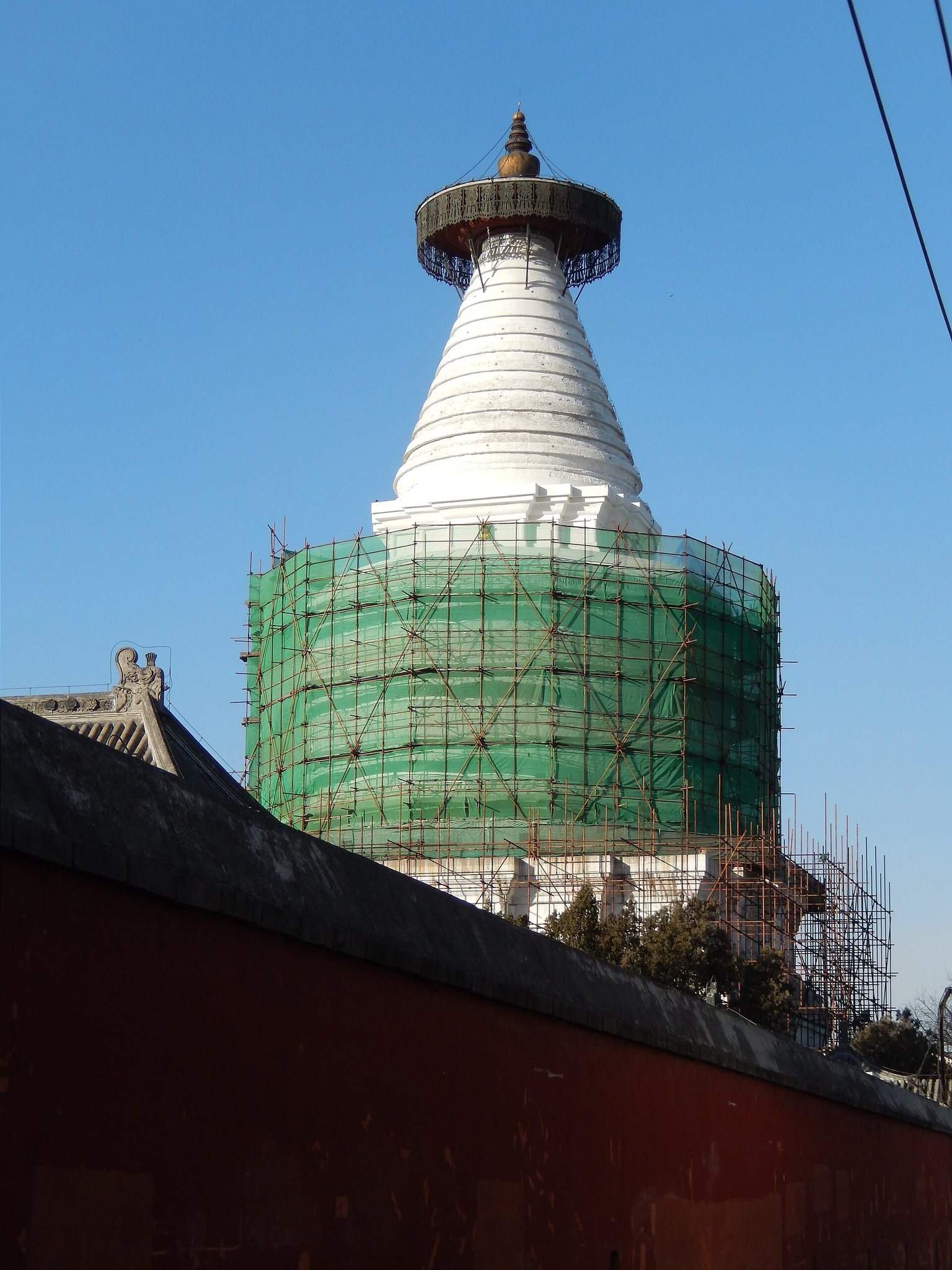
A major repair of the White Pagoda began in 2013 and ended in November 2015. Widespread cracking and the loss of exterior plaster had affected the structure. About 80 percent of the outer bricks were removed, nearly 10,000 bricks were replaced, and the pagoda was strengthened and resurfaced. The temple reopened on 6 December 2015 after the campaign.
Miaoying Temple continues to represent traditional friendship between China and Nepal, and visiting Nepalese officials have traditionally visited it. Its present institutional use is primarily museum and heritage-related rather than that of a functioning residential monastery.
Remains
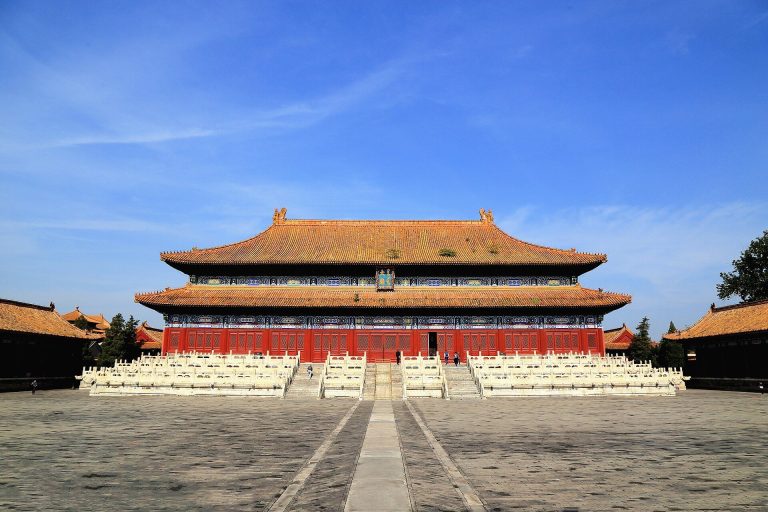
The surviving complex follows a central north-south route leading from the reconstructed entrance to the White Pagoda courtyard. The principal sequence is the gate, the Hall of the Heavenly Kings, the Hall of the Jewel of the Mind, the Hall of the Seven Buddhas, and the raised pagoda courtyard. The present arrangement broadly preserves the appearance of the Ming reconstruction, while the pagoda remains the Yuan-period focus of the site.
Central Route
Gate and Entrance Court
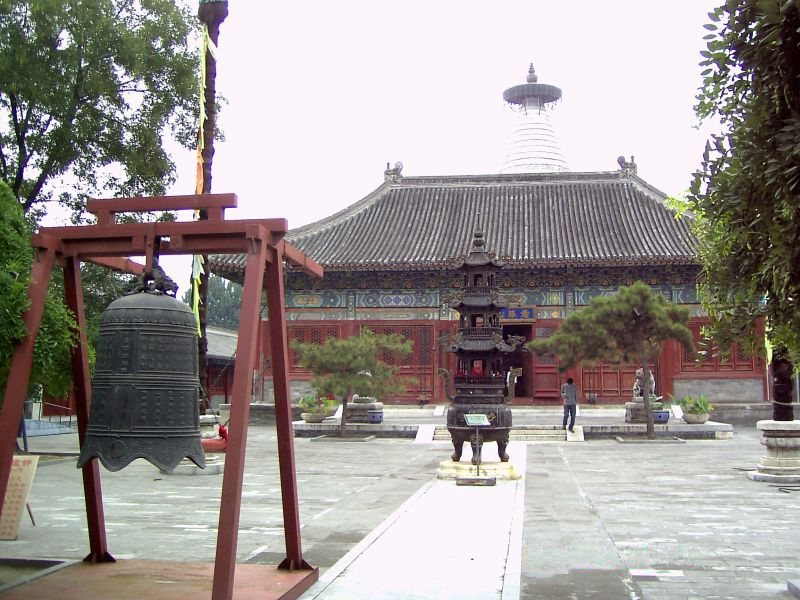
The gate was rebuilt in 1998 according to the earlier design. It is three bays wide, with three arched entrances, and carries a stone plaque identifying the temple as the Imperial Miaoying Chan Grove. Splayed screen walls flank the entrance. The bell and drum towers stand on the eastern and western sides of the courtyard before the Hall of the Heavenly Kings. Both are pavilion-like structures rebuilt in 1998.
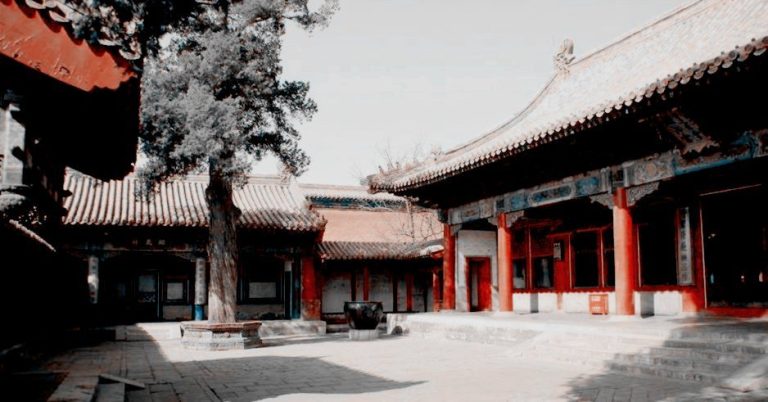
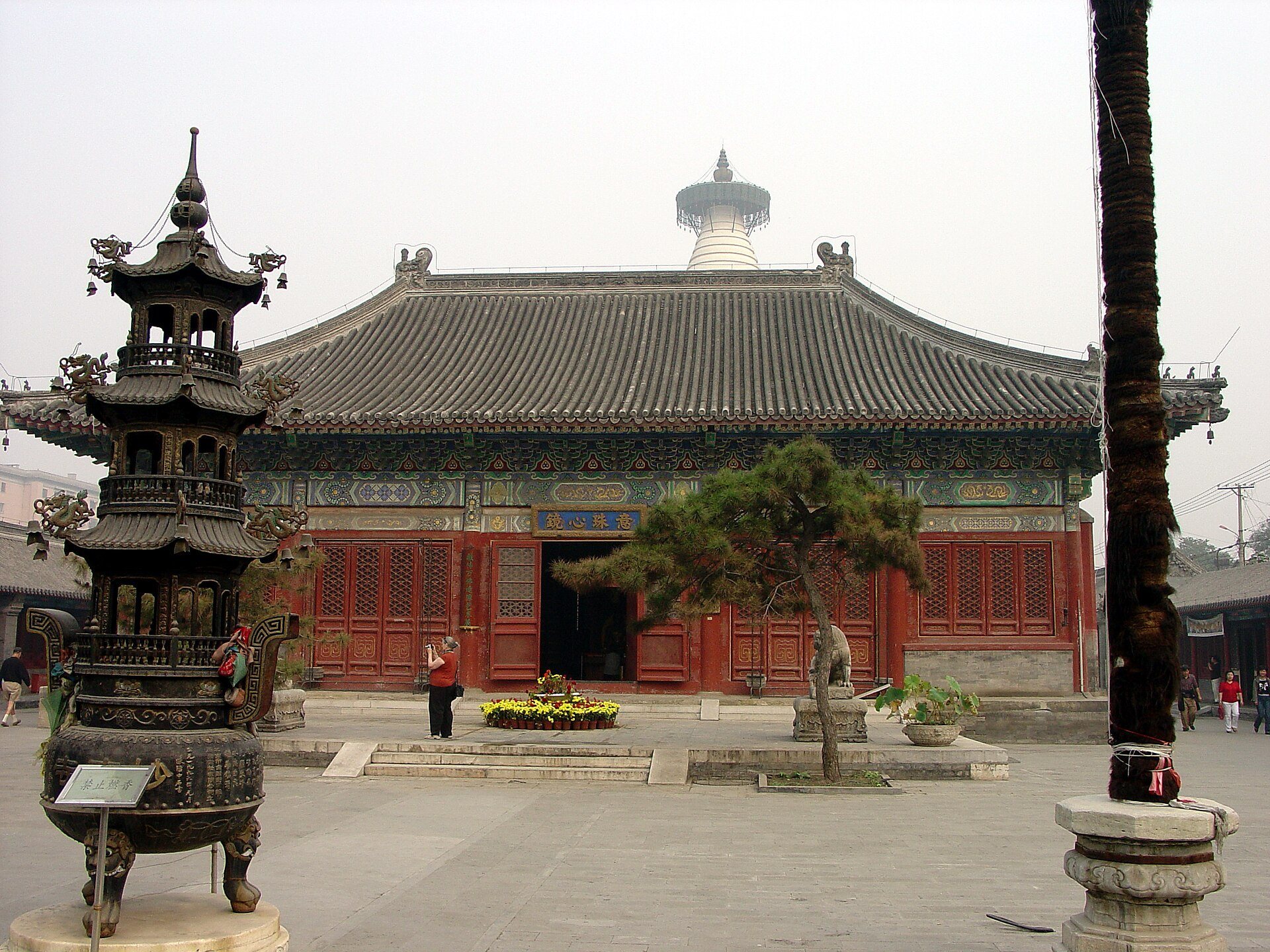
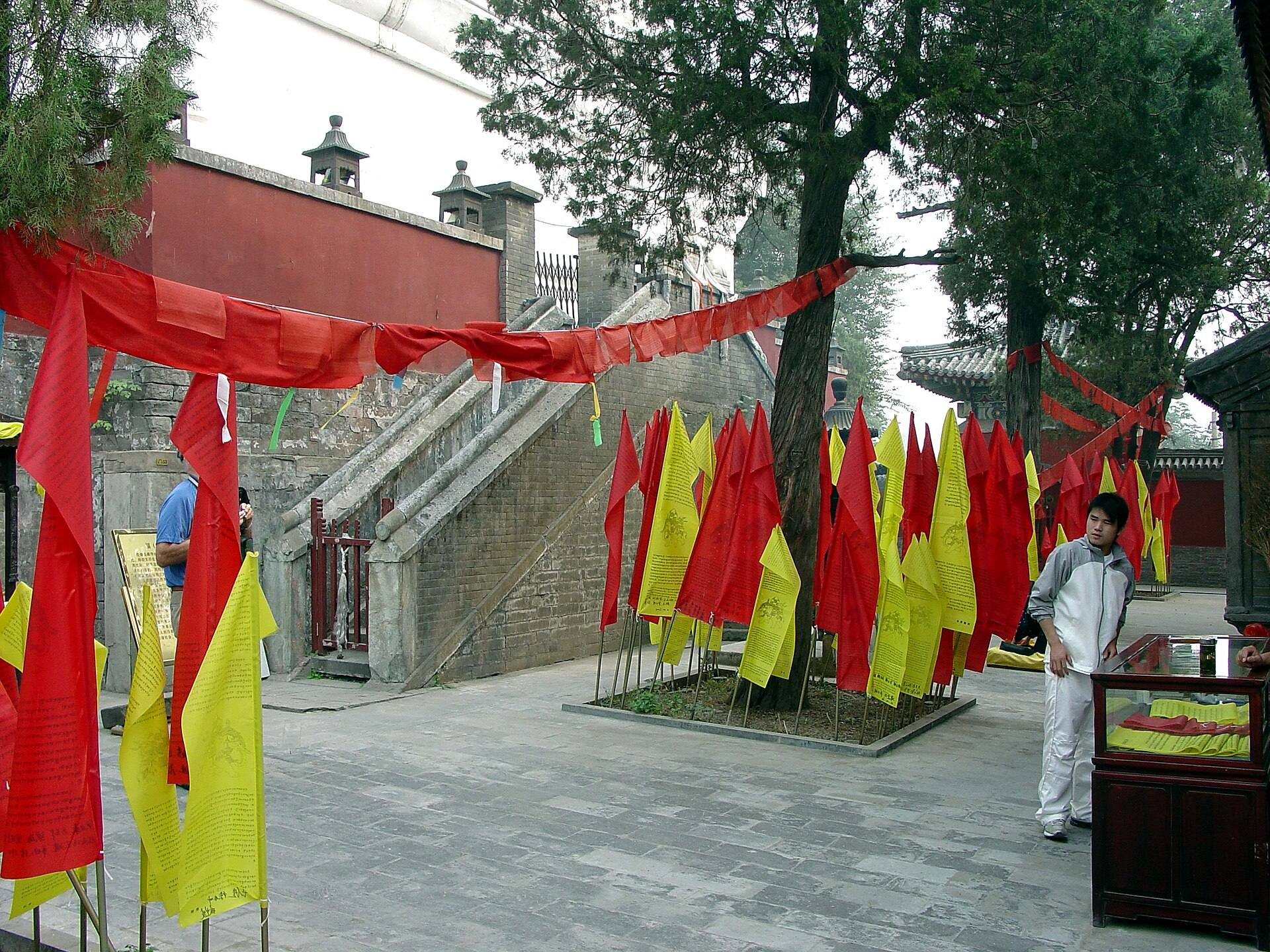
A merit bell cast in 1998 bears an inscription but was not hung in the bell tower. Another bronze bell was donated by Wendu Temple in Qinghai. Between the Hall of the Heavenly Kings and the Hall of the Jewel of the Mind stands a bronze incense burner donated in 1999, with banner poles on stone bases on either side. An old tree is located southeast of the western side hall.
Hall of the Heavenly Kings
The Hall of the Heavenly Kings is three bays wide and three bays deep. It formerly held an image of Budai, the Four Heavenly Kings, and Weituo. After the museum reopened, the hall displayed the Qianlong-period Buddhist canon known as the Dragon Canon. It was temporarily closed after 2015.
Hall of the Jewel of the Mind
The Hall of the Jewel of the Mind, also called the Hall of the Great Enlightenment Treasure, is five bays wide and four bays deep and has a moon platform. It was formerly known as the Hall of the Buddhas of the Three Ages, referring to three temporal aspects of Buddhist tradition. A gilded inscription written by the Qianlong Emperor displays its name.
The hall now contains an exhibition of Tibetan Buddhist art, including gilded-bronze images and a Ming-period bronze Thousand-Armed and Thousand-Eyed Guanyin. A pair of Yuan-period stone lions stands on the eastern and western sides of the moon platform. Each is approximately 17.5 centimeters high, 125 centimeters long, and 67 centimeters wide. The lions were badly damaged before being transferred from Qilin Stele Lane in 1986 and later repaired.
Side Halls and Exhibitions
The eastern and western side halls stand before the Hall of the Jewel of the Mind and connect north and south to side rooms. The eastern hall has served at different times as an exhibition space and a shop. Since 2003, the western hall has housed the Temple History and Culture Exhibition, with stone carvings, rubbings, models, photographs, and selected deposits from the pagoda.
Hall of the Seven Buddhas
The Hall of the Seven Buddhas is the largest of the principal halls, measuring five bays wide and four bays deep. Its ceiling contains three elaborate dragon-decorated caisson ceilings. The hall originally housed the Seven Buddhas of the Past.
Its present central images are nanmu figures of Amitabha, Shakyamuni, and the Medicine Buddha. Each is more than two meters high and seated in the lotus position, with Ananda and Kasyapa standing beside Shakyamuni. One Buddha was transferred from Huguo Temple, while the other two and the disciples were newly made in a similar style beginning in 1984.
Eighteen Ming-period bronze figures from a set of Twenty-Four Devas stand along the two sides of the hall. They were transferred from Nianhua Temple in place of planned images of the Eighteen Arhats. A Ming bronze Thousand-Armed and Thousand-Eyed Guanyin, transferred from the former Liulige site near Beihai, formerly stood behind the central Buddhas before being moved to the Hall of the Jewel of the Mind. A statue of the Leaf-Clad Goddess occupied its former position for a period.
The hall also contains a blue-and-white porcelain vat. A stone sculpture of the monk Haiyun, excavated from the twin pagodas of Daqingshou Temple and once displayed here, was transferred to the Capital Museum in 2005.
Moon Platform
A T-shaped moon platform lies between the Hall of the Jewel of the Mind and the Hall of the Seven Buddhas. A damaged stone tortoise, formerly the base of a stele, survives on its eastern lower side. A white-marble pavilion installed in the early 2010s was removed in 2016, and its four stone incense burners were redistributed around the platform.
Western Route and Scripture Repository
The western route consists of two courtyards. The southern courtyard contains the Hall of Great Enlightenment and Benevolence, a seven-bay front hall, side halls, and a two-storey pi-shaped corner building enclosing a small courtyard. North of it is an independent abbot’s courtyard. These buildings were repaired by 2003 and transferred in 2013 and 2014 for use by the Buddhist Association of China.
The eastern scripture repository stands outside the main compound at 17 East Baita Temple Lane. Facing south, it retains its gate and eastern and western side halls.
White Pagoda Courtyard
Courtyard and Hall of the Six Spiritual Powers
The pagoda courtyard occupies the northern end of the complex. It stands approximately two meters above the surrounding ground, has a roughly T-shaped plan with a narrower southern section, and is enclosed by red walls. The Hall of the Six Spiritual Powers occupies the south, while the White Pagoda stands in the northern section. Four square pavilions mark the corners.
The courtyard gate carries an inscription identifying the structure as the Pagoda of the Buddha’s Relics and Spiritual Efficacy. The Hall of the Six Spiritual Powers is three bays wide and three bays deep and retains much of its Qing-period arrangement. It contains gilded wooden images of Kashyapa, Shakyamuni, and Maitreya, two attendant disciples, three offering tables, and three sets of bronze ritual vessels donated in 1933 by Zhu Qinglan and two other donors.
The hall formerly contained eight Qing-period thangka paintings, Buddhist devotional paintings usually made on cloth, and two small wooden shrines. The paintings represented Buddhist and tantric figures including Badan Maben, the Lion-Faced Goddess, Hayagriva, Vajrabhairava, Green Tara, Eleven-Faced Thousand-Armed Guanyin, the Great Umbrella Goddess, and Amitayus. Before the 2013 pagoda repairs, the paintings, shrine images, and 17 suspended bronze bells had been removed, and photographs of the thangkas were displayed in their place.
Corner Pavilions and Incense Structures
The four corner pavilions received newly made images of Tibetan Buddhist protectors in the 2000s. Hevajra occupies the southeast pavilion, the Precious Canopy Protector the southwest, Kurukulla the northwest, and the White Wealth Deity the northeast.
A gray-brick incense structure stands outside the north wall of the Hall of the Six Spiritual Powers. It contains three separate arched chambers with stepped brick interiors. After the 2015 reopening, glass doors were fitted to the chambers, which contained small Buddhist images.
White Pagoda
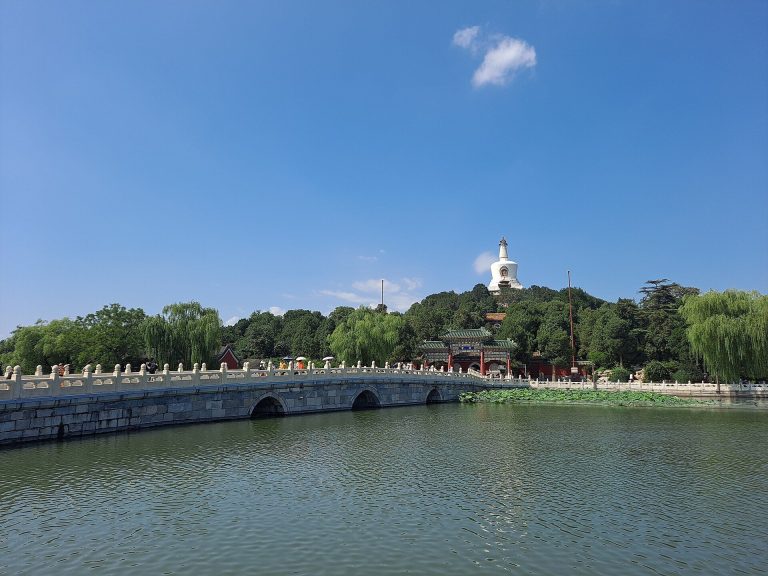
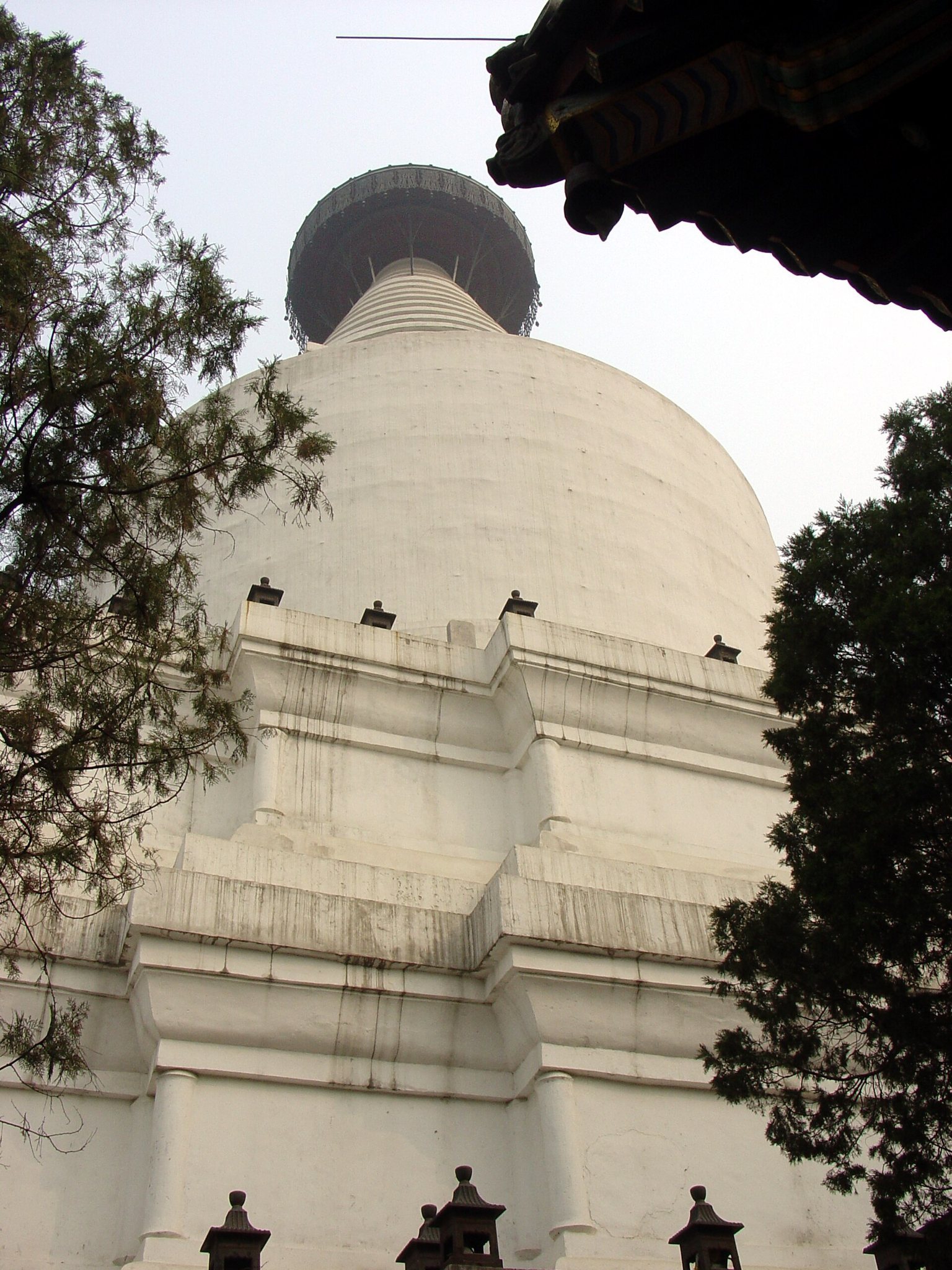
The White Pagoda stands at the center of the northern courtyard. Its formal name is the Pagoda of the Buddha’s Relics and Spiritual Efficacy, while its popular name refers to the white surface of its body. It is a brick-and-stone inverted-bowl stupa, a Buddhist reliquary monument with a rounded body resembling an alms bowl. The pagoda is 50.9 meters high, with a platform of approximately 1,422 square meters and a lower base measuring about 810 square meters.
The structure consists of a three-level base about nine meters high, the inverted-bowl body, a thirteen-ring finial, and a crowning finial. The upper base is surrounded by Ming-period iron lantern niches. It supports a large brick lotus seat with 24 projecting petals and five concentric vajra rings.
The rounded body is widest near its middle, where it reaches approximately 18.4 meters in diameter, and seven iron hoops strengthen it. Above it is a small square-edged pedestal supporting the thirteen horizontal rings known as the Thirteen Heavens. The circular canopy is approximately 9.7 meters in diameter. Its wooden core is covered with copper roofing and plates, and 36 pierced copper pendants hang around its edge. Each pendant is about one meter wide and two meters long and carries a wind bell.
The upper finial is approximately five meters high and weighs about four tons. It consists of eight levels of hollow, gilded copper shaped as a Tibetan lama stupa. A Yuan-period inscription survives on it. The finial and the Thirteen Heavens form a continuous conical summit.
A stone carving of two deer listening to a sermon is set south of the pagoda, on the short wall of the small platform where the eastern and western stairways of the pagoda base meet. A Ming iron incense burner, commissioned by the eunuch Wang Qi in 1521 and cast in 1522, has three legs, a bulging body, and a handled rim. Its inscription states his intention to provide a permanent offering vessel for the temple. It was later moved to the T-shaped platform and then to the platform’s south side. A modern burner modeled on it occupies its former position.
Nearby, a flower offering stand consists of a vase-shaped stone pillar on a hexagonal base. A long, finely carved stone trough in the courtyard was formerly used to feed horses. Outside the courtyard gate stands a bronze statue of Araniko, installed in 2002 as a memorial supported by Nepalese organizations.
Pagoda Deposits and Excavated Objects
In 1980, an approximately 25-centimeter-high Yuan-period poetry jar was excavated behind the pagoda base. It has a 15-centimeter mouth, a body 20 centimeters in diameter, a lid, yellow-brown glaze, and black painted decoration. Its interior contained cremated remains, gold foil, and medicinal herbs, indicating its use as a Buddhist monk’s funerary ash jar.
When the finial was opened during the 1978 repairs, more than 100 objects placed inside during the 1753 Qianlong restoration were recovered. Such a pagoda deposit is a consecratory collection of relics, scriptures, images, ritual objects, and other sacred materials placed inside a pagoda during construction or restoration. The recovered collection is held by the Capital Museum, with some objects later displayed at the temple.
The deposit included a partially water-damaged early Qing edition of the Dragon Canon. More than 560 fascicles survived, of which over 200 were relatively complete. A nanmu scripture chest decorated with gold and silver lotus-scroll designs contained a copy of the Qianlong Emperor’s Heart Sutra, a Tibetan victory dharani, ritual scarves, incense, jeweled vessels, prayer beads, and a small gold Amitayus image set with 44 rubies.
Another object was a rosewood Guanyin carved from a single block and enclosed in a decorated copper cover. Its internal reliquary held ritual textiles, sandalwood, wood fragments, resin, gold pieces, pearls, fragments of jade, and 33 relics. The inscription on its wooden cover was written by the Qianlong Emperor.
Other objects included three small copper images of Kashyapa, Shakyamuni, and Maitreya, a Five-Buddha crown, a patched ceremonial robe, and a sealed square container covered in textiles. Optical examination indicated that the container held a miniature white pagoda containing a small seated gold Buddha.
Conservation of the Pagoda
Over time, the White Pagoda developed subsidence, local deformation, declining material strength, and loss of exterior rendering. Major repairs before 1949 took place in 1344, 1433, 1457, 1592, 1688, 1753, 1816, 1925, and 1937. Later work was carried out in 1964, 1978, 1988, and 1996, followed by the large-scale campaign of 2013 to 2015.