Haji Ali Dargah: A Sufi Shrine and Mosque in Mumbai
Site at a Glance
- Rating
- 4.4
- Popularity
- Very High
- Country
- India
- Primary era
- Medieval
- External website
- Open
- Eras represented
- Medieval
- Civilizations
- Unclassified
- Site type
- Religious
- Remains
- Tomb
On this page12 sections
History
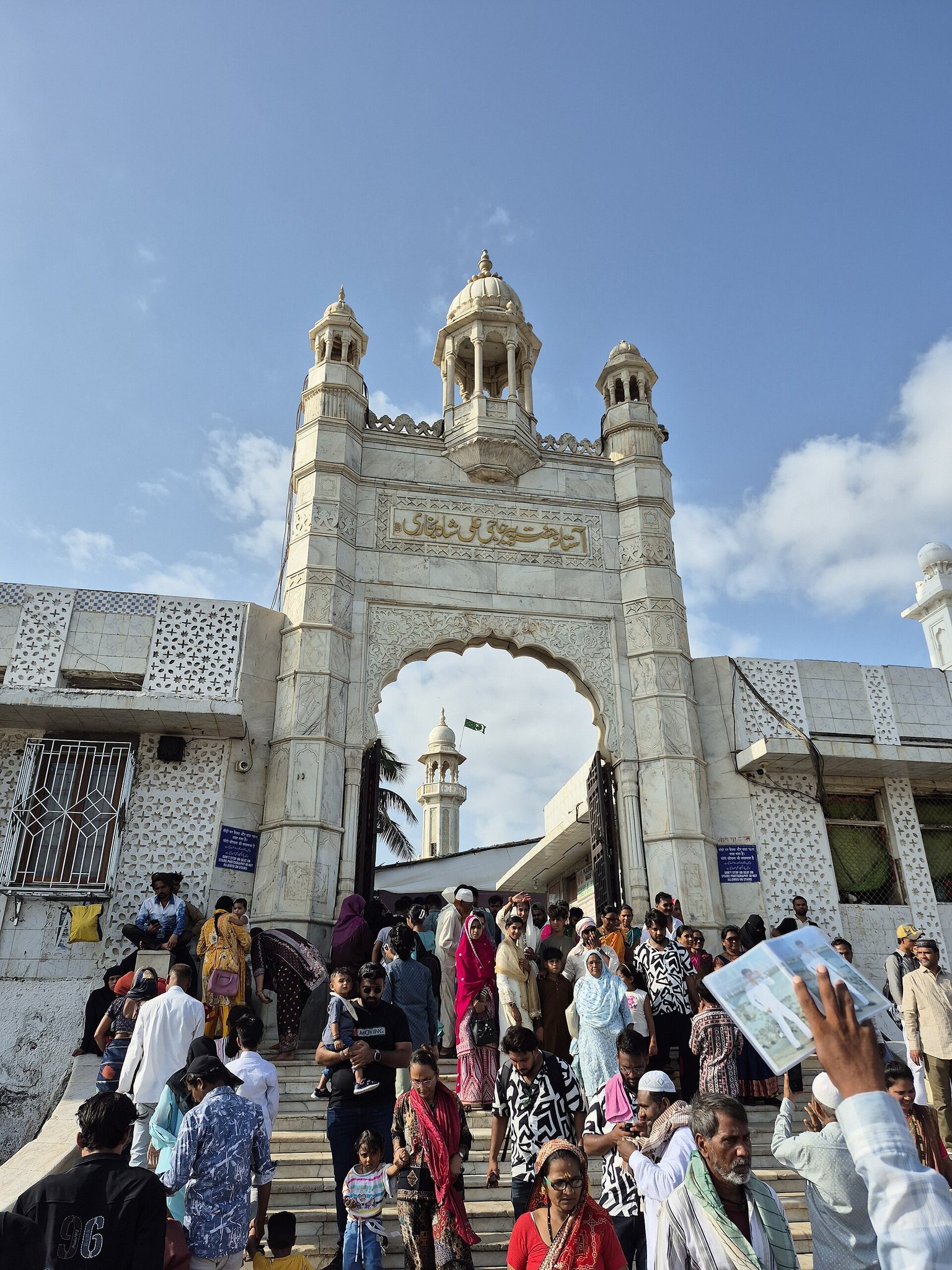
Haji Ali Dargah is a Sufi shrine and mosque on a rocky islet in Haji Ali Bay, Mumbai, Maharashtra, India. Constructed in 1431 in the Indo-Islamic architectural tradition, it commemorates Pir Haji Ali Shah Bukhari, a wealthy Muslim merchant from Bukhara in present-day Uzbekistan whose tomb lies within the complex.
Haji Ali Shah Bukhari
Haji Ali Shah Bukhari belonged to the Chishti Order, a Sufi tradition known for devotional practice and religious instruction. He gave up his worldly possessions before travelling to Mecca and journeyed widely during the early to mid-15th century. He eventually settled near present-day Mumbai, where he continued religious teaching and the dissemination of Islam among local people until his death.
The foundation tradition connects his journey to an act of remorse. Bukhari is said to have caused oil to gush from the ground by pressing a finger into the soil where a poor woman had accidentally spilled it. After dreaming that he had injured the earth, he became distressed and ill. With his mother’s permission, he travelled to India with his brother, later deciding to remain near Worli and sending his mother a letter to explain his choice.
Another tradition concerns the location of the shrine. Bukhari is said to have instructed his followers not to bury him in a conventional graveyard. Instead, they were to cast his shroud into the sea and bury it wherever the cloth came to rest. The followers reportedly followed these instructions, and the dargah was built where the shroud reached a small rocky mound in the sea.
Continuing religious use
The complex functions as both a mosque and a dargah, a Muslim shrine usually associated with the tomb of a saint. It remains an active centre of Sufi Islam and attracts pilgrims of different faiths, especially on Thursdays and Fridays, when visitors seek the saint’s blessings. Sufi musicians sometimes perform qawwali, a form of devotional music sung by a group, on Fridays.
Haji Ali Dargah is owned by the Haji Ali Dargah Trust and is regarded as one of Mumbai’s prominent landmarks. A movement called “Haji Ali for All,” involving the Bharatiya Muslim Mahila Andolan and the Bhumata Brigade, challenged restrictions on women entering the sanctum, the innermost and most sacred part of the shrine. The Bombay High Court ruled on 26 August 2016 that women could enter, and access was restored on 29 November 2016 after a ban imposed in June 2012.
Renovation and structural protection
Extensive renovation took place in 1960 and 1964. Saline winds, seawater, tidal conditions, and heavy visitation continued to affect the structure and its marble surfaces. A major structural upgrade began in October 2008 and included reconstruction or improvement of the mosque and minarets, using white Makrana marble quarried in Rajasthan.
Remains
Island complex
Shrine and mosque
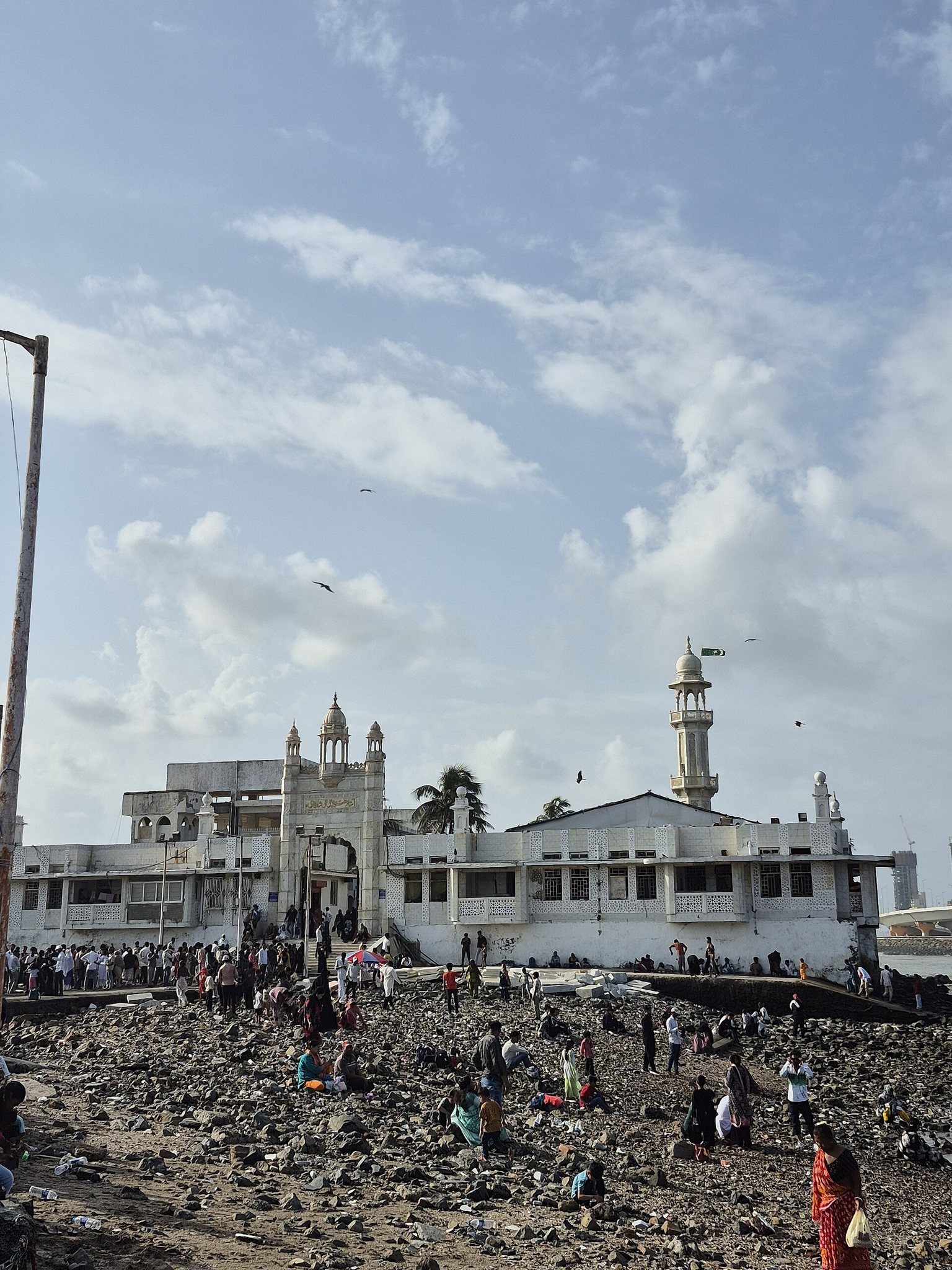
The complex occupies a tiny rocky islet approximately 500 metres from the coast near Worli in southern Mumbai. It is an example of Indo-Islamic mosque and mausoleum architecture, with a west-facing façade, one dome, one minaret, and a central shrine. Whitewashed buildings stand around a marble courtyard, giving the surviving complex a unified architectural setting.
Central tomb
The central tomb is covered by a red-and-green brocaded chaddar, a cloth placed over a tomb as a sign of respect. An ornate silver frame encloses it, supported by marble pillars. The tomb forms the physical focus of the shrine and contains the remains associated with Pir Haji Ali Shah Bukhari.
Main hall
Inside the main hall, marble pillars carry mirror work made from blue, green, and yellow pieces of glass arranged in kaleidoscopic patterns. Arabic designs incorporating the ninety-nine names of Allah are set among the mirrored decoration. Separate prayer rooms serve male and female worshippers.
Causeway and maritime setting
Approach across the bay
A narrow causeway nearly 1 kilometre long connects the islet toward the Mahalakshmi area. It is accessible only during low tide. At high tide, seawater submerges the causeway and leaves the shrine apparently isolated from the mainland. The route is not bounded by railings, making the tidal condition an important part of the site’s physical relationship with the bay.
Exposure to erosion
The islet and its buildings are exposed to saline winds, seawater, and tidal action. Heavy visitor traffic has also contributed to progressive wear, particularly on the structure and its marble surfaces. These conditions have shaped the need for repeated renovation and structural improvement while the shrine continues to serve its religious function.