Arnala Fort: A Coastal Stronghold in Maharashtra, India
Site at a Glance
- Rating
- 4
- Popularity
- Low
- Country
- India
- Primary era
- Early Modern
- Eras represented
- Early Modern
- Civilizations
- Portuguese
- Site type
- Military
- Remains
- Fort
On this page12 sections
History
Arnala Fort is a coastal fort in India, originally built by the Gujarat Sultanate in 1516 on an island off Arnala in Maharashtra. Also known as Jaldurg and Janjire Arnala, it occupies a strategic position near the mouth of the Vaitarna River, about 13 kilometres north of Vasai, the historic port known as Bassein. The fort controlled movement along the northern Konkan coast and later became associated with the Maratha rebuilding of 1737.
Gujarat Sultanate and Portuguese control
Mahmud Begada, the sultan of the Gujarat Sultanate, established the original fortifications in 1516. The Gujarat Sultanate was the Muslim state that ruled much of Gujarat before the region entered the Mughal and later colonial spheres. Portuguese forces took the island in 1530 and retained it for approximately two centuries.
In the same year, the Portuguese built a Martello tower, a small fortified coastal tower designed for artillery and resistance to naval attack, at the mouth of the Vaitarna River. The Portuguese captain of Bassein later donated the island to a Portuguese nobleman, who began a fort planned to measure about 210 by 210 metres. The work was never completed, but the Portuguese used the island to control shipping and navigation along the northern Konkan coast.
Maratha capture and rebuilding
In 1737, during the Maratha campaign against Portuguese possessions, Peshwa Bajirao I sent his brother Chimaji Appa to capture Bassein Fort. A Peshwa was the chief minister and effective executive ruler of the Maratha state; Bajirao I was one of the office’s prominent holders, while Chimaji Appa served as his military commander. After the Battle of Vasai, Shankarji Pant persuaded Chimaji Appa to attack Arnala because of its value to the Maratha navy.
A first assault, supported by vessels commanded by Govindji Kasar and Manaji Agre, failed against a stronger Portuguese naval force. On 28 March 1737, a second attack took the Portuguese by surprise and forced them to abandon the island. Bajirao I then ordered Shankarji Pant to build a new fort there. The surviving Maratha fort is therefore associated with the rebuilding of 1737, although the island had earlier Gujarat Sultanate and Portuguese fortifications.
British conquest and protected status
British forces captured Arnala Fort on 18 January 1781 during the First Anglo-Maratha War, a conflict between the British and the Maratha state. The Treaty of Salbai nominally returned Arnala and Bassein forts to the Marathas, who retained Arnala until 1817.
During the Third Anglo-Maratha War, Maratha defenders were compelled to surrender the fort to British naval power. The Treaty of Poona formally restored British control, and possession subsequently passed from the Maratha Empire to the East India Company in 1818, to British India in 1857, and to India in 1947. The Government of India declared Arnala Fort a National Protected Monument in Maharashtra on 26 May 1909. It remains a Monument of National Importance and survives as protected ruins in a state of disrepair.
Remains
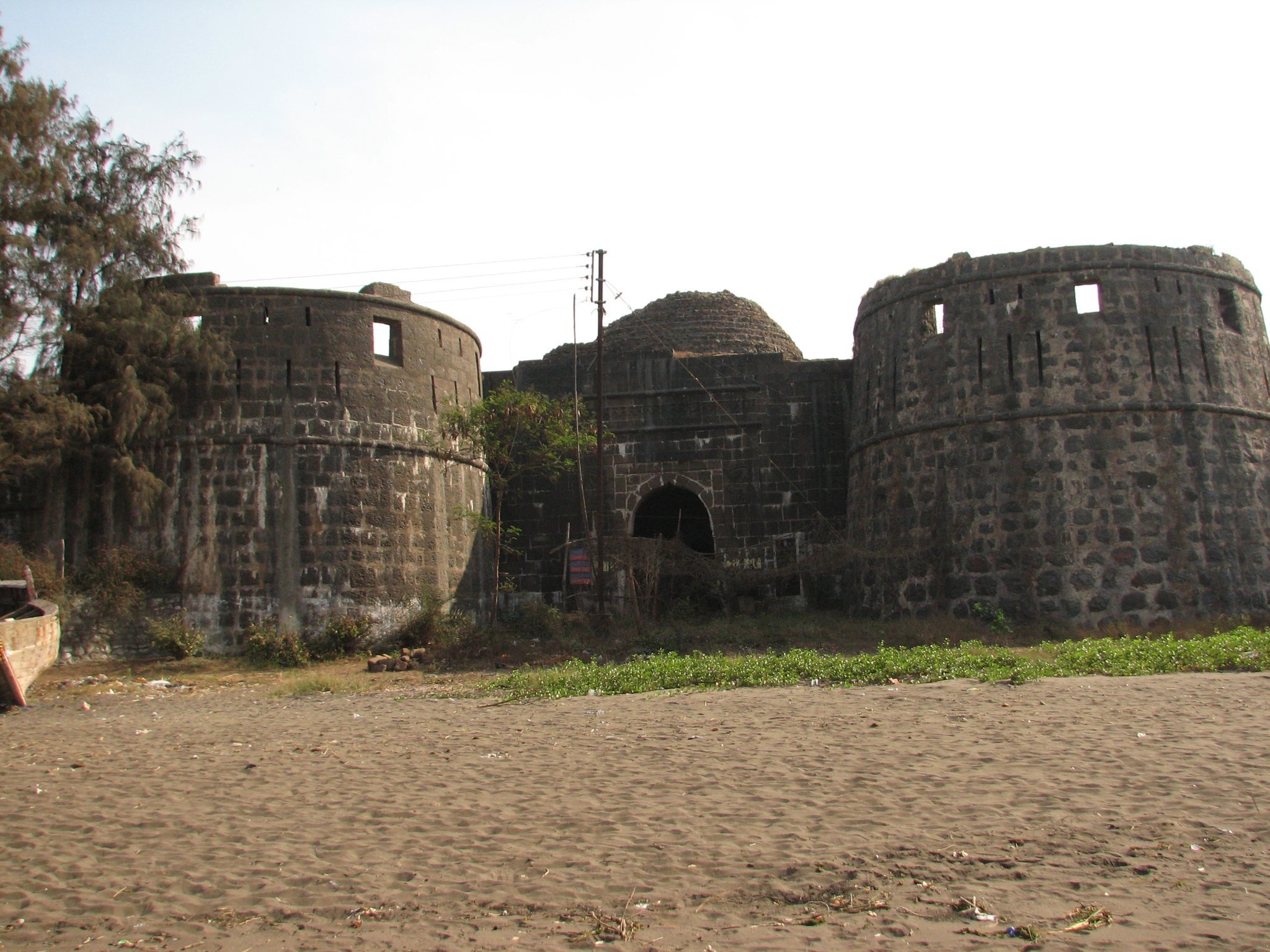
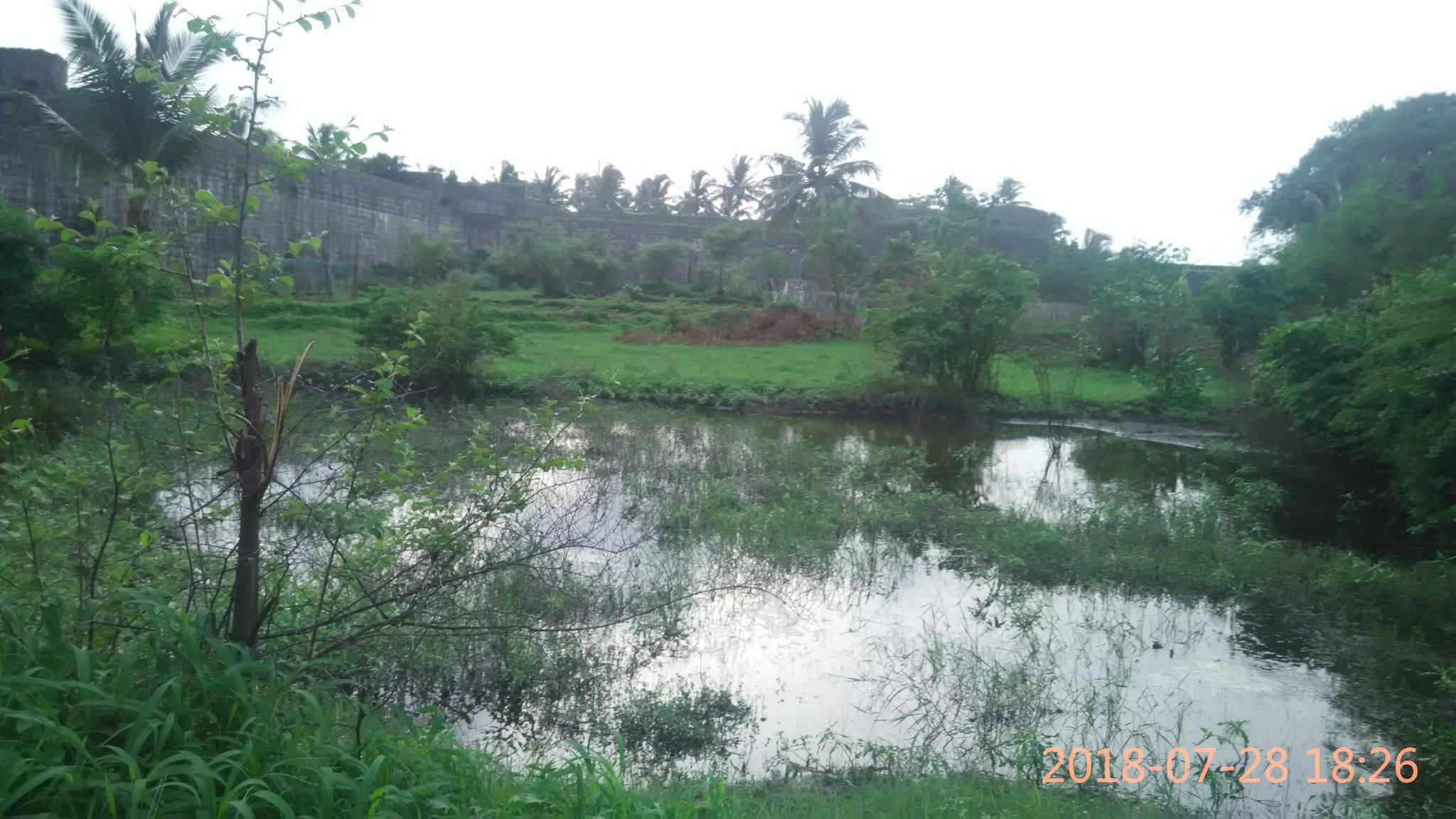
Arnala Fort occupies a small island near the point where the Vaitarna River meets the sea. The coastal fort and land battery overlook the bay. Its planned enclosure measured approximately 210 by 210 metres, with ten bastions forming part of the defensive system. The external ramparts remain in fairly good condition, and a path about three metres wide runs along the outer walls.
Main fortifications
Maratha fort and northern entrance
The main entrance faces approximately north and has a solid stone doorway decorated with representations of Sharabhas, mythical composite animals in Indian religious and artistic traditions, and elephants. A plaque or inscription at the northern entrance contains information about the fort’s construction. Of the ten Maratha bastions, one is currently standing, while the ramparts and entrance preserve the principal surviving defensive fabric.
Portuguese bastion
The Portuguese bastion built in 1530 survives at the western end of the island. It belongs to the period when Portuguese forces used Arnala to regulate shipping and navigation along the northern Konkan coast.
Southern Martello tower
A separate Martello tower stands at the southern end of the island, approximately 550 metres from the main fort. Built as a strongly constructed coastal defensive tower, it has no entrance gate.
Water supply and sacred structures
Freshwater reservoir
A large octagonal freshwater reservoir lies inside the fort. Its position within the enclosure reflects the provision of stored water within the island stronghold.
Temples and shrines
The interior contains the temples of Ambakeshwar, Bhavani, and Shiva, together with the dargahs, or tomb shrines associated with revered religious figures, of Shah Ali and Hajji Ali. On the eastern face, a dome houses the paduka, sacred sandals or footprints, of Shrinity Anand. These religious structures form part of the surviving interior of the fort.