Karanis: A Ptolemaic and Roman Agricultural Town in Egypt
Site at a Glance
- Rating
- 4.4
- Popularity
- Very Low
- Country
- Egypt
- Primary era
- Classical
- Eras represented
- Classical
- Civilizations
- Ptolemaic, Roman
- Site type
- City
On this page10 sections
History
Karanis is an ancient agricultural town near Qasr Rashwan in Tamiya, Egypt, founded by the Ptolemaic Greek rulers in the third century BC under Ptolemy II Philadelphus. It belonged to the Arsinoites nome, an administrative district centered on the Faiyum, and formed part of a settlement program associated with Greek mercenaries. Over time, it became a community of farmers, artisans, laborers, and Roman veterans whose lives were closely tied to agriculture.
Ptolemaic foundation and agricultural growth
Karanis expanded northward in the first century BC after Augustus, the first Roman emperor, conquered Egypt. His administration promoted the clearing of canals and the repair of neglected dikes, helping restore agricultural production in the Faiyum. These works supported prosperity among Karanis landholders into the second century, while the town continued to serve a population made up largely of relatively poor, self-sufficient farmers with limited contact with other settlements.
The population also included agricultural laborers, artisans, wine and oil workers, wool shearers, weavers, textile sellers, carpenters, and barbers. Roman veterans formed about 14 percent of the population in AD 171. The town paid substantial taxes in grain, although taxpayers without grain could provide other goods instead. A meat tax helped support Roman soldiers, while grain stored in Karanis’s large granaries was sent to Rome.
Life under Roman rule
Karanis remained occupied throughout the Roman period and probably until at least the sixth century. Papyri, documents made from processed papyrus stems, preserve tax records and other evidence for ordinary life, especially from the reign of Diocletian through the 370s. They also record incidents that reveal the pressures of daily life, including an attack on a farm manager’s assistant in AD 71, a plague in AD 165, a dispute with a violent tax collector in AD 198, a field destroyed by fire in AD 214, and a house burglary two years later.
The town experienced economic recessions in the late second century and during the second quarter of the third century. By the end of the third century, some houses had been left to collapse. Early excavators interpreted papyri from the early fifth century as evidence that Karanis was nearing abandonment, but later radiocarbon dating, which estimates age through the decay of radioactive carbon in organic material, showed that remains such as stored seeds pointed to continued habitation at least through the sixth century.
Abandonment and archaeological investigation
Karanis was gradually abandoned around the time of the seventh-century Sasanian conquest of Egypt, although the precise causes remain unclear. In the late nineteenth and early twentieth centuries, farmers removed soil from the mound for use as sebbakh, fertilizer-rich earth formed from decomposed organic settlement material. This severely damaged the ruins, while papyri and other objects were sold to collectors and museums.
Bernard Pyne Grenfell and Arthur Surridge Hunt conducted the first major excavation in 1895 and concluded that much of the site had already been plundered. Francis W. Kelsey of the University of Michigan later observed the continuing destruction, secured excavation grants in 1924, and began a major campaign in 1925. The work emphasized precise knowledge of ordinary inhabitants rather than the accumulation of collections.
Later investigations involved Cairo University, the French Institute, Virginia Commonwealth University, and the URU Fayum Project, a collaboration between UCLA, the University of Groningen, and the University of Auckland. Excavations identified five datable levels of remains and three principal areas: the north temple, the south temple, and the residential district. The Kom Aushim Museum, built at the site in 1974, displays material from Karanis and the surrounding Faiyum. Excavated papyri are now held in the University of Michigan Papyrus Collection.
Remains
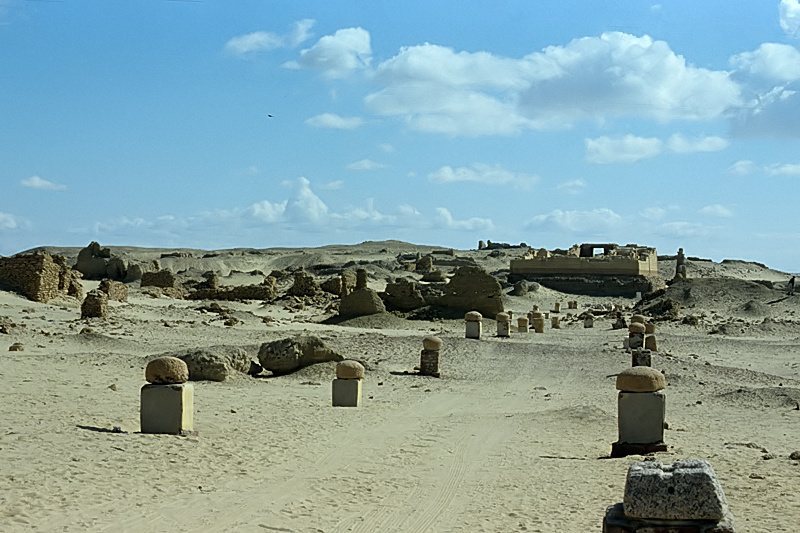
Karanis covers approximately 60 hectares on a low hill rising about 12 meters above the surrounding plain. The nearby landscape was formerly associated with Lake Qarun. Two main avenues crossed the settlement, which contained hundreds of houses as well as temples, granaries, a bath complex, public buildings, agricultural installations, and craft areas. Some houses shared courtyards, while others included gardens and animal pens. Exterior windows were set high in the walls, and oil lamps provided lighting.
Residential district and household production
The residential area included houses with varied domestic and productive uses. One tiled house with a stone entrance, probably occupied by a local leader, contained 26,000 coins stored in jars and also produced cloth bags. Other remains show the importance of food production and craft work within the town. Food deposits contained wheat, oats, lentils, radishes, figs, peaches, pistachios, walnuts, and other provisions, while at least two presses were used to process olives for oil.
Farmers kept dogs, cattle, pigs, mules, camels, pigeons, horses, antelopes, and crocodiles. Six pigeon towers were identified, including structures built above houses. At least two were used commercially, and the two largest could hold about 1,250 pigeons. Their birds and manure were sold for agricultural purposes, while smaller towers served household needs. Approximately 3,500 textile pieces, together with other evidence, show the presence of a complete local textile industry.
Temples and sacred buildings
South temple
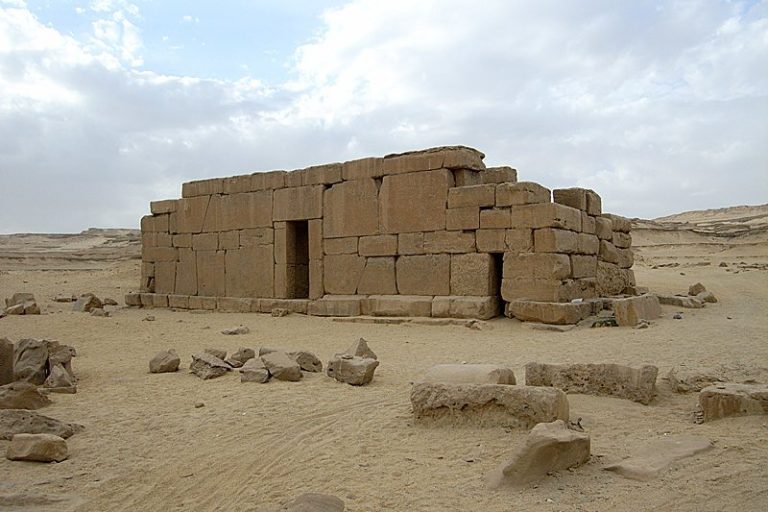
The south temple stands in the eastern part of the town and is larger than the north temple. Built of limestone in an Egyptian architectural style, it originated as early as the first century BC and may have replaced an earlier temple. It remained in use until the late third or fourth century. Under Nero, it was dedicated to the crocodile-associated gods Pnepheros and Petesouchos, Egyptian deities worshipped in the Faiyum.
Its complex contained shrine rooms, storage rooms, priestly residences, and storerooms on the north and south sides. A dining room in the southeast corner could accommodate local weddings and banquets. The temple faced east and included processional causeways, a columned court, and a three-room arrangement. The principal room opened through a vestibule into the sanctuary. The entrance area included structures known as the Gate of Vespasian and the Gate of Claudius. The latter has been interpreted as evidence that Claudius usurped a temple dedicated under Nero.
Niches in the temple contained mummified crocodiles. An altar in the sanctuary led to a concealed lower chamber reached through a side opening. This feature may have been connected with priestly oracular practices, although that interpretation remains uncertain. The temple’s cult formed part of a wider religious community in which at least 27 Greek and Roman deities were worshipped. Offerings included grain, meat, wine, milk, and honey, and crocodiles were mummified after death.
North temple
The north temple was built in the early Roman period, probably over an earlier temple, and continued in use until the third century. Smaller than the south temple, it is oriented north-south and constructed from limestone in an Egyptian style. Greco-Roman engaged columns, which are attached to walls rather than standing independently, stand at its outer corners and internal doorways. Part of the surrounding wall survives on the northern side, while the four corners were decorated with columns and pylons, monumental gateway structures formed by substantial masses on either side of an entrance.
An altar in the north temple may have incorporated a niche for an oracle. Its purpose is not identified by a surviving inscription, but an altar shaped to accommodate a crocodile mummy and a soft white-limestone figure of a hawk-headed crocodile suggest a connection with a crocodile deity, probably Soknopaios. Another altar bears the head of Serapis, a Hellenistic Egyptian deity combining Egyptian and Greek religious traditions, Zeus, or a form combining the two.
Granaries, bath complex, and archaeological evidence
Ten large and seven small granaries were identified at Karanis. The large granaries stored grain destined for Rome and were guarded by Roman soldiers. The Roman bath complex included cold-water facilities, a hot room that was nearly filled with steam, a separate dry hot room, and a rest area. Ceramic pipes used to heat the baths survive among the remains.
More than 100,000 objects and over 2,500 folders of documents were recovered during the excavations. The dry conditions preserved the papyri especially well, allowing tax records and other documents to be considered alongside buildings, food deposits, textiles, religious objects, and household goods. Together, these remains provide detailed evidence for the lives of Karanis’s ordinary inhabitants and for the town’s place within the Greek and Roman administration of Egypt.