Qasr el-Sagha: An Unfinished Middle Kingdom Temple in Egypt
Site at a Glance
- Rating
- 4.6
- Popularity
- Very Low
- Country
- Egypt
- Primary era
- Bronze Age
- External website
- Open
- Eras represented
- Bronze Age
- Civilizations
- Egyptian
- Site type
- Religious
- Remains
- Temple
On this page7 sections
History
Qasr el-Sagha is an ancient Egyptian temple in Ibsheway, Egypt, generally dated to the Middle Kingdom, the period of ancient Egyptian history in the early second millennium BC, and often attributed to the Twelfth Dynasty between the twentieth and eighteenth centuries BC. It was never completed, and its undecorated walls leave its intended religious purpose uncertain. One possibility is that it was a funerary temple containing statues of deities.
Date and Religious Associations
The temple’s date was debated for many years. Earlier interpretations placed it in the Old Kingdom, the earlier period associated especially with pyramid complexes, but ceramic evidence from later archaeological work supports a Middle Kingdom date. The temple may have been connected with Sobek, the crocodile deity strongly associated with the Fayyum, its waters, and the fertility of the region. An inscribed basalt stone found nearby has been interpreted as evidence for this connection, although the identities of the deities worshipped at Qasr el-Sagha remain uncertain.
A Middle Kingdom settlement and cemetery were excavated in connection with the temple. The cemetery lies south of the building, while the surrounding region contains evidence of earlier settlement, including several prehistoric village sites. Their inhabitants appear to have combined hunting, agriculture, and fishing.
Exploration and Archaeological Study
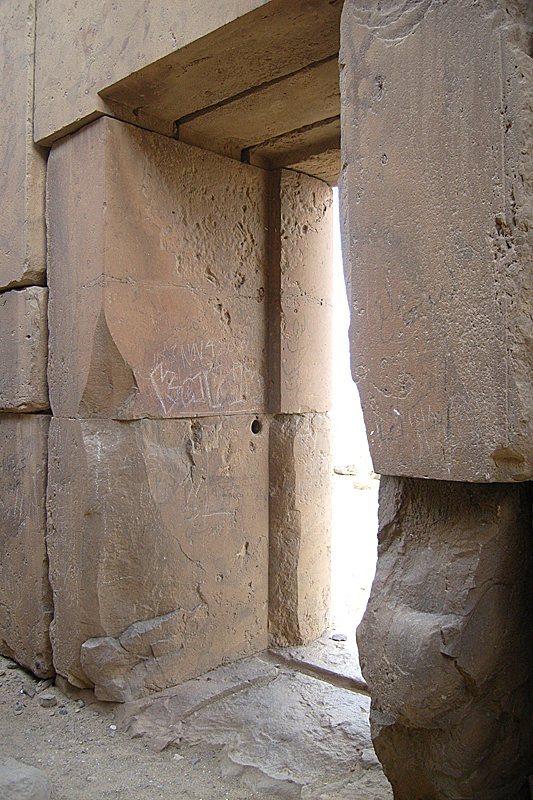
Georg Schweinfurth, a German explorer and botanist who researched northeastern Africa, visited the temple in 1884, described it, and published his account in 1892. He incised his initials on a block beside the building. Flinders Petrie later visited Qasr el-Sagha and published a plan. Modern excavations in 1977 used ceramic evidence to support the Middle Kingdom dating.
Remains
Layout and Construction
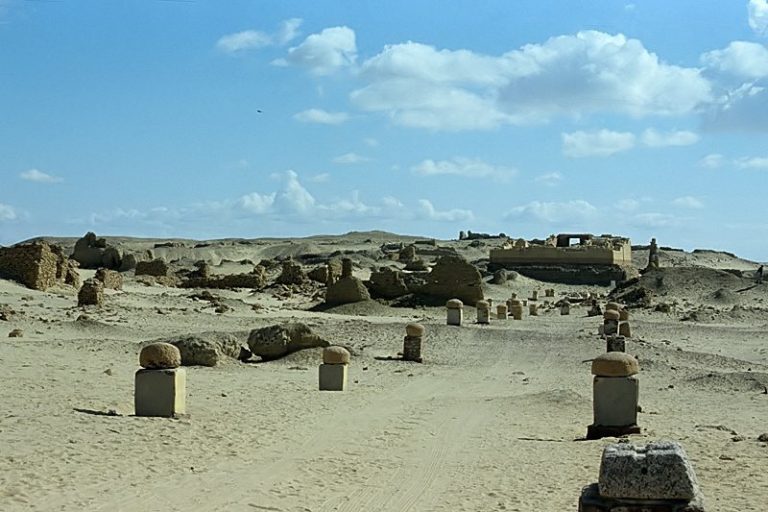
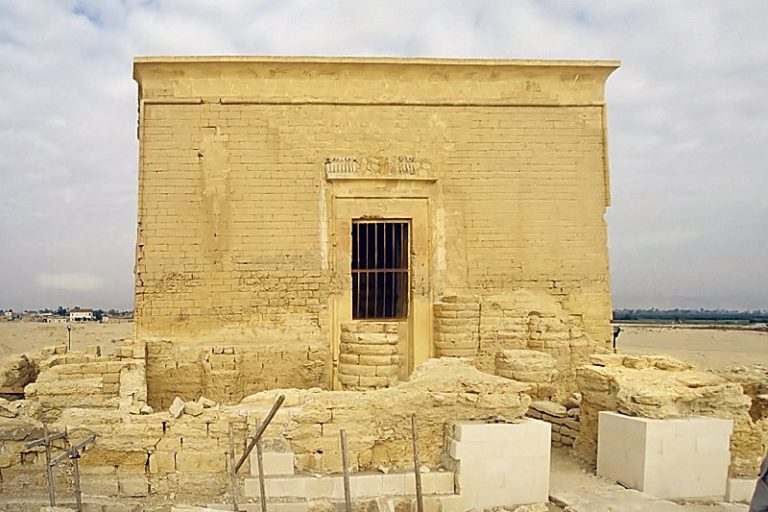
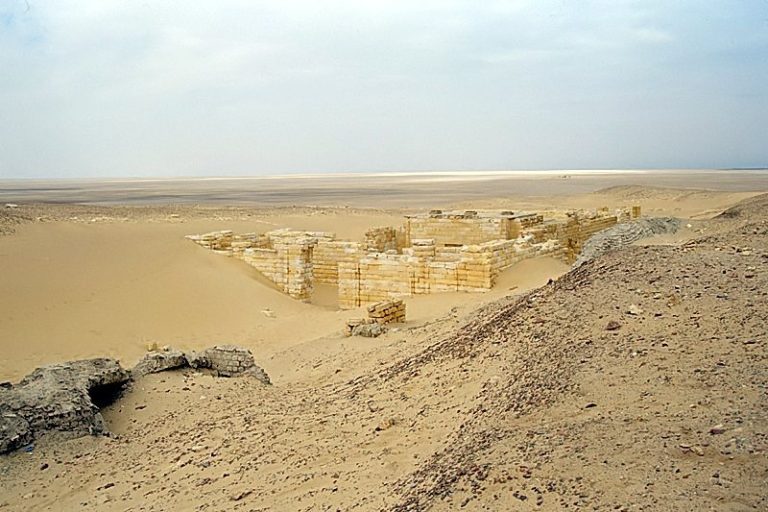
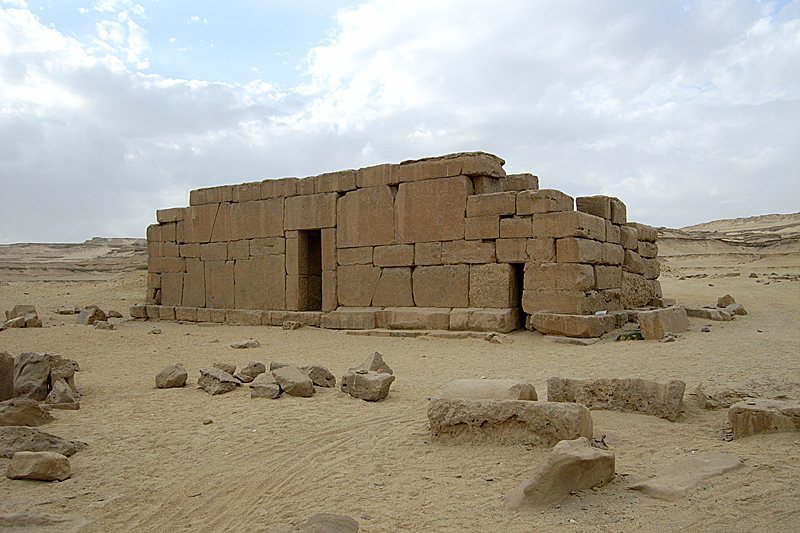
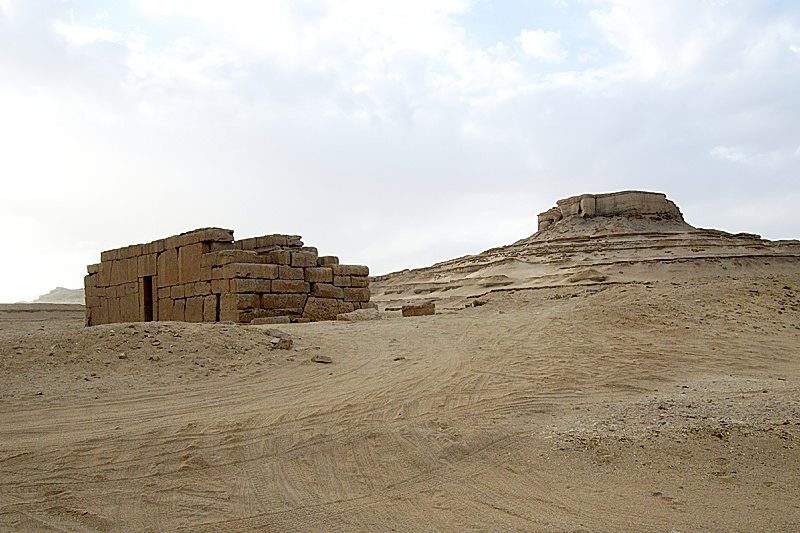
Qasr el-Sagha stands on a low promontory at the foot of Mount Qatrani, about 8 kilometres north of Qarun Lake, in an isolated and inhospitable area. The rectangular temple measures approximately 180 metres and is built from limestone and sandstone, including large calcareous sandstone blocks of varying sizes. The blocks fit tightly without mortar and have oblique corner joints, a construction technique compared with the Valley Temple at Giza and the Osireion at Abydos.
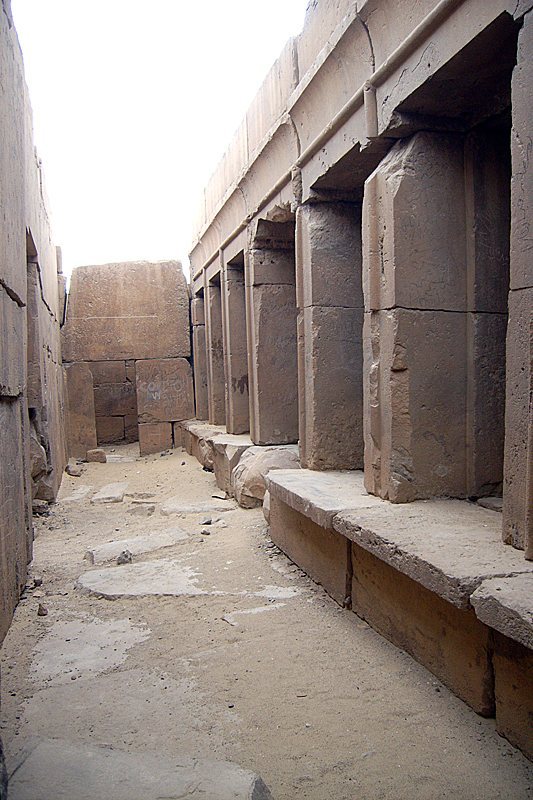
A southern entrance opens into a long courtyard or offering hall. Seven shrines, or naoi, occupy the rear wall. A naos is an enclosed sacred compartment intended to house a deity’s image. The doors of the shrines are missing, but their sockets survive. To the right of the main entrance, a smaller doorway leads into a passage within the outer wall and appears to have provided access to the door mechanism.
Interior Spaces and Finds
The interior contains a broad hall with seven small rooms and two lateral rooms. It also includes a completely enclosed room with no apparent entrance. This unexplained space is often described as a blind room. The unfinished condition of the building is visible in its undecorated walls and incomplete fittings.
Objects found at the temple include a black-granite statue of Amenemhat III, a pharaoh of the Twelfth Dynasty, along with papyri, bronze coins, and terracotta statues. A decorated basalt fragment discovered near the temple may originally have belonged to the building. It is held by the Petrie Museum, an archaeology museum associated with University College London, under inventory number 3883.
Surrounding Landscape
North of the temple, the escarpment preserves visible petrified remains of an ancient forest. Qarun Lake may once have extended to the northern shore near Qasr el-Sagha, while the modern shoreline lies more than 5 miles away. This changing relationship between the temple and the lake forms part of the site’s ancient environmental setting.