Dickson Mounds: A Native American Settlement and Burial-Mound Complex in Illinois
Site at a Glance
- Rating
- 4.4
- Popularity
- Low
- Country
- United States
- Primary era
- Medieval
- External website
- Open
- Eras represented
- Medieval
- Civilizations
- Mississippian
- Site type
- Burial
- Remains
- Necropolis
On this page12 sections
History
Dickson Mounds is a Native American settlement and burial-mound complex in Illinois, United States, founded by about 800 CE and used until after 1250 CE during the Middle Mississippian period. It occupied a low bluff above the Illinois River, where wetlands and the river valley supplied fish, shellfish, game, and other food resources. The site preserves evidence of the transition from seasonal hunting and gathering to permanent agricultural communities with regional trade, social ranking, and monumental earthworks.
Early settlement and changing subsistence
Earlier settlements in the area, dating to approximately 950 to 1050 CE, depended mainly on hunting and gathering. Their populations were relatively small and autonomous, exchanged little with outside communities, and maintained primarily seasonal camps. Between 1050 and 1175, the community developed a mixed economy that combined foraging with agriculture, especially the cultivation of maize. Settlements became more permanent, and exchange networks widened.
From about 1175 to 1350, population growth accompanied the development of complex permanent settlements, intensified agriculture, and long-distance trade. By about 1200, Dickson Mounds was connected to an exchange network that reached culturally diverse populations in the Plains, the Caddoan area, and Cahokia. Cahokia, a major Mississippian urban center and regional power in the central Mississippi River valley, supplied luxury goods such as copper ornaments and marine-shell necklaces. In return, food including meat and fish was exchanged. The demand for food surpluses intensified agricultural production and contributed to changes in health and social organization.
Health, status, and mortuary society
More than 800 skeletons from the site show the physical effects of this economic transformation. After agriculture was adopted and intensified, people experienced more enamel defects, iron-deficiency anemia, bone lesions, and degenerative spinal conditions. These changes are associated with a less varied diet, strenuous farm labor, denser settlements, and the spread of infectious disease. Expanded trade may also have contributed to declining health and inequality if residents exchanged needed food for objects valued for their symbolic importance, although this remains a possibility rather than a certainty.
Burial practices indicate that Dickson Mounds was a hierarchically organized society. Tools, copper ornaments, and imported materials occur with high-status burials, while pots, spoons, and beads are more common in burials of lower status. Age and sex also shaped social position. Burial groups include high-status mature males and younger individuals of lower status. Functional objects often marked men’s positions, while cultural, religious, and ornamental objects were associated with women, and marine shells tended to indicate the status of children. Differences in skeletal height and health further suggest deep class divisions, with elite children generally taller and healthier than children of lower status, probably because of better diets and less strenuous work.
Changing burial practices and abandonment
Earlier burials were placed in mounds that continued to be built as late as the ninth century. Later burials were placed in cemeteries, reflecting a change from mound burial as a monumental community focus toward platform mounds at the centers of towns. A group of four people appears to have been sacrificed: their heads had been removed and replaced with pots. This practice was not common in the earlier period.
The population apparently disappeared between the late thirteenth and mid-fourteenth centuries. Warfare, climate change affecting maize cultivation, and epidemics encouraged by population growth, permanent settlement, and expanded trade have all been proposed as possible causes. The reason for the disappearance remains uncertain.
Discovery, excavation, and reinterpretation
Don Dickson, a chiropractor, discovered the mounds on his family’s farm and began excavating them in 1927. He removed soil while leaving the bones in place, first protecting the excavation with a tent and later replacing it with a building that housed a private museum. Excavations are recorded for 1937. Human remains were displayed publicly from the 1930s until 1992, when objections from Native Americans led to the closure and resealing of the burial exhibition by Illinois Governor Jim Edgar.
The excavations had left 248 burials exposed in place inside a specially constructed museum enclosure. After the 1992 closure, the museum was renovated into galleries focused on the site’s history and prehistoric life in the region. The Dickson Mounds Museum was erected by the State of Illinois in 1972 and became part of the Illinois State Museum system, the state’s network of museums and collections devoted to natural and cultural history. The site was added to the U.S. National Register of Historic Places, the federal register of historically significant places in the United States, on May 5, 1972.
The adjacent river bottomland has been preserved and is undergoing ecosystem restoration through the Emiquon Project, an initiative focused on wetlands and floodplain habitat in the Illinois River valley. These wetlands supplied much of the food consumed by people living on or near the bluff-top settlement. In 2009, an excavation by Michigan State University in the bottomland recovered pottery sherds and arrowheads and exposed foundations of houses and other structures dating to about 1300 CE.
Remains
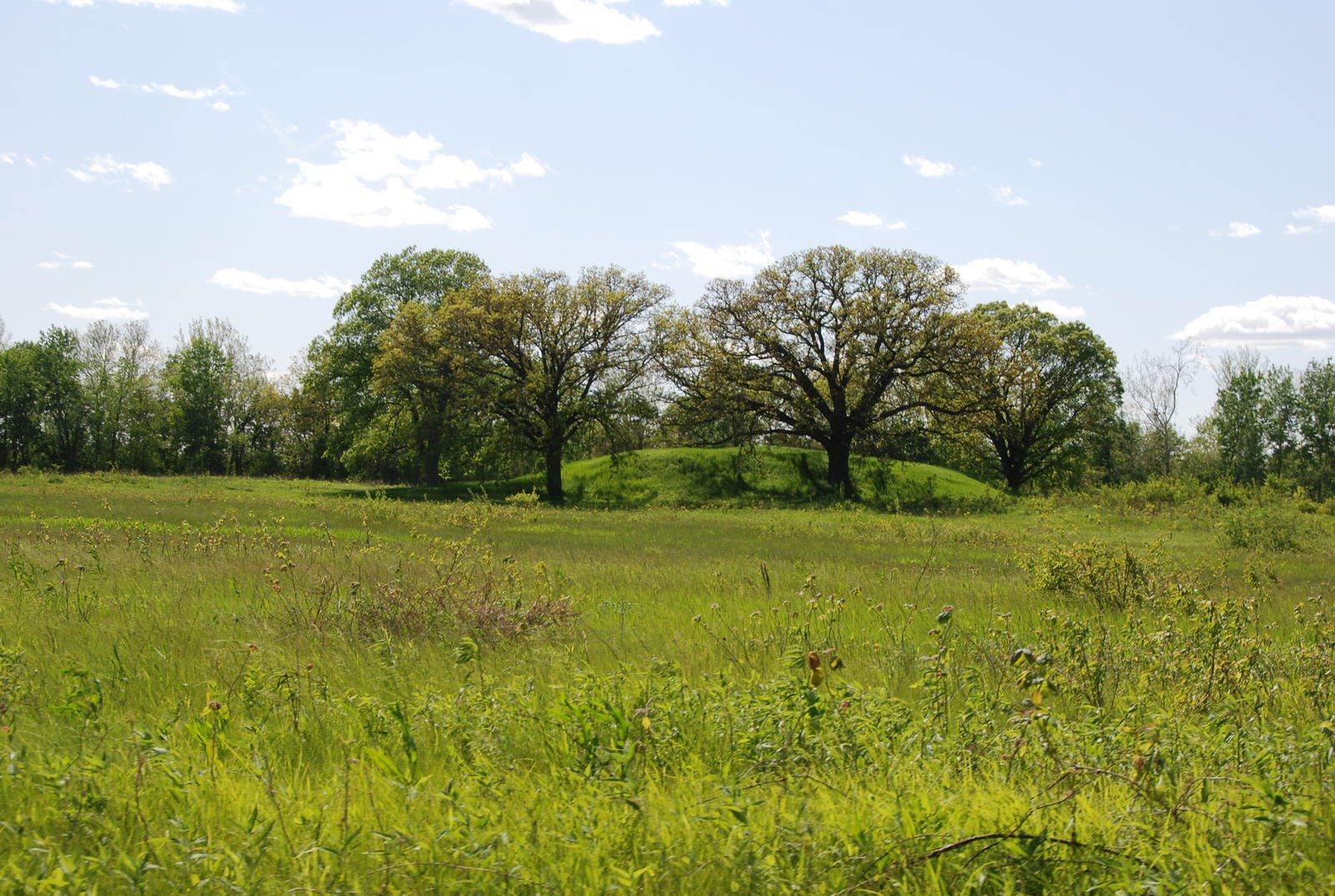
Dickson Mounds occupies a low bluff overlooking the Illinois River. The archaeological complex includes at least two cemeteries, ten superimposed burial mounds, a platform mound, and the remains of dwellings. More than 800 Native American skeletons have been recovered from the various burial areas, while the wider site is estimated to contain at least 3,000 burials. The adjacent river-bottom wetlands formed part of the settlement’s physical and subsistence landscape.
Burial landscape
Burial mounds
The complex contains ten burial mounds built over one another, with some continuing to receive construction as late as the ninth century. These earthworks formed part of an earlier mortuary arrangement in which mounds served as important communal features. Excavations exposed 248 burials in place. Objects associated with the burials include tools, copper ornaments, imported raw materials, pots, spoons, beads, marine shells, and cultural or religious items. Their distribution reflects differences in status, age, and sex.
Cemeteries and unusual burials
Later cemeteries represent a different arrangement from the earlier mound burials. One group of four burials contained individuals whose heads had been removed and replaced with pots, providing evidence for a possible sacrificial practice. The wider burial area preserves the physical evidence used to examine social rank and changing mortuary customs at the settlement.
Settlement structures and museum complex
Dwellings and bottomland structures
Archaeological remains include three excavated dwellings. Foundations of houses and other structures dating to about 1300 CE were also exposed in the adjacent river bottomland during the 2009 excavation. Together, these remains place domestic architecture within the same wider landscape as the bluff-top burial areas and the wetlands that supported the settlement.
Museum enclosure and galleries
The former burial display occupied a specially constructed enclosure built around the exposed burials. That display was later sealed, and the museum was reorganized into galleries rather than continuing to display excavated human remains. The River Valley Gallery examines Indigenous life since the end of the last Ice Age, while another gallery considers how archaeological evidence is used to interpret the inhabitants and culture of Dickson Mounds. The built museum complex remains part of the archaeological site and presents prehistoric life in the region through its surviving material evidence.