El Kab Tombs: A New Kingdom Necropolis in Egypt
Site at a Glance
- Rating
- 4.6
- Popularity
- Low
- Country
- Egypt
- Primary era
- Bronze Age
- Eras represented
- Bronze Age
- Civilizations
- Egyptian
- Site type
- Burial
- Remains
- Necropolis
On this page10 sections
History
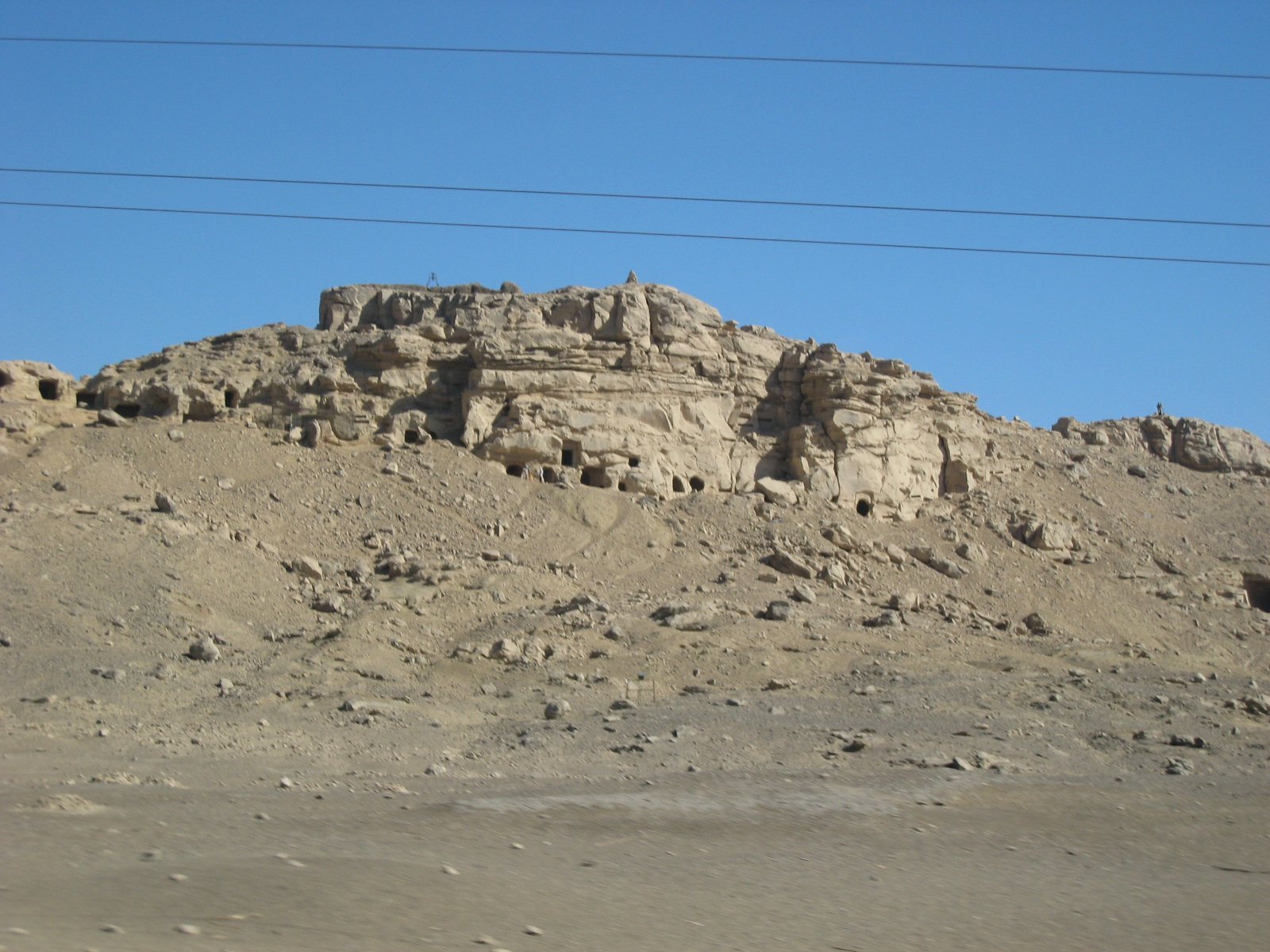
The El Kab tombs are an ancient Egyptian rock-cut necropolis at El Kab in Upper Egypt, on the northeastern bank of the Nile near modern Edfu, Egypt. Carved into a sandstone slope, the principal tombs belong mainly to the New Kingdom, the period of Egypt’s imperial power from the Eighteenth to the Twentieth Dynasty. The cemetery served officials, priests, military commanders, and administrators connected with Nekheb, the ancient city whose surviving mud-brick enclosure stands nearby, and with Nekhbet, its principal protective goddess.
Nekheb and the early New Kingdom
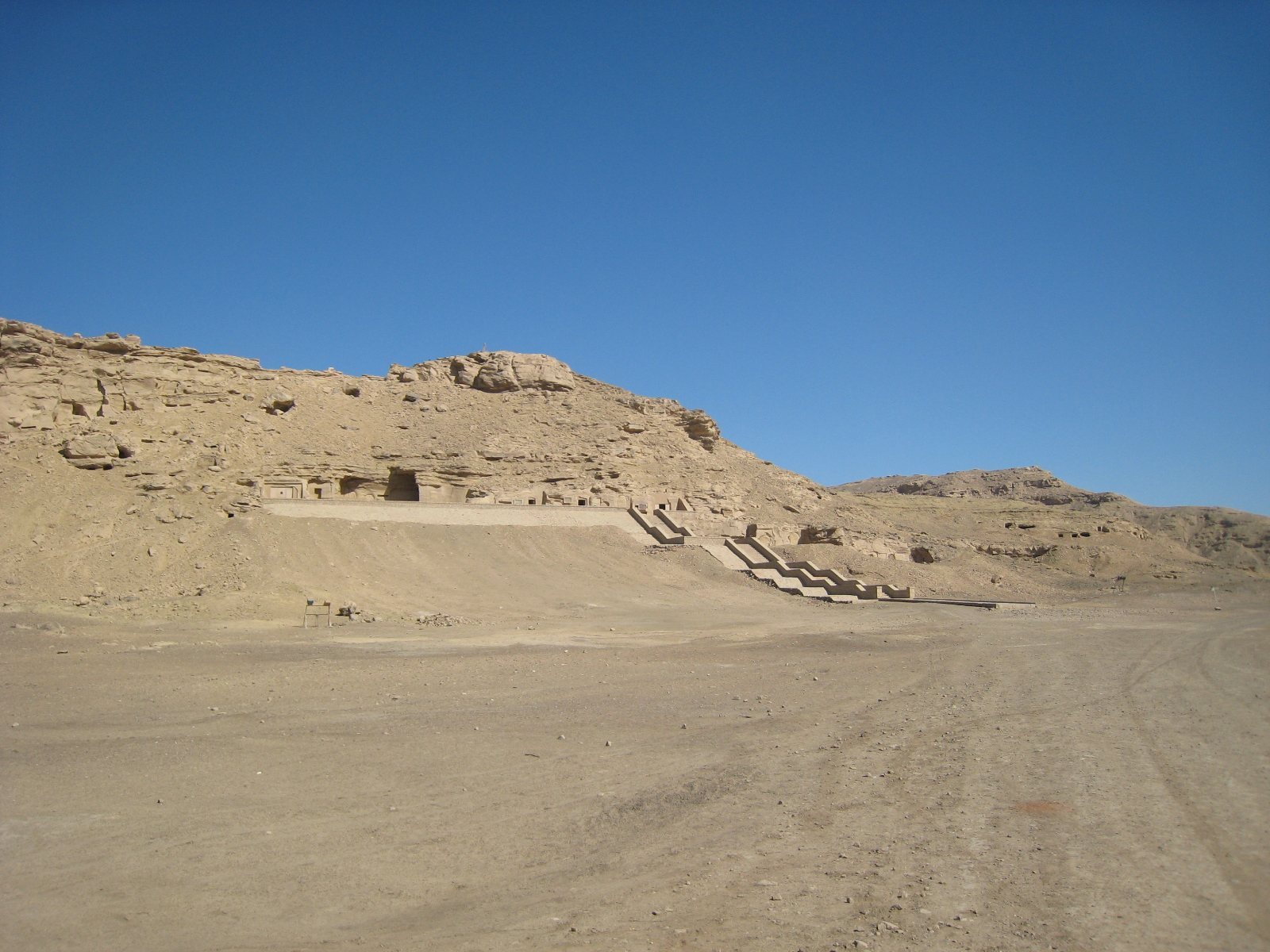
The tomb entrances lie about 450 metres north of the northeastern corner of Nekheb’s enclosure wall. A stairway on the southern side of the rocky massif gives access to the principal group, whose tombs are numbered from east to west with the prefix EK. Their owners held offices that connected the city’s religious institutions with provincial administration, royal service, agriculture, and the army.
Several tombs belong to the beginning of the Eighteenth Dynasty, when Egypt emerged from the Second Intermediate Period, the era that preceded the New Kingdom and included Hyksos rule in parts of the country. EK2 belongs to Ahmose Pennekhbet and his brother Khaemwaset. Ahmose Pennekhbet held a succession of senior offices, including hereditary prince, governor, king’s seal-bearer, chief treasurer, herald, and tutor of Princess Neferure.
EK3 was made for Paheri, governor of Nekheb and Junyt in the Nekhen nome, an administrative province of Upper Egypt. He was also chief priest of Nekhbet, a scribe responsible for grain administration across a large area of southern Upper Egypt, and probably a tutor of Prince Wadjmose. His father, Atefrura, appears to have held a similar responsibility. The tomb dates to the reign of Thutmose III and is the largest and most richly decorated monument in the necropolis.
Renni, also called Reneni, occupied comparable civic and religious positions under Amenhotep I. His tomb, EK7, identifies him as governor of Nekheb and overseer of Nekhbet’s priests. Its scenes combine family life, farming, offerings, pilgrimage, and the ceremonies carried out for the dead. EK5 belongs to Ahmose, son of Ibana, an officer who rose to command the royal fleet. Other tombs belonged to Tentis, a sistrum player of Nekhbet; Ipusoneb; Bebi, an Eighteenth-Dynasty general; and an unidentified man with his wife Ahneferu.
Military service and royal administration
Ahmose, son of Ibana, served under Ahmose I, Amenhotep I, and Thutmose I. His father Baba had been an army officer under Seqenenre, while his mother was Ibana, also known as Abana or Ebana. Ahmose took part in the Egyptian campaigns against the Hyksos, including the capture of Avaris and the three-year siege of Sharuhen. He later participated in the suppression of two rebellions in Upper Egypt and in campaigns in Nubia, Kerma, and against Mitanni.
Amenhotep I appointed him a “warrior of the ruler,” and Thutmose I eventually made him commander of the navy. His tomb was left unfinished, but its long autobiographical inscription preserves a detailed account of his service, rewards, and campaigns under several kings. Although written in the first person, the text was composed by his grandson Paheri, who described himself as Ahmose’s daughter’s son and as a scribe of Amun.
The inscription is one of the principal contemporary accounts of the expulsion of the Hyksos from Lower Egypt, alongside the victory accounts of Kamose. It describes the capture of Avaris, the siege of Sharuhen, campaigns in Nubia, and later operations under Amenhotep I and Thutmose I in Nubia and Syria. It also records land and enslaved people granted to Ahmose in recognition of his military service. Nineteen enslaved people are listed, with Egyptian, foreign, and place-derived names, including Istram or Isetar-ummi, a woman whose name is associated with northern Mesopotamia.
Later New Kingdom officials
By the Twentieth Dynasty, the cemetery continued to serve leading religious officials. EK4 belongs to Setau, First Prophet, or high priest, of Nekhbet during the reigns of Ramesses III and Ramesses IV. Its arrangement and decoration broadly recall Paheri’s tomb, although its treatment of the chambers and scenes differs. Setau appears with his wife before Re-Harakhty, a sun god, while other scenes refer to the royal jubilee of Ramesses III and to the work of a decorator named Merire.
EK9 belonged to Rensonb, a general during the Second Intermediate Period. EK10 was made for Sobeknakht II, governor of Nekheb at the end of the Seventeenth Dynasty. EK8b, now also numbered EK46, belonged to Djaty Senusret of the Twelfth Dynasty, while EK8a was the tomb of Bebi, an Eighteenth-Dynasty general. Together, these monuments show that the rocky slope was used by prominent members of the local administration and priesthood across several periods.
Religion and modern investigation
The inscriptions and scenes repeatedly invoke Nekhbet, Amun-Re, Re-Harakhty, Osiris, Anubis, Hathor, and other Egyptian deities. Nekhbet was the vulture goddess and tutelary deity of Nekheb. Osiris was associated with the dead, Anubis with embalming and funerary protection, Hathor with protection and the western realm of the dead, and Amun-Re and Re-Harakhty with royal and solar power. The tombs therefore preserve more than personal biographies. They also reveal how provincial office, royal authority, priestly service, agriculture, military activity, pilgrimage, and funerary belief were represented together.
European scholars accompanying Napoleon Bonaparte’s Egyptian expedition reached the necropolis in 1799. James Burton copied scenes and inscriptions in 1825, followed by work associated with Jean-François Champollion, Ippolito Rosellini, Robert Hay, and John Gardner Wilkinson. Richard Lepsius made drawings of reliefs in October 1843, and important nineteenth-century publications were produced by Lepsius and by Heinrich and Emil Brugsch.
British archaeologists, including James Edward Quibell, Frederick William Green, Archibald Henry Sayce, Joseph John Tylor, and Somers Clarke, excavated several tombs during the late nineteenth and early twentieth centuries. A representation of scenes from Renni’s tomb appeared in the 1809 Description de l’Égypte, produced from the French expedition of 1798 to 1801. The published drawing omitted inscriptions, compressed some scenes, and did not reproduce portions that had already been destroyed.
Remains
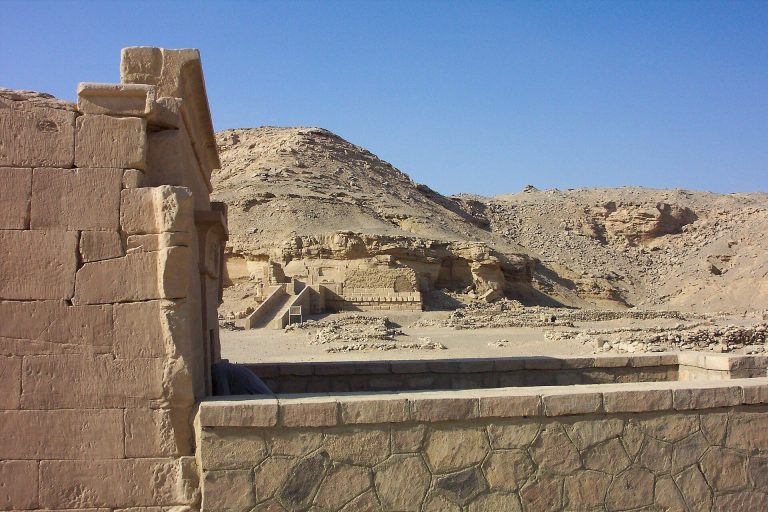
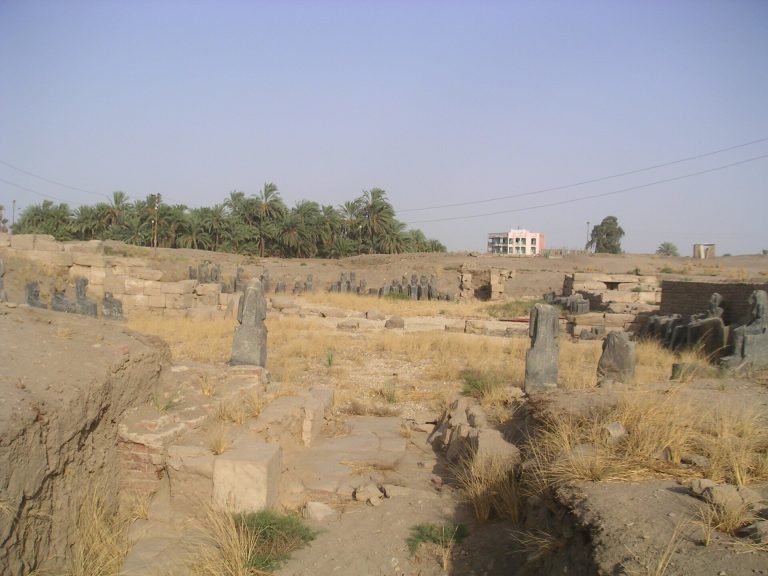
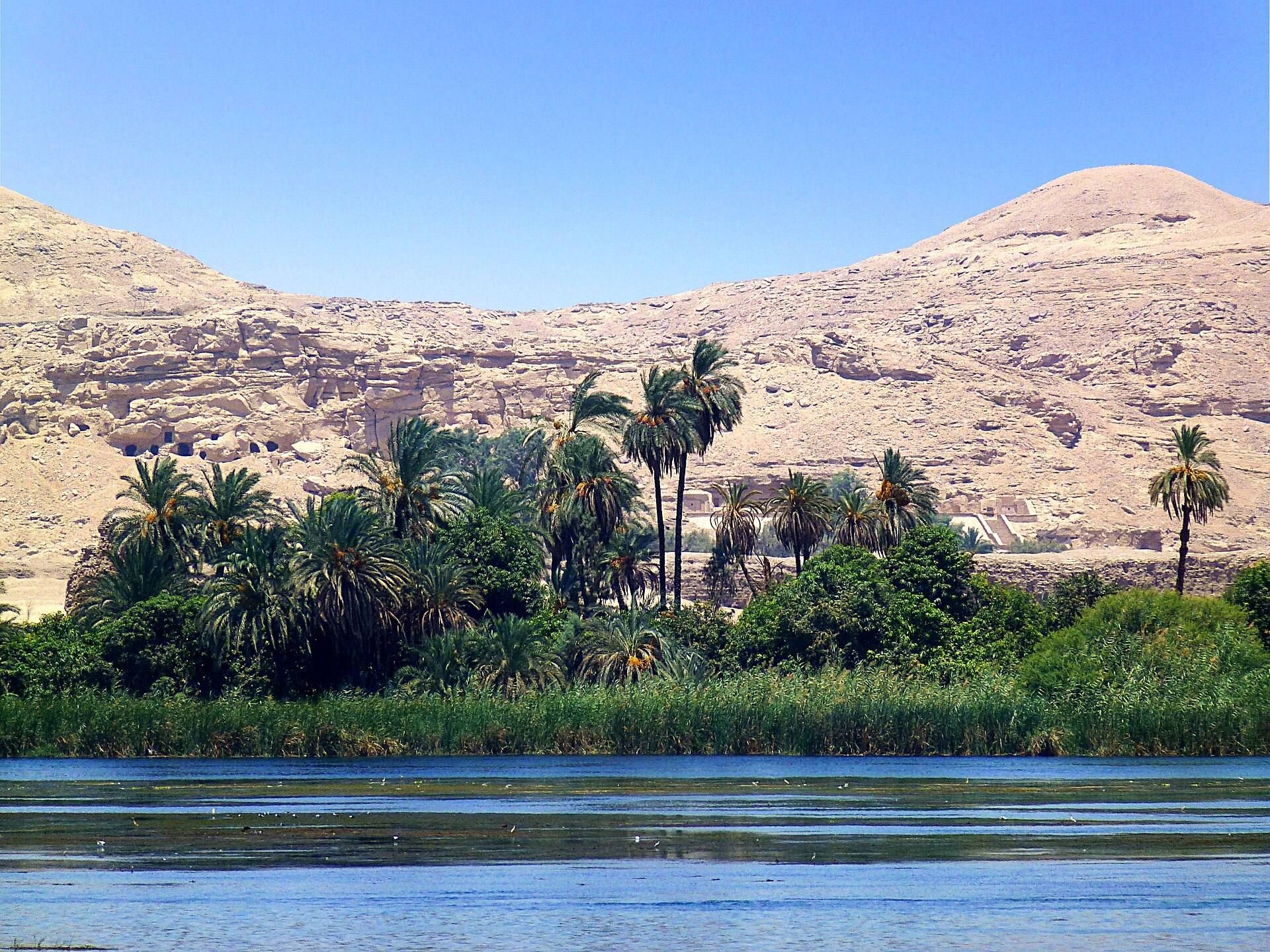
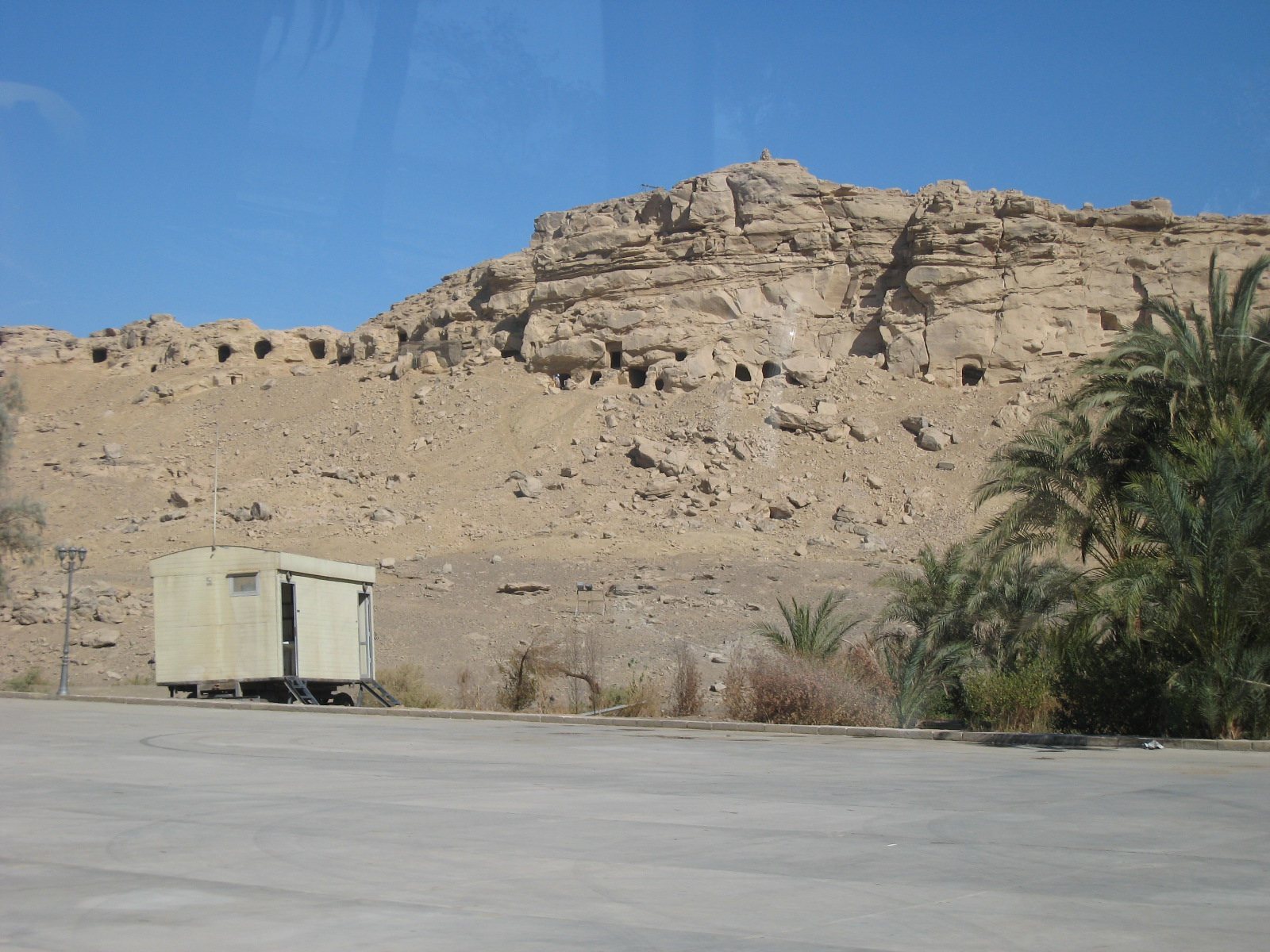
The necropolis is cut into sandstone on the southern face of a rocky massif. Its principal tombs are arranged along the slope in relation to the surviving mud-brick enclosure of Nekheb. The tombs vary from carefully finished and painted chambers to unfinished spaces with preliminary sketches, later passages, damaged facades, and subsidiary rooms. Their walls combine raised and painted relief, incised texts, architectural niches, family scenes, religious imagery, and long autobiographical inscriptions.
Paheri’s tomb
Paheri’s tomb, EK3, has a badly damaged entrance facade. On the right, Paheri kneels with raised arms toward the south before a damaged hymn to Nekhbet. The text invokes her as “Lady of the Mouth of the Two Valleys” and “Lady of Heaven.” Other prayers address additional deities, while two columns on the left invoke Amun-Re.
The main chamber opens behind the entrance on the southern side. It measures 8.30 metres in length and 3.80 metres in width, with a central height of 3.50 metres. Its straight barrel-vaulted ceiling and walls were carved from the sandstone and covered with raised low relief. A central niche in the rear wall is 1.80 metres high, 1.50 metres wide, and 1.73 metres deep. High-relief figures show Paheri seated beside his wife Henut-er-neheh and his mother Kem, although all three figures are damaged.
Colored reliefs around the niche show Paheri and Henut-er-neheh beside an offering table, their son Amunmose presenting offerings, and their six children, three sons and three daughters. On the eastern side, Paheri appears before the seated princes Wadjmose and Amunmose, sons of Thutmose I, while his parents stand behind him. A long lightly incised inscription, filled with blue pigment, praises Paheri, offers prayers for the future, and asks that visitors recite offerings for his ka, the vital spiritual power of a person.
The west wall is divided into three large sections. The first presents Paheri as a scribe and mayor, while the others show domestic activities and funerary rites. Near the entrance, three registers follow the agricultural year from sowing to harvest. Paheri is larger than the other figures and carries a staff and a sekhem scepter. The surrounding scenes include cattle, donkeys, goats, pigs, the weighing of gold from mines, ships with cabins, vessels carrying wheat and barley, bird-catching, and fishing.
One relief shows Paheri seated with the naked Prince Wadjmose on his lap, an image associated with the possibility that Paheri and his father tutored the prince. At the northern end of the wall, a funerary procession concludes with Paheri worshipping Osiris. A later passage cut through the east wall leads to three undecorated chambers and destroyed part of the earlier reliefs. Nearby, Paheri and Henut-er-neheh sit on a bench with a tethered monkey at their feet, while Amunmose, wearing the panther skin of a sem-priest, presents offerings. The remaining decoration includes a funerary banquet and relatives of the couple.
The southern side of the entrance retains incomplete reliefs. Paheri stands in a kilt and transparent cloak, accompanied by an inscription inviting him to go out into the land and see the sun. A ship appears above the doorway as part of a larger composition that has not survived.
Setau’s tomb
Setau’s tomb, EK4, has a heavily damaged facade. Its relief shows Setau and his wife worshipping Re-Harakhty. Above them, Khepri appears with a solar disk in a bark flanked by baboons. Four descending steps lead into a tomb whose general plan and decoration resemble Paheri’s, although its ceiling remains unfinished rock rather than a worked vault. Two low subsidiary chambers were cut later, with entrances measuring slightly more than half a metre in height.
The rear wall is smoothly plastered, and fragments of a hieroglyphic inscription on a red ground survive on either side. Reliefs on the west wall are severely damaged but preserve parts of four ships, including one with a shrine and the bark of Nekhbet associated with a jubilee of Ramesses III.
On the northern part of the east wall, Setau and his wife sit on a bench above a tethered monkey. Their son-in-law Ramessesnakht, wearing the panther skin of a sem-priest, appears nearby. He is followed by a seated couple before a food table and by male and female guests, probably relatives. The southern section shows Setau and his wife making offerings to the gods. At the entrance, Setau is shown on a large scale in a panther skin beneath a transparent cloak, with the surrounding decoration heavily damaged.
Ahmose’s tomb and inscription
Ahmose’s tomb, EK5, has a damaged facade and a rectangular chamber with a vaulted ceiling broadly comparable to Paheri’s. The decoration was never completed. Parts of the walls, particularly the west wall, retain preliminary sketches, while the surviving low relief extends across the rear wall without a statue niche.
On the right side of the rear wall, Ahmose and his wife Iput sit above a fruit-eating monkey. Their grandson Paheri stands before them with an offering table between the figures. Behind him are sections showing Ahmose’s deceased children. A lower scene shows a couple identified as Kema or Kem, possibly Paheri’s mother, receiving offerings from Paheri. The identification remains uncertain because the relevant name and parts of the relief are incomplete.
A later passage more than 1.60 metres high was cut through the northern part of the east wall to reach another undecorated chamber. It destroyed much of an earlier hieroglyphic text. Near the entrance, a life-size Ahmose leans on a staff while the smaller Paheri stands before him. Both face the autobiographical inscription, which continues along the east wall and onto the south wall.
The inscription originally occupied thirty-one columns on the east wall and nine on the south wall, with a thirty-second column at the corner completely destroyed. Its ten sections cover Ahmose’s youth, the expulsion of the Hyksos, campaigns under Ahmose I, the suppression of two rebels, operations under Amenhotep I and Thutmose I, Thutmose I’s Syrian campaign, and Ahmose’s old age. The western side of the south wall records land and enslaved people awarded to him by the kings he served. Near the end of the west wall, unfinished space gives way to family scenes with hieroglyphic captions, while a large area toward the northwestern corner is destroyed.
Renni’s tomb and funerary scenes
Renni’s tomb, EK7, measures 9.10 metres in length without its rear niche and 11.30 metres including it. It averages 3.40 metres in width and 3 metres in height. A blocked opening at the rear right once led to a small chamber of about three square metres, probably a storeroom for funerary equipment and apparently part of the original plan. The main chamber has a vaulted ceiling, and its side walls narrow slightly toward the rear.
The central rear niche contains a nearly destroyed seated figure of Renni carved from the surrounding rock. Two jackals on pedestals beneath paired Horus eyes symbolize Anubis. Painted ritual scenes flank the niche. Renni and his mother Ahmose sit on a bench, while the eastern side includes an offering table and a list of offerings followed by nine sons in two rows. The more damaged western side includes further sons, among them a sem-priest, a figure holding a libation vase, and another carrying the foreleg of an ox.
Above the niche, a checkerboard ceiling pattern represents the starry sky. Reliefs show Renni twice beside the cartouche of Amenhotep I, an elongated ring enclosing the king’s name, while six offering bearers face the centre. The accompanying texts concern offerings to Anubis and Osiris-Khentiamentiu, meaning Osiris, “Foremost of the Westerners,” a title linking the god with the realm of the dead.
Renni’s east wall is organized in three registers dominated by funerary ceremonies. The upper register shows a procession in which a sem-priest rides on a sledge drawn by an ox. People pour liquid over the runners, pull the rope, dance, and walk behind it. Three Muu dancers wearing tall woven-reed headdresses precede bearers carrying a yellow-brown chest with lion feet and paired Horus eyes. The chest probably held the deceased’s canopic jars, containers for separately preserved internal organs.
The same register includes the Tekenu wrapped in a hide and drawn on a sledge, a house with six rooms, a palm grove beside a square pool, two obelisks, isolated trees, and a blue square divided into sixteen fields. Hathor receives the procession, while Anubis waits in a chapel and leads the deceased toward Osiris-Khentiamentiu. The middle register shows Renni and his mother returning by boat from a pilgrimage to Abydos, a major centre of the cult of Osiris. It also includes purification, three mourning women identified as Renni’s sisters, embalming on a bier, and the Opening of the Mouth, a ritual intended to restore the dead person’s ability to breathe, eat, speak, and see in the afterlife.
The lower register brings the procession toward relatives seated at food tables. It includes mourners, a religious choir of ten women, Renni’s wife Nehi, a friend named Saumose, bearers with a box of personal belongings, a dancer, and Sataah leading the procession. Men bring and store drinks, while meat is cut and prepared.
The west wall is more damaged. Its upper left section shows a horse before a chariot, an important detail because horses had only recently become known in Egypt during Renni’s lifetime. A three-line Demotic inscription, written in a later cursive Egyptian script, was added by a visitor. The central and southern areas show agricultural work, including a swineherd, cattle, servants carrying Renni’s weapons and chair, and fragments of a boat.
The northern third of the west wall contains a banquet. Men occupy the upper registers and women the lower ones. Renni’s grandparents, Sobekhotep and Idi, sit on a bench as hosts, holding lotus flowers and wearing broad collars. A Hathor mirror and vessels for ointments and cosmetics appear beneath Idi. Their ten daughters stand below them, while guests hold cloths and lotus flowers and servants offer drinks. The scene distinguishes social position through seating, with some guests on chairs and others kneeling on the floor. A band of yellow and red rectangles on a blue ground frames the decoration of both side walls.