Nicopolis ad Nestum: A Roman City of Victory in Bulgaria


Site at a Glance
- Rating
- 4.5
- Popularity
- Low
- Country
- Bulgaria
- Primary era
- Classical
- External website
- Open
- Eras represented
- Classical, Medieval
- Civilizations
- Byzantine, Roman, Thracian
- Site type
- City
On this page14 sections
History
Nicopolis ad Nestum is an ancient Roman city in Bulgaria, near Garmen, founded by Emperor Trajan in AD 106 on the site of a Thracian settlement called Alexandroupolis. Trajan, who ruled from AD 98 to 117, established it to commemorate Rome’s victory over the Dacians in the Second Dacian War of AD 105–106. Its name means “City of Victory at Nestos,” referring to the Mesta River.
Foundation and Roman prosperity
The city occupied a strategically connected position on the route from the Aegean coast through the Rhodopes and the Upper Thracian Plain to Philippopolis. It was also linked with the Via Egnatia, the major Roman road connecting the Adriatic region with Constantinople along the northern Aegean. These connections supported Nicopolis ad Nestum as an economic, political, and cultural center, particularly from the second to the sixth century.
The ancient geographer Claudius Ptolemy mentioned the settlement. Coins and votive reliefs show that its inhabitants honored a varied group of deities, including Zeus, Pluto, Hermes, the Thracian Horseman, Asclepius, Hygieia, the river god Nestos, Ares, and Dionysus. The Thracian Horseman was a recurring deity or heroic figure shown as a mounted rider, while Asclepius and Hygieia were associated with medicine and health.
Late-antique transformation
Nicopolis ad Nestum became an episcopal center from the fourth to the eleventh century, meaning that it served as the seat of a bishop. A later ecclesiastical listing places it within the diocese of Thrace and identifies it as the seat of an archbishop.
The city was destroyed by Slavs and Avars in AD 577. It was rebuilt during the reign of Justinian I, the Byzantine emperor who ruled from AD 527 to 565, and later revived during the ninth or tenth century under the shortened name Nicopol. The settlement survived until the thirteenth century, when it declined during the Crusades.
Medieval continuity and modern investigation
During the Late Middle Ages, part of the former city was occupied by a Bulgarian settlement, while an Ottoman estate occupied the southeastern part of the fortified area. Under Ottoman rule, the settlement moved several kilometres west and retained the name in the form Nevrokop. The modern town is called Gotse Delchev.
Interest in the ruins grew during the late nineteenth and early twentieth centuries, when they were reportedly subjected to systematic looting and destruction. By the 1930s, some discoveries had been deposited in the Archaeological Museum in Sofia. Excavations took place from 1980 to 1987 and resumed in 2007, with research continuing on a more limited scale. Work has concentrated chiefly on the southeastern corner of the fortified city, whose defenses date from the second half of the fourth or the beginning of the fifth century. Only a small part of the former settlement has been excavated.
In 2020, researchers reassembled and translated a Greek inscription on a stone stele found at the city in 1923. The inscription preserves a letter from Emperor Septimius Severus and his son Caracalla thanking the inhabitants for a donation of 700,000 denarii. The donation was apparently intended to secure imperial favor because the city had supported one of Severus’s rivals in AD 193. Septimius Severus ruled from AD 193 to 211, while Caracalla was his son and co-emperor before becoming emperor in his own right.
Nicopolis ad Nestum is regarded as one of the few preserved ancient cities in Bulgaria and as the only one in the Rhodopes representing Roman rule in the Balkans. It is designated as an archaeological and architectural monument from Antiquity and the Middle Ages.
Remains
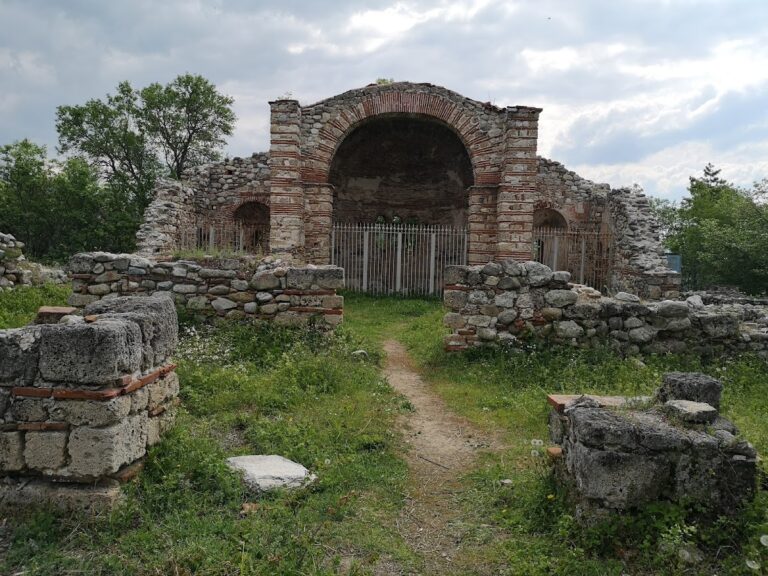
The original town covered approximately 25,000 to 30,000 square metres. It followed an irregular quadrilateral plan enclosed by high fortification walls. About 280 metres of the walls have been exposed, together with foundations of administrative and religious buildings and tumuli, or burial mounds. The excavated southeastern sector includes parts of the southern, western, and eastern defenses, eight partially restored towers, thermal baths, former shops, a church, and residential buildings. The investigated territory covers approximately 13 hectares, although only a small portion of the settlement has been excavated.
Fortifications and urban buildings
City walls and towers
The fortification wall is 2.40 to 2.60 metres thick and survives in places to a height of 5 to 6 metres. Its opus mixtum masonry combines stone bonded with mortar and regular horizontal bands of four brick courses. The southern wall had four round towers. Its gate opened within a broad exedra, a curved architectural recess, measuring approximately 40 metres across, and was protected by square towers. Other exposed defenses include a western wall with a U-shaped tower and an eastern wall with a rectangular tower.
Courtyard dwelling
A substantial urban dwelling stood in the southeastern corner of the fortified city beside the southeastern corner tower. The house predates the fortification wall and had rooms arranged around a courtyard with a marble peristyle, a courtyard surrounded by a colonnade, and a covered portico. Its largest room was the kitchen. An impluvium, a sunken basin for collecting rainwater, originally occupied the center of the courtyard before being replaced by a cobbled court.
Late-antique bath
The late-antique bath was a provincial public bath of block type, heated by a hypocaust system that circulated hot air beneath floors and through wall spaces. Its excavated rooms included changing areas, heated bathing rooms, and cooling spaces, together with the hot-air installation. The bath was built before the fortification wall, probably during the 320s. It burned in the late fourth or early fifth century, probably during Gothic raids at the end of the Second Gothic War, and was rebuilt in the late fifth century. It probably remained in use until the end of the third quarter of the sixth century, when an earthquake destroyed it. A gold coin of Emperor Zeno, who ruled from AD 474 to 491 with an interruption in AD 475–476, provides evidence for the rebuilding phase.
Early Christian churches
Southwestern basilica
The earliest of three early Christian churches associated with Nicopolis ad Nestum lies 3 kilometres southwest of the city. This three-aisled basilica measures 40.24 metres in length. It was built in the late fourth century, rebuilt in the late fifth or early sixth century, and used until the end of the sixth century. Its mosaic floors contain geometric and natural motifs, while some areas use opus sectile, a decorative technique in which cut pieces of stone are fitted into geometric or figurative designs. The style and themes show influence from northern Greece and Macedonia.
Garmen church
A second three-aisled church stood in the center of present-day Garmen. Built in the fifth century, it functioned until the second half of the sixth century. Two tombs and traces of frescoes were found inside it.
Northeastern church
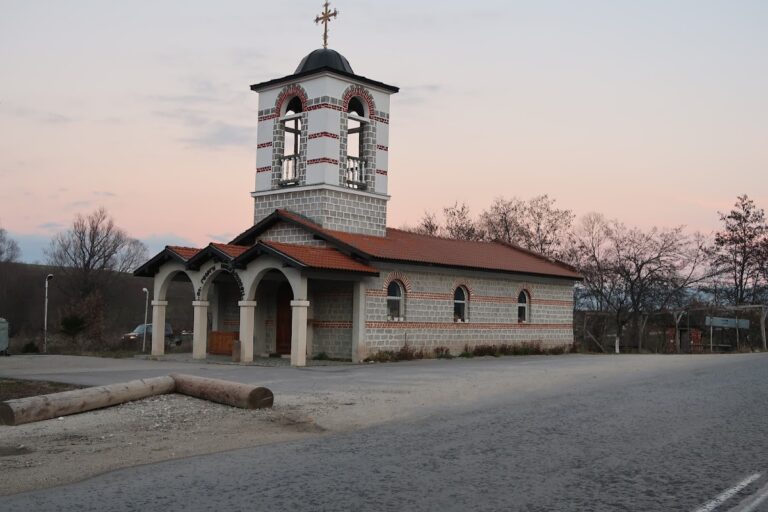
A third church, also dating from the fifth century, was discovered northeast of the present village. The churches associated with the settlement preserve early Christian floor decoration using geometric and natural motifs.
Altar and archaeological finds
Fragments of a late-antique altar table made from white marble were found in a building in the northwestern part of the city. The table had a diameter of approximately 1.15 metres and carried four scenes, three showing hunts and one depicting fantastic sea creatures. Four human heads were placed between the scenes. Seven of its eight fragments are displayed in the Historical Museum in Gotse Delchev.
Other finds include fragments of a votive relief of the Thracian Horseman, a small statuette of Hermes, an early Christian gravestone, more than 95 gold coins, approximately 22 other coins, glass, bronze, and ceramic vessels, and a gold ring. Medieval ceramic kilns, pits containing domestic pottery fragments, metal objects, and coins also illuminate the later occupation of the area. Some of these finds are displayed in the Historical Museum in Gotse Delchev. A tumulus is visible near the city, and Thracian tumulus necropolises dating from the first century BC have been identified in the surrounding area.