Archaeological Museum of Patras: A Museum of Achaian and Roman History


Site at a Glance
- Rating
- 4.7
- Popularity
- Medium
- Country
- Greece
- Primary era
- Classical
- External website
- Open
- Eras represented
- Stone Age, Bronze Age, Iron Age, Classical
- Civilizations
- Ancient Greek, Mycenaean, Roman
- Site type
- Museum
On this page13 sections
History
The Archaeological Museum of Patras is a museum in Patras, Greece, devoted to the history and archaeology of the city, southern and western Achaia, and the wider region from the fourth millennium BC to the fourth century AD. Its collections are especially strong in material from Mycenaean culture, the Bronze Age civilization of mainland Greece, and the Roman imperial period.
Early museum collections
Before the present museum was built, antiquities from Patras and its surrounding region were kept in several municipal buildings. In 1934, the archaeological collection moved to the ground floor of the house of I. Karamandani, a raisin merchant. Karamandani donated the building to the Archaeological Service in 1942. For ten years the museum shared the building with the city library, while its curators began expanding the exhibitions from 1960.
The former building was a listed neoclassical structure in Olga Square, in the centre of Patras. As the collection grew, it became increasingly inadequate, although it continued to serve as the museum until February 2008.
Creation of the present museum
Plans for a new museum were announced during the tenure of Minister of Culture Melina Mercouri. Planning for the project began in 1984, when a site in northern Patras was selected. Architectural competitions followed in 1991 and 2000, and the design was awarded to architect Theofanis Bobotis. Construction began in 2004, and the building was officially inaugurated on 24 July 2009.
The museum had originally been intended to open in 2006, when Patras was European Capital of Culture. Planning, organizational, financial, and installation delays postponed the opening. Minister of Culture Antonis Samaras inaugurated the building while the exhibition hall devoted to public life was still unfinished; that hall opened on 21 July 2011. The permanent exhibition was completed in 2011 by the scientific committee of the Ministry of Culture and Sports. In 2015, information kiosks introduced a virtual exhibition with three-dimensional exhibits and explanatory material. The museum is administered by the Ephorate of Antiquities of Achaia.
Collections and historical interpretation
Most of the collection comes from excavations carried out since the beginning of the twentieth century in Patras, its surrounding area, and southern and western Achaia. The permanent displays are arranged around private life, public life, and necropolises, while a fourth hall is used for temporary exhibitions. Projected visual material supports the displays, and approximately 70 percent of the exhibited objects were being shown for the first time in thirty years.
The museum presents Patras as a prosperous and socially open city, particularly during the second and third centuries AD, when it was an important port of the Roman Empire. Imported coins, jewellery, vessels, swords, and amphorae, along with the worship of deities from outside the Greek tradition, point to cultural influences and the arrival of people from other parts of the Roman world. The finds indicate peaceful coexistence among different peoples in Patras during this period.
Funerary material traces changing beliefs, ceremonies, burial customs, and cremation from the Mycenaean period through the late Roman period. More than forty Mycenaean cemeteries have been found around Patras, and their rich decoration has been associated with the prosperity of the region during the early Mycenaean period. Educational activities also allow school pupils to handle exhibits under archaeological guidance and learn about the conservation of archaeological finds.
Remains
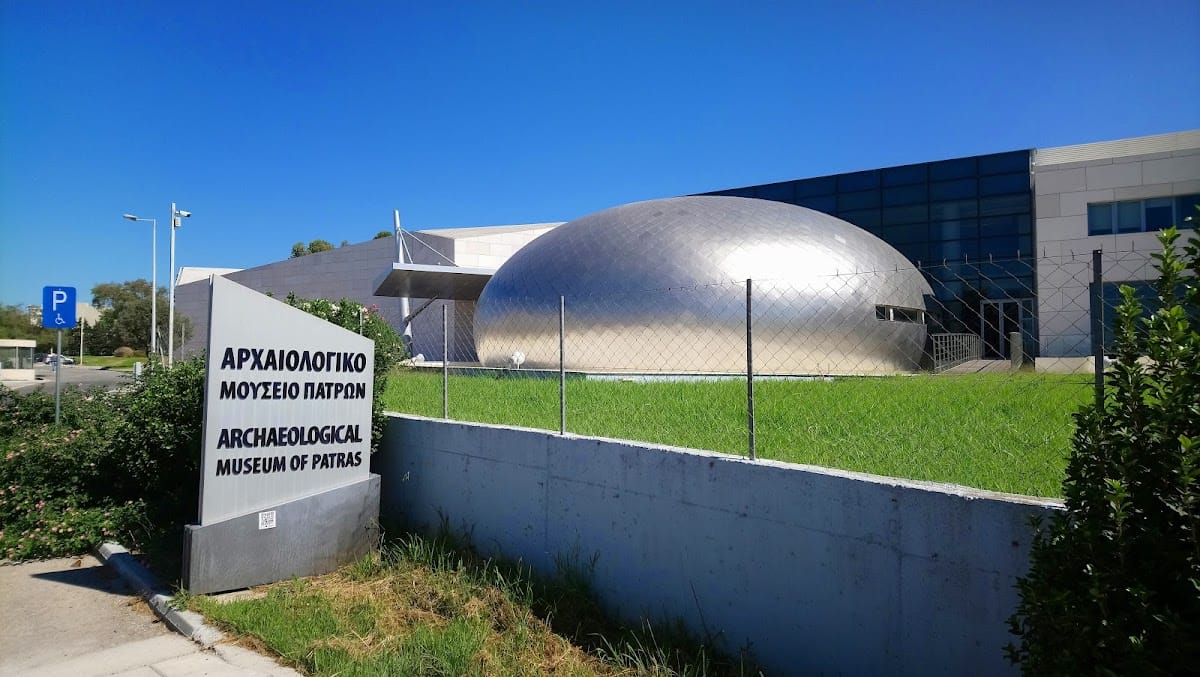
The present museum occupies a 28,000-square-metre site and contains approximately 8,000 square metres of interior space, including 2,600 square metres of exhibition area. Its geometric form is made from prisms reaching a maximum height of 14 metres. Straight wall lines contrast with a titanium-clad dome, 8.5 metres high and 24 metres in diameter, while a titanium-clad canopy extends above the entrance. Marble slabs cover the exterior walls, whose appearance recalls Doric masonry. Greenery surrounds the building, and a 500-square-metre water basin encircles the dome, evoking Patras’s relationship with the sea.
Museum architecture and exhibition arrangement
The building contains three permanent exhibition halls and a fourth hall for temporary exhibitions. The dome houses an amphitheatre or small theatre for lectures and other cultural events. Multimedia and virtual-tour facilities, an educational-program room, and a theatre seating 140 people are also included. High windows combine natural and artificial lighting, while white metal, wood, and glass dominate the exhibition interiors. The display spaces are arranged on one level or are accessible by lift.
Private life and Roman houses
The Private Life hall covers approximately 160 square metres and brings together everyday objects from the Mycenaean, Geometric, Archaic, Hellenistic, and Roman periods. Its chronological range extends from approximately 3000 BC to AD 400, with the oldest specifically dated exhibits coming from the seventeenth century BC.
Roman residences
Two life-size, partly reconstructed Roman residences are built with original materials. One is a rural house, or villa rustica, meaning a Roman estate or farmhouse. The other is an urban house, or villa urbana, meaning a Roman city residence. Projections explain the agricultural activities of Roman villas, as well as the excavation and reconstruction of the houses.
Roman mosaics
Fourteen Roman mosaics from Patras form part of one of Greece’s largest mosaic collections and cover approximately 300 square metres. Most are displayed vertically, with some arranged like paintings on the walls. Many came from luxurious Roman houses in Patras. Their subjects include mythology and nature, marine creatures, fishermen, hunters, Gorgon or Medusa heads, river deities, athletic contests, the Nile, the Cyclops, the Three Graces, Pan making wine, and Aphrodite holding a mirror.
One mosaic measures 70 square metres. A second-century mosaic of Aphrodite was originally more explicit, but it was altered during the Christian period so that the figure appeared more modest.
Public life in Patras and western Achaia
The Public Life hall covers western Achaia and Patras from approximately 1500 BC to AD 400. It presents evidence for public buildings and urban infrastructure, including sanitation facilities, roads, bridges, and an aqueduct. A representation of the aqueduct illustrates the city’s administrative organization, while maps of Roman territory frame information about Patras’s monumental topography.
The displays include kantharoi, drinking vessels with raised handles, as well as statues, coins, amphorae, musical instruments, and weapons. Sixty marble statues represent gods and Roman officials. Among them are Greek and non-Greek deities, Roman officials, and weapon sets from the province of Patras, including bronze weapons and helmets.
Roman-period sculptures include Dionysus, the Greek god associated with wine, vegetation, and festivity, accompanied by a young satyr and a dog; Artemis in a peplos, a long draped garment, with a deer; and Mithras killing a bull, dated to the third century AD. Mithras was a deity worshipped in the Roman world, especially in the mystery cult commonly called Mithraism. The hall also contains a Roman marble copy of Phidias’s Athena Parthenos. Phidias was a major fifth-century BC Greek sculptor traditionally associated with the statue in the Parthenon. Other sculptures represent Heracles and Dionysus in several forms.
Necropolis and funerary remains
The Necropolis hall occupies approximately 500 square metres and follows the development of funerary architecture from prehistory to the Roman period. Natural-size reconstructions of two Mycenaean tombs and one Roman tomb are presented with skeletons and grave goods, allowing the burial settings to be considered alongside the objects placed within them.
Tombs and burial settings
The reconstructed features include a rock-cut Mycenaean chamber tomb, a Geometric-period burial in a large storage jar, a Classical grave covered with tiles, a Roman cist grave formed from stone slabs or masonry, a Roman exedra tomb with a semicircular or recessed space, a carved Mycenaean tomb, and a large Roman funerary monument.
A pit containing four partly decorated sarcophagi is displayed in the condition in which it was found during excavation. Various urns illustrate cremation, while jewellery, glass vessels, and second-century funerary wreaths made from high-quality materials provide further evidence of funerary practice.
Hellenistic burial and the girl’s skull
One display contains the skull of a girl dated approximately to 300–275 BC. It is accompanied by a wreath made from bronze wire and gilded, coloured clay flowers. Pink, blue, and green pigments appear to have been applied after firing, in addition to the characteristic red Hellenistic glaze. Damage to the skull is present, but whether it occurred during life or after death remains uncertain.
The rich grave goods associated with the burial suggest that the girl came from a wealthy family. She may have been an aristocrat of the Macedonian elite or a soldier who took part in the campaigns of Alexander the Great, but this interpretation remains tentative.