Abbey of Henryków: A Cistercian Monastic Complex in Poland
Site at a Glance
- Rating
- 4.6
- Popularity
- Low
- Country
- Poland
- Primary era
- Early Modern
- External website
- Open
- Eras represented
- Medieval, Early Modern, Modern
- Civilizations
- Habsburg, Holy Roman Empire, Kingdom of Bohemia
- Site type
- Religious
- Remains
- Monastery
On this page17 sections
History
The Abbey of Henryków is a Cistercian monastery in Poland, founded in 1222 in the Oława River valley under the protection of the Silesian Piast dukes. Henry I the Bearded authorized Nicholas, a canon of Wrocław Cathedral, to establish the house as a daughter monastery of Lubiąż Abbey, while Henry I’s son, Henry II the Pious, became its official founder. The abbey combined medieval monastic life with agricultural and craft production and later developed into a major Baroque religious complex.
Foundation and Medieval Development
Nine monks from Lubiąż arrived at Henryków on 28 May 1227 under Abbot Henry. A foundation document issued the following year established the monastery’s endowment, and the first wooden church was consecrated in 1228. The Cistercians gradually expanded their landed possessions, drawing most of their income from agriculture and crafts.
The Mongol invasion of 1241 interrupted this development. The church and monastery were burned and looted, while the death of Henry II the Pious at the Battle of Legnica weakened the institution’s political protection. The monks rebuilt the monastery and recovered its possessions after the attack. Abbot Peter organized the monastery’s affairs in the Liber fundationis claustri Sancte Marie Virginis in Henrichow, known as the Book of Henryków. This medieval Latin record of the monastery’s foundation and property contains the first sentence preserved in a Polish-language document and became an important monument of Polish writing.
Henryków strengthened its regional position in 1292 by founding a daughter house at Krzeszów. Construction of a new Gothic church began in 1304. The dukes of Ziębice chose the monastery as their family burial place, and Duke Bolko II of Ziębice was buried there in 1341, followed soon afterward by his wife.
Wars, Rebuilding, and Early Modern Reform
The Hussite Wars, fifteenth-century conflicts connected with the reform movement founded by Jan Hus, brought severe damage between 1427 and 1430. The monastery was burned and looted, forcing the monks to flee to Nysa and Wrocław. Further destruction followed in 1438, when the forces of Sigismund von Reichenau destroyed the complex, and in 1459, when Czech troops of King George of Poděbrady damaged it.
Recovery began gradually in the mid-sixteenth century. Under Abbot Andrew, Renaissance elements were added to the monastic buildings, while disciplinary and economic reforms reshaped daily life. The dormitory was locked at night, gatherings for food and drink and disputes after Compline, the final traditional prayer service of the monastic day, were forbidden, and women were excluded from the cloister. The monastery operated an inn outside the complex and brewed beer. Abbot Wincenty of Strzelin continued these reforms. German monks arrived from the abbeys of Ląd, Obra, and Wągrowiec in Greater Poland, where a process of Polonization was taking place.
The Thirty Years’ War, a major European conflict fought from 1618 to 1648, again interrupted Henryków’s development. The monastery was looted and burned, much of its original library was destroyed, and a plague epidemic broke out there in 1633.
Baroque Prosperity
After the war, Henryków entered its greatest period of expansion. Heavy debts forced Abbot Kaspar Liebichen to resign, but his successors Melchior Welzel and Henry Kahlert restored the monastery, and Tobias Ackermann continued its development. Most of the Baroque buildings date from this period. The church became the center of a program intended to strengthen Catholic practice in surrounding villages.
In 1699 the abbey acquired the Cistercian Abbey of Zirc in Hungary. Until secularization, the abbot of Henryków also served as abbot of Zirc through a personal union. Henryków’s church became an important Marian sanctuary and a center of devotion to Saint Joseph. The Silesian Wars between Prussia and Austria, fought from 1741 to 1762, curtailed this prosperity. Troops were stationed at the monastery several times, looted its treasury, and imposed heavy war contributions.
Dissolution and Later Uses
Prussian authorities closed the monastery school in 1801 and confiscated its library, which contained 132 manuscripts and 20,000 books and was described as the richest collection in Silesia. On 22 November 1810, King Frederick William III issued a secularization edict intended to raise funds for the army. The monks were forced to leave with only their habits, breviaries, and two days’ food. After 582 years of operation, the abbey was dissolved.
The Henryków estate was soon purchased by Frederica Wilhelmina, Queen of the Netherlands and sister of the Prussian king. The former monastery was slightly remodeled as a magnate residence and passed by inheritance to the Dukes of Saxe-Weimar in 1863. A landscape park and an Italian-style garden were created in 1879. The former abbey later housed an elite psychiatric hospital. During the Third Reich, a military factory operated at Henryków, where prisoners of war from Luxembourg worked. At the end of the Second World War, the monastery was looted and devastated.
Return of the Cistercians and Modern Diocesan Use
Cistercians returned in 1949, when monks from Szczyrzyc established a priory, a monastic house governed by a prior, and took over the church and part of the monastery. Other parts of the complex served first as military warehouses, then as a holiday center operated by an Upper Silesian mine. From 1965, they were used by a plant-breeding and seed-production company and a seed and agricultural technical school. A gradual reconstruction of the complex began during this period.
In 1990, on the initiative of Cardinal Henryk Gulbinowicz, the entire abbey became the property of the Archdiocese of Wrocław. On 25 September that year, Annus Propedeuticus, a branch of the Metropolitan Theological Seminary in Wrocław for first-year seminarians, was established in the monastery. The buildings and grounds were subsequently renovated and redeveloped. A Caritas care home dedicated to Saint Hedwig of Silesia was founded in 1997 in connection with the 46th International Eucharistic Congress in Wrocław. The Blessed Edmund Bojanowski Catholic High School was established in 2002, and the former infirmary became its dormitory. In 2005, diocesan Caritas established John Paul II occupational-therapy workshops in part of the complex.
Cardinal Joseph Ratzinger visited Henryków on 28 October 2000 for the vesting ceremony of first-year students of the Wrocław seminary; he later became Pope Benedict XVI. Archbishop Marian Gołębiewski continued diocesan care of the monastery after becoming metropolitan archbishop of Wrocław in 2004. Henryków currently functions as a priory of Szczyrzyc Abbey, while its buildings accommodate the seminary branch, the Catholic high school, a Caritas care home, a dormitory, and occupational-therapy workshops.
The complex is a post-Cistercian Baroque monument ensemble entered in Poland’s register of monuments. Its listed components include several dozen buildings and landscape elements. The principal church was registered in 1949, the gardens and park in 1952, the Piast Mausoleum in 1956, the monastery in 1980, several ancillary buildings in 1981, and Saint Andrew’s Auxiliary Church in 1984.
Henryków also provides evidence for the economic changes of medieval Silesia. Some historians have interpreted the monks’ agricultural and settlement work as part of medieval German eastward settlement, while Polish researchers have emphasized the existence of Polish predecessors in the villages and the lack of explicit documentary direction for colonization. The monastery’s management nevertheless changed the local economic structure substantially, and Polish nobles gave land to the monks for cultivation.
Remains
The Monastery Church
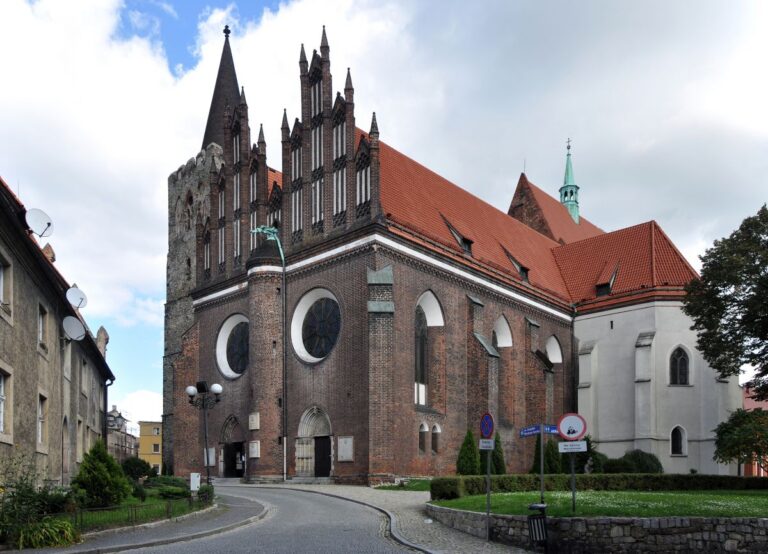
The Church of the Assumption of the Blessed Virgin Mary and Saint John the Baptist is the oldest and most important surviving monument at Henryków. Its construction began in 1241. The late Gothic presbytery, the eastern part containing the main altar and sanctuary, and the transept, the crosswise section intersecting the nave, belong to this phase. The Gothic nave, the principal longitudinal space used by the congregation, was completed in the mid-fourteenth century.
Gothic Chapels and Tower
Two late Gothic chapels, dedicated to the Holy Cross and the Holy Sepulchre, were added to the northeastern side of the presbytery at the beginning of the sixteenth century. A western tower was erected in 1608. These additions form part of the church’s transition from its medieval structure to the more extensive Baroque rebuilding that followed.
Baroque Chapels and Piast Mausoleum
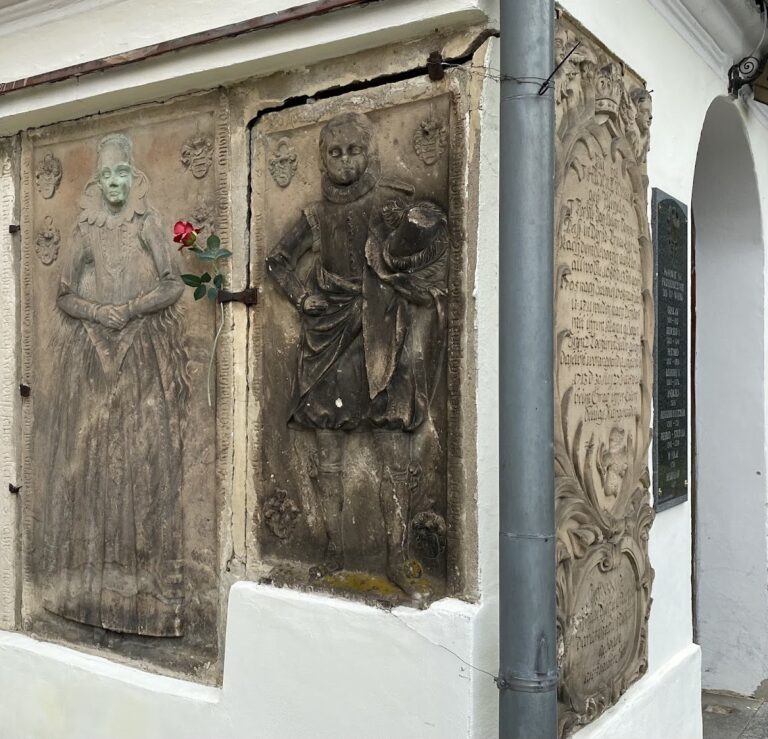
The seventeenth-century rebuilding added chapels dedicated to Saint Joseph and the Holy Trinity, as well as a Baroque façade with a chapel-like vestibule. The Chapel of Saint Mary Magdalene was built in 1753 and became the Piast Mausoleum, a monumental burial chamber. It contains the Gothic double tombstone of Duke Bolko and his wife Jutta, described as one of the oldest double tombs in Poland.
Altars and Paintings
Georg Schroetter made the main altar between 1681 and 1684. Its principal painting, Nativity as Seen by Saint Bernard, and the upper image, The Saviour of the World, are by Michael Willmann, a major Baroque painter active in Silesia. The Nativity is flanked by sculptures of Saints Benedict, John the Baptist, and Peter on the left, and Saints Bernard, John the Evangelist, and Paul on the right.
A side altar contains a statue of the Virgin and Child known as the Mother of the Polish Language. The statue received episcopal crowns in 1952. The upper part of the nave contains fourteen Baroque paintings showing episodes from the life and legend of Saint Bernard.
Choir Stalls and Organ
The Baroque choir stalls are an outstanding example of Silesian woodcarving. Their oak Renaissance framework dates from 1567, while carved acanthus and shell motifs decorate the structure. The linden-wood backs contain 36 reliefs depicting scenes from the life of Christ. After 1700, the abbot’s and prior’s boxes were added, along with free-standing figures of Saints Gregory the Great, Eugene III, Jerome, Benedict, Bernard, and Conrad of Poitiers.
The church organ was made by craftsmen from Świdnica in the mid-seventeenth century and is described as the oldest organ in Silesia. Together with the choir stalls, it belongs to the church’s surviving furnishings from the period of Baroque artistic renewal.
Baroque Monastery Building
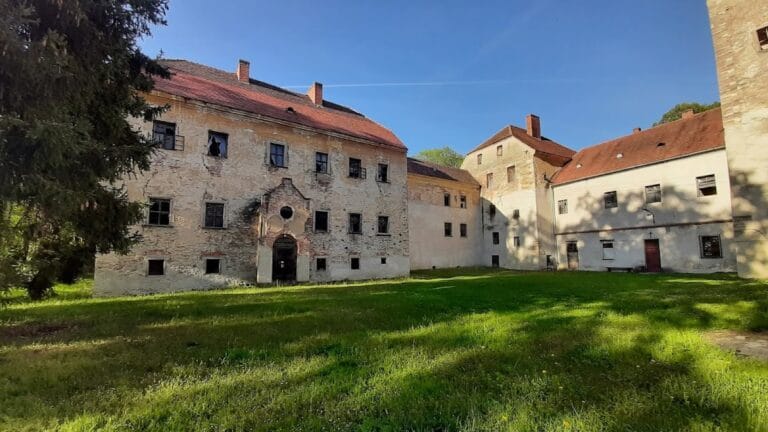
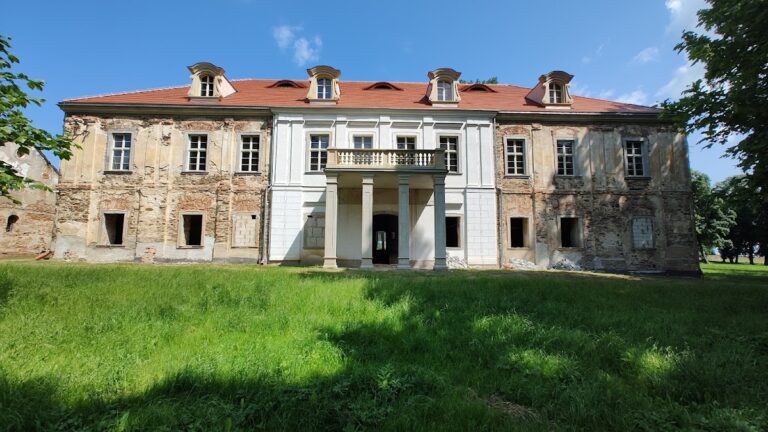
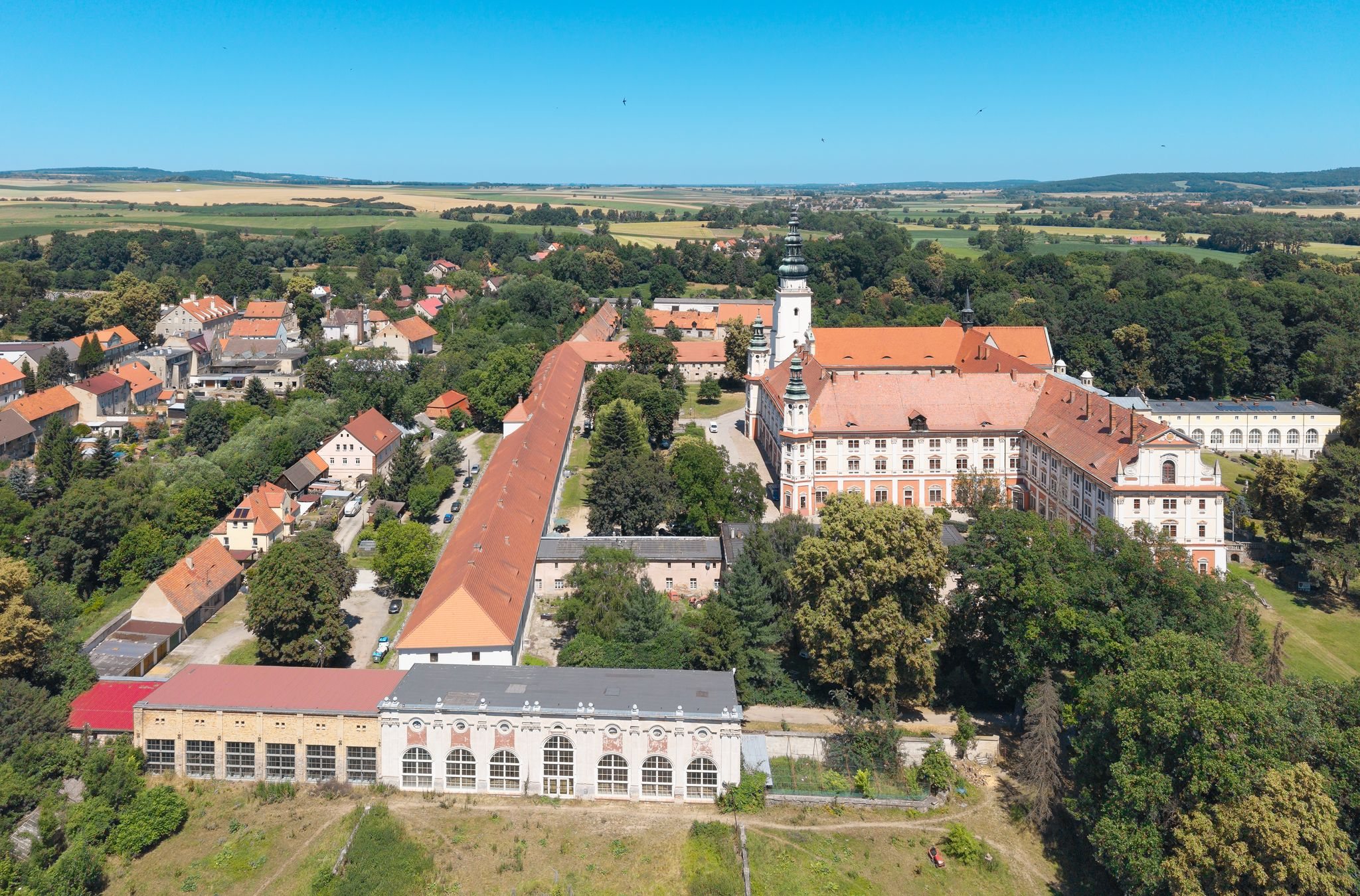
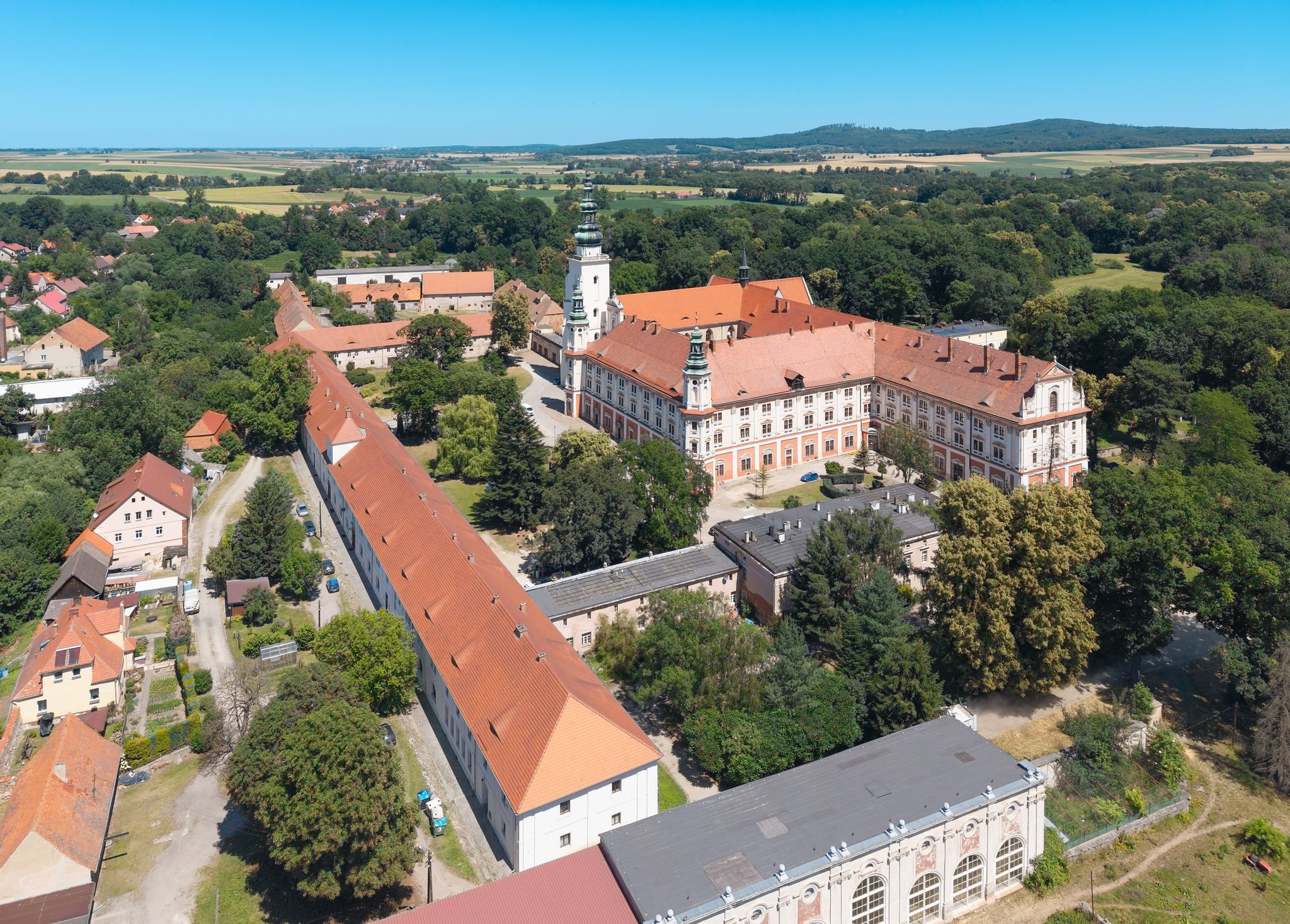
The Baroque monastery building was constructed between 1681 and 1702 and remodeled into a quadrangular structure in the second half of the nineteenth century. It is arranged around a rectangular courtyard, has a projecting southern wing, and contains approximately 300 rooms.
Portals and Interior Rooms
Three Baroque portals lead into the monastery interior. The court portal bears a figure of Themis, the monastic portal carries a figure of Saint Benedict, and the abbey portal displays the abbot’s coat of arms.
The ground floor contains a Baroque refectory, the communal dining hall of the monastery. The first floor includes the representative Prince, Purple, Oak, and Papal rooms. The Oak Room has an intarsia parquet floor, made by fitting pieces of wood into a surface to form decorative patterns, and wood paneling ornamented with plant and fruit garlands by Henryków woodcarvers.
The Purple Room was used to receive distinguished guests. Its purple walls and upholstery accompany a marble fireplace and six paintings by Willmann depicting the founders of the abbey. The refectory contains a multicolored Rococo stove whose individual tiles were painted by hand, along with eighteenth-century oak benches. Renaissance wood paneling survives in the seminary chapel.
Ancillary Buildings and Service Areas
The monastery courtyard is enclosed by residential and agricultural buildings. The historic complex includes the former hospital, now used as a school dormitory; the former Latin school, now a residential building; officials’ apartments, now occupied by a Caritas care home; a stable with living quarters; a coach house; and residential and service buildings connected with the monastery.
Gates, Orangeries, and Saint Andrew’s Church
Other listed components include the main upper gate building, the park gate, two orangeries, a garden pavilion, a gardener’s house, and the auxiliary Church of Saint Andrew. The first orangery is now used as a gymnasium. These structures extend the complex beyond the central church and quadrangular monastery building into its former agricultural and landscaped areas.
Gardens and Park
The Baroque park surrounds the monastery, while the abbot’s garden survives in its original form. The former summer dining hall of the abbots stands at the center of the garden. The grounds also include the Italian-style garden established in the nineteenth century and the landscape park created in 1879.
A monument beside the monastery commemorates the writing of the Book of Henryków. A yew tree in the monastery park is described as the third-oldest in Poland.