Žitenice Castle: From Gothic Fortress to Baroque Chateau
Site at a Glance
- Rating
- 3.8
- Popularity
- Very Low
- Country
- Czechia
- Primary era
- Early Modern
- External website
- Open
- Eras represented
- Medieval, Early Modern
- Civilizations
- Holy Roman Empire
- Site type
- Domestic
- Remains
- Castle
On this page8 sections
History
Žitenice Castle is a historic noble residence in Žitenice, Czechia, whose origins lie in a Gothic fortress that was probably standing by 1472. It later became a Renaissance residence and was rebuilt as a Baroque chateau in the seventeenth century. The site’s history reflects the changing fortunes of the Lords of Roupov, the Vyšehrad Chapter, and the political conflicts that reshaped Bohemia.
The Gothic fortress and the Lords of Roupov
The date when the original fortress was built is uncertain. Its existence is presumed by 1472, when Žitenice was granted as the dowry of Ludmila, daughter of the chancellor Jiří Prokop of Rabštejn. Ludmila married Jan of Roupov, a royal steward who later became chief scribe and received noble status. The Lords of Roupov held Žitenice as a pledged estate until 1621.
Jan’s son Petr pledged the estate to Jindřich Brozanský of Vřesovice. After Petr died, his sons Václav and Jan were still minors, and their guardians sought to recover the property. A decision by the provincial court in 1556 returned Žitenice to the Roupov family. The fortress was assigned to Jan, while Václav lived at a mill until his death in 1578. Jan later enlarged the estate by acquiring the neighboring village of Trnovany.
After the death of Petr Oldřich’s brother, Jan Šťastný of Roupov, the estate eventually passed to Václav Vilém of Roupov. Petr Oldřich, his elder brother, showed signs of mental illness, so guardians acted on his behalf. In 1611, Václav Vilém paid the Vyšehrad Chapter, a collegiate religious institution at Vyšehrad in Prague, seven thousand kop of Meissen groschen. Emperor Rudolf II, who ruled as Holy Roman Emperor and King of Bohemia from 1576 to 1612, then recognized the estate as hereditary property.
Renaissance rebuilding and the Estates’ Revolt
Václav Vilém rebuilt the fortress in the Renaissance style and invited contemporary humanists and scholars to Žitenice. His political career brought a dramatic change to the estate. During the Bohemian Estates’ Revolt of 1618 to 1620, an uprising of the Bohemian estates against Habsburg rule, he led the insurgents and became chairman of their directorate.
After the Battle of White Mountain, which ended the revolt’s main military challenge to Habsburg authority, Václav Vilém left the country. In 1621 he was sentenced to death and deprived of his property and honor. The Žitenice estate was acquired by Jan Kryštof Kilián, provost of the Vyšehrad Chapter, whose senior officeholder was responsible for leading the institution.
Václav Vilém lived in exile and sought the pardon of Emperor Ferdinand II in 1627, promising not to oppose him again. He broke that promise by joining the Saxon invasion of 1631, during which Litoměřice was captured. He briefly regained control of Žitenice, but left again after the Saxon withdrawal and was sentenced in 1634 to lose all his property. He returned to Bohemia with the army of General Banér, a Swedish commander in the Thirty Years’ War, in 1641 and died in Litoměřice in September of that year.
Baroque chateau and later use
After these events, Žitenice belonged to the Vyšehrad Chapter. In the middle of the seventeenth century, Provost Ferdinand Leopold Beno of Martinice had the Church of Saints Peter and Paul altered and the former fortress rebuilt as a Baroque chateau. The work was completed under Provost Hugo Francis of Königsegg, who later became bishop of Litoměřice.
The chateau burned in 1806. It was repaired, but the reconstruction removed most of its earlier architectural elements. At the end of the nineteenth century, the Žitenice estate was leased and was later divided during the second land reform. After the Second World War, the chateau served first as a state farm and then as a unified agricultural cooperative. A branch of the State Regional Archive in Litoměřice occupied the building from 1962.
Žitenice is protected as a cultural monument. In September 2024, a local referendum approved efforts by the municipality to purchase the chateau, which was then being offered for sale.
Remains
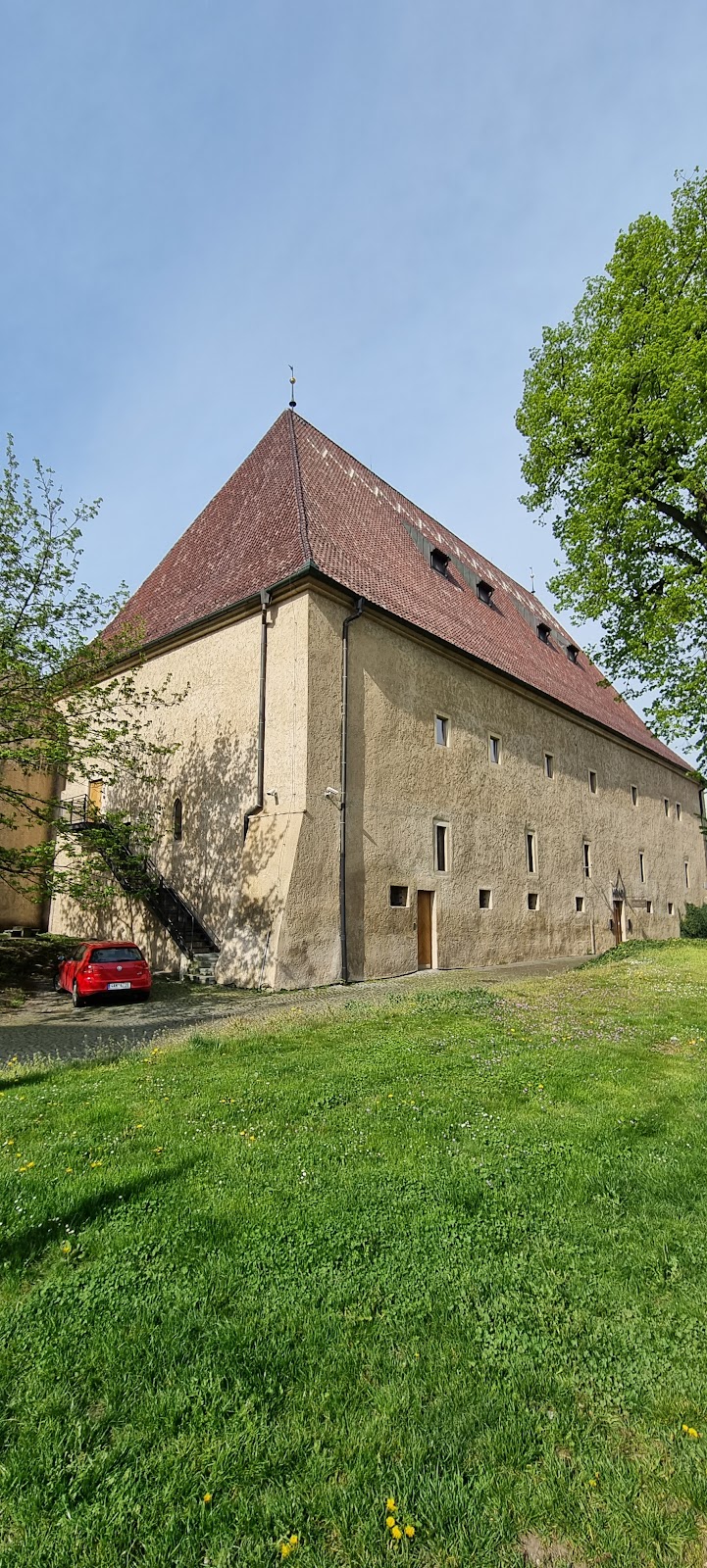
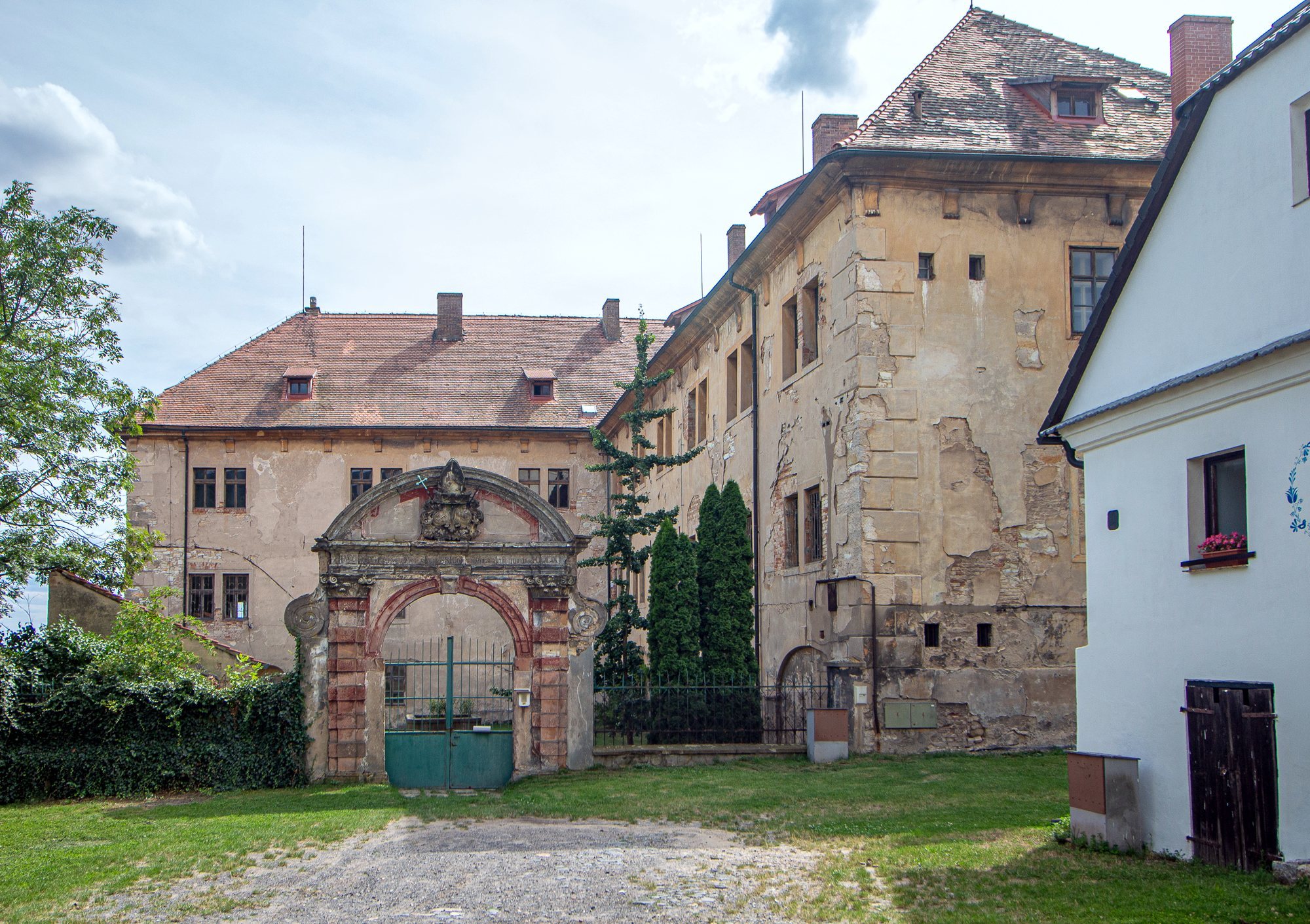
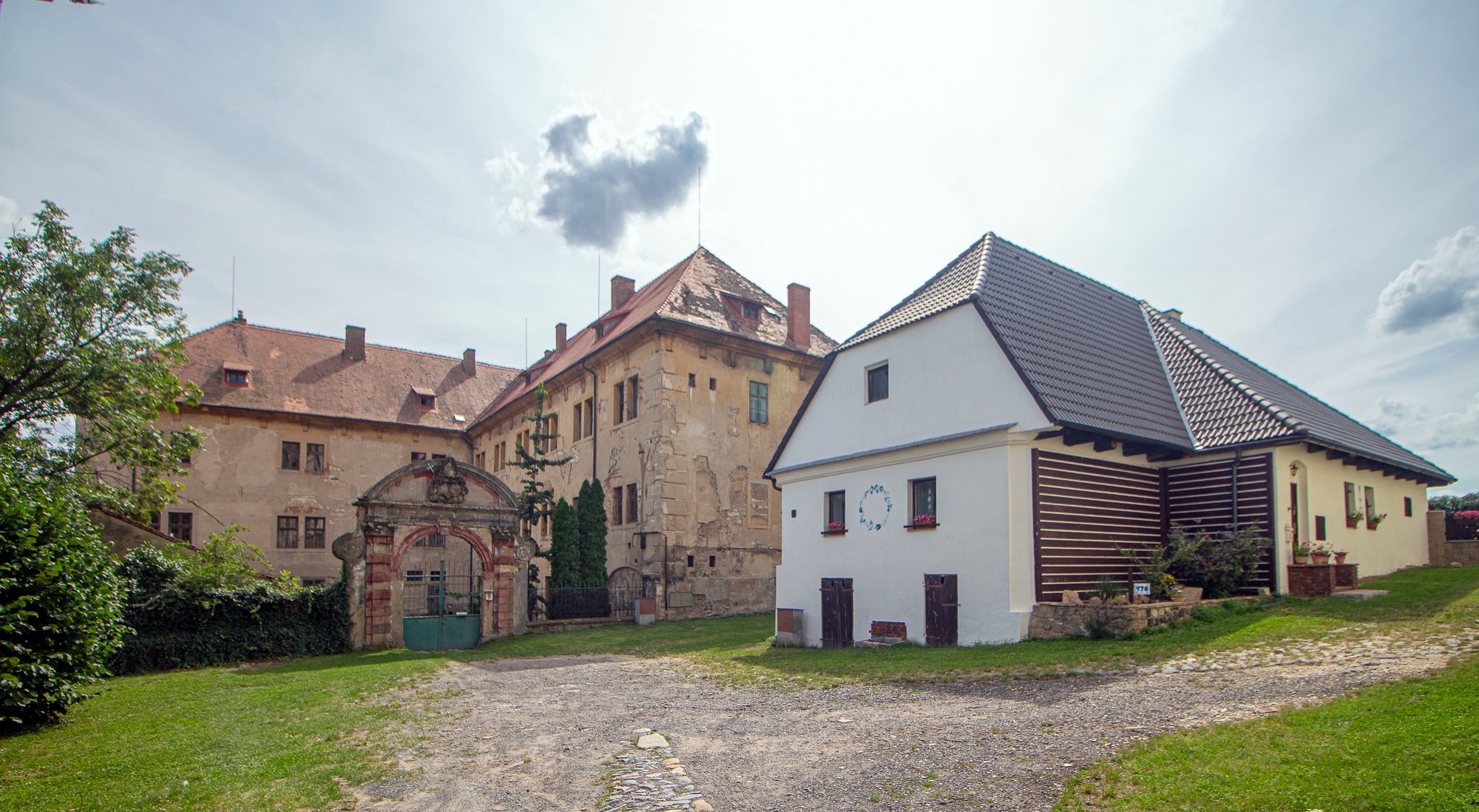
The surviving two-storey chateau consists of two wings joined at a right angle. Its fabric combines elements associated with the earlier Gothic fortress, the Renaissance rebuilding, and the later Baroque transformation. The original fortress’s form is unknown, but masonry believed to come from it survives within the western wing.
Western wing and Renaissance fabric
Western wing
The western wing contains masonry attributed to the original Gothic fortress. It also retains paired windows from the Renaissance building and bricked-up arcades, which preserve evidence of the residence’s earlier arrangement despite the changes made after the 1806 fire.
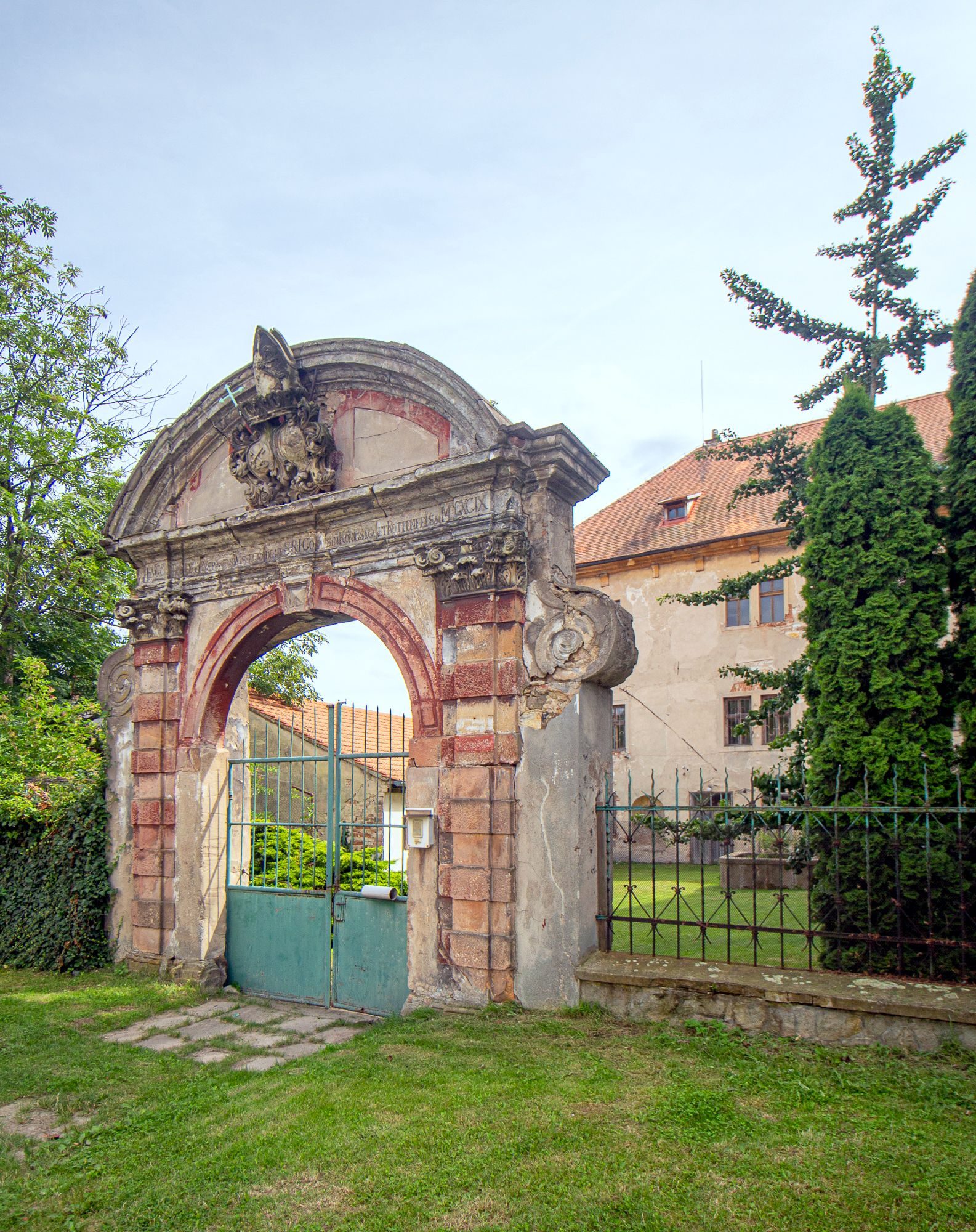
Courtyard entrance gate
The entrance from the courtyard has rusticated pilasters, masonry treated to emphasize block-like joints and texture, and a segmental gable. The gable bears the date 1699 and the coat of arms of Provost Hugo of Königsegg. The gate is probably the work of Giulio Broggio, an Italian-born architect and builder active in Baroque Bohemia.