Hájek Monastery: A Franciscan Pilgrimage Complex in Czechia
Site at a Glance
- Rating
- 4.6
- Popularity
- Low
- Country
- Czechia
- Primary era
- Early Modern
- External website
- Open
- Eras represented
- Early Modern
- Civilizations
- Habsburg, Holy Roman Empire, Kingdom of Bohemia
- Site type
- Religious
- Remains
- Monastery
On this page15 sections
History
Hájek Monastery is a Franciscan pilgrimage complex in Czechia, set in woodland east of Červený Újezd near Prague. Developed during the seventeenth century in the early Baroque period, it grew around a Loreto chapel, a shrine modelled on the Holy House associated with the Virgin Mary at Loreto in Italy. The complex became an important pilgrimage destination and later experienced dissolution, military reuse, restitution, and restoration.
The woodland and first Loreto chapel
The name Hájek, also known as Waldl or Sacra silva, refers to the woodland enclosed within the monastic grounds. Tradition attributes its planting in 1589 to Gotthard Florian of Žďár, the owner of the neighbouring Červený Újezd estate and castle. At first, the enclosed woodland served the Žďár family and its guests as a game preserve.
Gotthard Florian’s grandson, Florian Jetřich of Žďár, laid the foundation stone of the first Loreto chapel on 12 June 1623. He established the chapel in fulfilment of hopes for the birth of an heir, in gratitude for the favour of Emperor Ferdinand II, and after surviving the wars that followed the Bohemian Revolt and formed part of the Thirty Years’ War. The chapel was completed after two years and consecrated on 2 June 1625 by Arnošt Vojtěch, Cardinal of Harrach, the archbishop of Prague.
The shrine soon attracted pilgrims and helped inspire the establishment of Prague Loreto. In 1630, the original chapel was demolished and replaced by a more exact copy of the Italian Holy House. Cardinal Harrach consecrated the new building. For more than thirty years, an appointed hermit, a religious recluse living apart from a formal community, cared for the pilgrimage site.
The Franciscan monastery
In 1659, Florian Jetřich’s eldest son and successor, Count František Adam Eusebius of Žďár, founded a medium-sized Franciscan monastery beside the chapel. The Franciscans followed the tradition of Saint Francis of Assisi and maintained a communal religious life centred on poverty and preaching. Four friars initially lived at Hájek.
Carlo Lurago and Giovanni Domenico Orsi directed the design and construction. František Adam Eusebius kept rooms on the monastery’s first floor and stayed there frequently. Work continued after his death, financed by the Žďár estates and supported by the related Martinic family. The monastery was completed in 1673, and the wall around the woodland was renewed in 1699.
The pilgrimage route linking Prague Loreto with Hájek was established with donor support between 1720 and 1726. It extended for approximately 14 kilometres and included twenty niche chapels. The archiepiscopal chancery estimated that about 60,000 pilgrims visited the Loreto chapel at Hájek in 1722. In 1742, Generalfeldwachtmeister Count Franz von Olivieri, a senior commander in the Habsburg army, was buried in the Franciscan crypt after falling at Motol on 14 August during the First Silesian War, the 1740 to 1742 conflict between Austria and Prussia over Silesia.
In 1844, the settlement of Waldl or Hájek comprised the Franciscan monastery, the Loreto chapel, and an inn. During the first half of the twentieth century, the site continued to host major religious events. As many as 6,000 people attended the celebration of the 300th anniversary of the Loreto foundation on 12 September 1926.
War, dissolution, and return
During the Second World War, the monastery served as an archive and repository for documents belonging to other religious orders and for the Archive of the Czech Lands. The monastery continued operating until 1950, when the communist government dissolved it during Operation K, a state action that forcibly disbanded male religious communities and interned many of their members.
From 1950 to 1953, the complex served as an internment and collection camp for clergy. The internees undertook agricultural, forestry, livestock, gardening, tailoring, framing, and rosary-making work, while being permitted to celebrate Mass daily. After 1953, the army used the monastery buildings as storage facilities.
The complex was returned to the Franciscans during the 1990s. In 2016, after prolonged legal disputes, the surrounding woodland park was also returned, reuniting the enclosed grounds as a single property. Repairs from the late twentieth and early twenty-first centuries included work on the walls and entrance gate, removal of army-installed concrete corridor floors, restoration of the Loreto paintings, reconstruction of the roofs and tower, and restoration of the eastern rooms, hermitage, garden pavilion, and sections of the pilgrimage chapels. Hájek has been protected as a cultural monument since 1958.
The Lang spouses administered the complex for about twenty years before leaving in 2011. The Dirbák spouses took over in late spring 2021, restored two cells in the eastern wing as an apartment, and left in May 2022. Since 2021, the monastery has been administered by rector Father Filip Jan Rathouský, appointed by the former rector Father Jan Maria Vianney Dohnal. The complex has continued to face financial difficulties and periods without a resident administrator.
Remains
Enclosure and monastic layout
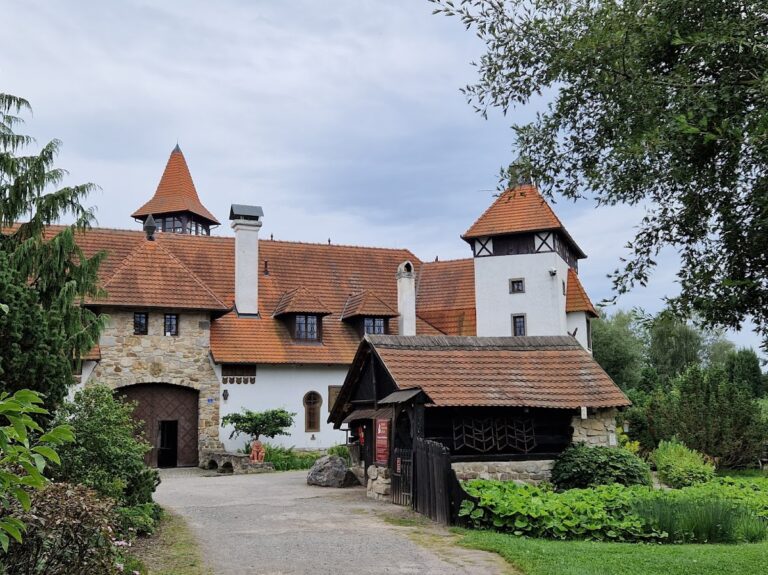
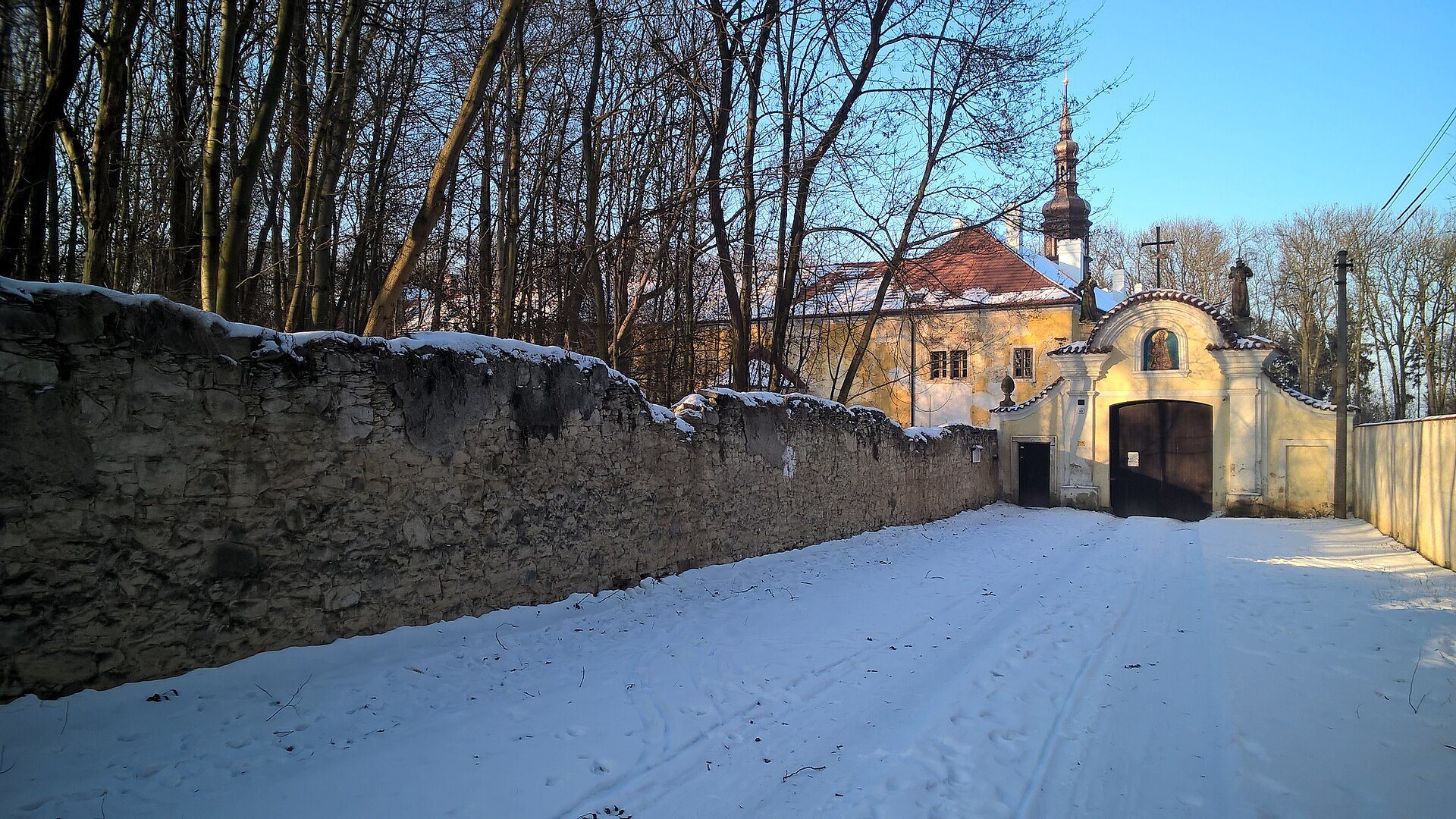
The pilgrimage complex occupies a roughly rectangular woodland surrounded by fields and meadows. A wall of quarry-stone masonry encloses an area approximately 350 by 270 metres. The entrance lies on the south side and is reached by a road running perpendicularly from the main road. At the centre stands the five-winged monastic building, arranged around a large rectangular courtyard covered with grass.
Entrance gate
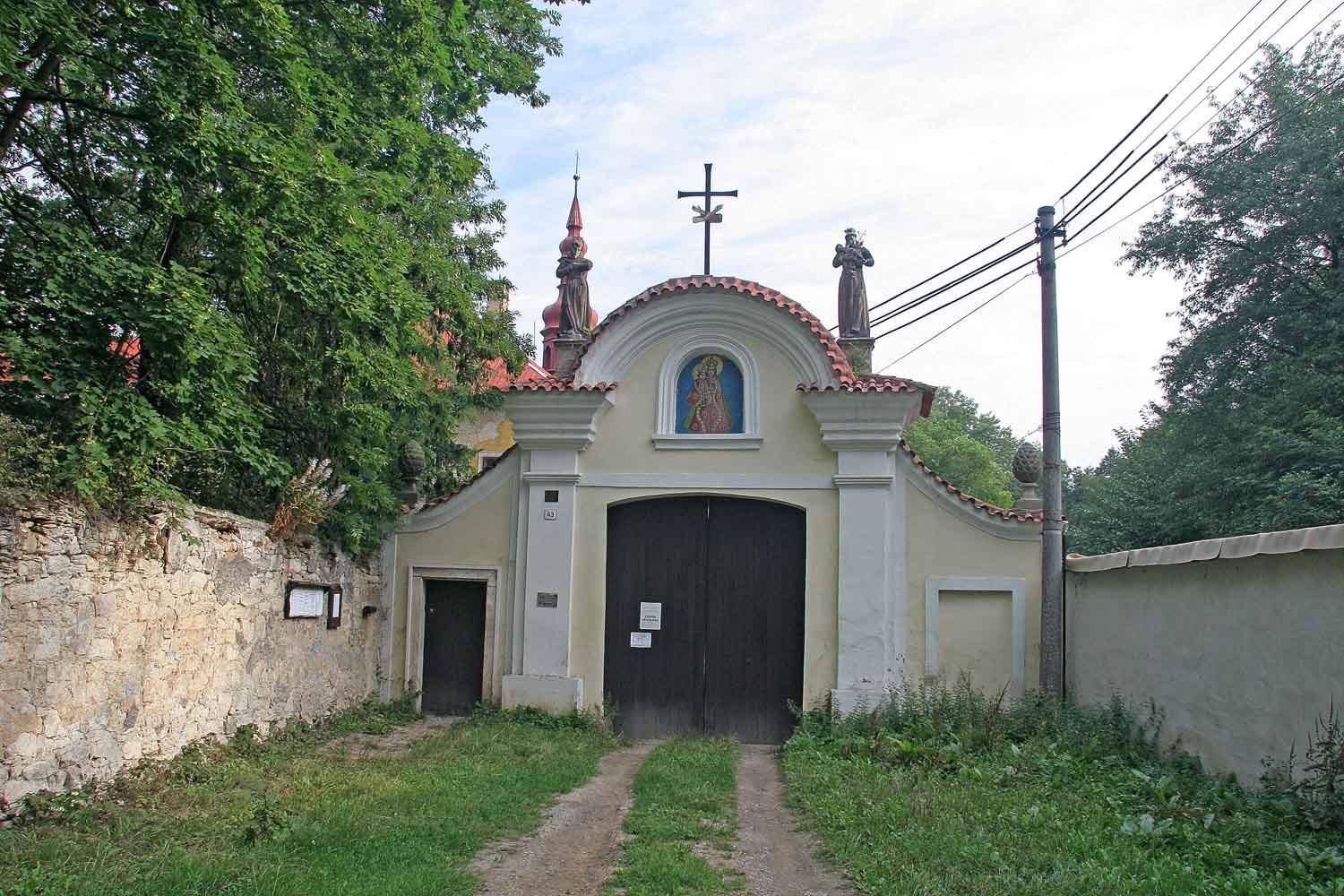
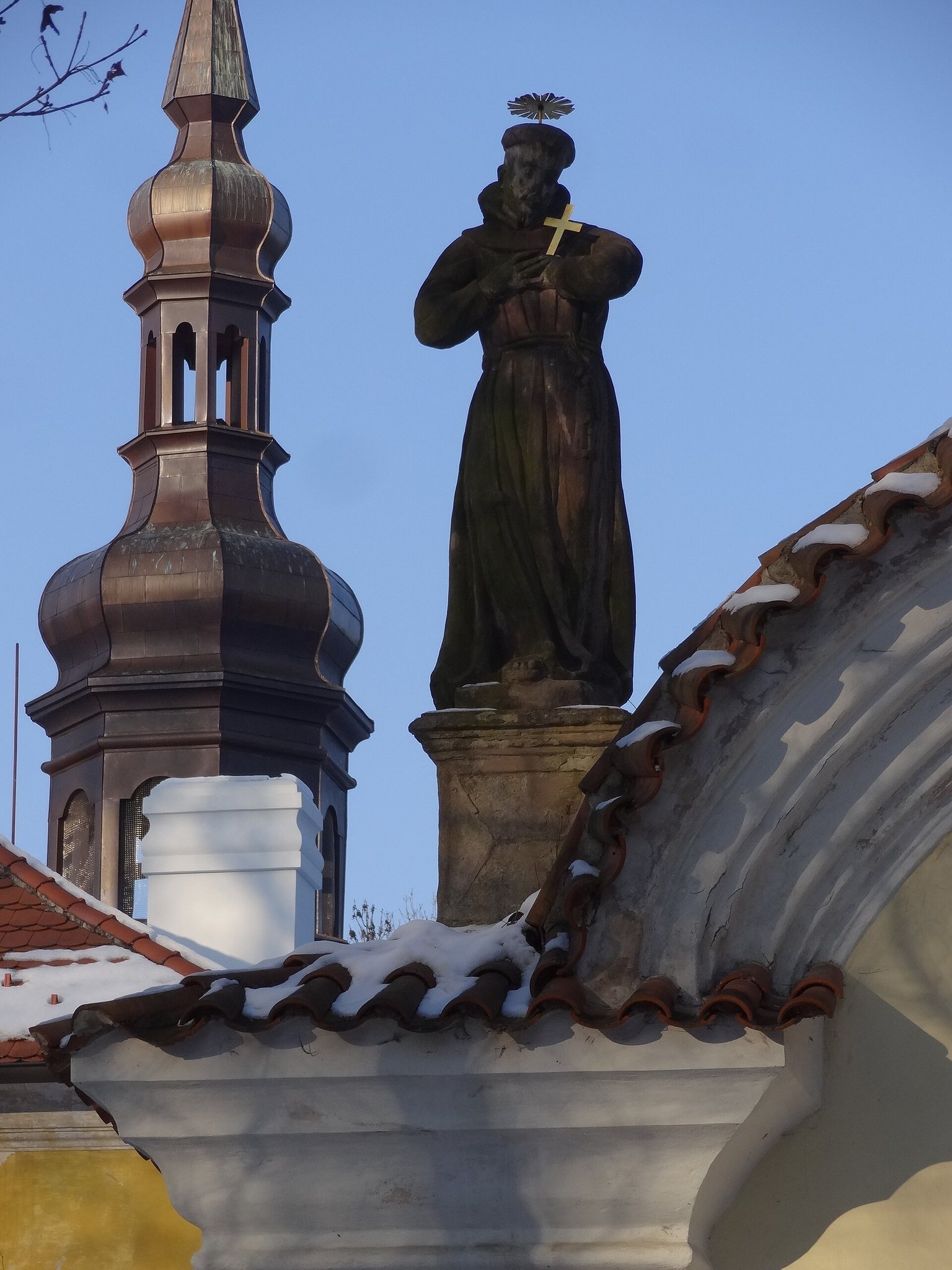
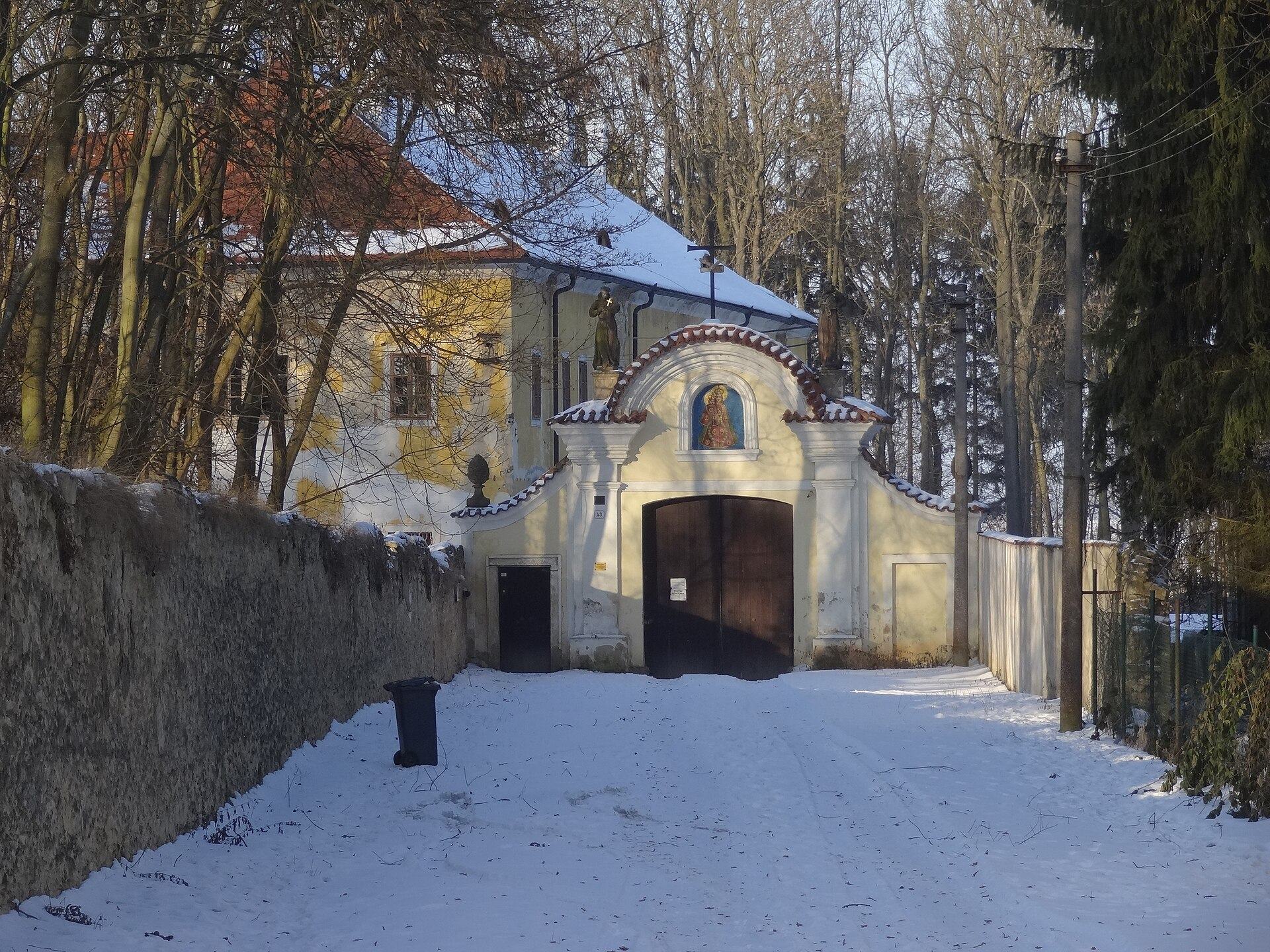
The Baroque entrance gate has a gabled portal decorated with a mosaic of the Loreto Madonna, reconstructed after 1990. Two stone pinecones and statues of Saint Francis of Assisi and Saint Anthony of Padua carrying the Christ Child complete the composition. The main entrance to the covered walkways and Loreto chapel has another Baroque portal. Its cornice bears the heraldic alliance of the founders beneath a mascaron, an ornamental face or mask.
Monastic walkways
The covered walkways around the courtyard, known as ambits, were built under a contract signed by Carlo Lurago and Giovanni Domenico Orsi in 1663, when the monastery’s foundation stone was laid. Construction began with the eastern wing. A small tower with a cupola was erected in 1668, a cross was added in 1669, and the remaining wings were completed in 1681. The walkways have barrel vaults, continuous curved ceilings, with lunettes formed where the vaults meet the walls.
Two corner chapels occupy the northwestern and southwestern corners, while further chapels are set within the middle of the south and west wings. Their wooden furnishings, including an altar, benches, balustrades, and cupboards, survive in fragmentary and badly damaged condition. Eight statues of Czech patron saints, dating from around 1891, stand in niches at the upper-floor corners. They are arranged in four pairs and signed by Adolf Havel, a sculptor and stonemason from Slaný. Two larger-than-life wooden statues of Franciscan saints from the second quarter of the twentieth century stand on the ground floor of the eastern wing.
The Loreto chapel and courtyard
Loreto chapel
The Loreto chapel is a rectangular brick building with a barrel vault and is the present copy of the Holy House at Loreto. Its foundation stone was laid in 1623, the first chapel was consecrated in 1625, and the current copy was built in 1630. The unplastered interior preserves copied remnants of wall paintings on the east, south, and west walls, based on paintings in the Italian Loreto chapel.
Above the altar mensa stands a crowned Black Madonna and Child in a niche. The statue is encircled by a silver wreath set with coloured glass and a radiant halo. A modern sanctuary was inserted into a niche in the north wall. Square stone tiles cover the floor, which also contains a rhomboidal tomb slab bearing the name of František Eusebius of Žďár, a heart symbol, and a chronogram, an inscription whose selected letters encode a date. The chronogram gives 7 April 1670, the date of his death, and marks the place intended for his heart.
Courtyard monuments
A Marian column stands in the southeastern part of the courtyard. Erected in 1703, it has a twisted shaft, a stone statue of the Immaculate Virgin Mary, and a stone balustrade. The sculptor is not documented, though the work is associated with the circle of Václav Matěj Jäckel. The statue resembles the Immaculate Virgin on Prague’s Marian column, but it has no wings, turns its head downwards to the right, and looks towards the pilgrims.
A freestanding stone gate with five empty niches was formerly part of the wall separating the monastery and its farm buildings from the garden. The statues that once occupied the niches have disappeared. A painting of Saint Francis Seraph in the monastery is attributed to Peter Johann Brandl, a prominent Bohemian Baroque painter.
Library
The monastery library occupied a first-floor room in the eastern wing and was reached from the ambits by a staircase. Its documented history begins in 1682, when the building plans already provided for a dedicated library room. Its first book was Martyrologium franciscanum, containing biographies of Franciscan saints, and an archive was established alongside the collection.
The library held more than 1,200 volumes after 1780 and approximately 3,000 books in 1850. It later declined to about 1,500 to 2,000 volumes, including an incunable, a book printed in Europe before approximately 1501, of the Golden Legend from 1485. The state confiscated the library in 1850. After restitution in 1991, a fragment of approximately 300 old books remained in 2006, stored in Prague.
Woodland structures and pilgrimage route
Garden chapel and Holy Sepulchre
Beyond the northern gate, in the grassy part of the woodland, stands a four-sided garden chapel or hermitage on a high base. Its original staircase has partly collapsed and was replaced by a temporary steel structure. In the eastern wooded part of the complex, a small cave-like structure known as the Holy Sepulchre is formed from piled stones.
Route from Prague
The pilgrimage route from the Strahov Monastery area at Dlabačov in Prague to Hájek passes through Liboc, Břevnov, Řepy, Hostivice, Litovice, and Chýně. It originally had twenty Baroque niche chapels with painted decoration and was lined by an avenue. Portions survive as a fruit-tree alley, while a lime-tree avenue has been replanted near the final section since the 1990s. Several chapels have survived and have undergone restoration.