Temple Church, London: The Knights Templar’s English Headquarters Church
Site at a Glance
- Rating
- 4.6
- Popularity
- Medium
- Country
- United Kingdom
- Primary era
- Medieval
- External website
- Open
- Eras represented
- Medieval, Early Modern
- Civilizations
- Crusader, Knights Templar
- Site type
- Religious
- Remains
- Church
On this page8 sections
History
Foundation and Templar use
Temple Church is a medieval church in the United Kingdom, founded by the Knights Templar in London during the mid-12th century as the church of their English headquarters. The Knights Templar were a military-religious order established to protect pilgrims and support Christian rule in the Holy Land. Before moving to the present site, London’s Templars met at an earlier establishment in High Holborn. As the order expanded, it purchased the current site during the 1160s for a larger complex with a church, residences, military-training facilities, and recreational grounds.
The church was consecrated on 10 February 1185 by Heraclius, the Latin Patriarch of Jerusalem, and King Henry II is believed to have attended. The Templars used the church for worship and initiation ceremonies. New recruits entered through the western door at dawn, took vows of piety, chastity, poverty, and obedience in the circular nave, and underwent ceremonies whose secrecy later helped encourage accusations against the order.
During the Templars’ tenure, the complex also served as a royal residence, a residence for papal legates, and an early deposit bank. The Master of the Temple held the parliamentary position of primus baro, meaning the first baron in precedence. In January 1215, William Marshal negotiated at the Temple between King John and the barons. His undertaking on the king’s behalf that their grievances would be addressed contributed to John’s sealing of Magna Carta in June 1215. The charter placed important limits on royal authority and protected certain rights. Marshal later became regent for John’s son, Henry III.
Medieval enlargement and institutional change
Henry III wished to be buried in the church, and this led to the demolition of the original chancel and the construction of a larger eastern replacement. The new chancel was consecrated on Ascension Day in 1240. Henry later changed his burial plans and was buried at Westminster Abbey, although infant sons of his were buried in the Temple Church chancel.
After the suppression of the Knights Templar in the early 14th century, Edward II brought the church and its property under Crown control. The complex later passed to the Knights Hospitaller, another medieval military-religious order also known as the Order of Saint John of Jerusalem. The Hospitallers leased the property to two legal colleges, which developed into the Inner Temple and Middle Temple, two of England’s four Inns of Court. These institutions remain associated with the training and organization of barristers.
In 1540, Henry VIII made the church Crown property again after abolishing the Hospitallers in England and confiscating their possessions. The Crown retained the title of Master of the Temple for the church’s priest. In the 1580s, the building became a setting for the Battle of the Pulpits, a theological conflict between Puritans and supporters of the Elizabethan religious settlement, the institutional and liturgical framework established for the English church under Elizabeth I.
The church and its garden also appear as the setting for the fictional rose-plucking scene in Shakespeare’s Henry VI, Part 1. White and red roses were planted in the modern gardens in 2002 to commemorate the scene. In 1608, James I granted the Inner Temple and Middle Temple perpetual use of the church on condition that they maintain it. They continue to use it as a ceremonial chapel and private chapel, with weddings restricted to members of the two Inns.
Restoration, worship, and music
Temple Church escaped the Great Fire of London in 1666 but was extensively altered internally by Christopher Wren. Sydney Smirke and Decimus Burton restored it in 1841, and James Piers St Aubyn carried out further restoration in 1862. On 10 May 1941, German incendiary bombing set the roof of the Round Church alight. Fire spread through the nave and chapel, destroying the organ and wooden furnishings, including the Victorian work. Heat cracked the chancel columns, and the Master’s House was burned.
Post-war restoration under Walter Godfrey recovered surviving 17th-century elements by Wren from storage and returned them to their original positions. The church was rededicated in November 1958. It is a Church of England church and a royal peculiar, meaning that it stands directly under the Crown rather than under the normal authority of a diocesan bishop. The church is jointly owned by the Inner Temple and Middle Temple and has been a Grade I listed building since 4 January 1950.
Regular worship continues, including Holy Communion and Mattins, a traditional Anglican form of morning prayer. The church remains the private chapel of the two Inns. Its two clergy are the Master of the Temple and the Reader of the Temple, while the Crown appoints the Master, whose title preserves terminology from the former Templar order. The church’s institutional tradition is associated with the Church of England, the Book of Common Prayer, and the liberal Catholic tradition.
A cathedral-style choir was established in 1842 under E. J. Hopkins. Under the organist and choir director George Thalben-Ball, its 1927 recording of Mendelssohn’s Hear My Prayer, including Ernest Lough’s performance of “O for the Wings of a Dove,” became internationally famous. It reached gold-disc status in 1962 and eventually sold an estimated six million copies. The choir continues to record and perform, and in 2003 it gave the world premiere of John Tavener’s The Veil of the Temple during an overnight vigil. The church has also attracted recordings by secular musicians, including John Barbirolli, Paul Tortelier, and Hans Zimmer’s organ-related recording for Interstellar.
Remains
The Round Church and medieval chancel
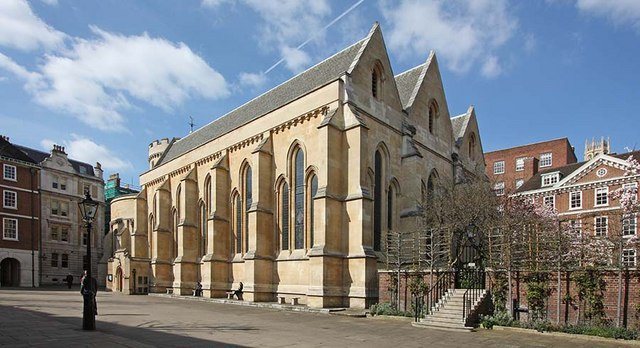
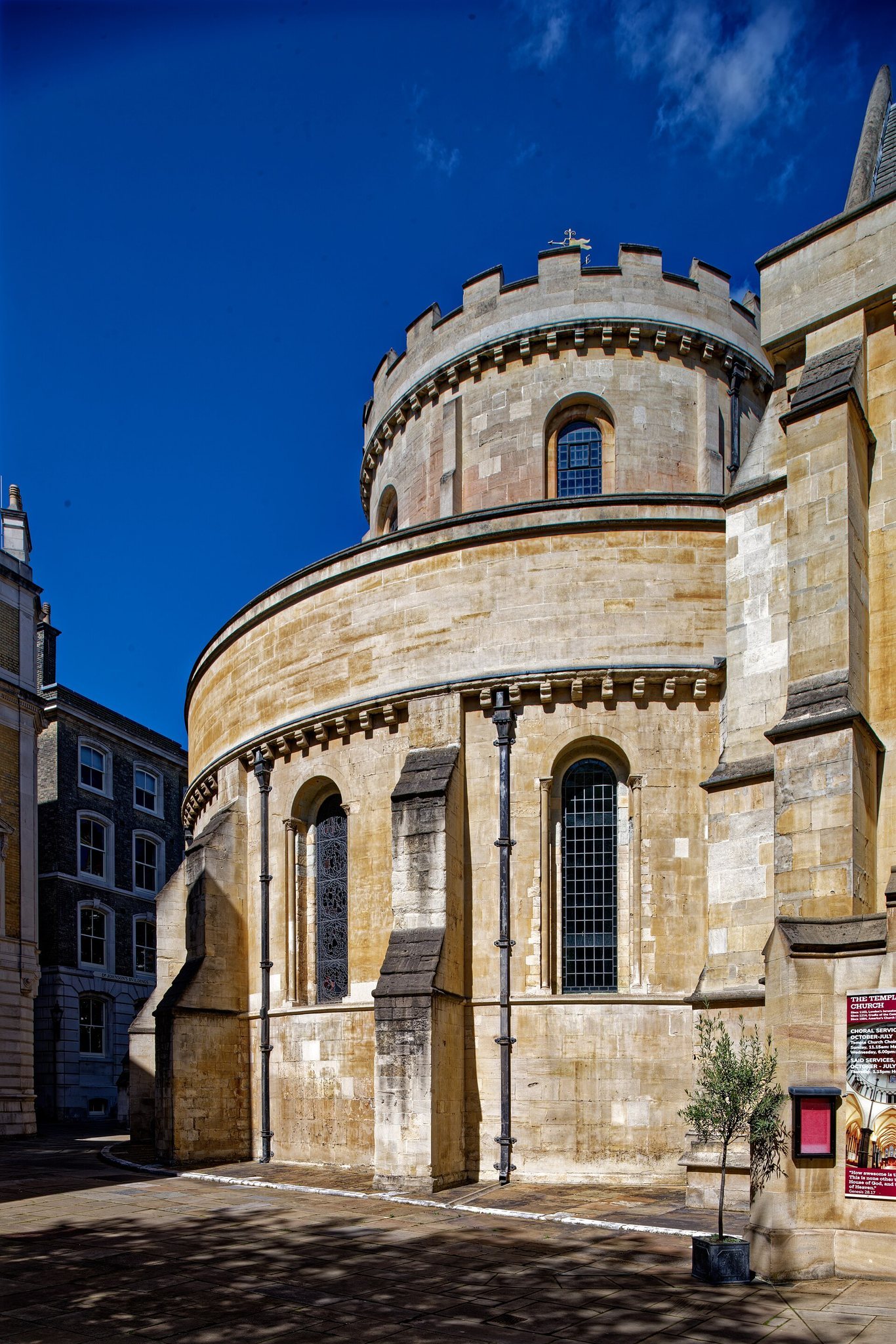
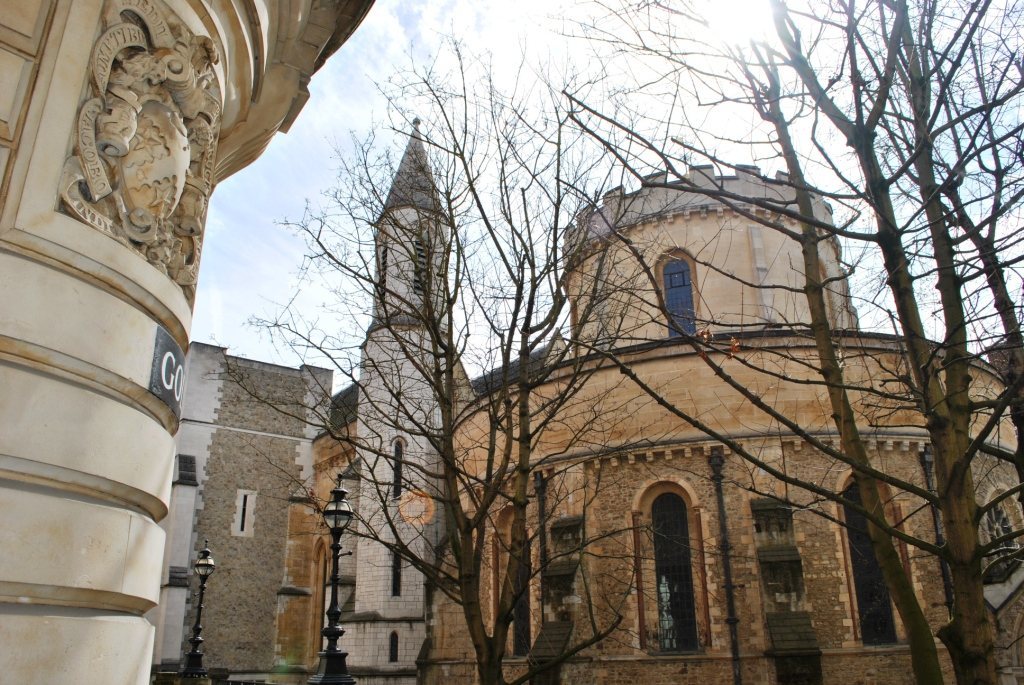
Temple Church lies between Fleet Street and the River Thames and consists of two principal sections. The original circular Round Church now functions as the nave, while the rectangular chancel was added on its eastern side roughly half a century later. The Round Church is about 55 feet, or 17 metres, in diameter. Its circular plan followed Templar architectural traditions inspired by Jerusalem’s Church of the Holy Sepulchre and the Dome of the Rock, which the Templars called the Templum Domini and associated with the Temple of Solomon.
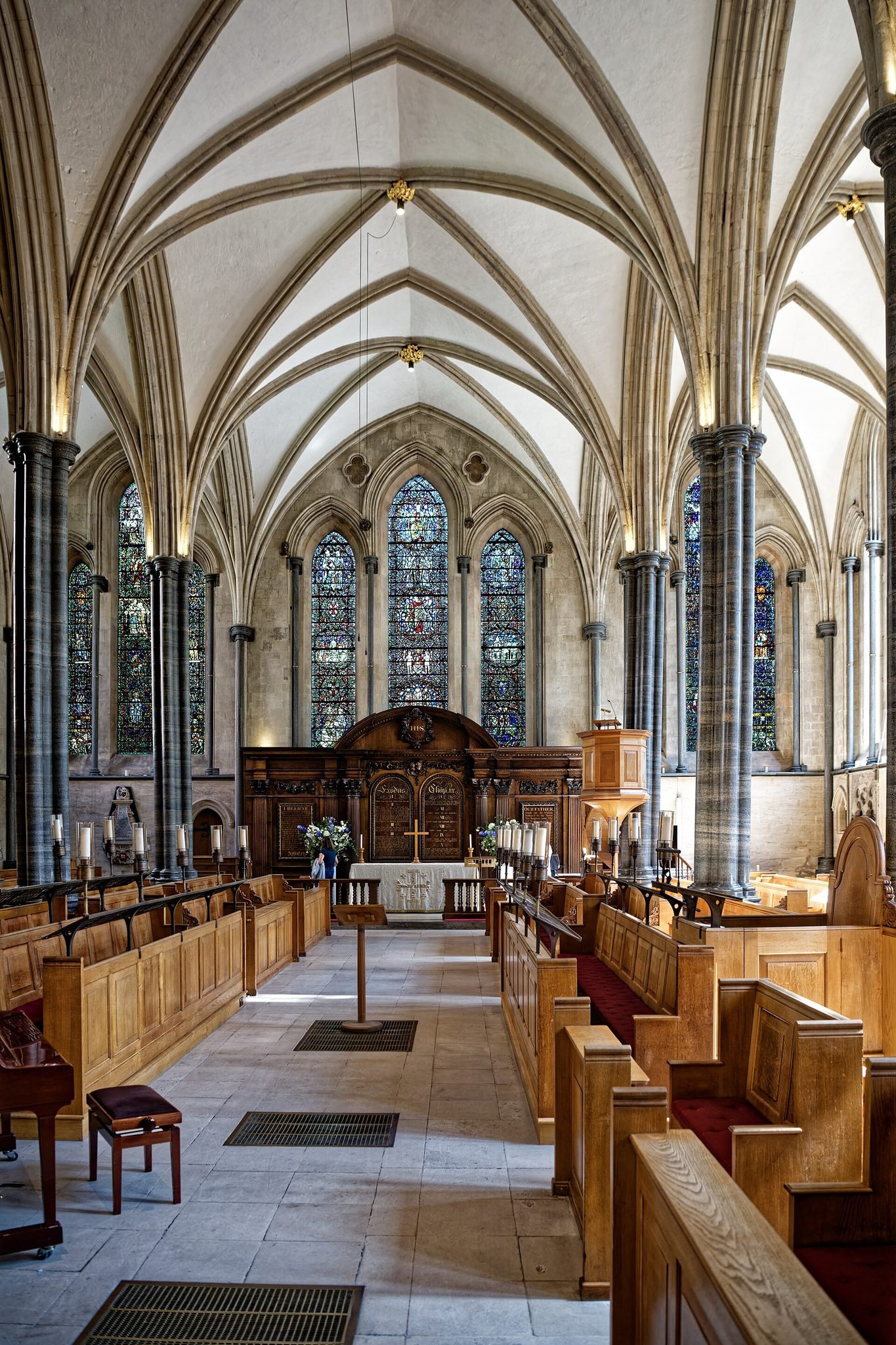
Inside the Round Church is a circle of free-standing Purbeck Marble columns. Despite its name, Purbeck Marble is a polished limestone from Dorset that was widely used for medieval columns, tombs, and architectural fittings. The columns are described as among the earliest known surviving examples of their kind. The original columns leaned slightly outward, and replacement columns installed after the wartime damage reproduce that feature. The walls and grotesque heads were probably painted in colour originally. The building combines Early English Gothic work with later English Baroque and Gothic Revival alterations.
The replacement chancel, consecrated in 1240, has a central aisle and two side aisles of equal width. Its vault rises approximately 36 feet 3 inches, or 11.05 metres. The church’s present appearance therefore brings together the Templars’ circular medieval building, the later medieval enlargement, and successive phases of alteration and repair.
Burials and medieval features
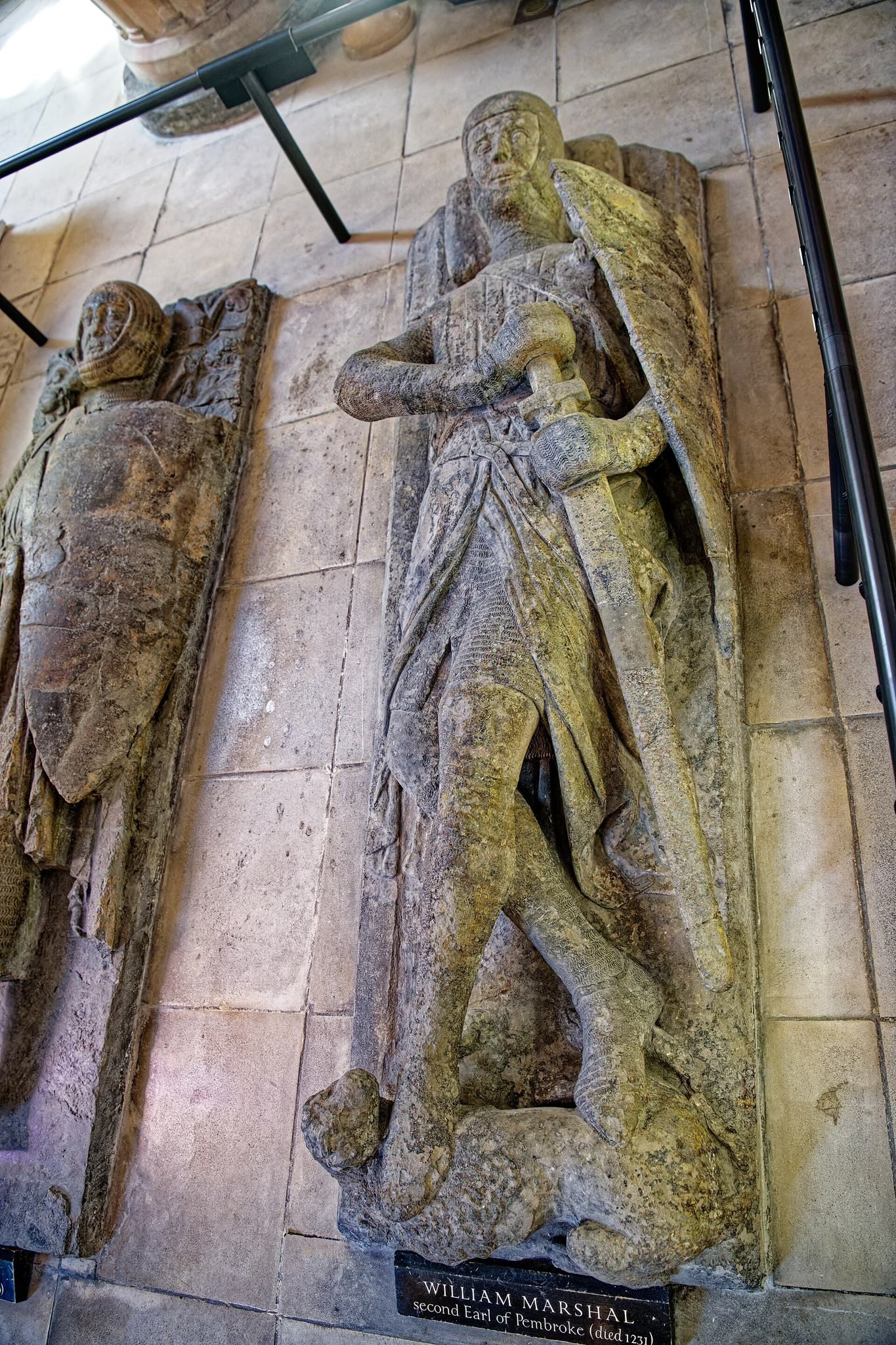
Temple Church contains 13th- and 14th-century stone effigies. William Marshal, 1st Earl of Pembroke, is buried in the nave with members of his family and is represented by one of the medieval marble effigies. Other medieval burials include Robert de Ros, Robert de Vieuxpont, William Marshal, 2nd Earl of Pembroke, Gilbert Marshal, and Silvester de Everdon.
A marble effigy in the south aisle of the chancel is generally attributed to Silvester de Everdon. When it was examined in 1810, the remains of an adult and the bones of a young child were found beside it. The child was traditionally attributed to a young son of Henry III. In the north-west corner of the chancel, a stairway leads to a penitential cell where Walter le Bacheler, described as Grand Preceptor of Ireland, was traditionally said to have been left to die of starvation.
Later fittings and surviving structures
Wren’s 17th-century alterations included an altar screen and the church’s first organ. The altar screen was removed in the 19th century and later preserved at the Bowes Museum before being returned to its original position in 1953. The 1941 fire destroyed the organ and all wooden elements, including the Victorian restoration work. Purbeck columns in the chancel were replaced in identical form after cracking, while surviving Wren elements recovered from storage were reinstated during the post-war restoration.
The church now contains two organs. A chamber organ was built by Robin Jennings in 2001, while a four-manual Harrison and Harrison organ was built in 1924 as a private ballroom organ and installed at Temple Church in 1954. Beside the church stands the Master’s House, a Georgian townhouse built in 1764 that serves as the official residence of the Master of the Temple.