St. Jakobus, Rüdesheim: A Historic Catholic Church in Germany
Site at a Glance
- Rating
- 4.6
- Popularity
- Very Low
- Country
- Germany
- Primary era
- Modern
- External website
- Open
- Eras represented
- Medieval, Early Modern, Modern
- Civilizations
- German, Holy Roman Empire
- Site type
- Religious
- Remains
- Church
On this page9 sections
History
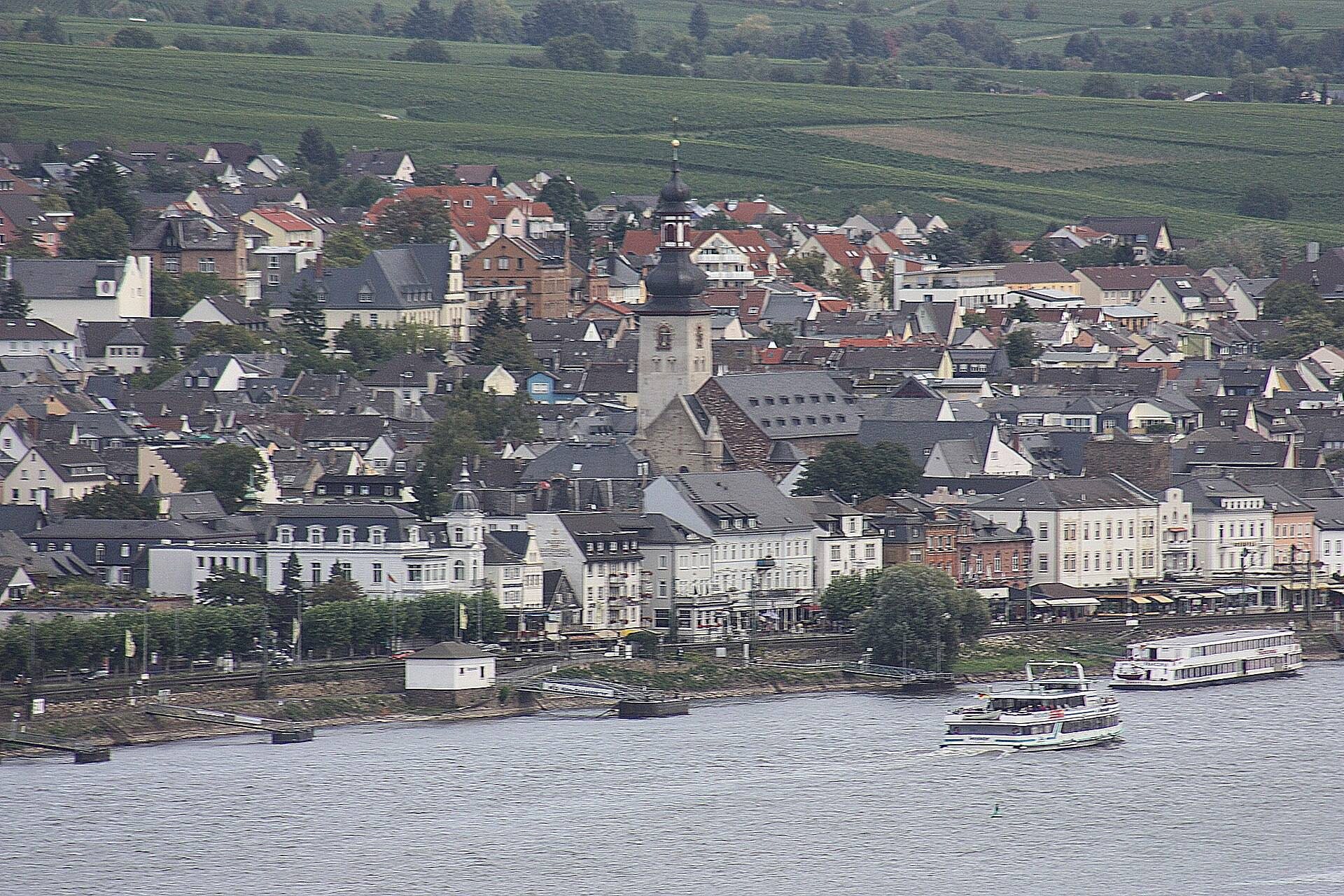
St. Jakobus is a Catholic church in Rüdesheim am Rhein, Germany, dedicated to James, son of Zebedee, one of the Twelve Apostles traditionally known as Saint James the Greater. The church has medieval origins, including an early Romanesque chapel from the eleventh century, and developed into the town’s parish church before becoming a branch church of the Heilig Kreuz Rheingau parish.
Medieval foundation and expansion
The oldest surviving fabric lies in the basement of the northern tower, whose structure dates from the twelfth century. Around 1400, Johann Brömser founded the present church as a long, aisleless hall. The building was vaulted in 1489, when a northern aisle was added. These stages created the main medieval framework that later alterations would modify.
Baroque changes and twentieth-century enlargement
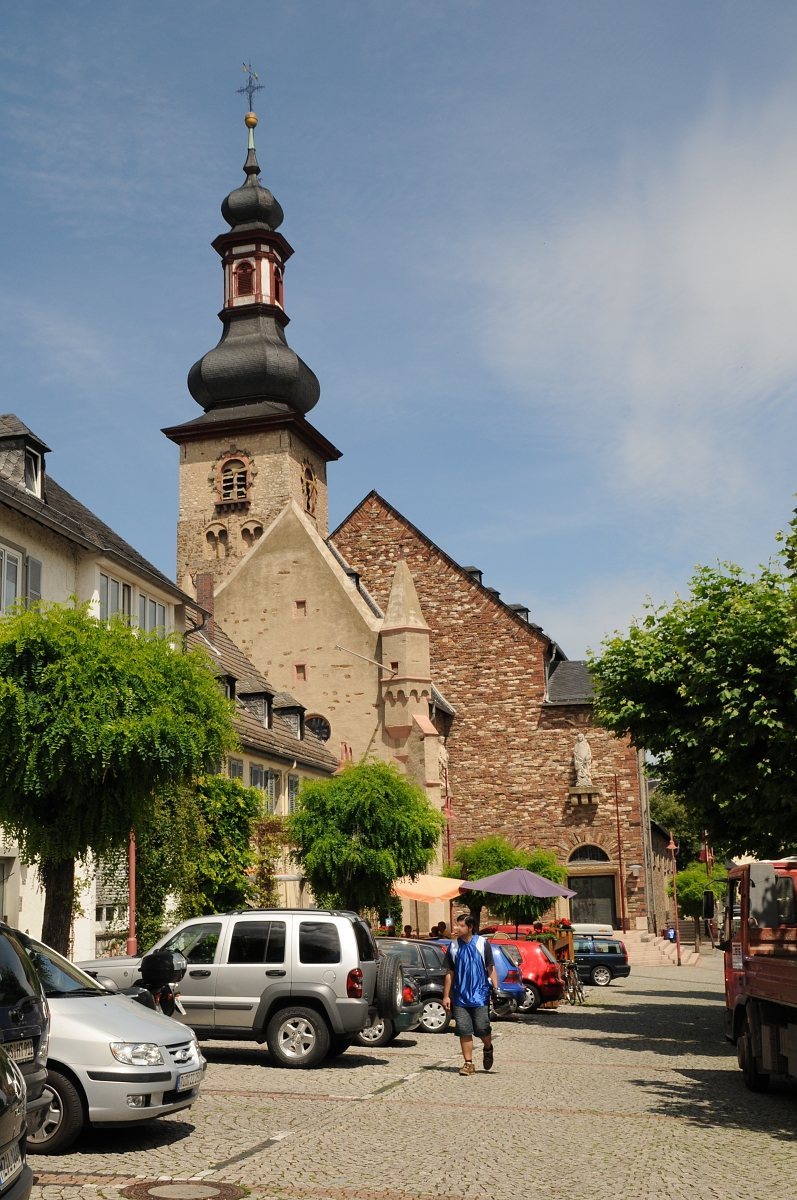
The church received Baroque alterations, including a new tower helmet, or roof structure over the tower, in 1766 and the installation of a high altar. Further enlargement took place in 1912, when the church was extended to the east and south.
Destruction and reconstruction
A heavy air raid on Rüdesheim on 25 November 1944 burned out the church and destroyed much of its historic inventory. Reconstruction began after the war in an altered form. The foundation stone was laid on 25 July 1947, work continued from 1946 to 1956, and a new tower helmet was installed in 1959. A restoration followed in 1984 and 1985. The church remains a protected historic monument.
Parish and cultural role
On 1 January 2015, the parish was incorporated into the larger parish of Heilig Kreuz Rheingau. Since 2015, the Rheingau Cathedral in Geisenheim has served as Rüdesheim’s parish church, leaving St. Jakobus as a filial church, meaning a branch church within a larger parish. The building also hosts sacred-music concerts, including events associated with the Rheingau Music Festival.
Remains
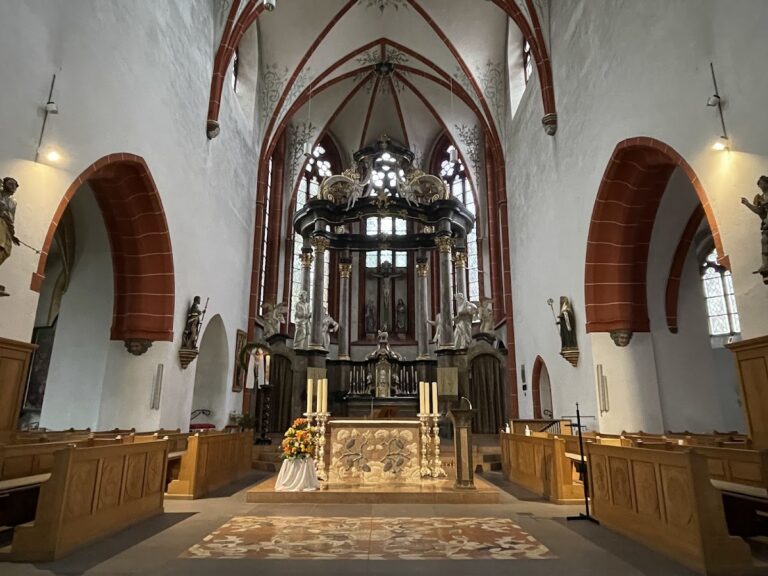
The surviving church combines medieval fabric with a postwar reconstruction in modified form. The western facade retains octagonal corner turrets, while the northern aisle and northern tower preserve important historic elements. The reconstructed interior has a flat ceiling, and the basement of the northern tower contains the oldest building fabric associated with the twelfth-century structure.
Altars and memorials
The 1600 sandstone Marian altar is dedicated to Mary, the mother of Jesus. Its relief, treated in a painterly manner, shows the return of the Holy Family from Jerusalem. Hans Richard Brömser and his wife, Anna Margareta von Kronberg, donated the altar in memory of their wedding in 1587. A late-Renaissance tomb monument from 1597 commemorates Heinrich Engelhard Brömser, who is shown lying down.
Other surviving furnishings include a sixteenth-century epitaph from the school of Hans Backoffen, a reliquary containing relics associated with Saint Clare of Assisi, and a memorial to the victims of the world wars. The church also contains its entrance portal and a memorial plaque for Abbot Leonhard of Eberbach Abbey, the former Cistercian monastery in the Rheingau.
Organ
The organ was built in 1964 by the Wagenbach firm of Limburg with 40 stops on three manuals and pedal. Its disposition was changed in 1975, and the Oberlinger workshop renovated, extensively redesigned, and enlarged it in 1996. From 2012 onward, the Karl Göckel workshop carried out further enlargement and tonal revisions. A 32-foot Contraposaune was added in 2014, while original Spanish trumpet stops from the predecessor organ of the Basilica del Pilar in Zaragoza were installed in 2019.
The present slider-chest organ, using sliding strips to control the wind supply to sets of pipes, has 61 stops on three manuals and pedal, with electric action and stop mechanisms. Its couplers are I/II, III/I, III/II, I/P, II/P, and III/P.
Bells
The smallest and oldest bell dates from the thirteenth century. It is a heavily ribbed bell without decoration or inscription and the only bell to survive both world wars. Four principal bells were cast in Heidelberg in 1960 by Friedrich Wilhelm Schilling. Together with the medieval bell, they formed a five-bell peal until late autumn 2018.
Two postwar bells cast in 1956 by Feldmann and Marschel of Münster were later incorporated into the peal. They had previously hung in the secularized Catholic Church of St. Mary in nearby Geisenheim. Two further bells were cast at the Rincker Bell and Art Foundry in Sinn on 14 September 2018 under the direction of Hanns Martin Rincker. Four existing bells were repositioned to make room for the additions, and all nine bells were rung together for the first time on 1 December 2018.