Brömserburg: A Medieval Castle in Rüdesheim am Rhein


Site at a Glance
- Rating
- 4.5
- Popularity
- Low
- Country
- Germany
- Primary era
- Medieval
- External website
- Open
- Eras represented
- Medieval, Modern
- Civilizations
- Holy Roman Empire
- Site type
- Military
- Remains
- Castle
On this page14 sections
History
Brömserburg, also known as Niederburg, is a medieval fortified castle in Germany, built in Rüdesheim am Rhein near the Rhine bank. Its origins belong among the early stone castles of the area now included in the UNESCO World Heritage Upper Middle Rhine Valley, although its first construction phase remains difficult to date precisely.
Early origins and construction
Older interpretations placed Brömserburg on the foundations of a Roman fort that may have served as a watchtower or bridgehead opposite Bingium, near present-day Bingen am Rhein. This explanation remains unconfirmed. It also creates a chronological problem, because Roman forces had withdrawn from the Rhine’s right bank after the fall of the frontier system known as the limes, before the proposed fort was built in the fourth century.
The earliest phase of the medieval castle may have begun as a royal Salhof, an estate centre combining administrative, agricultural, and residential functions, before 980. Another interpretation places the first castle complex in the middle of the twelfth century. Examination of an alder post from the foundation of the southeast tower places that tower’s construction between 1044 and 1216. The first phase already followed approximately the dimensions of the present castle.
A second building phase took place around 1186 to 1190. This expansion strengthened the outer walls, added buildings around the enclosure, and created the principal four-winged form. A new central keep was also built in the raised courtyard. Its lower walls were more than four metres thick, and its height was estimated at about 35 metres.
The Brömser lords
In the thirteenth century, members of the Brömser family from the Wisper valley held the castle. They possessed it as free family property rather than as a feudal fief from the Archbishops of Mainz. Those archbishops were powerful ecclesiastical princes of the Holy Roman Empire who also exercised territorial and feudal authority in the region.
The Brömser family’s later relationship with the castle was more complex than a continuous residence. After the main Rüdesheim branch ended with Melchior von Rüdesheim in 1538, the Brömsers gradually acquired that family’s Rüdesheim fiefs, including Niederburg. They lived at Brömserhof in Oberstraße 29, however, rather than at the castle. After the Brömser line died out, the Archbishop of Mainz granted the fief in 1678 to Emmerich von Metternich, an heir of the Brömser von Rüdesheim family.
War, decline, and reuse
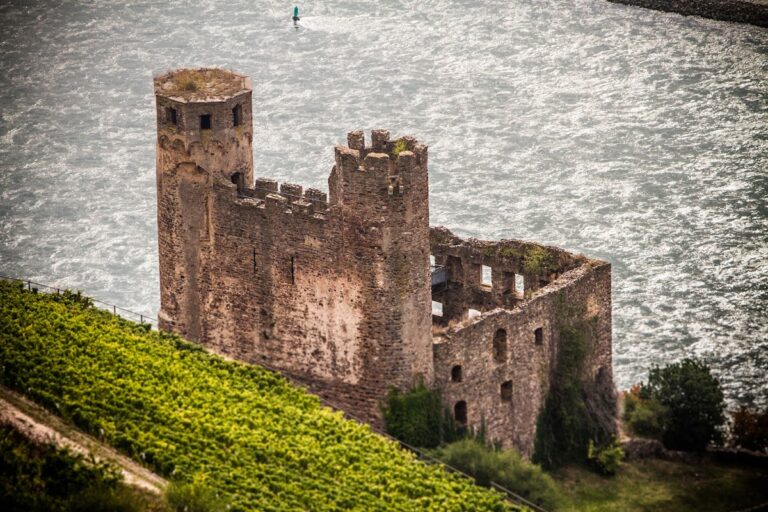
Brömserburg suffered major damage in 1640 during the Thirty Years’ War, the European conflict of 1618 to 1648 that combined religious, dynastic, and political struggles across the Holy Roman Empire and neighbouring states. French troops serving Duke Henri II d’Orléans blew up the Rhine-facing southeast corner. The blast destroyed the upper part of the keep and the donjon, the principal residential and defensive tower. A mine passage driven into the keep was not detonated and remains visible.
During the eighteenth century, the unoccupied castle deteriorated into a ruin. It acquired the mocking names “Brömser’s dog house” and later “Metternich’s dog house.” After 1811, the Counts of Ingelheim converted the ruin into a romanticized country residence. Alterations made to the south wing during this period were removed in a renovation of the 1950s.
The castle remained inhabited until 1937. The town of Rüdesheim purchased it in 1941, and from 1950 it housed the Rheingau Wine Museum. The damaged southeast corner was reconstructed in 1961, while the keep was raised to 27 metres in 1969. These interventions shaped the form in which the castle and its museum were presented in the modern period.
Remains
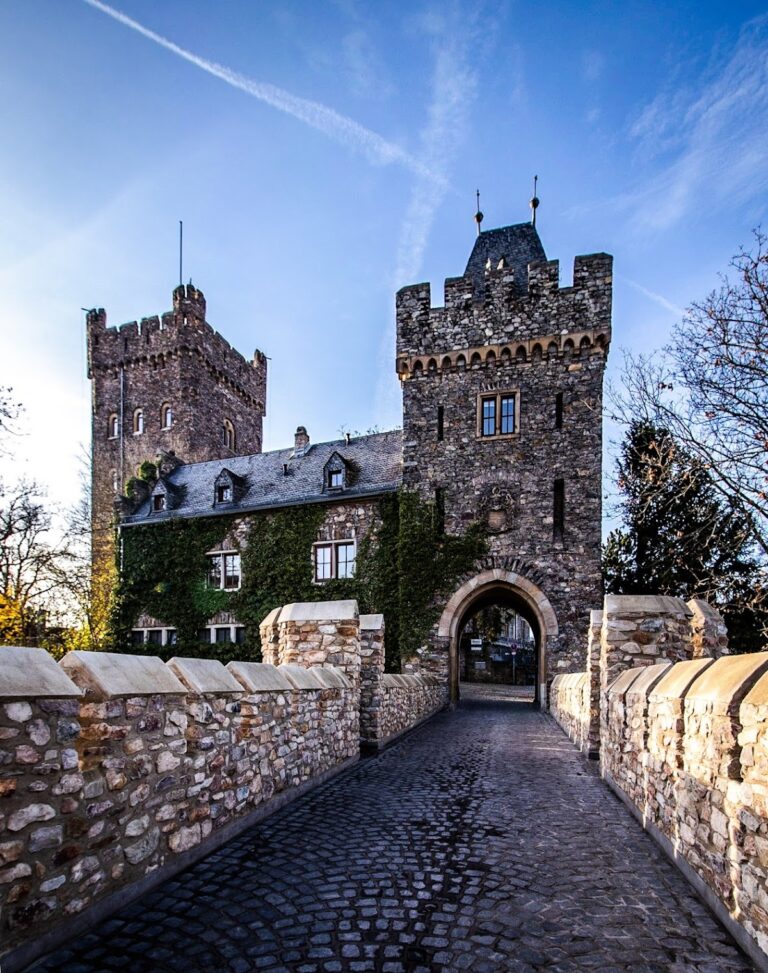
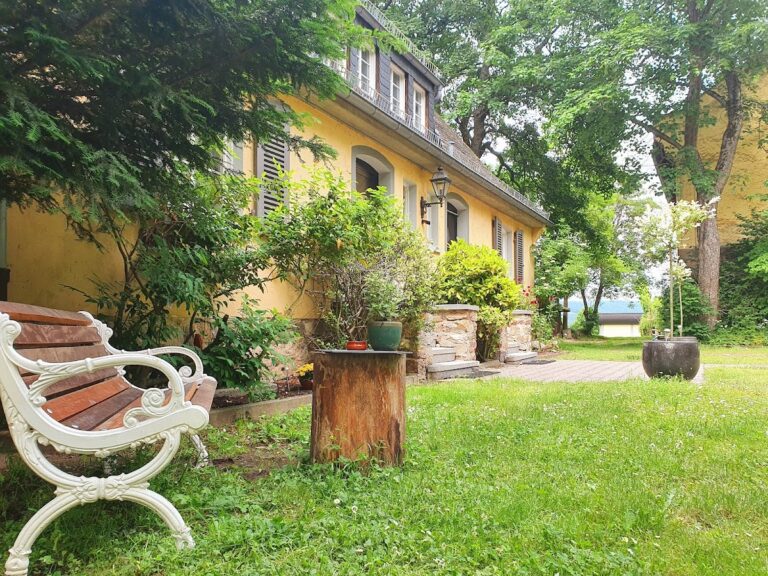
Brömserburg is a massive, roughly cuboid complex of four three-storey wings with flat roofs. The wings enclose a narrow rectangular courtyard, while the medieval ditches around the castle have been filled. The masonry is between four and five metres thick and contains small round-arched window openings. A small park surrounds the building and forms part of its museum setting.
Medieval fortifications
Ring wall and entrance tower
The first castle consisted of an enceinte, or enclosing ring wall, and a surrounding ditch. The wall was originally lower and about 1.6 to 1.7 metres thick. A tower at the northwest corner, built before 1200, survives from this first phase. It protected the entrance and also served as the bergfried, a mainly defensive keep used as a strongpoint rather than a residence. In its earliest form, the tower reached approximately to the upper edge of the present defensive platform.
Southeast tower and keep
A donjon stood in the southeast corner during the first phase. The second phase strengthened and raised the outer wall, while buildings were attached to the donjon to the same height. These structures were vaulted through as many as four storeys, an unusual arrangement for a castle on the Rhine.
The square keep in the southeast interior corner was rebuilt on the surviving lower section after the wartime destruction. It now carries an accessible viewing terrace. The central keep added in the late twelfth century was structurally bonded to the adjoining buildings without joints. Its elevated entrance was placed on the highest surviving floor, showing that the tower originally rose well above the surrounding wings.
Interior spaces and museum collections
Vaulted rooms
The interior contains barrel vaults and groin vaults. Nineteenth-century additions and alterations changed the internal arrangement, while several stairways connect the exhibition rooms and the different wings around the courtyard. The barrel-vaulted entrance area displayed two medieval suits of armour.
Wine-culture displays
The Rheingau Wine Museum presented the history and working practices of wine production through documentation and tools associated with grape varieties, viticulture, and the vintner, cooper, and cellar master. Its displays also followed the development of wine barrels and bottles up to the European Union standard bottle introduced in 1977. Corks and labels formed part of the collection.
One room focused on Dilthey, Sahl & Co., Rüdesheim’s oldest wholesale wine and sparkling-wine business. The company operated from 1815 to 1969 and primarily supplied the Russian tsars until 1917. The castle garden displayed historical wine presses, including one dated 1594, as well as barrels, transport equipment, and a sandstone sculpture of a vintner carrying a vine.
Historic vessels and glass
Ceramic and drinking vessels
The museum held a cultural-historical collection of ceramic and glass jugs and drinking vessels associated with wine. Early objects included prehistoric and early historic ceramic vases, sculptures from Egypt and Western Asia, Minoan objects from the Bronze Age civilization of Crete, and material linked to the Villanovan culture of early Iron Age central and northern Italy.
Roman-period displays included ceramic vessels and a small group of plain utility glass. The presentation explained that ancient wine was more acidic than modern wine and was mixed with water or mead. Among the most art-historically valuable objects were a Nuremberg coconut cup from around 1600 with finely worked Baroque gold decoration and an ivory cup from around 1800 decorated with reliefs of putti, or childlike winged figures.
European glass history
The glass collection traced several stages of European glassmaking. It included medieval forest glass, from Krautstrunk vessels to the classic eighteenth-century Römer, a traditional German wine glass with raised decorative knobs called prunts. Nineteenth-century Historicist Römer glasses appeared in varied colours and decorations.
Other examples included Venetian-style glass with wing decoration, thread glass, and reticulated glass; Baroque cut glass and related Historicist pieces; Baroque beakers with enamel painting; and Historicist glass made in the same style. Biedermeier view glasses, especially those depicting the Rhine, were displayed alongside Art Nouveau and Art Deco glass, including mass-produced utility glass based on designs by René Lalique, the French jeweller and glass designer.
Additional identified objects included a grape mill from the first half of the twentieth century for crushing must, nineteenth-century Historicist Römer and stemmed glasses, and a seventeenth-century Venetian-style reticulated glass. The viewing platform on the keep looked south across the Rhine toward Bingen and the Rochusberg and upstream into the Rheingau.