Oude Sint-Jacobskerk: A Former Church and Arsenal in ’s-Hertogenbosch
Site at a Glance
- Rating
- 4
- Popularity
- Very Low
- Country
- Netherlands
- Primary era
- Medieval
- Eras represented
- Medieval, Early Modern, Modern
- Civilizations
- Duchy of Brabant, Dutch, Holy Roman Empire
- Site type
- Religious
- Remains
- Church
On this page8 sections
History
Oude Sint-Jacobskerk is a former Catholic church and pilgrim hospice in the Netherlands, located in ’s-Hertogenbosch. Built in the Gothic period from around 1430 by the Brotherhood of Saint James, it served pilgrims travelling to Santiago de Compostela, whose principal patron was James the Great.
Chapel and Parish Church
The building began at the Windmolenberg as a chapel and hospice under the Brotherhood of Saint James. Its main altar was dedicated to James the Great, while altars dedicated to Mary and Saint Quirinus were added in 1478 and later. In 1569, the chapel became the church of the newly created parish of Saint James. The parish covered part of ’s-Hertogenbosch and extended towards Rosmalen. By 1584, the former brotherhood chapel had been enlarged to its present extent.
Confiscation and Military Use
In 1629, after the Siege of ’s-Hertogenbosch during the Eighty Years’ War, the Dutch States forces took possession of the church. The conflict was the Dutch revolt against Spanish Habsburg rule, fought mainly between 1568 and 1648. The building remained a Protestant church until 1650, when it was converted to military use.
Between 1650 and 1668, the former church served as a wagon house and burial place, and it was also used as a cavalry stable. From 1669 to 1752, it housed a military arsenal and stored equipment. A barracks constructed beside it in 1744 became known as the St James Barracks, and a memorial stone from that building remains beside the church. The surrounding barracks complex was used by the infantry from 1880 until 1918.
Museum and Heritage Centre
The Provincial Society for Arts and Sciences in North Brabant obtained the building for museum use after receiving a bequest of 110,000 guilders from C. P. D. Pape in 1919. Military authorities leased the former church to the society, which made it its seat in 1920. Architect Oscar Leeuw adapted the building for this purpose in 1924, and the Centraal Noord Brabantsch Museum opened there in 1925. Later known as the Noordbrabants Museum, it shared the building with the society’s library.
The museum moved to the former Military Government building on Verwersstraat in 1986 because the former church could no longer contain its expanding activities and collections. From 1988, the building served as a depot for the municipal Department of Building History, Archaeology and Monuments. Since 2015, it has housed Erfgoed ’s-Hertogenbosch, including offices, parts of the municipal archive, archaeological and building-history storage, and a heritage workshop. The building is protected as a Dutch national monument, or Rijksmonument, under monument number 21585.
Remains
Church Layout and Medieval Fabric
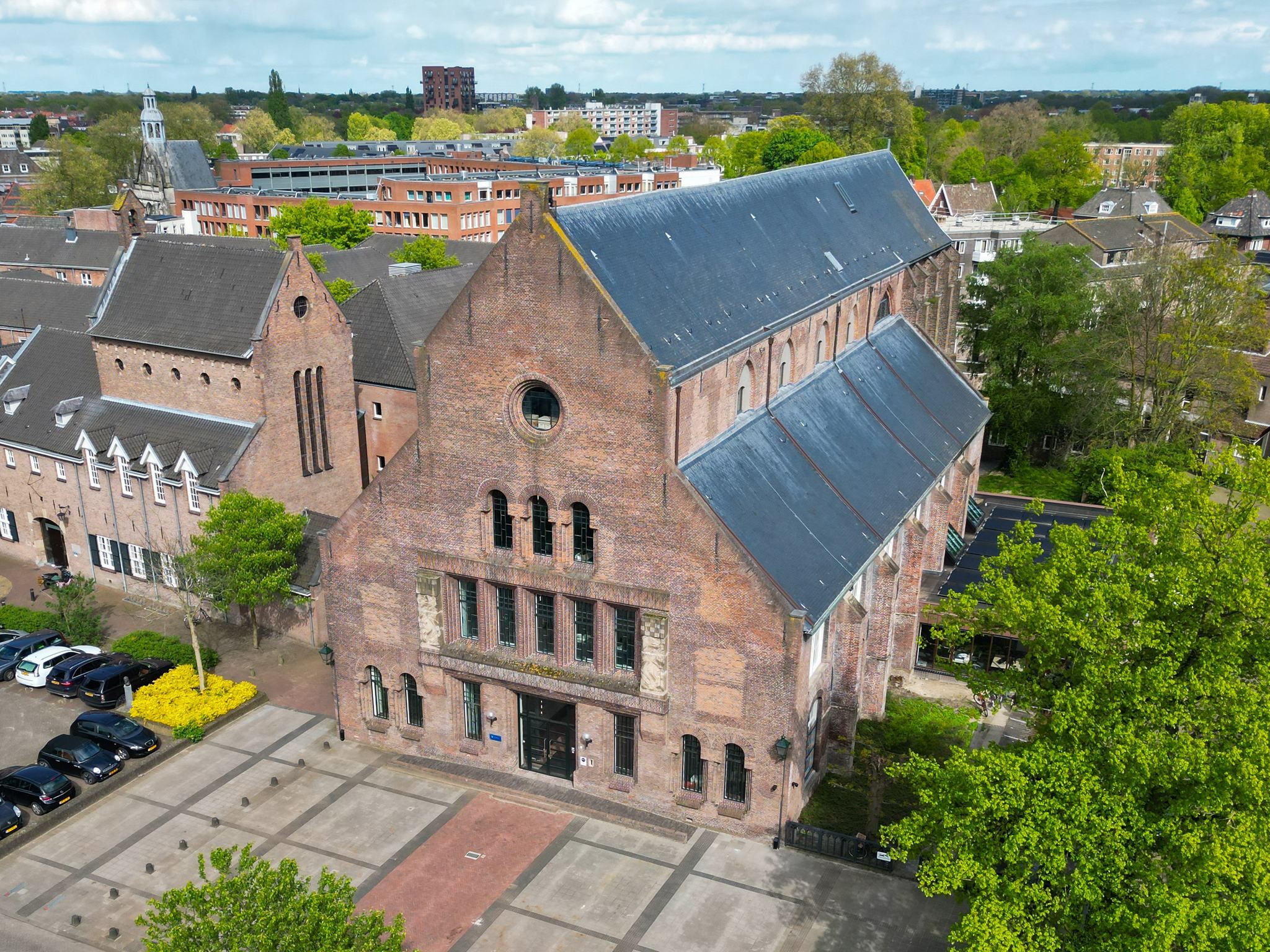
Oude Sint-Jacobskerk is a three-aisled basilica, a church arranged around a central nave with lower side aisles, and has a single-aisled choir without parallel side aisles. Its side façades preserve the layout of a planned transept, while construction stopped before that crossing was built. A stair tower stands on the north façade at the intended junction. The surviving structure combines the former church with later military alterations and twentieth-century museum adaptations.
Military Alterations
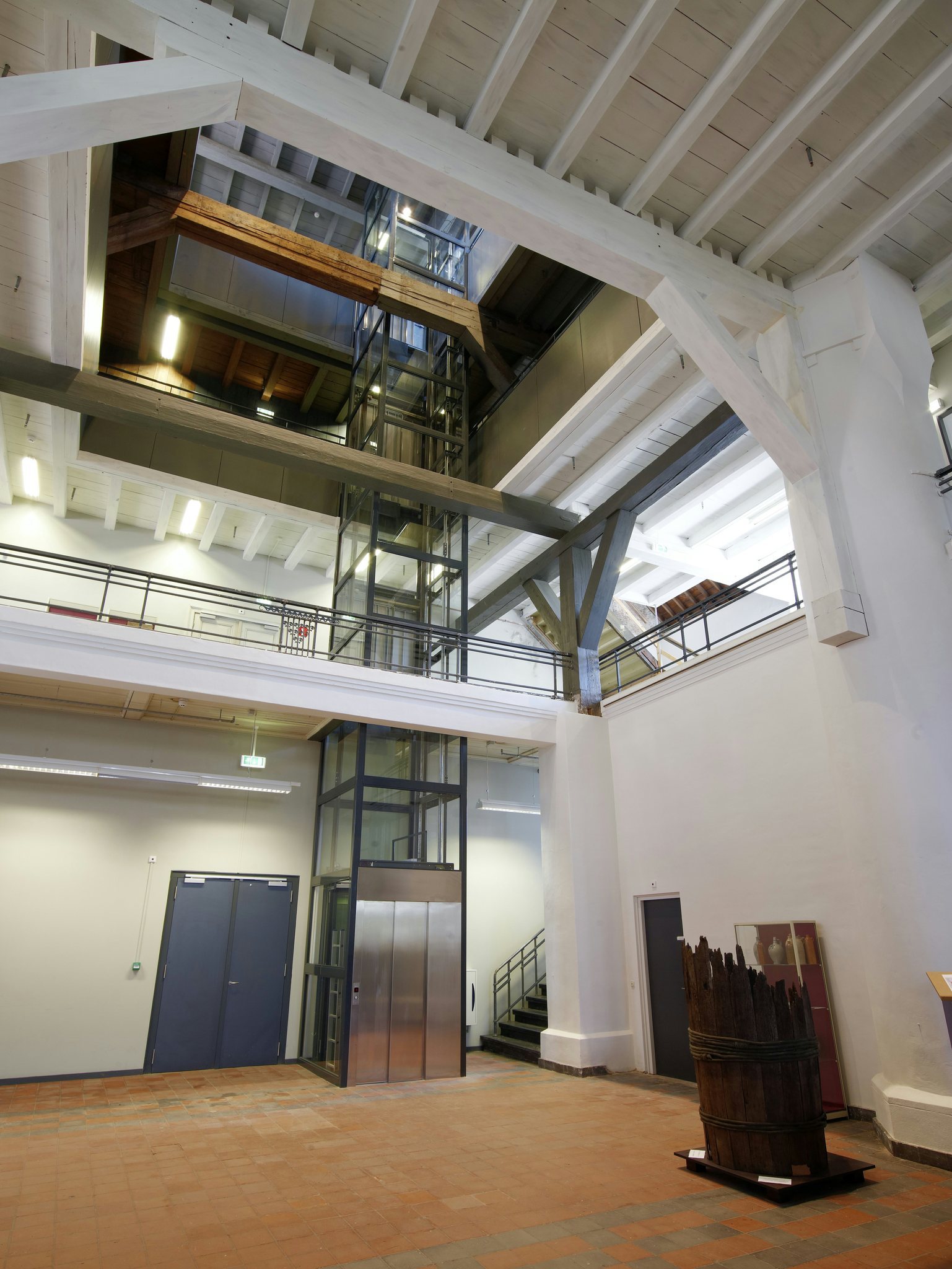
In 1752, several internal floors were inserted to store weaponry. Their exceptionally heavy construction remains visible and forms a defining part of the building’s present interior. The Gothic windows were sealed and replaced with smaller openings, while the roof and entrance façade were renewed. These solid military floors later made the former church suitable for the museum and its large library.
Museum and Cultural Spaces
For the museum conversion, Oscar Leeuw designed the present western façade as a suitable entrance and adapted the earlier eighteenth-century entrance façade. During the museum period, the central nave contained a hall used mainly for sculpture, the choir held the society’s meeting room, and stairs near the choir led to upper galleries devoted to the history of North Brabant and ’s-Hertogenbosch.
The former choir now contains a separate cultural venue, Podium de Azijnfabriek, reached through a side entrance. It was used for concerts and other cultural activities in 2020. Elsewhere, the building contains offices, storage, archaeological and building-history workspaces, and public displays of archaeological finds from ’s-Hertogenbosch. The ground floor also presents archaeological working methods.