Kraton Ngayogyakarta Hadiningrat: The Royal Palace of Yogyakarta
Site at a Glance
- Rating
- 4.7
- Popularity
- Very High
- Country
- Indonesia
- Primary era
- Modern
- External website
- Open
- Eras represented
- Early Modern, Modern
- Civilizations
- Unclassified
- Site type
- Domestic
- Remains
- Palace
On this page10 sections
History
Kraton Ngayogyakarta Hadiningrat is a Javanese royal palace and court complex in Yogyakarta, Indonesia, built for the Sultanate of Yogyakarta in 1755 and 1756. Its traditional Javanese architecture and continuing role as the seat of the Sultan make it both a working royal residence and a center of Javanese culture. The complex remains occupied by Hamengkubuwono X and his family, houses a museum of royal artifacts, and is guarded by the Yogyakarta Kraton Guards.
Foundation of the Sultanate
Hamengkubuwono I, the founder and first Sultan of Yogyakarta, ordered the palace soon after the Treaty of Giyanti. This agreement formalized the division of Mataram and recognized the Sultanate of Yogyakarta under the authority of the Dutch East India Company, the Dutch colonial trading and governing organization. The palace was among the new Sultan’s first acts, and its official opening took place in 1756.
A banyan forest between two rivers was selected for the royal center because its position protected the palace from flooding. The complex’s plan followed the basic design of the old city of Yogyakarta. Its location also established the palace within a larger sacred and political landscape extending between the southern coast and Mount Merapi.
War, Destruction, and Rebuilding
On 20 June 1812, Sir Stamford Raffles led a force of 1,200 British and Irish soldiers in an attack on the walled royal city. Raffles was the British administrator who directed the assault. The city fell in one day, and the palace was sacked and burned. The attack was the first of its kind against a Javanese court. The sultanate then briefly came under British authority before control returned to the Dutch.
Much of the palace seen today was built during the reign of Hamengkubuwono VIII, who ruled from 1921 to 1939. The complex was rebuilt after earthquakes in 1876 and 2006. Its continuing functions include royal residence, cultural ceremony, and performances of gamelan music, Javanese dance, macapat poetry, and wayang shadow puppetry.
Cosmological and Cultural Meaning
The palace forms part of the Cosmological Axis of Yogyakarta and its Historic Landmarks, which UNESCO inscribed as a World Heritage cultural property in 2023 under criteria ii and iii. The axis expresses Javanese ideas about the cycle of life, the unity of God and human beings, and harmony among God, humanity, and nature. In ritual settings, the northern square and northern palace buildings represent the Sultan, understood as ruler of the Yogyakarta Special Region, joining with the people.
The axis also carries religious and political symbolism. The Great Mosque beside the palace connects with the northern square and represents unity in prayer among God, the king, and the people. The southern section, from the Krapyak Hunting House to the palace, is associated with conception, birth, growth, marriage, and the formation of a family. The northern section, from Tugu Yogyakarta to the palace, represents maturity, old age, death, and return to the Creator.
Remains
Palace Complex
Kraton Ngayogyakarta Hadiningrat occupies a 1.4-hectare complex arranged around a sandy courtyard, a main building, and a secondary building. The courtyard is covered with sand brought from the southern coast. Walls separate the buildings, while gateways organize movement through the compound. The wooden structures follow traditional Javanese architecture and are arranged in the joglo form, a raised building type with a central roof supported by a principal interior column structure.
Courtyard and Buildings
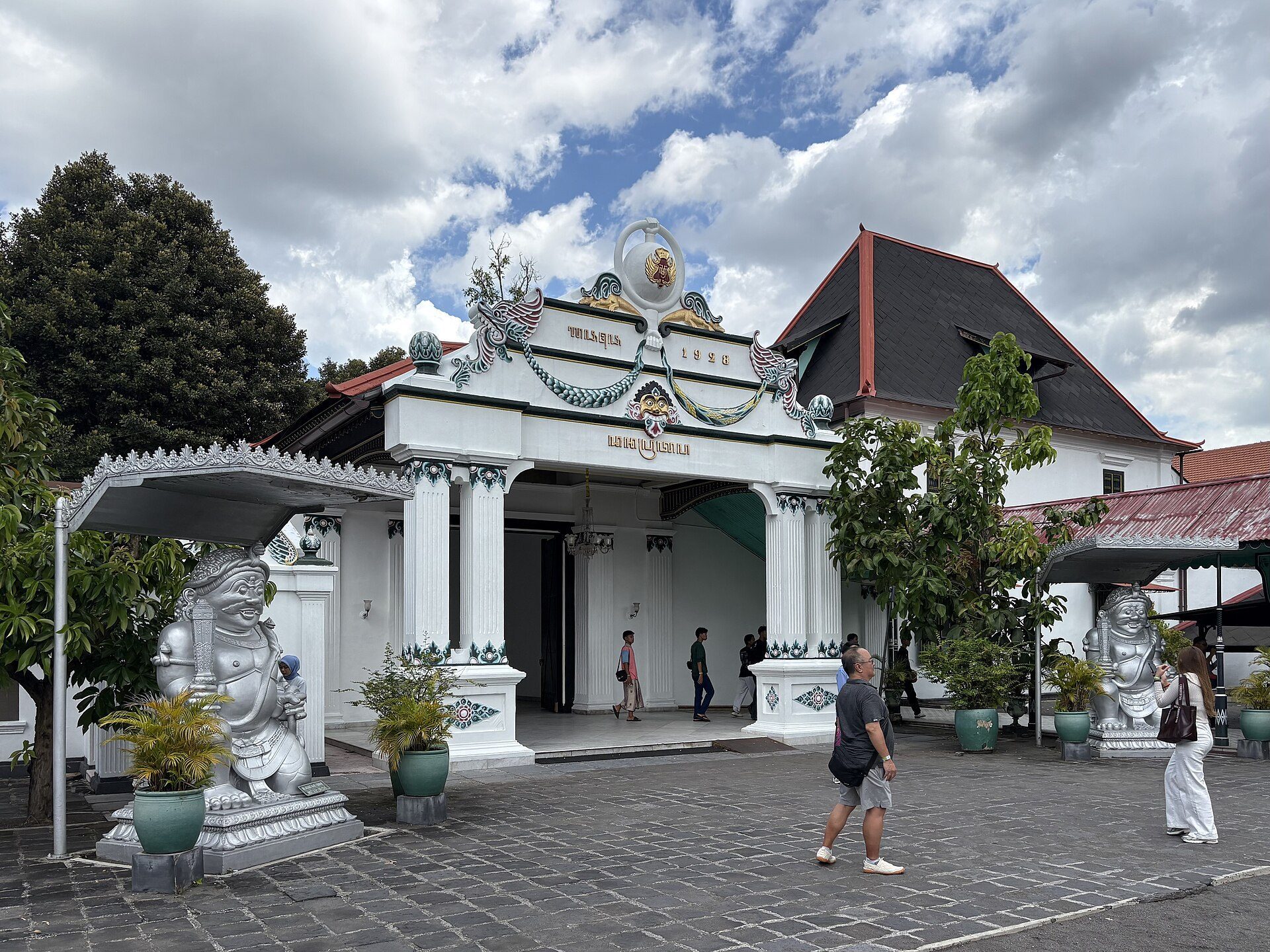
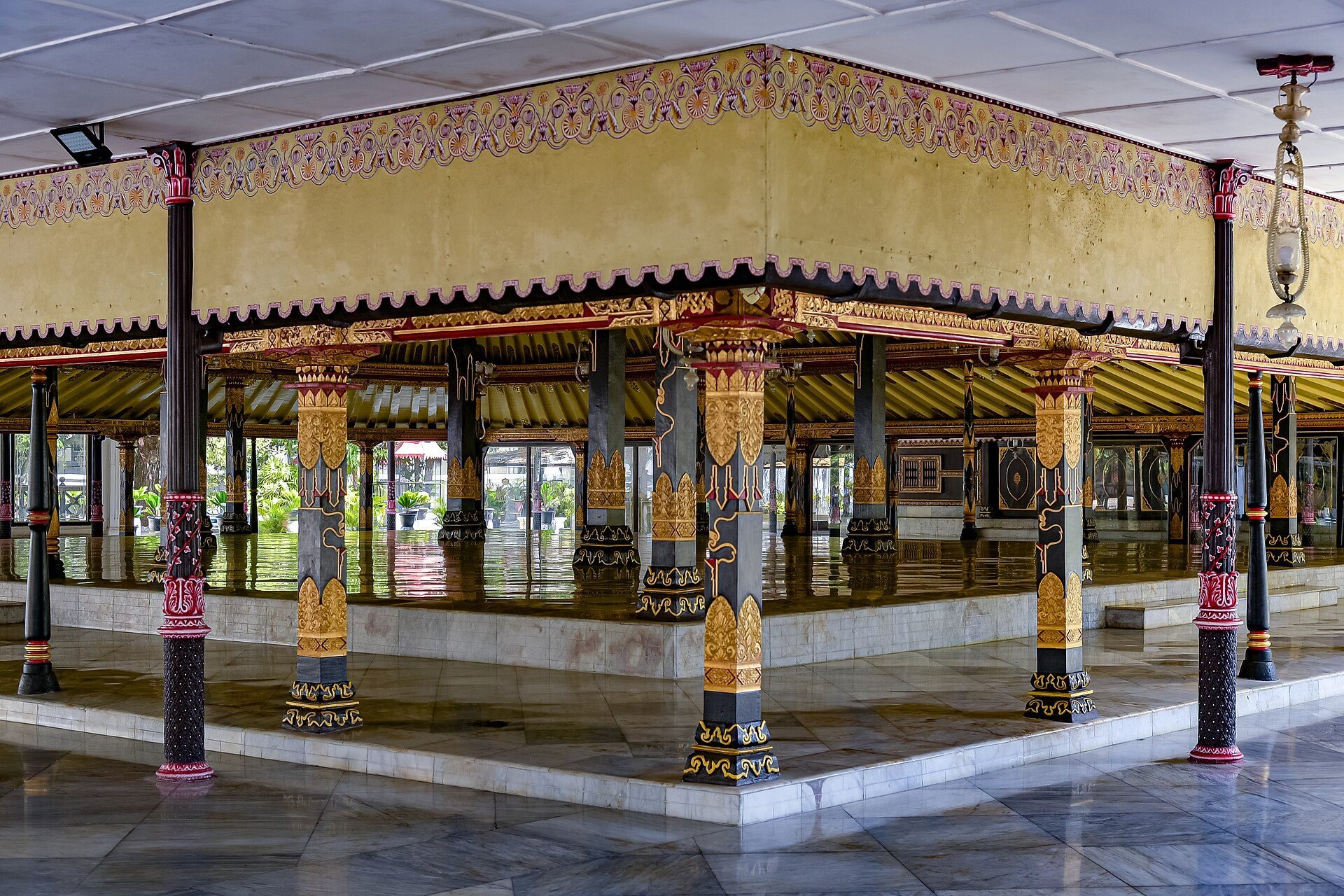
The buildings are classified according to their use. Structures associated with the Sultan have more elaborate decoration, while buildings for lower-status functions have simpler treatment. White predominates on the walls and across the complex. Floors are generally made of white marble or patterned tile and stand above the sandy courtyards. Some structures have especially high main floors, while others contain a square stone called a Selo Gilang, used as the Sultan’s throne.
Gates and Guarding Figures
The gateways are known as regol, or entrances, and include the Semar Tinandu style. The palace door is made of thick teak. Javanese gate arrangements may also include a detached screening wall called a Renteng or Baturono wall, sometimes decorated with traditional ornament. The Donopratono Gate leads to the Kedaton quarter and symbolizes generosity and control of desire. Two Dvarapala guardian figures, Balabuta and Cinkarabala, represent good and evil. A Dvarapala is a protective figure placed at the entrance to a sacred or royal precinct, and palace artifacts are believed to repel evil.
Javanese Wooden Architecture
The wooden buildings have trapezoidal roofs supported by a central soko guru, the principal pillar beneath a traditional Javanese roof, together with secondary pillars. Roof coverings include red or gray shingles, tiles, or zinc. Decorative designs use plants, animals, and other nature motifs, alongside Portuguese, Dutch, and Chinese influences. Pillars are generally dark green or black with yellow, light green, red, or gold accents, while other wooden elements follow similar colors. The stone Ompak pedestals beneath the pillars combine black surfaces with gold ornament.
Cosmological Axis
The cosmological axis runs for approximately six kilometers from the Indian Ocean in the south to Mount Merapi, a volcano, in the north, with the palace at its center. It passes from the Krapyak Hunting House and monument through the palace to Tugu Yogyakarta and is bounded on both sides by streams. Tamarind and Spanish cherry trees line the route between the Krapyak Hunting House and the palace, which also extends from Tugu Yogyakarta toward the royal complex.
The Indian Ocean represents the feminine element of water, while Mount Merapi represents the masculine element of fire and is regarded as the dwelling place of protective spirits. The Krapyak monument, palace, and Tugu Yogyakarta correspond symbolically to nature, humanity, and God. Tugu Yogyakarta, also called the Gilig Golong monument, symbolizes the union of the king and the people and the ultimate unity of the Creator and human beings.