San Luigi dei Francesi: France’s National Church in Rome
Site at a Glance
- Rating
- 4.8
- Popularity
- Medium
- Country
- Italy
- Primary era
- Early Modern
- External website
- Open
- Eras represented
- Early Modern
- Civilizations
- Papal States
- Site type
- Religious
- Remains
- Basilica
On this page13 sections
History
San Luigi dei Francesi is a Catholic basilica in Rome, Italy, built between 1518 and 1589 for the French community and combining late Renaissance and early Baroque features. It has served since 1589 as France’s national church in the city, while also functioning as a rectoral church associated with the parish of Sant’Agostino in Campo Marzio.
Farfa and the French community
The site’s institutional history reaches back to the Abbey of Farfa. After Saracen forces destroyed the abbey in 898, its monks settled in Rome. By the late tenth century, Farfa controlled churches, houses, mills, and vineyards in the city. An imperial bull issued by Otto III in 998 confirmed the abbey’s rights over three Roman churches, including Santa Maria. That church’s property passed to the Medici family in 1480, and its dedication later became associated with San Luigi dei Francesi.
In 1518, Cardinal Giulio de’ Medici, who later became Pope Clement VII, commissioned a new church for Rome’s French residents. Jean de Chenevières prepared an initial plan for an octagonal, centrally planned building, but the project was interrupted during the Sack of Rome in 1527. Construction later resumed according to a different design.
Construction and consecration
Giacomo della Porta designed the church and its façade, while Domenico Fontana directed and substantially carried out the building work. Construction and completion were supported by Henry II, Henry III, Catherine de’ Medici, and Charles III, Duke of Lorraine. Catherine de’ Medici also acquired or donated property for the church and personally intervened to bring the long project to completion.
The church was consecrated on 8 October 1589 by Cardinal François de Joyeuse. Its formal dedication is to the Virgin Mary, Saint Denis of Paris, and Saint Louis IX of France, the thirteenth-century French king canonized in 1297. The building was intended both as a parish church for French residents and as the residence of the cardinal associated with San Luigi dei Francesi. Its liturgical dedication is celebrated on 25 August, the feast of Saint Louis.
Administration and later history
San Luigi dei Francesi has been administered by the Pieux Établissements de la France à Rome et à Lorette, a French institution responsible for French churches and related charitable properties in Rome and Loreto. Its rector is appointed in connection with the French ambassador to the Holy See.
Between 1749 and 1756, Antoine Dérizet comprehensively restored and transformed the interior, giving it much of its later Baroque appearance. The church became a cardinalitial titular church on 7 June 1967, meaning that it was assigned as the institutional title of a cardinal-priest belonging to the College of Cardinals. Its titular cardinal-priests have included Pierre Veuillot, François Marty, Jean-Marie Lustiger, and André Vingt-Trois, who held the title from 2007 to 2025.
Burials and musical life
The church has long served as a burial place for French residents of Rome and other associated figures. Those buried or commemorated there include Pauline de Beaumont, François-Joachim de Bernis, Frédéric Bastiat, Giuseppe Sisco, Natale Saliceti, Henri Cleutin, Pierre Le Gros the Younger, and Antoniazzo Romano. Claude Lorrain’s remains were transferred from Santissima Trinità dei Monti in 1840.
Music also forms part of the church’s history. Luigi Rossi served as organist from 1633 to 1635, while Ercole Bernabei was organist from 1647 to 1653 and later became maestro di cappella, the director of church music. Orazio Benevoli and Antonio Maria Abbatini also held the position. After arriving in Rome around 1675, Arcangelo Corelli began his career at San Luigi dei Francesi as a third violin.
Remains
Plan, structure, and façade
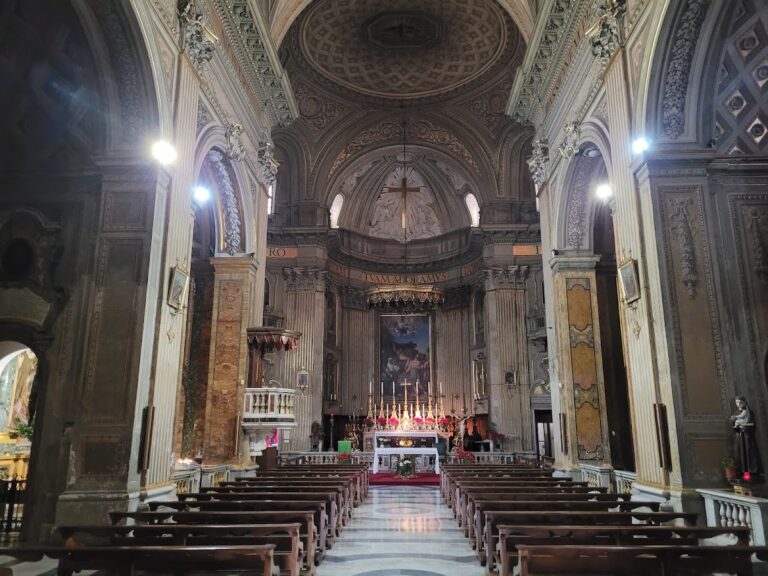
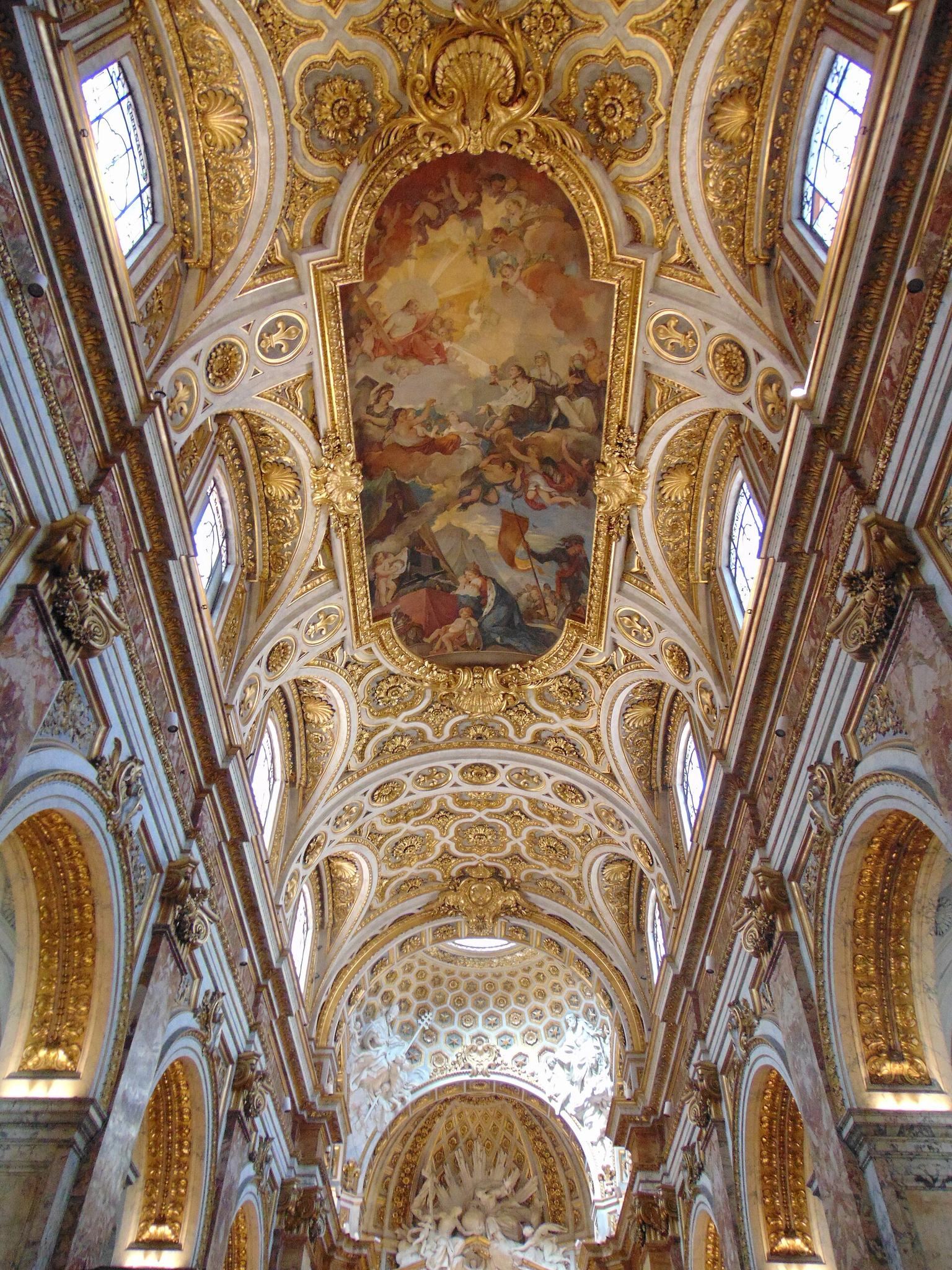
The church is a three-aisled basilica without a transept, arranged on an east-west axis. Its five-bay nave is accompanied by side aisles and rectangular chapels, while the presbytery has a separate semicircular end. The building measures approximately 51 metres in length and 35 metres in width. A barrel vault with lunettes covers the main nave. The three eastern bays continue into a flat painted ceiling, and the bay between the nave and presbytery carries a low dome. The side aisles have cloister vaults, while the chapels are covered by barrel vaults.
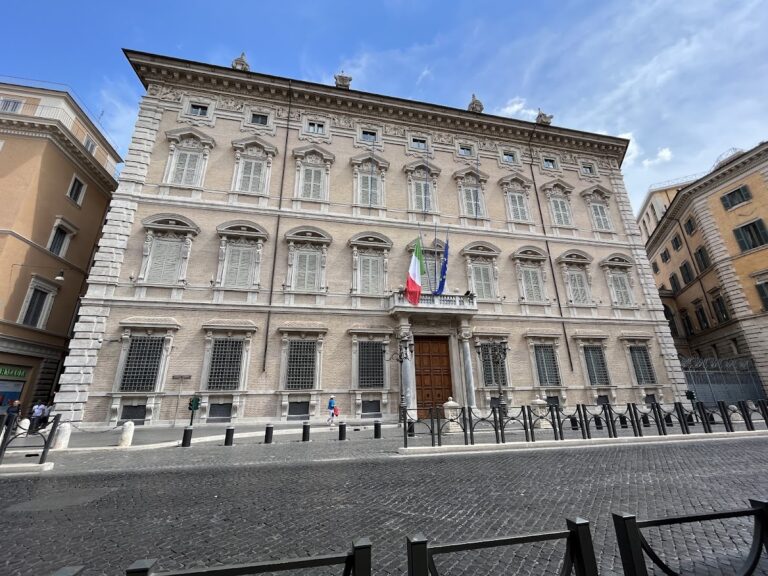
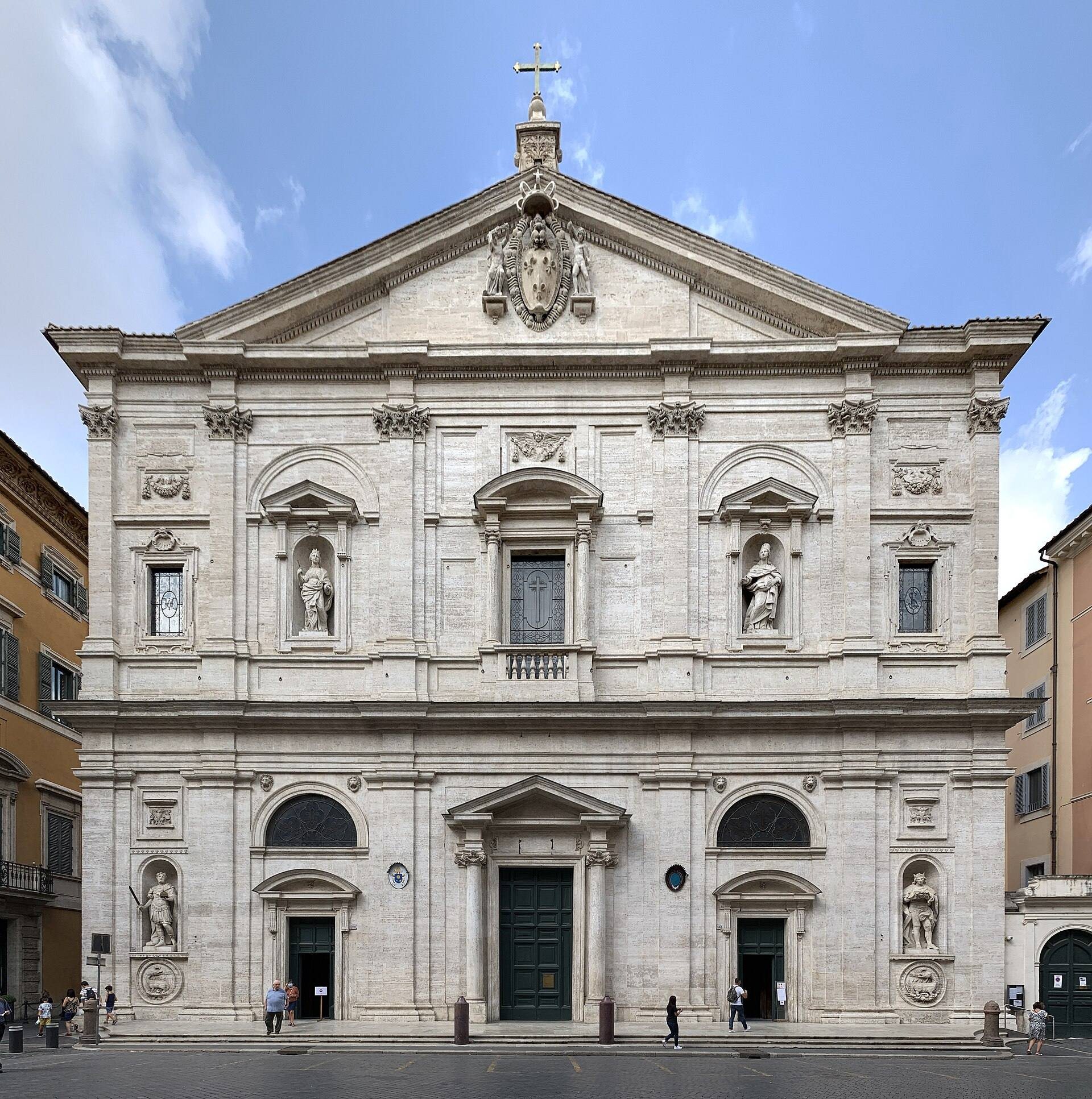
Giacomo della Porta’s façade was built between 1580 and 1584 with the assistance of French craftsmen. It projects independently from the rectangular church body and combines early Roman Baroque features with classicizing forms associated with French architecture. Strongly articulated entablatures, pilasters, and a triangular pediment organize the front. Niches contain full-length statues of Charlemagne, Saint Louis IX, Saint Clothilde, and Saint Joan of Valois, while salamanders, the emblem of Francis I of France, appear at both ends.
Interior decoration and chapels
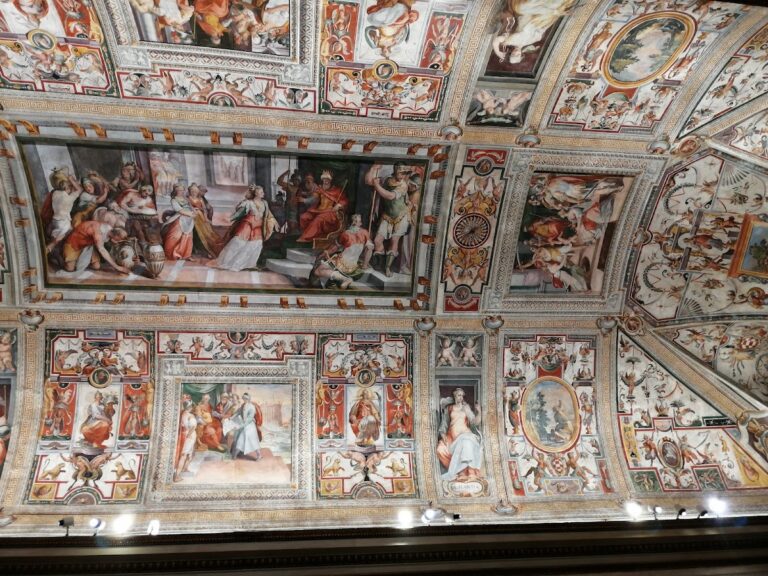
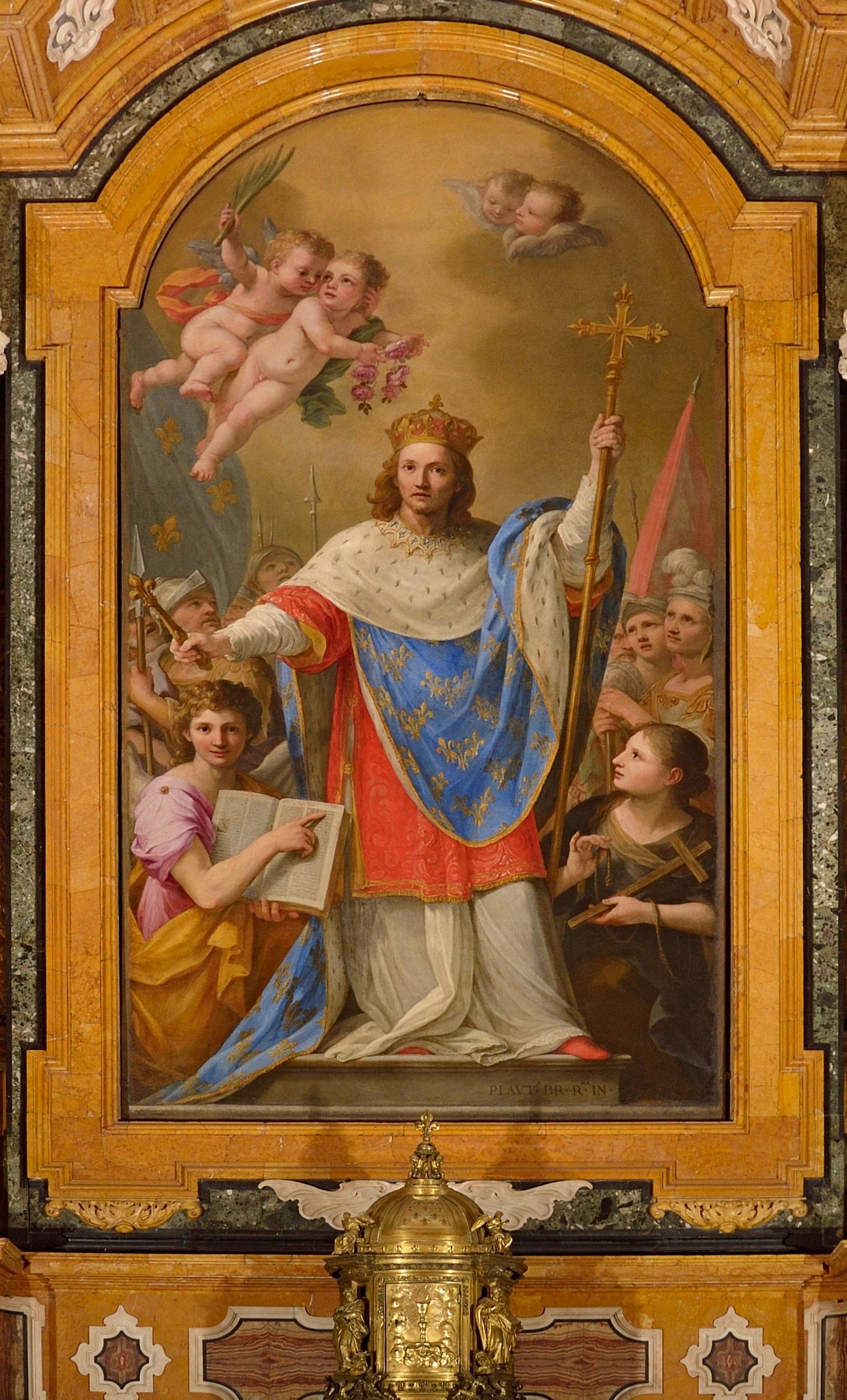
The interior combines multicoloured marble, paintings, gilded stucco reliefs, and extensive Baroque ornament. Charles-Joseph Natoire painted the ceiling with the Death and Glory of Saint Louis in 1754 and also produced paintings concerning Saint Louis, Saint Denis, and Clovis. The main altar contains Francesco Bassano the Younger’s Assumption of the Virgin. In the Chapel of Saint Louis, Plautilla Bricci painted the large altarpiece depicting the saint and also produced Saint Louis IX between History and Faith between 1676 and 1680.
Chapel of Saint Cecilia
The Chapel of Saint Cecilia, the second chapel on the right, contains Domenichino’s frescoes of episodes from the saint’s life, painted in 1614. Its altar holds a copy of Guido Reni’s version of Raphael’s Ecstasy of Saint Cecilia. Other works in the chapel and elsewhere in the church are by Cavalier d’Arpino, Girolamo Muziano, Giovanni Baglione, Siciolante da Sermoneta, Jacopino del Conte, and Pellegrino Tibaldi. The interior also includes a cycle concerning the life of Clovis, along with paintings of Saint Nicholas and the Adoration of the Magi.
Contarelli Chapel
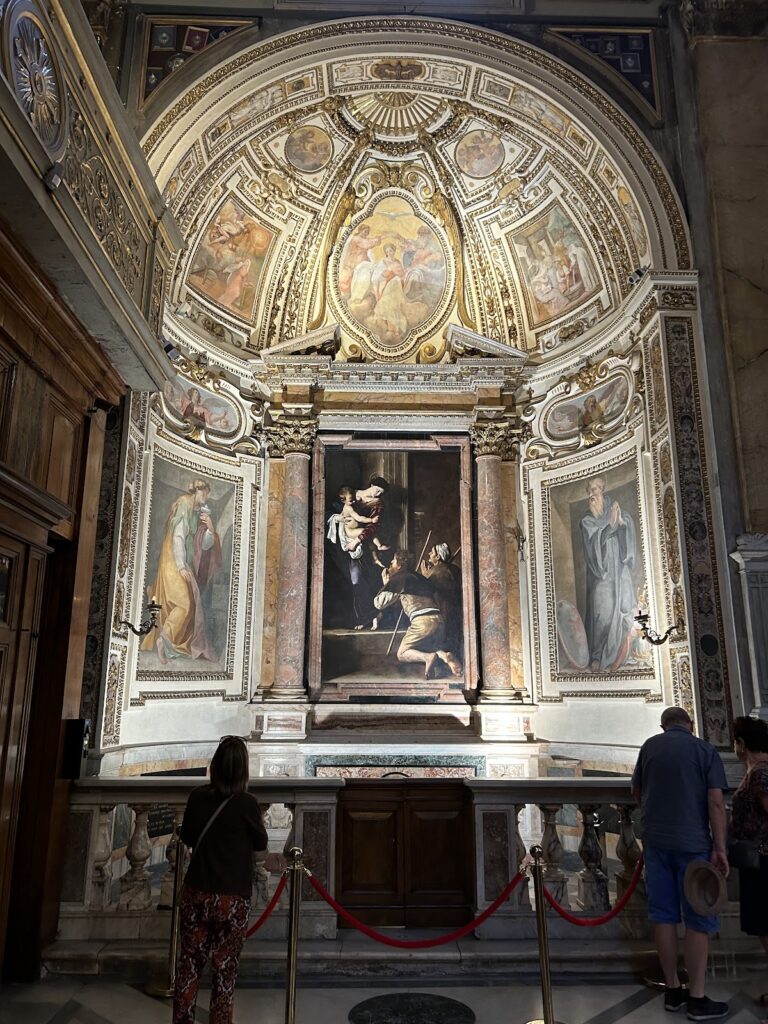
The fifth chapel on the left is the Contarelli Chapel, established in 1565 as a family chapel by the French cardinal Matthieu Cointrel, whose name was Italianized as Matteo Contarelli. After his death, the chapel passed to Virgilio Crescenzi, who commissioned its decoration. It contains three paintings by Caravaggio, the leading Italian Baroque painter Michelangelo Merisi, devoted to the life of Saint Matthew, one of the twelve apostles and the traditional author of the Gospel of Matthew.
Caravaggio’s Calling of Saint Matthew occupies the left wall, The Martyrdom of Saint Matthew the right wall, and Saint Matthew and the Angel the space above the altar. The paintings were produced between 1599 and 1602. The two narrative canvases date from 1599 to 1600, while the altarpiece was completed in 1602. On 25 June 1599, Crescenzi contracted Caravaggio to paint the cycle in oil on canvas for 400 scudi.
Caravaggio’s first version of Saint Matthew and the Angel was rejected because the apostle appeared as an overly ordinary peasant. The second version remains in the chapel with the other two paintings. In Calling of Saint Matthew, a diagonal beam of light, directional hand gestures, and strong contrasts of light and shadow draw attention to Matthew. The Martyrdom of Saint Matthew uses similar contrasts and includes a self-portrait of the artist among the witnesses in the background. Cavalier d’Arpino, who had previously employed Caravaggio, painted the chapel’s ceiling fresco showing the resurrection of a king’s daughter.
Other chapels and commemorative spaces
The south aisle contains the chapels of Saint Sebastian, Saint Nicholas, Saint Louis, the Three Kings, and Saint Matthew, the Contarelli Chapel. The north aisle contains the chapels of Saint Denis, Saint Cecilia, Saint Joan of Valois, Clovis, and the Crucifixion. The Chapel of the Crucifixion is dedicated to victims of terrorism and contains a portrait of Father Jacques Hamel, murdered at Saint-Étienne-du-Rouvray near Rouen in 2016.
Organ, tombs, and later discoveries
The organ stands on the richly decorated balcony of the counter-façade. Joseph Merklin built it in 1881. It has three manuals of 56 notes each, a 30-note pedalboard, and mechanical action with a Barker lever. The instrument is preserved in an earlier Baroque case.
The church’s tombs and funerary monuments include the monument to Pauline de Beaumont, erected by Chateaubriand and sculpted by Joseph Charles Marin, and the monumental mausoleum of Louise Cheuvreux-Guillemin by Charles Gumery. Claude Lorrain’s transferred burial is also commemorated inside the church. In 2020, Vincenzo Catalani’s painting The Preaching of Saint Paul at Athens was rediscovered after having been stored and forgotten in the building.
Ospizio San Luigi dei Francesi
The adjacent Ospizio San Luigi dei Francesi is a late-Baroque building constructed by Cardinal Melchior de Polignac between 1709 and 1716. It provided accommodation for the French religious community and impoverished pilgrims. Its porch contains a bust of Christ whose face is traditionally identified with Cesare Borgia. Inside are a gallery of portraits of the kings of France and a notable music hall.