Palazzo Giustiniani: A Historic Palace and Senate Residence in Rome


Site at a Glance
- Rating
- 4.7
- Popularity
- Low
- Country
- Italy
- Primary era
- Early Modern
- Eras represented
- Early Modern, Modern
- Civilizations
- Papal States
- Site type
- Civic
- Remains
- Palace
On this page10 sections
History
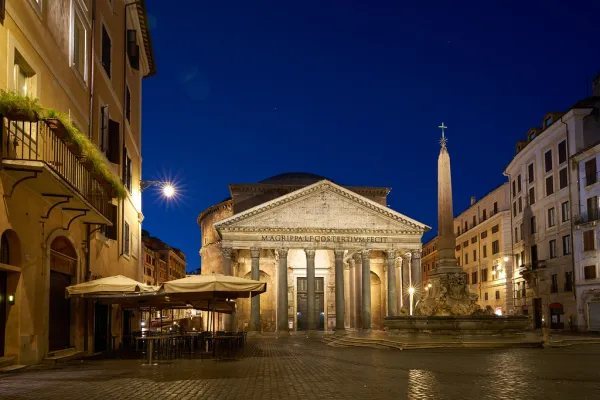
Palazzo Giustiniani is a historic palace in Italy, near the Pantheon in Rome’s Sant’Eustachio district. Built at the end of the sixteenth century in the Roman classical style for Monsignor Francesco Vento, it later became a Giustiniani residence, an important setting for art collecting, and a center of Italian political and institutional life.
Foundation and Giustiniani expansion
The palace was acquired in 1590 by Giuseppe Giustiniani, a member of the Genoese Giustiniani family. Before the Ottoman conquest of Chios, that family had governed the island. Giuseppe’s son, Cardinal Benedetto Giustiniani, enlarged the residence by incorporating surrounding buildings. The complex eventually occupied an entire city block near the Pantheon and became known as the “Piccolo Colle,” or “Little Hill.”
Further alterations took place repeatedly during the first half of the seventeenth century. The sequence of changes culminated in an intervention by Francesco Borromini in 1650. Borromini was a major seventeenth-century Roman architect, recognized for dynamic spatial compositions and distinctive curved and lowered forms. His work gave parts of the palace a more individual architectural character while preserving its earlier foundations and development.
The Giustiniani collection
Expansion of the palace was accompanied by archaeological excavations, whose finds entered its growing collection. Vincenzo Giustiniani, Cardinal Benedetto’s brother, assembled approximately 1,600 objects for the palace gallery. The holdings included ancient statuary, Roman sarcophagus reliefs, archaeological finds, and paintings associated with Giorgione, Titian, Raphael, and Caravaggio.
The collection also attracted artists and scholars. Joachim van Sandrart lived in the palace from 1633 to 1636 and directed the first inventory of its sculpture. With Theodoor Matham, Reinier van Persijn, Cornelis Bloemaert, and Michel Natalis, he reproduced the classical sculptures in 153 plates. An earlier group of drawings commissioned by Cassiano dal Pozzo had likewise recorded notable statues and reliefs once kept there.
Palazzo Giustiniani remained a destination for foreign travelers undertaking the Grand Tour, the educational journey through Europe, especially Italy, made by many elite eighteenth- and nineteenth-century visitors. Johann Joachim Winckelmann, the German scholar whose studies of ancient Greek and Roman art helped establish modern classical archaeology and art history, included the palace in his eighteenth-century journey through Italy. Some visitors criticized the arrangement of the gallery, comparing it to a storehouse rather than a properly ordered gallery.
From the second decade of the nineteenth century, the remaining collection began to be dispersed. The Minerva Giustiniani was later transferred to the Vatican, while other works moved into different collections. The dispersal ended the palace’s role as the home of an exceptionally large unified group of ancient and modern artworks, although the building retained important traces of its earlier decorative program.
Masonic headquarters and political change
After the principal Giustiniani line became extinct in 1859, ownership passed to the Grazioli family. In 1898, the family leased the palace to the Grand Orient of Italy, the country’s principal Masonic organization. The organization established its headquarters there on 21 April 1901. The building also housed the Supreme Council of the Ancient and Accepted Scottish Rite for the Italian jurisdiction, a Masonic system of degrees governed nationally by a supreme council.
During this period, Palazzo Giustiniani acquired the names “Green Vatican” and “Vatican of the Thirty-Three.” Its statues were sold to the Metropolitan Museum of Art in New York for 275,000 lire through agreements whose transparency and legality were questioned. In 1917, Achille Ballori, a candidate for Grand Commander of the Scottish Rite and an associate Grand Master of the Grand Orient of Italy, was shot and killed inside the palace by a mentally disturbed person.
At the beginning of 1926, Mussolini’s regime outlawed Freemasonry and confiscated the building for use by the Senate. A settlement allowed the section facing Piazza della Rotonda to remain under Masonic control. The Senate obtained control of almost the entire palace in 1985, after the Masons moved their headquarters to Villa del Vascello on the Janiculum Hill. An agreement in 1991 provided for the transfer of 140 square metres.
The palace in republican Italy
Palazzo Giustiniani acquired a direct role in the formation of the Italian Republic. Enrico De Nicola used it as his official residence from 1946 to 1948 while serving as provisional head of state, rather than using the Quirinal Palace. On 27 December 1947, the republican Constitution was signed in the palace’s Sala della Costituzione. De Nicola, Prime Minister Alcide De Gasperi, Constituent Assembly President Umberto Terracini, and Minister of Justice Giuseppe Grassi took part in the signing.
In 1938, an underground passage was built between Palazzo Giustiniani and Palazzo Madama, another Senate seat. The passage still exists. In 1972, the palace became associated with the alleged “Pact of Palazzo Giustiniani,” involving Aldo Moro and Senate President Amintore Fanfani. The story claimed that the agreement delayed a transfer of leadership within the Christian Democracy party, but its truth remains uncertain because of its similarity to the “Pact of San Ginesio” of 1969. In 1973, Enrico Minio, a Communist parliamentarian and former mayor of Civita Castellana, died by suicide in his office in the palace.
Today, Palazzo Giustiniani serves as the official residence of the President of the Senate of the Republic. It is also a representative and administrative center for life senators, former presidents of Italy, former presidents of the Senate, and former prime ministers. By republican custom, the President of the Senate may make offices there available to a designated prime minister during consultations when that person is neither a deputy nor a senator. If the President of Italy is temporarily unable to serve, the Sala della Costituzione becomes the office of the acting president. In 2024, Italy’s Court of Cassation ruled that the Administrative Regional Tribunal must determine the legality of the measure by which Mussolini expelled the Masonic headquarters from the palace.
Remains
Exterior and entrance
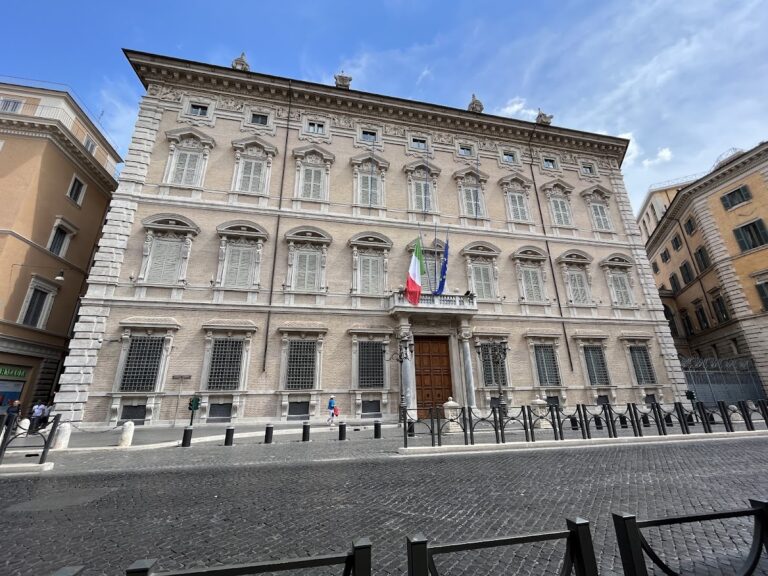
Palazzo Giustiniani stands on Via della Dogana Vecchia and extends toward Piazza della Rotonda. Its original design is attributed to Giovanni Fontana, probably with assistance from his better-known brother Domenico Fontana. Giovanni and Domenico were prominent late Renaissance and early Baroque architects active in Rome. The building has symmetrical facades, clear proportional divisions, corners emphasized by rusticated stonework, and characteristic window surrounds. On the Via della Dogana Vecchia facade, Borromini’s 1650 intervention is marked by an entrance portal placed away from the center and by the balcony above it.
Courtyard and atrium
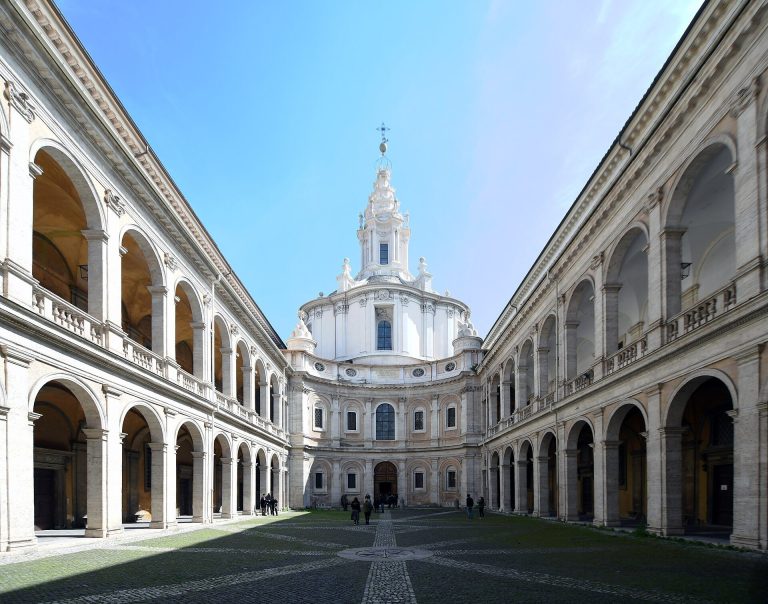
Borromini also created the internal courtyard and an atrium with lowered arches. These spaces belong to the palace’s seventeenth-century transformation and express the architect’s preference for distinctive curved and compressed architectural forms. They form part of the surviving interior arrangement produced during the repeated alterations that enlarged and reshaped the earlier residence.
Sala Zuccari
The official Grand Gallery is generally called the Sala Zuccari, after Federico Zuccari, a leading Italian late Renaissance painter and architect. It is the room that has remained most nearly unchanged through the palace’s many alterations and restorations. Its surfaces are covered with frescoes, although parts of the decoration are incomplete. The ceiling presents five episodes from the story of Solomon: his anointing, the construction of the Temple of Jerusalem, the Judgment of Solomon, the sons forced to pierce their father’s corpse, and Solomon’s meeting with the Queen of Sheba.
Four virtues associated with Solomon, Religion, Industry, Vigilance, and Eloquence, also appear on the ceiling. Small landscapes enclosed in circular frames occupy its corners. The walls once carried several female personifications of virtues. Temperance survives, while the other figures remain in fragments. The frescoes are set within delicate grotesque ornament, a decorative style derived from ancient Roman wall painting that combines foliage, figures, animals, and architectural motifs. Seventeenth-century tapestries supplement the decoration. The attribution of the cycle is not completely settled, but the work dated to 1586–1587, before the palace belonged to the Giustiniani family, is associated with Antonio Tempesta and Pietro Paolo Bonzi.
Former gallery and archaeological holdings
The first-floor gallery formerly contained approximately 1,600 works, bringing together ancient statues, Roman sarcophagus reliefs, archaeological finds, and paintings. The excavated objects entered the collection during the palace’s enlargement, while the sculpture inventory and printed plates created in the seventeenth century preserved visual records of works that once occupied the building. Much of the movable collection was later dispersed or transferred elsewhere, but the former gallery remains central to the palace’s historical identity as a residence shaped by collecting, excavation, and the display of ancient and Renaissance art.