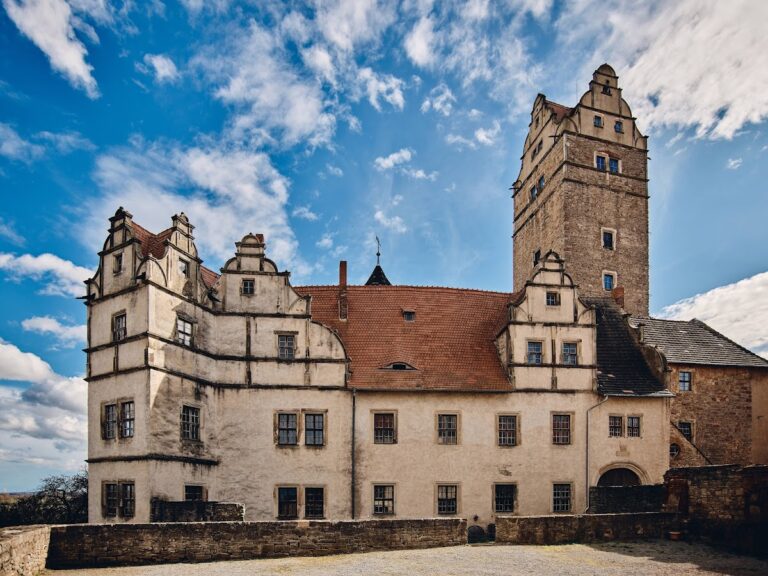
Monastery in Gerbstedt: A Medieval Women’s Convent in Germany
Site at a Glance
- Rating
- 4.3
- Popularity
- Very Low
- Country
- Germany
- Primary era
- Medieval
- External website
- Open
- Eras represented
- Medieval, Modern
- Civilizations
- Holy Roman Empire
- Site type
- Religious
- Remains
- Monastery
On this page14 sections
History
The Monastery in Gerbstedt was a women’s convent in Gerbstedt, Germany, founded in the late tenth century as an Augustinian canoness community. Its foundation is dated to 981 or 985, and it is described as the oldest monastery in the Mansfeld region. Margrave Rikdag established it on his own estate, although he died before construction was complete. His sister Eilswitt became the first abbess and led a community of 24 nuns.
Foundation and Wettin protection
Dietrich I, regarded as a relative of Rikdag and Eilswitt and as the progenitor of the Wettin dynasty, is also considered a founder. In 1014, the monastery passed to his grandson. From 1062 to 1072, it became the proprietary monastery of Friedrich of Wettin, Bishop of Münster, and consequently came under the authority of the Diocese of Münster.
Political disturbances then placed the convent under severe pressure. Bishop Erpho gave away several monastic estates, but returned them after pressure from the Wettins. His successor, Burchard, expelled most of the nuns, leaving only four who supported him, and prevented the election of a new abbess. The situation was regularized after his death in 1118.
The counts of Wettin became the monastery’s protective bailiffs, secular guardians who represented the convent in legal and administrative matters. In return, they received precisely regulated payments in kind and presided over the monastery’s court three times a year. Margrave Konrad of Meissen is regarded as the figure who refounded and reformed the institution as a Benedictine convent, whose members followed the Rule of Saint Benedict rather than the rule of Saint Augustine.
Medieval religious and noble community
The Wettins were sometimes buried at Gerbstedt, although their Augustinian foundation at Petersberg probably replaced Gerbstedt as the family monastery from about 1124. In 1146, Hoyer II, Count of Mansfeld, buried Konrad of Meissen’s wife at Gerbstedt. When Konrad returned from pilgrimage, he had her reinterred at Petersberg.
Gerbstedt’s provosts acted as arbitrators in disputes in 1192 and 1197. In the latter year, the monastery received the tithe from a vineyard near Rothenburg, together with the right to collect tithes from vineyards established by the convent itself. Its religious and economic connections extended across the surrounding region and eastward over the Saale to Domnitz, where it owned a monastic estate.
The convent attracted members of the nobility from distant territories. Agneta, a daughter of the Duke of Bohemia, was mentioned there in 1171. Bertha, the daughter of Margrave Berthold III of Istria or of a Count of Andechs, became abbess no earlier than about 1205 and was last mentioned in 1249. Six descendants of Konrad of Meissen also belonged to the community.
In 1225, the counts of Mansfeld acquired the monastery’s bailiwick rights and sometimes transferred them to others. The resulting distribution and sale of monastic estates led Popes Honorius III, Alexander IV, Clement IV, and Nicholas IV to issue protections or intervene in 1225, 1259, 1265, and 1290. In 1285, several nobles violently entered the monastery and mortally wounded a man named Gottfried. Volrad of Kranichfeld, Bishop of Halberstadt, excommunicated them. In 1290, the monastery received a 40-day indulgence, a formal remission of part of the temporal punishment associated with sin in medieval Catholic practice.
The Bishops of Münster defended their rights at Gerbstedt in 1277 and 1325. They ultimately lost this struggle in the fifteenth century, after which the abbess no longer had to swear a feudal oath to them. A foundation confirmation from the second or third quarter of the twelfth century names Saint John the Baptist as the monastery’s patron and records relics associated with him.
Late medieval expansion and reform
The convent reached a peak population of as many as 120 nuns. In 1438, it authorized the council of Marktgerbstedt to build a chapel dedicated to Saints Peter and Paul. The round chapel at the monastery was begun in 1168 and consecrated in 1177, although its exact location is unknown. It was first mentioned in 1195 as a chapel of Saint Mary in the cloister. The pilgrimage chapel at Welfesholz also belonged to Gerbstedt and was included in indulgences granted to the monastery.
An attempted reform began in 1506, apparently in response to impoverishment caused by repeated encroachments on monastic property. The initiative came from Neu-Helfta, and Johannes Busch, then provost of Neuwerk in Halle, is said to have commissioned it. In 1516, Archbishop Albrecht of Magdeburg granted the monastery a 140-day indulgence.
The monastery retained its traditions and property for several decades after the Reformation began in 1517. In 1520, the absence of a provost responsible for supervising the servants was reported. During the Peasants’ Revolt of 1525, the monastery was affected, although the nuns were able to return relatively easily after a payment of 2,000 gulden intended to prevent further disruption.
Reformation and secularization
From 1541, the monastery and its estate came under the Counts of Mansfeld-Friedeburg. The estate is also recorded as passing to the city of Halle in that year and to Otto von Plotho in 1660. Archbishop Sigismund of Magdeburg intervened in 1558 to prevent dissolution.
In 1561, Counts Hans Georg and Peter Ernst of Mansfeld ordered the 40 nuns to abandon Catholicism, implement the Reformation, and convert the monastery into a general girls’ school. The resulting dispute produced correspondence with the Archbishop of Magdeburg and Emperor Ferdinand I. The abbess was expelled in 1574, effectively secularizing the institution. Secularization transferred the ecclesiastical foundation and its property into secular control.
Parts of the monastery housed a Catholic girls’ school from 1540 to 1587, while other educational experiments, including a boys’ school, were short-lived. In 1576, Count Ernst ordered the establishment of an “honourable Christian disciplinary school.” The monastery was sold to Otto von Plotho in 1581, and he soon ended the school uses while attempting to retain their income.
Decline and destruction
After secularization, the monastery declined as the modern town gradually overbuilt its grounds. The Plotho family retained the monastery estate until 1738, when King Frederick William I acquired it, united it with the Steub estate as the Gerbstedt administrative estate, and gave it to his son, Prince Augustus Ferdinand of Prussia. The administrative estate passed to the von Neumann family in 1910, then by marriage to the Counts of Schulenburg, and was confiscated in 1945.
The monastery church suffered major structural losses. Its nave collapsed on 12 February 1658, and its south tower fell on 2 December 1805. The church was later demolished, and its rubble was used to build a civic school. Gerbstedt’s present town church stands near the former monastery but is substantially later than the monastery church. It was originally dedicated to Saint Stephen and probably inherited the monastery church’s dedication to Saint John the Baptist.
Later accounts also produced false stories about the former convent. A polemical work published in 1658 claimed that 300 children’s heads had been found in the monastery pond and used the story to imply sexual misconduct by the nuns. It also falsely alleged that the last abbess had been expelled for attempting to murder an evangelical pastor.
Remains
Site layout and surviving structures
The monastery stood in the center of Gerbstedt immediately southeast of the present market square. The area known as Monastery Gerbstedt was separated by walls from Altgerbstedt and Obergerbstedt and occupied a plateau bounded to the south and northeast by two converging field depressions. The complex included a double-towered, three-aisled Romanesque basilica, a medieval church plan with a central nave and side aisles, as well as buildings for communal meetings and the nuns’ residence.
Monastery church
The monastery church was a tenth-century Romanesque basilica dedicated to Saint John the Baptist. It had three aisles and two towers. The nave collapsed in 1658, the south tower followed in 1805, and the remaining church was later demolished. Its rubble was reused in the construction of a civic school.
The church possessed at least five bells. The largest, in the north tower, was cast in 1732 by Peter Becker of Halle from an earlier bell. A smaller north-tower bell carried the inscription “MCCCCXXX,” other letters in an old monastic script, and coin-like images of Christ on the Cross, Adam and Eve, a knight with a sword, and the Virgin Mary. Another small bell in the north tower was uninscribed and described as extremely old.
Two bells hung in the south tower. One carried an invocation of Saint Anne and the Virgin Mary, the words “Verbum domini in aeternum,” the date “Anno Domini MCCCCCIV,” the names of the four Evangelists, and images of a pope with a key, cardinals, and the Burial of Christ. The smaller bell repeated the inscription but included only one saint’s image.
Reused masonry and remains
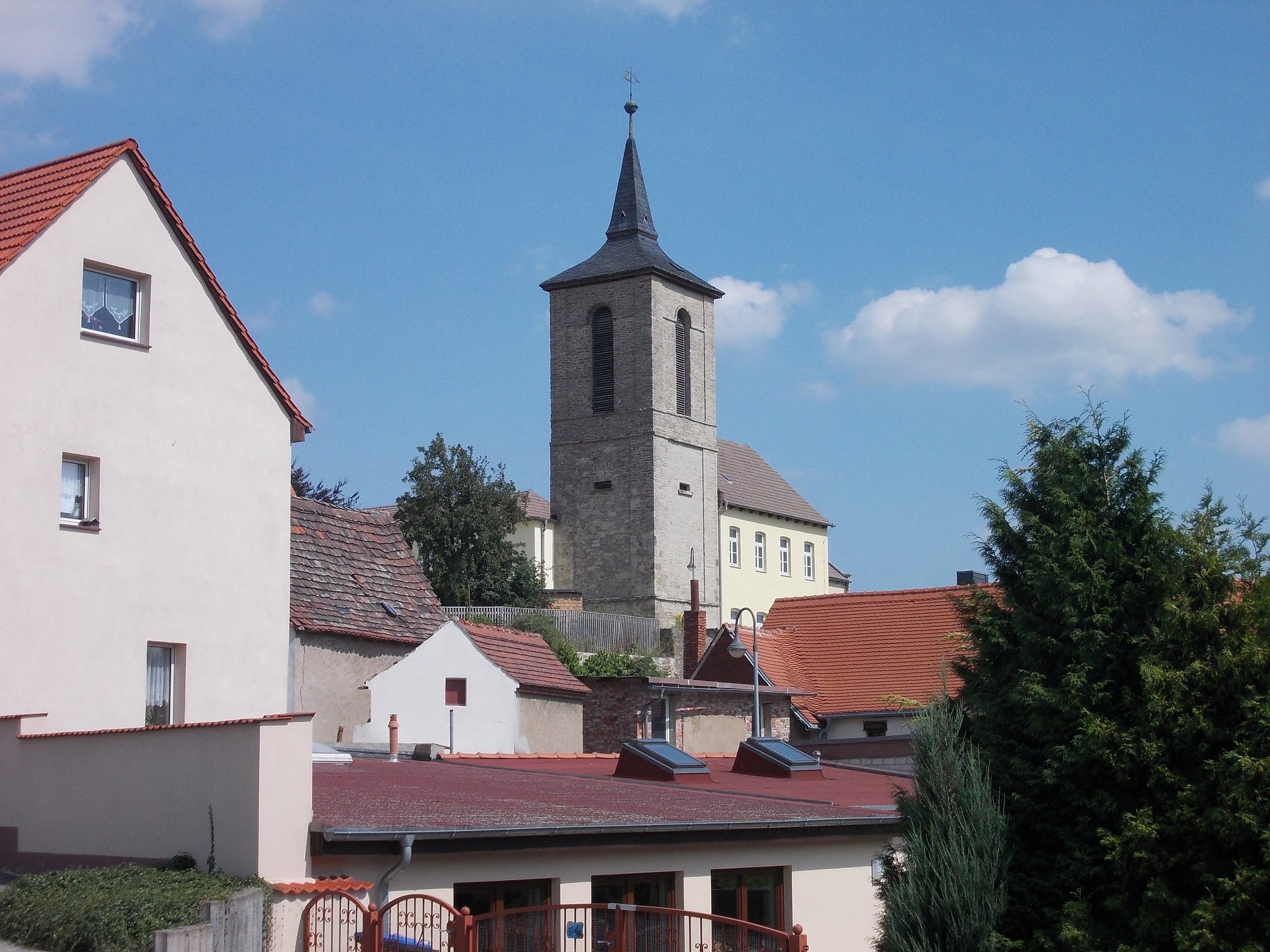
Only isolated architectural elements of the former monastery survive in later buildings. The school at Schulstrasse 7 incorporates a Romanesque impost block, the projecting stone at the springing point of an arch or vault, decorated with stars and vine ornament. The bell tower built in 1827 and 1828 has a lower section inherited from the Romanesque monastery. Romanesque cellars survive beneath the former nuns’ residence at Klosterplatz 12 to 16.
A portion of a tomb slab depicting a nun or abbess survived in the monastery cellar. Other finds from the ruins were later transferred to Halle. Former underground monastery passages have also been made visible again.
Artistic and commemorative remains
Altarpiece and stucco fragments
The monastery’s winged altarpiece, made in 1440, was transferred to the town church and incorporated into a new altar in the seventeenth century. Medieval stucco fragments from the demolished monastery church, including a basilisk, are preserved in the State Museum of Prehistory in Halle. Several additional fragments are held by the Bode Museum in Berlin.
Models and memorial figures
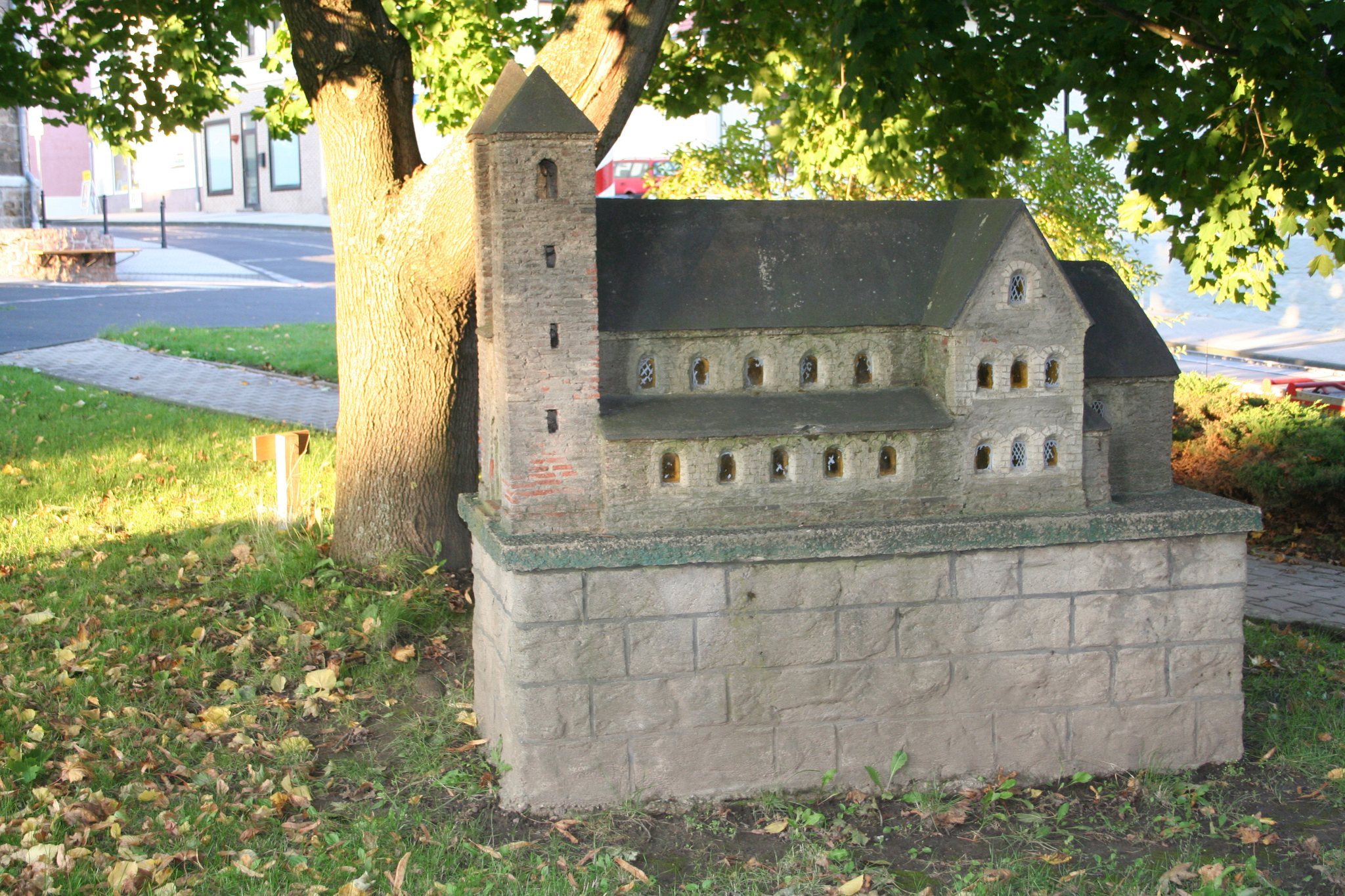
A model of the monastery stands on Schiller Square, while another is displayed in the civic center with other monastery relics. A group of figures placed beside the bell tower in 1999 commemorates the foundation of the monastery.
Round chapel and pilgrimage connections
The round chapel begun in 1168 and consecrated in 1177 was first associated with Saint Mary in the cloister. Its precise location is unknown. It was later incorrectly connected with Charlemagne because of a misreading of its bell inscription. The corrected reading dates the bell to 1495 rather than to the ninth century. The pilgrimage chapel at Welfesholz, also belonging to Gerbstedt, formed part of the monastery’s wider religious property.