Manyava Skete: An Orthodox Monastic and Fortified Complex in Ukraine
Site at a Glance
- Rating
- 4.8
- Popularity
- Medium
- Country
- Ukraine
- Primary era
- Early Modern
- External website
- Open
- Eras represented
- Early Modern, Modern
- Civilizations
- Polish–Lithuanian Commonwealth
- Site type
- Religious
- Remains
- Fortified Monastery
On this page14 sections
History
Manyava Skete is an Orthodox male monastery in Ukraine, near the village of Manyava in the Carpathian Mountains. Founded by Ukrainian Orthodox monks, it developed through construction dated broadly to 1611–1621 as an ascetic religious community and an important spiritual, cultural, and artistic center of Galicia. A skete is a monastic settlement organized around solitary or semi-solitary religious life, usually with less central organization than a conventional monastery.
Foundation and Orthodox development
A monastic community was established at Manyava in 1606 by Job Knyahynytskyi, Ivan Vyshenskyi, and Zakharia Kopystenskyi. Job, who had previously lived as a monk on Mount Athos, became the first hegumen, or abbot. The community followed a notably strict ascetic regime. Monks lived in cold cells and generally abstained from meat and dairy products.
By 1640, the monastery reportedly housed about 200 monks. It maintained a substantial library, produced liturgical books, and functioned as a religious tribunal involved in choosing candidates for the metropolitan see of Lviv. Its influence extended across Galicia, Bukovina, Moldova, and neighboring regions. In 1620 or 1621, the Patriarch of Constantinople granted the monastery stavropegic status, placing it directly under the patriarch rather than the ordinary local ecclesiastical hierarchy. The status was reaffirmed in 1748.
In 1628, a church council in Kyiv granted Manyava the rank of prot, meaning a principal monastery that exercised authority over other monasteries. The jurisdiction then extended over monasteries in the Ruthenian, Belz, and Podolian voivodeships, with 556 monasteries said to be subject to it. During the religious competition between Catholic, Greek Catholic, and Orthodox communities in the Polish-Lithuanian Commonwealth, Manyava became a center of opposition to the Union of Brest. That union brought parts of the Orthodox hierarchy into communion with Rome while retaining the Byzantine rite. Manyava remained Orthodox, although Greek Catholics and Roman Catholics also attended its major services.
Privileges, trade, and destruction
Political authorities granted the monastery protection during the seventeenth century. In 1653, during the Khmelnytsky uprising, a Cossack-led revolt against Polish rule and the existing political order, King John II Casimir praised the monks for their loyalty to the Polish crown. Adam Potocki placed them under his protection, while Stanislaw Rewera Potocki exempted the skete from wartime taxes, billeting, and military stationing. Augustus II later guaranteed that its customs and freedoms could not be violated by Roman Catholic, Greek Catholic, or Orthodox hierarchs.
Seven privileges exempted the monastery from tolls at city gates, on roads, and at fords and bridges. Four were issued by John II Casimir in 1659, Michael Korybut Wisniowiecki in 1669, John III Sobieski in 1686, and Augustus II in 1698. These concessions supported a salt trade from Pokuttya toward Volhynia and Ukraine and contributed to the monastery’s prosperity.
In 1676, Ottoman forces commanded by Ibrahim Pasha devastated the surrounding area, burned the skete, and killed monks and local inhabitants who had sought refuge there. The monks appealed afterward to Tsar Fyodor III of Russia. He presented part of a relic traditionally identified as the True Cross and promised a recurring subsidy of 300 rubles every five years from 1680. Russia also supplied books, liturgical vestments, and cloth.
Dissolution and dispersed heritage
After Austria occupied Red Ruthenia in 1772, the monastery sought confirmation of its privileges and possessions. Maria Theresa confirmed the inviolability of its property in 1776. Her successor, Emperor Joseph II, ordered the skete dissolved on 1 July 1785 as part of his religious reforms. The monks moved to Orthodox monasteries in Bukovina, while the monastery’s movable property was dispersed.
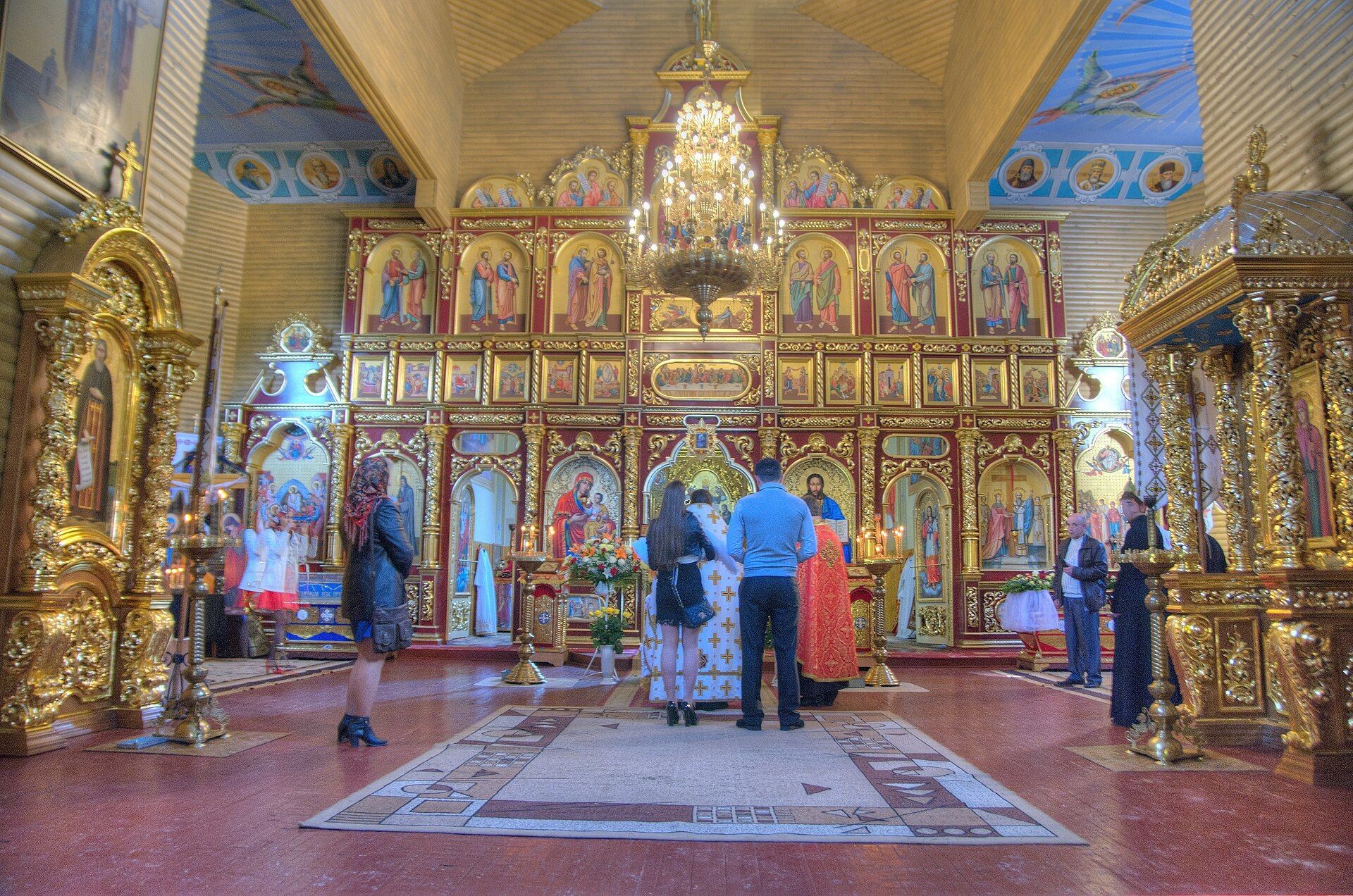
Books were transferred to Lviv University, and liturgical vessels and vestments went to a newly established Greek Catholic seminary. The church was transferred to Nadvirna, where it served as a parish church until it burned in August 1914. The principal iconostasis, an icon screen separating the sanctuary from the main body of an Eastern Christian church, was made by the Ukrainian painter Job Kondzelevych. After the dissolution it was moved to the church at Bohorodchany and later entered the Andrey Sheptytsky National Museum in Lviv, where it has been kept since the 1920s. A reliquary containing part of the True Cross was transferred to an Orthodox monastery in Suceava.
Restoration and renewed monastic life
The former monastery was protected during the Soviet period as an architectural monument of the Ukrainian Soviet Socialist Republic. An historical and architectural museum opened there in 1980, and restoration of the neglected complex began during the 1980s. Orthodox monastic life returned after the collapse of communism. The present Holy Cross monastery formally reopened in 1998 under the jurisdiction then associated with the Kyiv Patriarchate and now belongs to the Orthodox Church of Ukraine.
New religious buildings have continued to be added and consecrated. A Transfiguration church was consecrated in 2013, while a church dedicated to the Holy Spirit was consecrated on 26 September. The main Holy Cross church, built in 2001, stands on the foundations of the earlier church.
Saints, traditions, and commemorations
Job Knyahynytskyi and Theodosius, the first two abbots, are buried beneath a surviving tombstone and are venerated as saints. The Orthodox Church of Ukraine also recognizes 23 additional Manyava venerable martyrs as locally venerated saints. The traditional memorial day for Job and Theodosius is 7 July, while the 23 martyrs are commemorated on 19 September.
The skete is associated with traditions of Marian apparitions and miraculous icons. A tradition connected with a plague in 1652 recounts that the hieromonk Filaret saw the Virgin Mary, after which the epidemic was said to end. An icon commemorating the event is kept at the skete. Another miracle-working icon of the Mother of God was painted on Mount Athos in 1788 and brought to Manyava in 2003. It is said to have shed myrrh, a fragrant sacred oil, in 2004 and again in spring 2012.
Manyava is also traditionally connected with Blessed Stone, a former hermitage associated with the area’s first monks. Devotees believe that its spring has healing properties comparable to the waters of Lourdes. According to the tradition, the spring stopped flowing after the monastery closed and resumed after the complex was restored. Scholars have considered it possible that Hetman Ivan Vyhovskyi was buried at the skete because he had requested burial there, but searches in the 1930s found no remains. His wife, Olena Statkevych, may also have been buried nearby, although that identification remains uncertain.
Remains
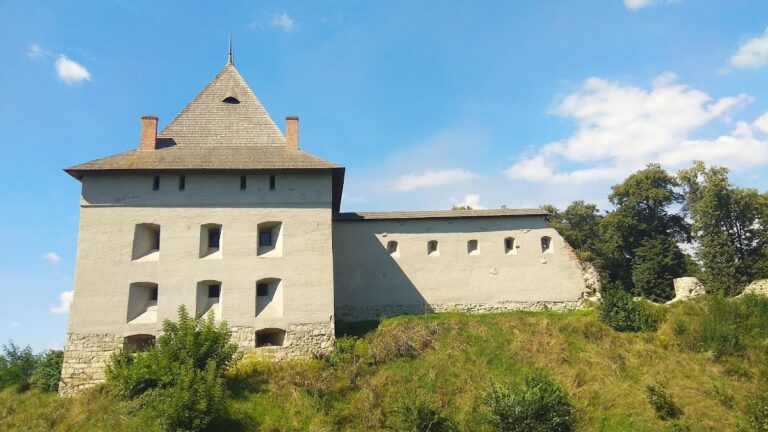
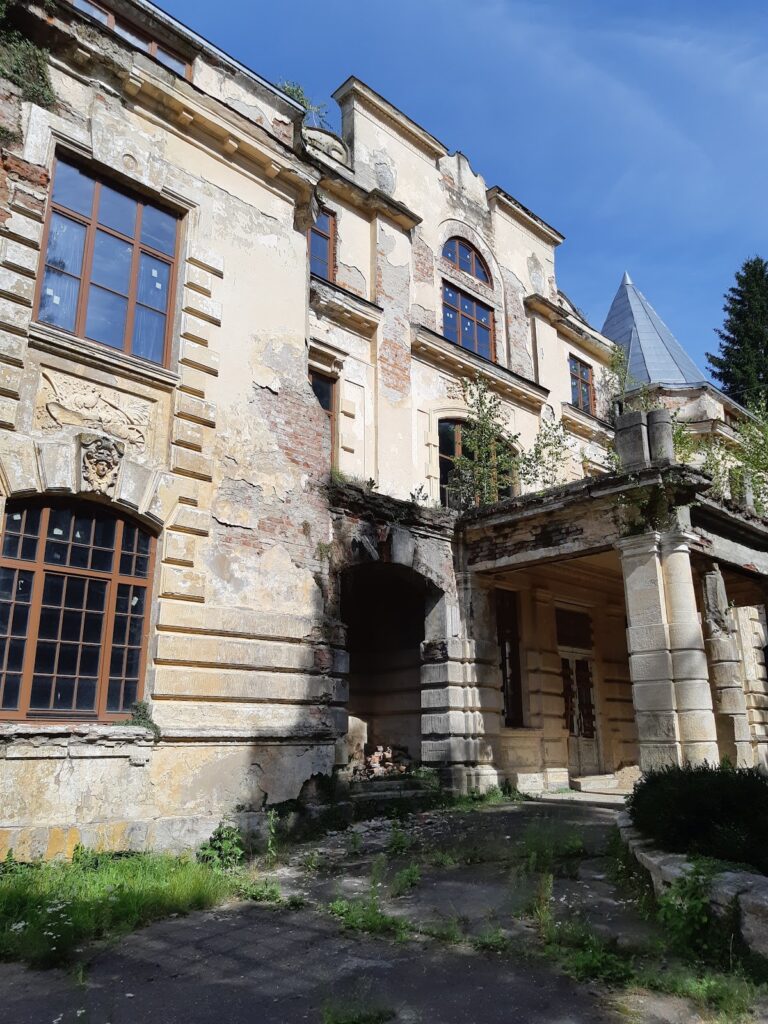
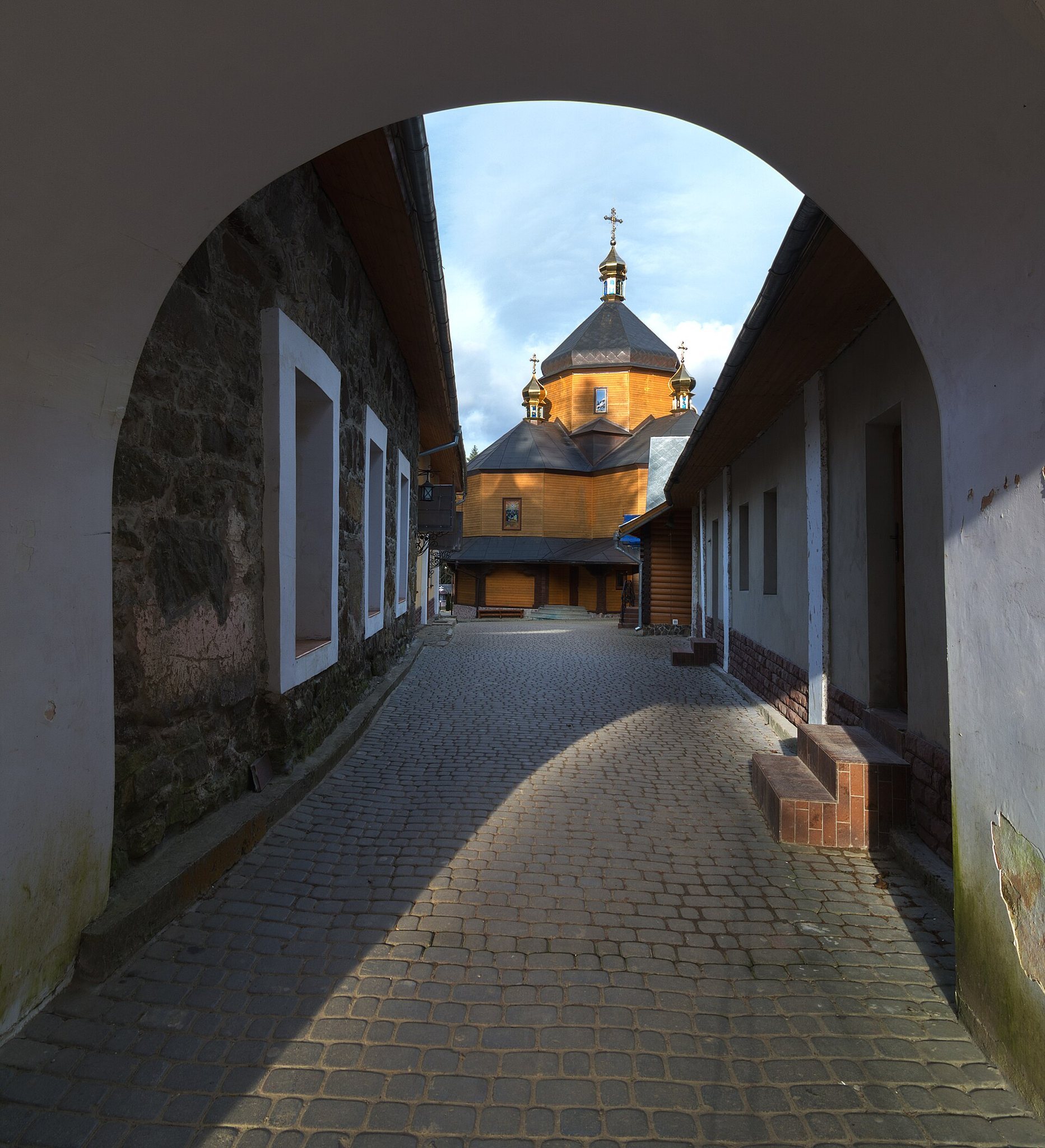
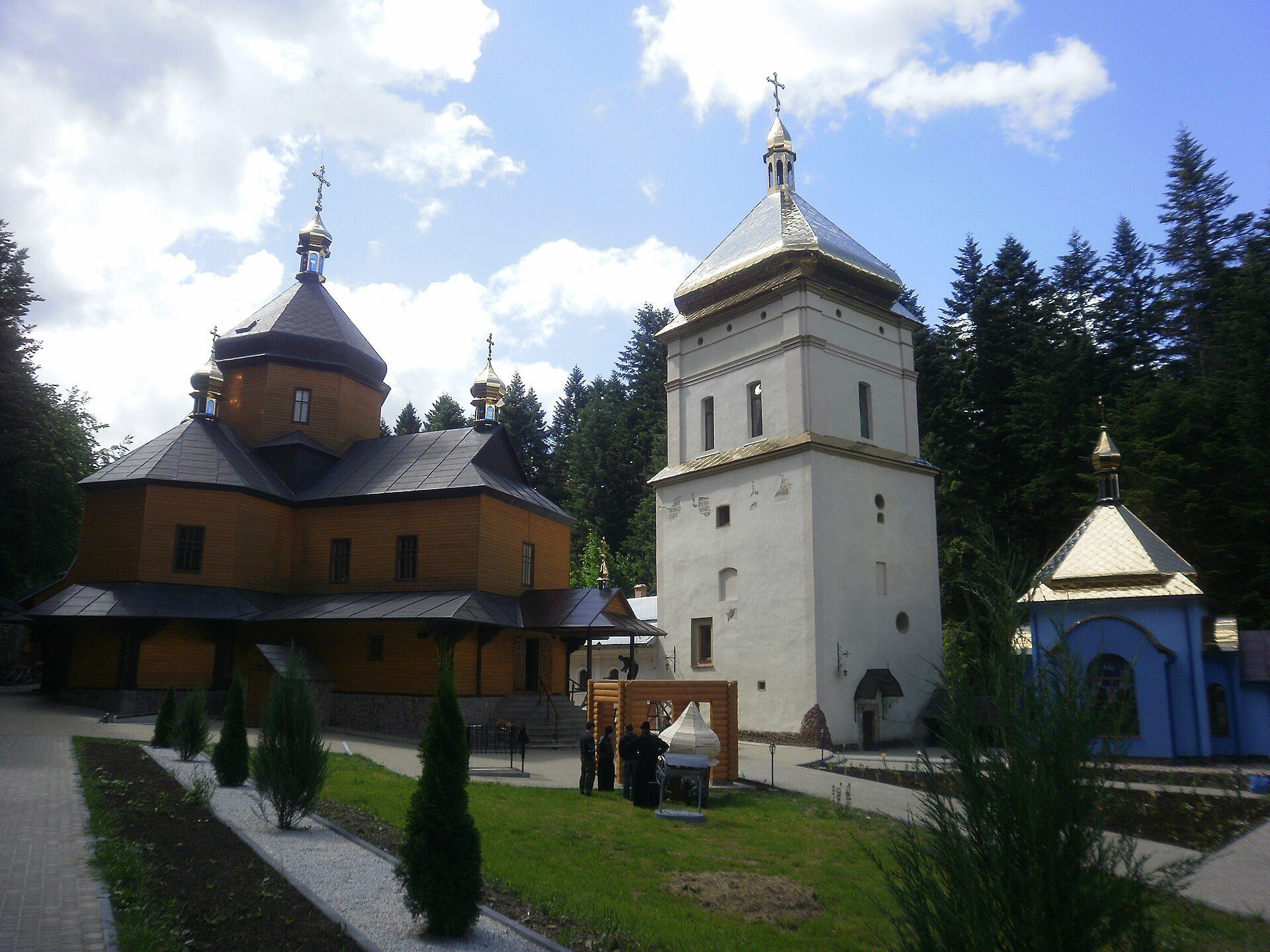
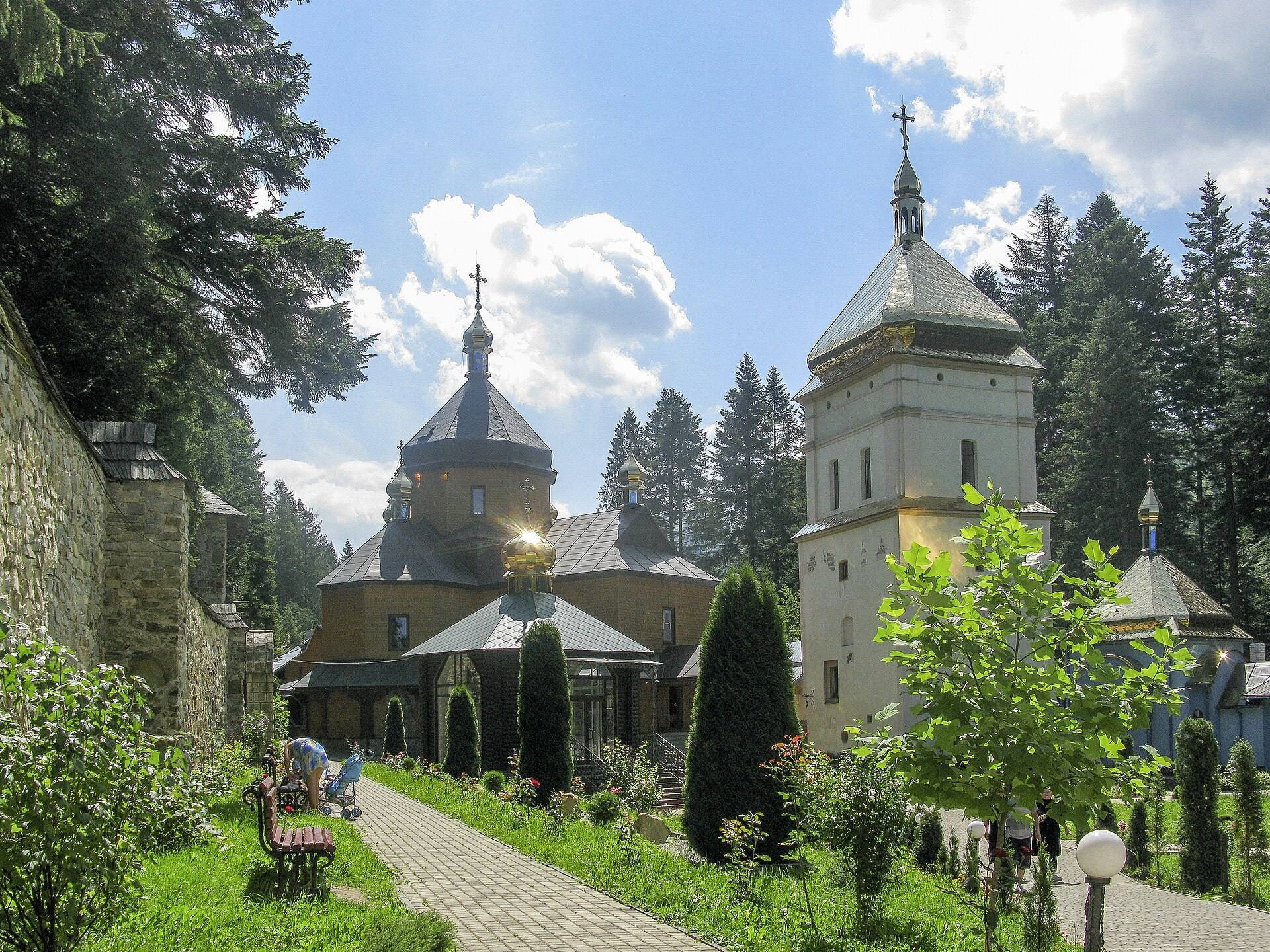
Manyava Skete survives as an ensemble of stone and wooden buildings set between forested mountain slopes. Watercourses border the site on three sides, including the Skitets stream, a right tributary of the Manyavka River. The natural setting formed part of the monastery’s defensive character, while the built complex combined religious, residential, service, and fortified elements. A high stone wall with towers and loopholes enclosed the grounds.
Walls, towers, and underground spaces
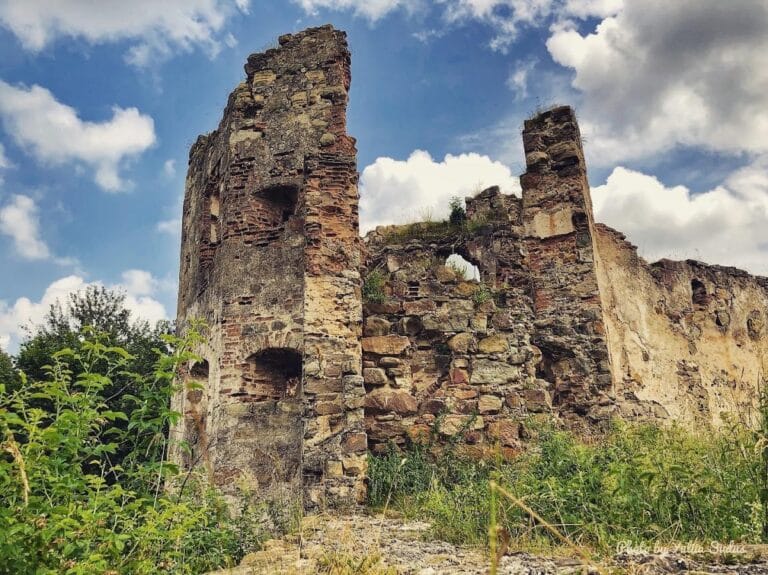
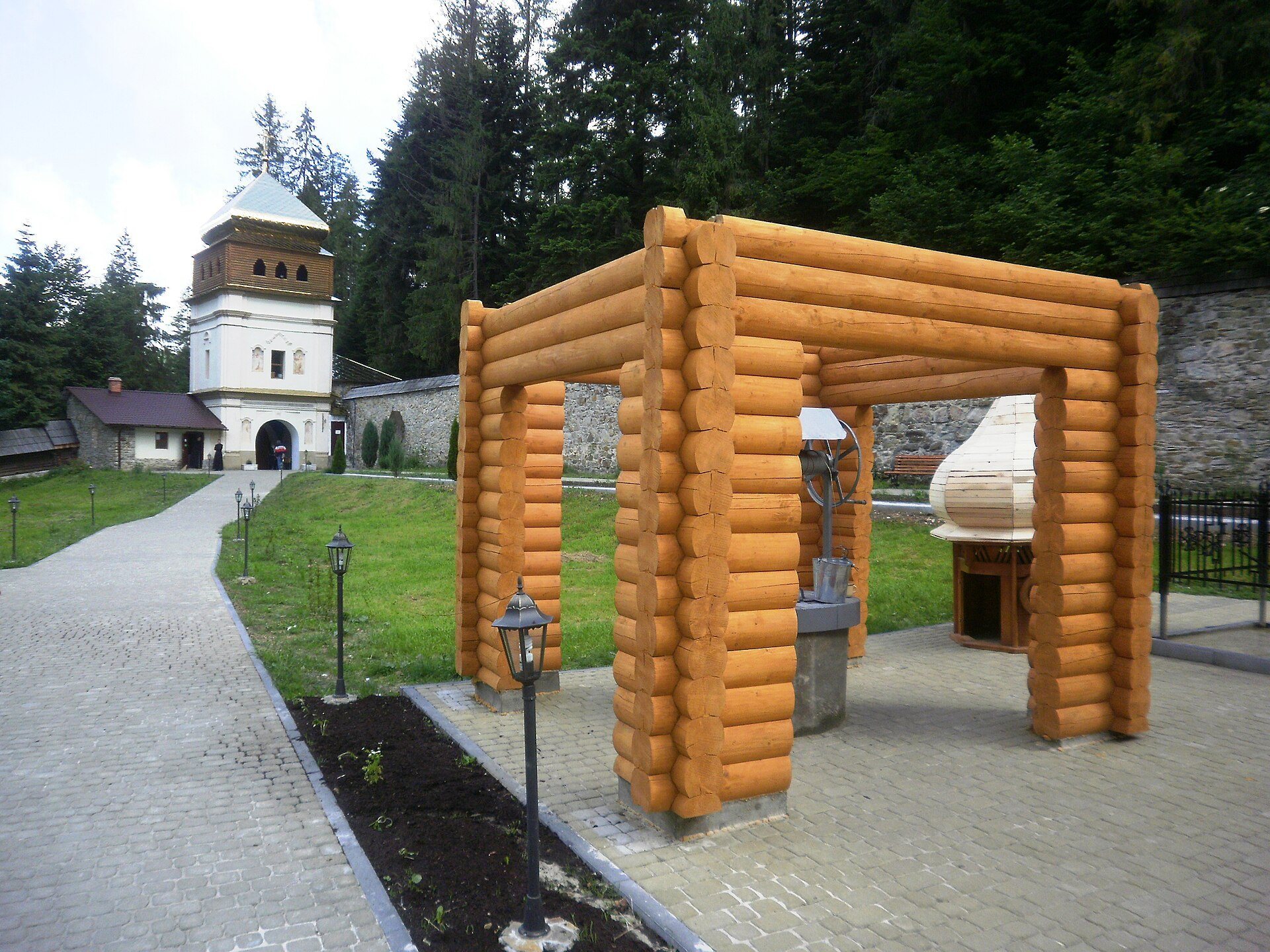
The defensive enclosure included three towers. A surviving tower-treasury, a southeastern entrance tower, and a gate tower or gate bell tower are among the recorded elements of the complex. Monastic cells and a refectory stand beside the southeastern entrance. The surviving fragments of the walls, the tower, and the associated monastery structures preserve the physical outline of the former fortified enclosure.
Vaulted underground cellars lie beneath the courtyard. Concealed exits lead toward the mountains, and passageways connect different buildings. These spaces formed part of the monastery’s service and defensive infrastructure, linking the enclosed buildings with routes through the surrounding landscape.
Churches and sacred buildings
Church of the Exaltation of the Holy Cross
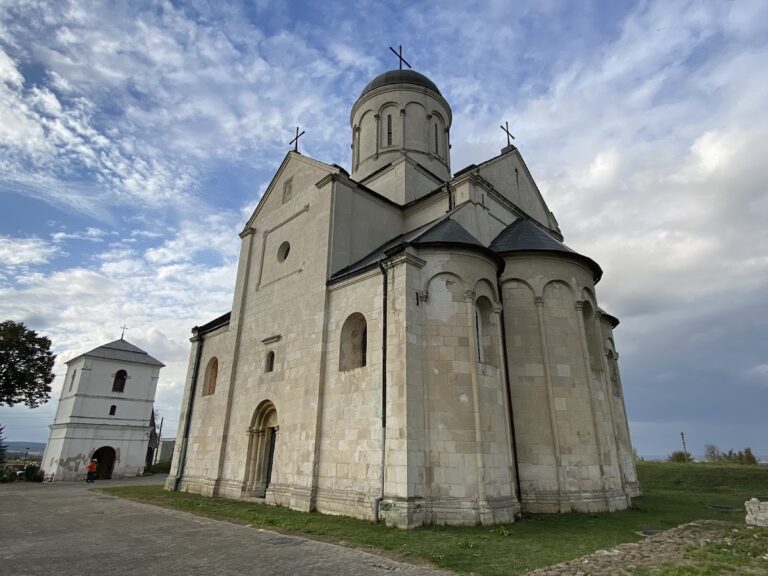
The present Church of the Exaltation of the Holy Cross was built in 2001 on the foundations of an earlier Holy Cross church dated to 1619. Its foundations therefore preserve the location of a principal church of the early monastery, while the standing building belongs to the restored phase of monastic life.
Churches of Borys and Hlib and the Archangel Michael
The complex also includes the Church of the Holy Martyrs Borys and Hlib and an underground church dedicated to the Archangel Michael. Together with the Holy Cross church, they form the principal group of churches associated with the skete.
Later monastic churches
The restored grounds include a Transfiguration church, consecrated in 2013, and a church dedicated to the Holy Spirit, consecrated on 26 September. These buildings belong to the continuing development of the modern monastery.
Cemetery, museum, and movable remains
The large monastery cemetery contains burials of monks and Christian believers from different confessions. The tombstone over the graves of Job Knyahynytskyi and Theodosius remains at the skete. The museum holds six old icons, five copies of icons from the Bohorodchany iconostasis, processional banners, liturgical vestments, several crosses, examples of relief carving, and metal objects made for religious use.
The 1788 Athonite icon of the Mother of God is preserved at the present monastery. By contrast, the principal iconostasis by Job Kondzelevych is no longer at Manyava. It survives in the National Museum in Lviv, where it represents the artistic heritage of the former monastery.
Lake and Blessed Stone
The monastery grounds include a lake traditionally dated to 1617. Beyond the monastery, near the lake and a forest road, Blessed Stone forms a large rock with a recess approximately 10 by 3 meters. The recess resembles a cave or niche and is described as an early solitary dwelling of monks. Water has flowed from the stone for centuries, preserving the site’s association with the first ascetic communities in the area.