Reginald’s Tower: A Medieval Fortified Tower in Waterford, Ireland
Site at a Glance
- Rating
- 4.6
- Popularity
- Low
- Country
- Ireland
- Primary era
- Medieval
- External website
- Open
- Eras represented
- Medieval
- Civilizations
- Norman
- Site type
- Military
- Remains
- Tower
On this page11 sections
History
Reginald’s Tower is a historic fortified tower in Waterford, Ireland, built by the Anglo-Normans during the medieval period after their conquest of the city. The present structure probably dates from the thirteenth or fourteenth century and may have been built between 1253 and 1280. It replaced an earlier Viking fortification of uncertain date and is regarded as Ireland’s oldest civic building. The tower also retains the only urban Irish monument name derived from Norse or Viking tradition.
Viking and Anglo-Norman origins
The tower’s name is the English form of Reginald, derived from the Irish Raghnall and ultimately from the Old Norse name Røgnvaldr. It probably refers to one of Waterford’s Viking rulers, possibly Ragnall Mac Gilla Muire, who is regarded as the last Hiberno-Norse ruler of the town. Hiberno-Norse communities combined Norse and Gaelic political and cultural traditions.
After the Anglo-Norman conquest of Waterford, Norman-led forces and settlers established the tower as part of the city’s new defensive system. In 1185, Prince John, the future King John, ordered the rebuilding of Waterford’s defences, including the tower. The structure visible today probably belongs to a later phase of that development. It was also known as Dundory Tower and the Ring Tower.
Reginald’s Tower became one of seventeen towers that encircled medieval Waterford. It stood at the apex of a defensive triangle completed by Turgesius Tower on Barronstrand Street and St Martin’s Castle on Lady Lane. The tower consequently served both as a strongpoint and as part of the wider fortified boundary of the city.
Royal visits and medieval government
The tower had several civic and royal functions. It served at different times as a customs house, mint, prison, arsenal, military storehouse, and occasional royal castle. King John visited in 1210 and ordered new coins to be struck there. In 1463, while the Irish Parliament was meeting in Waterford, coins were minted at the tower bearing the inscription “Civitas Waterford,” meaning “City of Waterford.”
Reginald’s Tower was also associated with the marriage of Richard de Clare, the second Earl of Pembroke, commonly called Strongbow, and Aoife, daughter of Dermot MacMurrough, king of Leinster. MacMurrough’s alliance with the Anglo-Normans helped bring about their intervention in Ireland.
Richard II visited the tower in 1394 and again in 1399, when it was used to store munitions. On 27 July 1399, he left Waterford as king of England and Wales. After returning to England, he was captured by the future Henry IV and forced to abdicate.
Sieges and military history
In 1495, the tower’s cannons helped Waterford resist the forces of Perkin Warbeck, a pretender to the English throne during the reign of Henry VII. The eleven-day siege ended unsuccessfully for Warbeck’s forces, and one of their ships was sunk by fire from the tower. A cannon from that vessel was recovered from the River Suir in 1901. The action was regarded as the first successful use of artillery by an Irish city and contributed to Waterford’s motto, “Urbs Intacta Manet,” meaning “Waterford remains unconquered.”
Waterford was besieged in 1649 by Oliver Cromwell’s parliamentarian army during the conquest of Ireland, but the attack failed. Cromwell’s forces returned and captured the city in 1650. A cannonball lodged in the tower’s north wall is traditionally associated with that siege. During the Irish uprising of 1641, the flag of the Irish Confederation was reportedly flown over Waterford and the tower.
In 1690, after his defeat at the Battle of the Boyne, James II is said to have climbed to the top of Reginald’s Tower for a final view of his lost kingdom before going into exile in France. The tower continued to store munitions during the seventeenth and eighteenth centuries, and it housed a prison in the early nineteenth century.
Civic use and museum history
Reginald’s Tower became the property of Waterford Corporation in 1861 and served as the residence of Waterford’s chief constable. It remained inhabited until 1954, when it was converted into a museum. During the Emergency, Ireland’s policy of neutrality and wartime preparedness during the Second World War, the tower was used as an air-raid shelter.
The tower is now part of Waterford’s Viking Triangle and houses the Waterford Viking Museum. It is a National Monument of Ireland and remains an important surviving element of the city’s medieval defensive circuit.
Remains
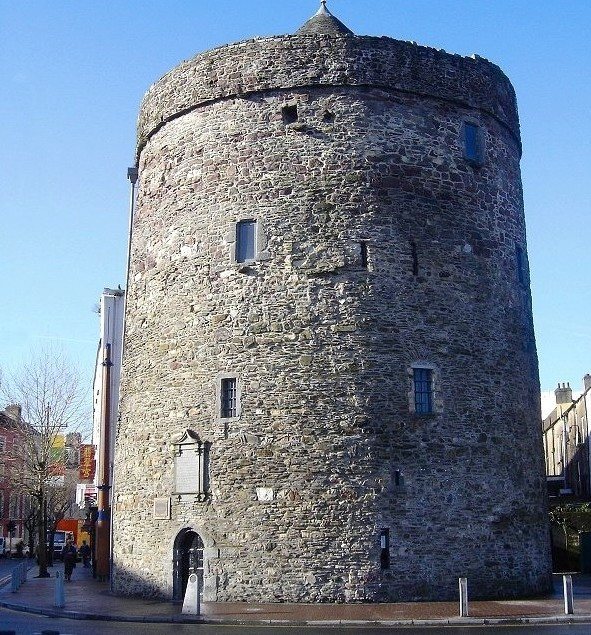
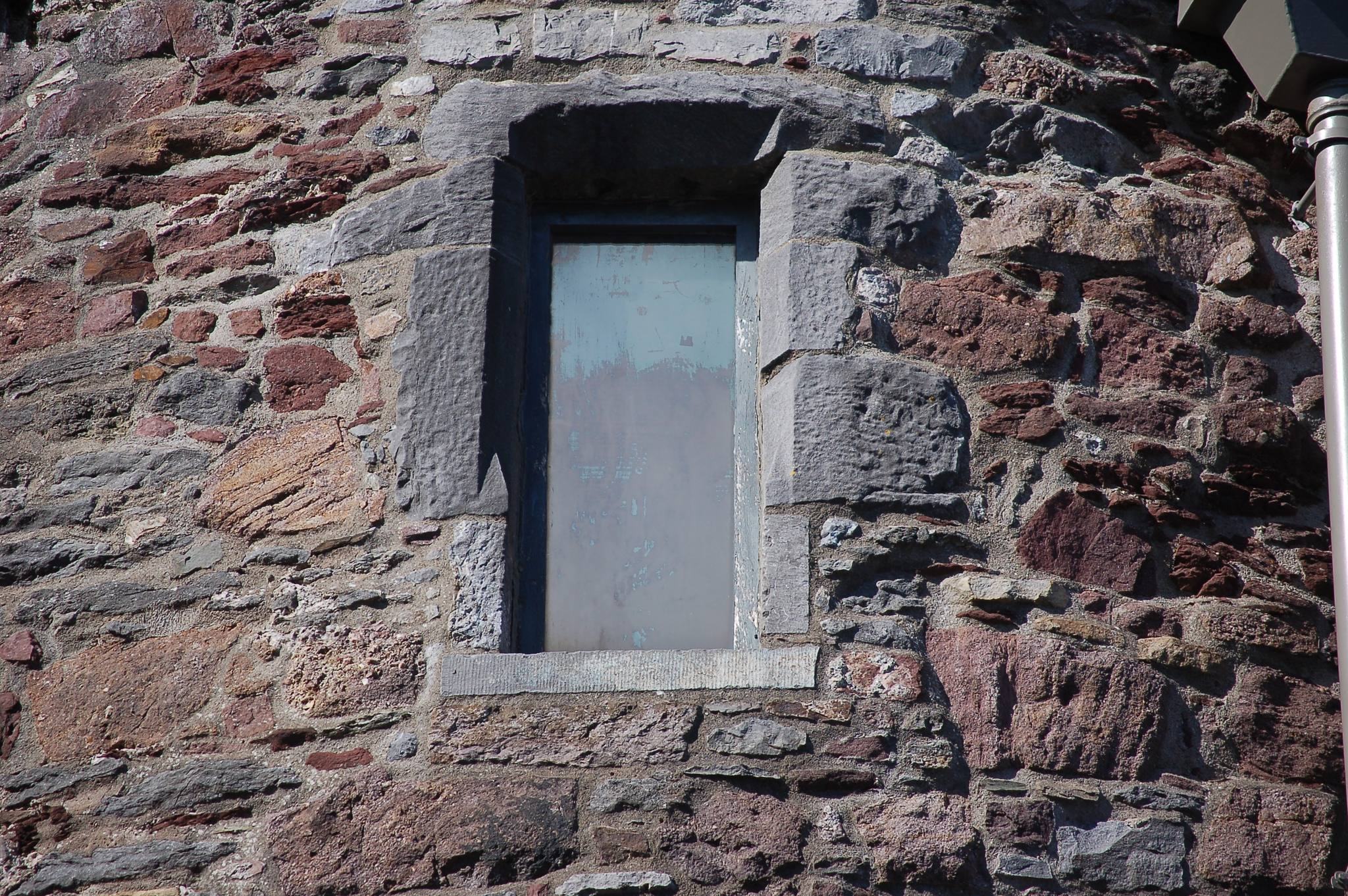
Reginald’s Tower is a circular stone structure about 54 feet, or 16 metres, high and approximately 42.5 feet, or 12.75 metres, in diameter. A conical roof surmounts the building. Its massive walls measure about 10 feet, or 3 metres, thick at the base and narrow to roughly 7 feet, or 2.1 metres, near the top. A spiral staircase rises within the thickness of the walls.
Setting and defensive layout
The tower occupies high ground between a branch of the St John’s River to the southeast, now drained and known as the Mall, and the River Suir to the north. It stands close to the historic French Church. Its position formed one point of a defensive triangle with Turgesius Tower on Barronstrand Street and St Martin’s Castle on Lady Lane, while the surrounding city wall connected it to Waterford’s broader defensive circuit.
Fortifications and surviving evidence
Defensive tower
Reginald’s Tower is the largest of the six surviving medieval towers associated with Waterford’s defences. The others are the Watch Tower, Double Tower, French Tower, Semi-Lunar Tower, and Beach Tower. The tower’s circular plan, thick tapering walls, internal stairway, and roofed upper form reflect its long defensive and military use.
Cannonball and recovered cannon
A cannonball remains lodged in the north wall and is traditionally linked with the 1650 siege of Waterford. The cannon associated with the 1495 attack was recovered from the River Suir in 1901, preserving physical evidence connected with the tower’s artillery history.
Viking museum collections
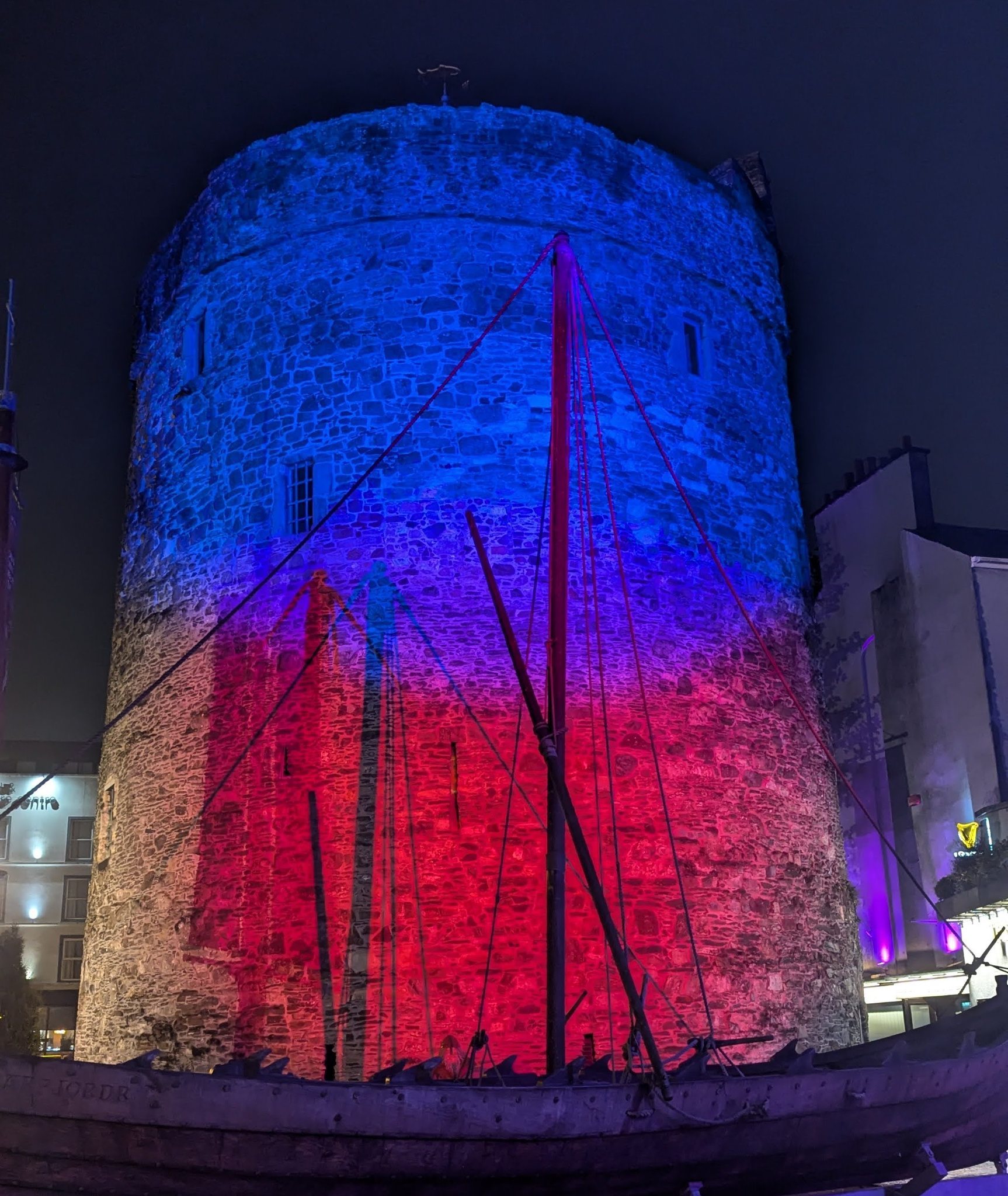
The Waterford Viking Museum inside the tower displays archaeological finds from the 2003 excavations at Woodstown on the River Suir near Waterford. A replica Viking longship is exhibited beside the building, linking the museum’s collections with the city’s earlier Norse and Hiberno-Norse history.