Torre del Conde: A Late-Gothic Military Tower in La Gomera
Site at a Glance
- Rating
- 4.3
- Popularity
- Medium
- Country
- Spain
- Primary era
- Medieval
- External website
- Open
- Eras represented
- Medieval, Early Modern
- Civilizations
- Crown of Castile, Spanish
- Site type
- Military
- Remains
- Tower
On this page9 sections
History
Torre del Conde is a late-Gothic military tower in Spain, built by Castilians between 1447 and 1450 during the conquest of the Canary Islands. It stands in San Sebastián de La Gomera and was commissioned by Hernán Peraza the Elder, a Castilian hidalgo, or member of the lesser nobility, who held the title of Count of La Gomera. The tower expressed his seigneurial power, meaning the authority exercised by a territorial lord over a dependent domain. It is the only surviving tower built during the conquest of the Canary Islands.
Foundation and the Rebellion of the Gomeros
The tower’s position near, but not directly beside, the port and at the bottom of a valley shaped its military role. Its design provided no specific provision for firearms, and its location suggests that it was not principally intended to resist an external attack equipped with such weapons. Instead, it relied largely on the indigenous population’s lack of modern weaponry and served as a visible stronghold of the ruling family.
Its defensive purpose became clear during the Rebellion of the Gomeros in 1488. This uprising by the indigenous inhabitants of La Gomera followed the killing of Hernán Peraza the Younger. His wife, Beatriz de Bobadilla, and their two children took refuge in the tower until Pedro de Vera, a Castilian military commander and royal official, arrived from Gran Canaria with troops. The tower may then have stood at the centre of a wider group of temporary or minor fortifications. It resisted the lightly armed Gomeros, but its later history showed the limits of its defenses against better-equipped attackers.
Repairs and changing defenses
French Huguenots, French Protestants associated with the Reformed tradition, severely damaged the tower in 1571. In 1578, the military engineer Jacome Pelearo Fratín directed its repair and added a small cubic structure for artillery pieces. The cost was 3,000 ducats, shared equally by the reigning count and the Crown under King Philip II.
Several years later, the Italian military engineer Leonardo Torriani examined La Gomera’s defenses and judged the tower ineffective in its existing form. He proposed strengthening it with a bastion, a projecting fortification designed to allow defensive fire along adjoining walls. The proposal was initially rejected mainly because of its cost. Instead, the slope at Buen Paso was fortified to improve the security of the port.
In 1634, Íñigo de Brizuela y Urbina, newly appointed Captain General of the Canary Islands, found the archipelago’s military installations, particularly those on Fuerteventura and La Gomera, in very poor condition. He ordered the tower to be enclosed by a diamond-shaped bastion, which has not survived. British Captain Charles Windham severely damaged the tower during an attack in 1743, and repairs followed in 1776.
Later uses and preservation
During the nineteenth century, Ramón de Echevarría, captain of the provincial militias, commissioned further alterations that did not substantially change the exterior. In the second half of that century, the tower was temporarily rented to private individuals. It later served as a barracks during both world wars and housed a fish-processing operation during the period between them.
In the mid-twentieth century, the tower was transferred to the Cabildo, the island-level governing institution of the Canary Islands, because of its historical importance. The Cabildo restored it to its original appearance in 1960. Torre del Conde was declared a Historic-Artistic Monument in 1990 and a Bien de Interés Cultural in 1993. It is also associated with illustrious visitors, including Christopher Columbus, Amerigo Vespucci, and Hernán Cortés.
Remains
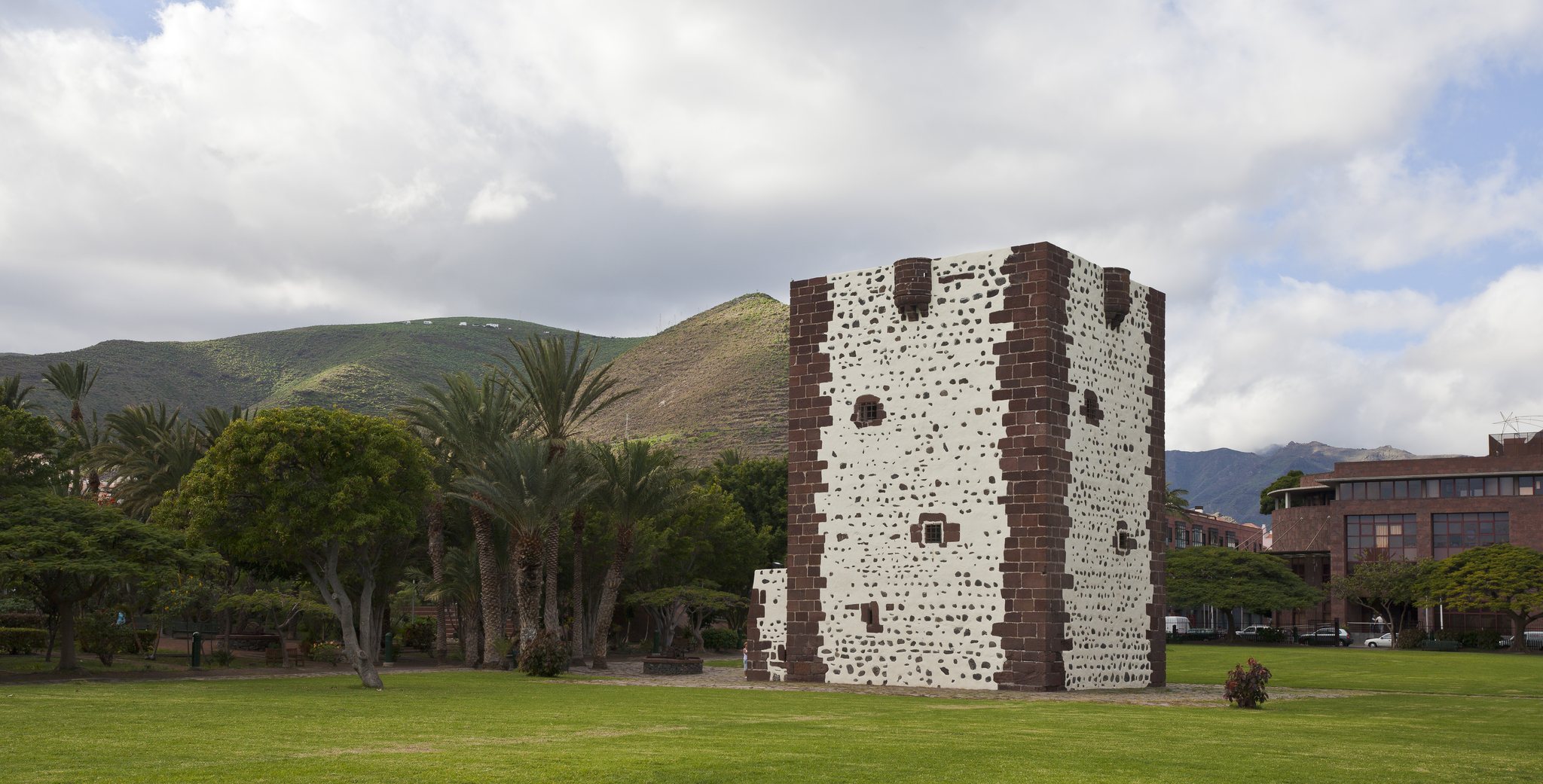
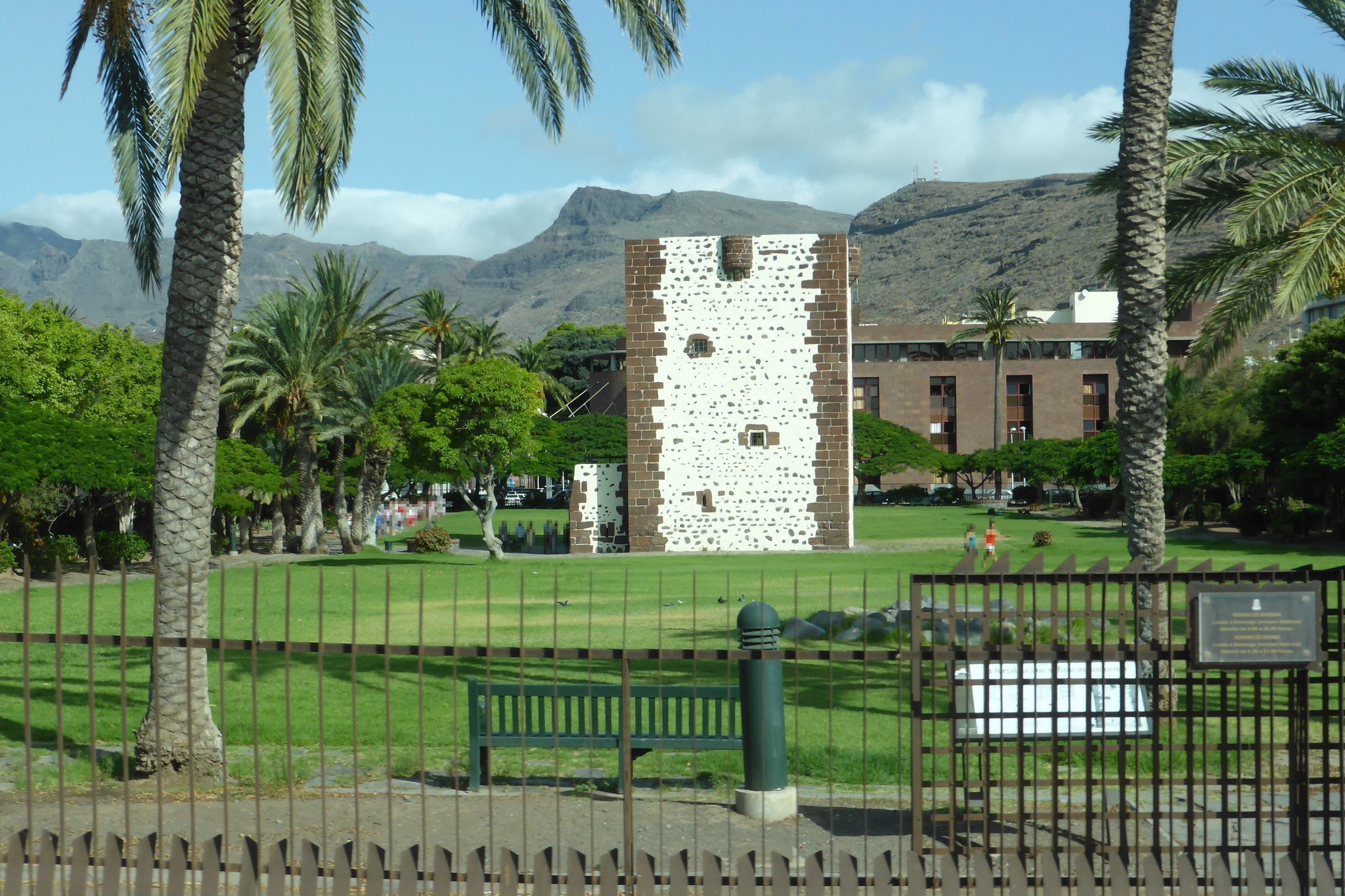
Torre del Conde stands in the park named after it, in the southern part of San Sebastián de La Gomera, near the port and in the southeast of the island. The structure occupies the bottom of a valley, while the port lies nearby at some distance. It is an almost square, three-storey tower with a broadly prismatic form, approximately 15 metres high, a perimeter of about 40 metres, and walls around 2 metres thick. Its late-Gothic military architecture shares features with late-medieval defensive buildings in northern Iberia, including the Torre del Merino at Santillana del Mar in Cantabria.
Main tower
The exterior is whitewashed, with red stone ashlar blocks clearly visible at the corners. A lower forebuilding on the southwest side leads by a staircase to the entrance on the first upper storey. The individual floors are connected by a staircase attached to an interior wall, allowing movement through the compact vertical structure.
The tower’s form reflects the defensive conditions for which it was built. It was better suited to protection from the indigenous population than to resistance against external attacks involving firearms. Its survival through the 1488 rebellion and its later damage in the Huguenot attack illustrate the difference between those two military circumstances. The building is regarded as the southernmost recorded medieval Gothic construction.
Later defensive works
Artillery extension
The small cubic addition on the tower’s structure dates from the repairs directed in 1578. It was intended to accommodate artillery pieces and represents an attempt to adapt the earlier building to changing methods of warfare after the damage inflicted in 1571.
Diamond-shaped bastion
A diamond-shaped bastion was built around the tower in the seventeenth century on the orders of Íñigo de Brizuela y Urbina. The projecting defensive work was intended to strengthen the tower’s military protection, but it no longer survives. Earlier claims that the tower had originally been enclosed by palisades or other fortifications were not confirmed by archaeological soundings.