Fort San Felipe: A Spanish Military Fortress in Cavite, Philippines
Site at a Glance
- Rating
- 4.7
- Popularity
- Very Low
- Country
- Philippines
- Primary era
- Early Modern
- Eras represented
- Early Modern
- Civilizations
- Spanish
- Site type
- Military
- Remains
- Fort
On this page8 sections
History
Fort San Felipe is a Spanish military fortress in Cavite City, Philippines, constructed between 1609 and 1616 during the governorship of Juan de Silva. It was the first military fortress built in Cavite Province and protected Cavite Puerto, the port town that served as a gateway to Manila.
Spanish fortification of Cavite
Cavite Puerto had been recognized as a strategic location before construction began. In 1591, Governor-General Gómez Pérez Dasmariñas started efforts to fortify the port. About two decades earlier, Miguel de Legazpi had hidden his ships at the isthmus before attacking Manila, demonstrating the value of Cavite as a base for military operations.
A description from 1659 presented Fort San Felipe as a quadrilateral fortification with four corner bastions, or projecting fortified platforms, and a perimeter of 220 feet (67 meters). It faced Cavite Port and Manila. The same description mentioned the nearby Santa Catalina the Martyr artillery platform and the ruins of the Casa Real, a Spanish colonial government building that had another gun platform requiring repair.
In August 1663, Governor Sabiniano Manrique de Lara ordered a platform for ten cannons at the fort’s entrance. Four more platforms were added later, each named for a Catholic saint. Between 1679 and 1688, the fortress served as a prison for Fernando de Valenzuela, who had been the valido, or powerful royal favorite, of Queen Regent Mariana of Austria.
Mutiny and nationalist memory
On January 20, 1872, about 200 soldiers and arsenal laborers led by Sergeant Francisco La Madrid mutinied at Cavite, including at Fort San Felipe. The uprising involved the killing of the fort’s governor and was suppressed on January 22. Its aftermath brought executions and a broader crackdown on the emerging nationalist movement.
The three Filipino priests Mariano Gómez, José Burgos, and Jacinto Zamora were unjustly implicated in the aftermath and executed by garrote, an execution method involving strangulation by a tightened cord or collar, on February 17, 1872. Many scholars regard the mutiny as an important early development in Filipino nationalism, which later contributed to the Philippine Revolution of 1896.
On September 12, 1896, thirteen Filipino patriots were executed by musketry at the Plaza de Armas, the military parade and assembly square, outside Fort San Felipe. They had been identified as leaders of a failed uprising planned at the Cavite Arsenal on September 3 and became known as the Thirteen Martyrs of Cavite. The musician Julián Felipe, who later composed the Philippine national anthem, was imprisoned at the fort for nine months after being captured in connection with the conspiracy. Pablo and Marcos José and Juan Castañeda of Imus were later released.
Demolition and later status
During the early American colonial period, part of Fort San Felipe was demolished to make room for a naval station. The surviving fortification now lies within Naval Base Cavite, which occupies part of the historic port town and the former Cavite Arsenal. The area forms part of the San Roque district of Cavite City and is controlled by the Philippine Navy. The Government of the Philippines owns the site. Fort San Felipe is also associated with the Battle of Manila Bay.
Remains
Fort layout
Fort San Felipe was arranged as a four-sided enclosure with defensive curtain walls, meaning walls that connected the corner bastions. The eastern wall, facing the sea, was longer than the others and carried twenty cannons. The entrance stood in the southern wall and opened into the central area of the fort.
The interior contained barracks, an ammunition depot, a gunpowder store, a water tank, and several offices. The garrison included three infantry companies of 180 men each and a separate Filipino unit of 220 men. A ten-cannon artillery platform stood near the entrance, while the Santa Catalina the Martyr platform and four later platforms strengthened the fort’s defenses.
Surviving structure
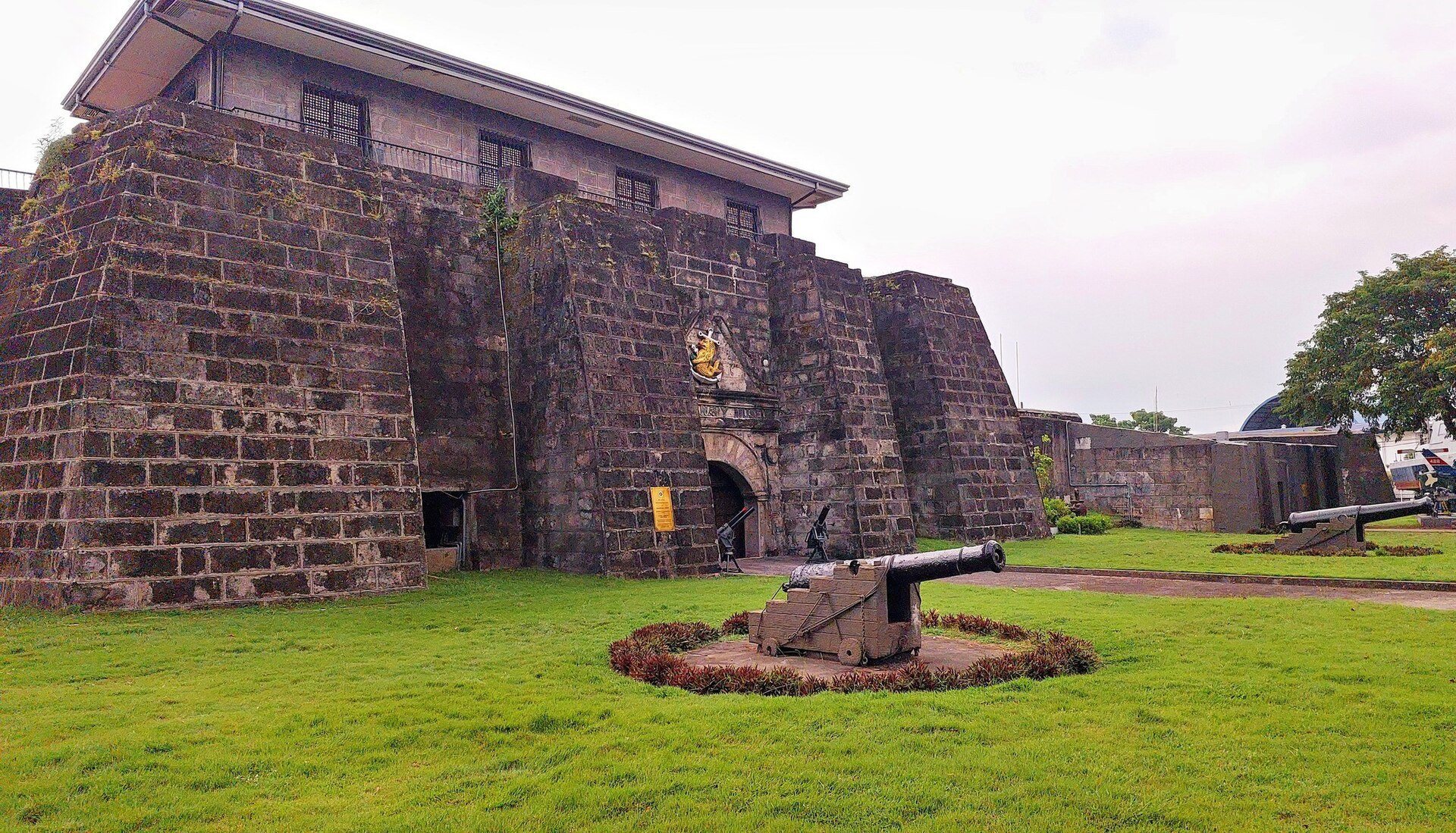
Less than half of the original fort remains. The surviving elements include the facade, the main entrance with sections of its flanking curtain walls, and two terminal bastions. The rest was removed for the naval station during the early twentieth century.
The remaining walls are built from granite blocks and rise approximately 30 feet high. A broad stairway leads to the tops of the bastions and the surviving walls. The remains occupy part of the 9-hectare (22-acre) Naval Base Cavite.
Displayed artillery
Antique cannons and cannonballs are displayed on the lawns of the surviving fortification, preserving material reminders of the artillery defenses that formed part of Fort San Felipe’s original design.