Himmerod Abbey: A Cistercian Monastery in Germany
Site at a Glance
- Rating
- 4.5
- Popularity
- Medium
- Country
- Germany
- Primary era
- Early Modern
- External website
- Open
- Eras represented
- Medieval, Early Modern
- Civilizations
- Holy Roman Empire
- Site type
- Religious
- Remains
- Monastery
On this page21 sections
History
Himmerod Abbey is a Cistercian monastery in Germany, founded by monks from Clairvaux in the Salm valley of the Eifel during the twelfth century. Dedicated to the Blessed Virgin Mary, it belonged to the Diocese of Trier and later to the Mehrerau Cistercian Congregation. The abbey became a major religious and economic center, established daughter foundations, endured war and dissolution, and was refounded in the twentieth century.
Foundation in the Salm valley
In 1131, Albero of Montreuil, after becoming Archbishop of Trier, asked Bernard of Clairvaux to help establish a Cistercian monastery within the Trier ecclesiastical territory. The Cistercians were a reform branch of Western monasticism that followed the Rule of Saint Benedict and emphasized communal prayer, manual labor, austerity, and secluded valley settlements. Bernard, the influential abbot and religious reformer of Clairvaux, sent a founding group under Prior Randulf in 1134.
The monks first settled at Winterbach near the Kyll. Flooding and the restricted nature of that location made construction difficult, so the community moved to the Salm valley in 1135. Himmerod was the fourteenth Cistercian monastery and the first German monastery founded by Bernard of Clairvaux. Bernard sent the monk and builder Achard to organize the work. A foundation charter issued in 1138 marked the transition from the first wooden settlement to a larger stone monastery.
The community used the Latin title Abbatia Claustri Beatae Mariae Virginis. The name Himmerod, used since at least the late thirteenth century, derived from a former uncultivated area associated with Haymo or Hemmo. The foundation was also regarded as a direct establishment of Clairvaux. Its Romanesque abbey church was consecrated by Archbishop Arnold of Trier in 1178. David of Himmerod, a member of the founding community and later regarded as a mystic, died in 1179 as its last surviving founder. He was beatified in 1699.
Medieval expansion and economy
Himmerod took part in the wider expansion of the Cistercian order. Its monks settled at Châtillon between 1153 and 1156, and the abbey founded Heisterbach Abbey in 1189. By 1224, the abbot of Clairvaux had limited Himmerod’s community to no more than 60 monks and 200 lay brothers. The abbey had acquired extensive landed property, including farms and vineyards across the surrounding region, and leased some of its holdings.
Agriculture, fishing, fruit and vegetable cultivation, and viticulture supported the monastery. Himmerod’s boats carried wine as far as Holland and Zeeland. The abbey also served as a burial place for the counts of Sponheim until the beginning of the fifteenth century. Economic decline, private disputes, and warfare gradually damaged the monastery’s position, although its economic life recovered from the middle of the fifteenth century under Priors Peter II of Wittlich and John VII of Saint-Vith.
Rebuilding from the sixteenth to the eighteenth century
In 1519, Pope Leo X granted Himmerod’s abbots pontifical insignia, including the mitre and crosier. The Romanesque church was restored between 1621 and 1630, despite severe plundering by soldiers during the Thirty Years’ War. That conflict, fought across Europe from 1618 to 1648, repeatedly brought military destruction to the monastery.
Abbot Matthias Glabus of Lieser laid the foundation stone for a new convent complex in 1641. The buildings were completed in 1688 under Abbot Robert Bootz, although wartime conditions prevented the planned reconstruction of the church at that stage. Under Abbot Leopold Camp, Christian Kretzschmar began a new Baroque church in 1739. The building was completed in 1751 and consecrated on 10 October of that year by Bishop Nikolaus von Hontheim of Trier.
Dissolution and destruction
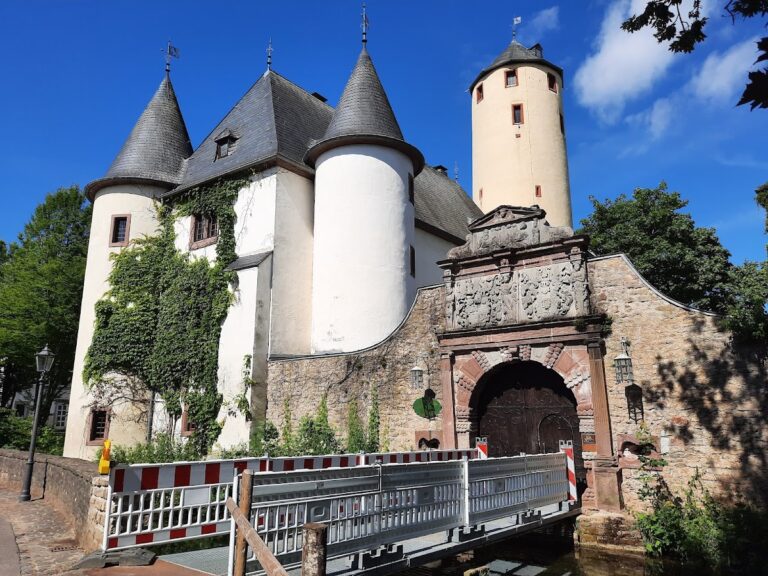
French government reforms under Napoleon dissolved Himmerod on 26 July 1802 during secularization, the suppression of a religious institution and transfer or sale of its property to secular authorities or private owners. In 1803, the property was auctioned to an ironworks owner who ordered the church’s copper roof to be removed. Without the roof, the church deteriorated into a ruin, while the monastery buildings were largely used as a quarry. The mill and gatehouse survived, together with the west gable and limited sections of the church.
The final private owner, Count Ottokar von Kesselstatt, sold the property in 1919. German Trappists from Mariastern in Bosnia acquired part of the former monastery that year. German Cistercians from Marienstatt in the Westerwald repopulated and canonically re-established Himmerod in 1922. The convent buildings were reconstructed in 1925 to 1927, and Carlos Münz was elected abbot in 1925.
Refoundation and the twentieth century
The Nazi authorities confiscated the assets of Himmerod’s building association in 1934 and prevented the immediate rebuilding of the church. During the Second World War, the monastery served as a hospital for hundreds of soldiers, and a military cemetery was established near the property. Before and during the war, many monks and lay brothers moved to Brazil. The community had at one point numbered about 90 religious.
Himmerod also became associated with the creation of the postwar Bundeswehr, the armed forces of the Federal Republic of Germany. From 5 to 9 October 1950, former German Wehrmacht officers met at the abbey at the request of the West German government and Chancellor Konrad Adenauer. The Wehrmacht had been Germany’s armed forces under the Nazi regime from 1935 to 1945. The meeting produced the Himmerod Memorandum, a policy document proposing conditions for rebuilding German armed forces and integrating them into the defense of Western Europe. It became an important step toward the establishment of the Bundeswehr in 1955.
Reconstruction of the church began in 1952 under Abbot Vitus Recke, who led Himmerod from 1937 to 1959. Bishop Matthias Wehr of Trier consecrated the reconstructed building on 15 October 1960, and the building works were completed in 1962. In 1936, Himmerod had also established the Cistercian Abbey of Itaporanga near São Paulo in Brazil, initially as a dependent priory.
After its refoundation, Himmerod resumed its pilgrimage tradition. The abbey operated a press and library and provided hospitality, retreats, cultural events, and religious services. Its library belonged to the Association of Catholic Theological Libraries. In 2008, 550 recruits held a formal military oath at Himmerod because of the abbey’s place in the history of Germany and the Bundeswehr.
Decline and transfer to the Diocese of Trier
The abbey suffered serious financial losses in 2008 and 2009. Staff reductions followed, and enterprises including the fishery were closed. In 2015, an attempted auction of a valuable manuscript and incunabula from the abbey library provoked criticism. An incunabulum is a book printed in Europe before 1501, during the early period of movable-type printing. The manuscript was withdrawn and purchased directly by the Rhineland-Palatinate State Library Centre, which also acquired other books from the collection for public ownership.
In 2017, the Mehrerau Congregation decided to dissolve the monastery because the community had declined to six monks and could no longer sustain its communal and financial life. The property passed to the Diocese of Trier. Most of the monks moved to other monasteries in late 2017 and early 2018. Stephan Reimund Senge remained for a time as the last formal member, living in the guesthouse and continuing worship and pastoral work. A diocesan rector was appointed in 2018, while the diocese continued efforts to preserve Himmerod’s spiritual function.
A major fire damaged the abbey church in summer 2017, and the church reopened on 10 June 2018. Another fire in an unused monastery room on 22 April 2020 was extinguished before it spread to other rooms. In 2021, the Diocese of Trier announced plans to convert Himmerod into a diocesan youth center, but in 2022 it stated that the necessary general renovation could no longer be planned reliably. A later proposal for an upscale guesthouse through an investor was abandoned because of its cost.
Remains
Himmerod occupies a monastic site in the Salm valley between Eisenschmitt and Großlittgen. Its historic complex included the church, convent buildings, a mill, a gatehouse, farms, fishponds, and other service buildings. The site preserves elements from the medieval foundation, the seventeenth-century convent, the Baroque rebuilding, the nineteenth-century destruction, and the twentieth-century reconstruction.
Medieval church and monastic enclosure
The Romanesque basilica
The first stone church was a Romanesque basilica modeled on the church at Clairvaux. Its three naves formed a cross-shaped plan with a straight-ended choir, chapels, and a lantern above the crossing. The main nave measured approximately 60 to 70 meters in length and was divided between the monks’ choir and the area used by the laity. Twenty-seven altars stood within the church.
A porch stood before the eastern facade, with a round window as its principal ornament. The interior contained the tombs of Archbishop John I of Trier and Archbishop Boemund I before the high altar, as well as the heart of Archbishop Albero. Burials connected with the knights of Manderscheid and the counts of Sponheim-Starkenburg occupied the side aisles.
Burials and excavated structures
A building completed north of the nave in 1317 housed the remains of the founder Gerard Gelincks, who was a squire, along with additional burials of priests and laypeople. A grave slab commemorating Countess Loretta of Sponheim was still present in the eighteenth century, while the grave slab of Agnes of Pyrmont lay at the entrance to the abbey church.
Excavations in 1951 and 1952 exposed lower wall remains, enclosure walls, and parts of the presbytery and a chapel belonging to the early complex. The investigations also identified a clustered corner pillar as part of the cloister rather than a side entrance to the church. Two chapter-house columns preserve floral ornament associated with Cistercian decoration.
Seventeenth-century convent
The rebuilt convent complex
The convent rebuilt after the Thirty Years’ War was shifted about seven meters south of the earlier foundations and given a generally southeast-oriented axis. Completed in 1688, it had two stories and a single roofline at the same height as the cloister. A Renaissance-style portal provided a formal entrance, while the cloister retained Gothic characteristics.
The reconstructed convent was built in 1925 to 1927 according to plans by the Cologne architect Lehmenkühler, using the foundations of the seventeenth-century complex. Hans Scheble of Ellwangen supplied the interior decoration. A retaining wall of roughly 400 years of age was repaired in 2013.
Baroque church and later reconstruction
The eighteenth-century church
The Baroque church begun in 1739 stood about two meters north of the Romanesque basilica and ran almost parallel to it. Its unusually narrow three-aisled foundations followed the earlier layout without reusing the Romanesque foundations. Earth was arranged so that the floor level could remain unchanged.
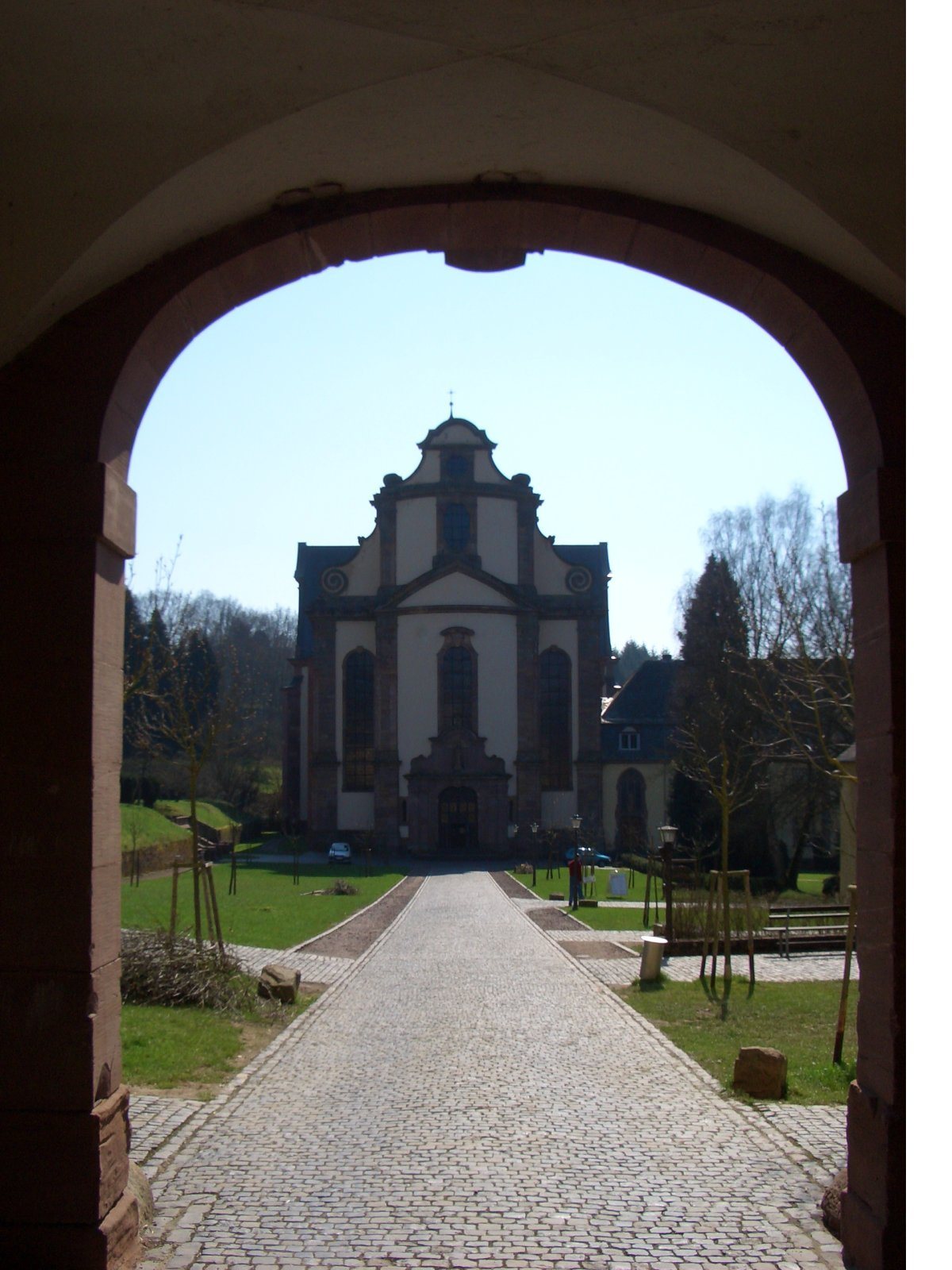
Despite its scale, the church followed Cistercian restraint. It had neither towers nor a conventional facade and was surmounted by a roof lantern, or central roof turret. The design was attributed to Christian Kretzschmar, and the interior included works associated with the Baroque furnishings of the period. After the 1802 dissolution, removal of the copper roof accelerated the building’s deterioration. Much of the remaining fabric was quarried for other construction. The mill, gatehouse, west gable, and limited lateral sections of the church formed the principal remains of the former complex.
The reconstructed abbey church
The present reconstructed church was built from 1952 onward on the site of the largely destroyed earlier church and completed in 1962. A statue by Hans Scheble replaced a lost portrait of the Virgin Mary and is displayed in the chapel beside the church. The building was damaged by the 2017 fire and reopened in 2018.
The Klais organ
The church’s 1962 organ was built by the Klais organ workshop. It was installed in the south transept rather than being divided between a west organ and a choir organ, placing it near the celebrant’s altar and the monks’ choir stalls. Its cross-shaped case follows the arrangement of the organ works. The case is 12.40 meters high and 7 meters wide, with the main division above the console, the swell division above it, and the crown division beneath the vault. The positive division is incorporated into the gallery rail.
The instrument originally had 39 stops on three manuals and pedal. Its pedal was enlarged in 1977 with a 32-foot stop, and a major overhaul in 2007 added two reed stops and two sub-octave couplers. A smoldering fire beneath the organ stairs in July 2017 caused heavy soot contamination, requiring cleaning by Klais. The organ now has 57 stops, three transmissions, four manual divisions, and pedal. Its key actions are mechanical and its stop actions electrical, with an electronic setter system holding 10,000 combinations.
Mill, service buildings, and wider holdings
The old mill
The old mill is described as the oldest maintained convent building. It was extensively renovated and converted into a museum in 1998. The building contains information on Cistercian history, an enamel-art museum, the mill equipment, and spaces for cultural events.
Economic buildings and landscape
The abbey complex included a guesthouse, retreat house, book and art shop, restaurant, nursery, fishery, and fishponds. Himmerod’s former estates included farms at Rheinbach, Andernach, and Ürzig, together with agricultural and vineyard properties extending between the Moselle, Lieser, and Kyll and toward Koblenz, Leutesdorf, Bonn, Echternach, and Speyer.
The library
Himmerod’s library contained biblical, literary, philosophical, theological, legal, and historical works, along with classical texts. A fifteenth-century report attributed about 2,000 volumes to the collection. After secularization, the holdings were dispersed, and surviving manuscripts are preserved in institutions in Germany, Luxembourg, Austria, France, Belgium, the Netherlands, Britain, and the United States.