Langley Priory: A Benedictine Nunnery and Later Country House
Site at a Glance
- Rating
- 4.7
- Popularity
- Very Low
- Country
- United Kingdom
- Primary era
- Modern
- Eras represented
- Medieval, Early Modern, Modern
- Civilizations
- British, English
- Site type
- Domestic
- Remains
- Elite Residence
On this page9 sections
History
Foundation and medieval endowments
Langley Priory, also known as Langley Nunnery, is a former Benedictine nunnery in the United Kingdom, near Diseworth in Leicestershire. William Pantulf and his wife, Burgia, founded it around 1150, dedicating the house to God and the Blessed Virgin. Its Benedictine nuns followed the Rule of Saint Benedict, and its first community came from Farewell Priory in Staffordshire, which served as Langley’s mother house. The priory belonged to the Diocese of Lincoln.
William Pantulf endowed Langley with the legal rights to appoint priests at Little Dalby and Somerby, together with land in Langley, Little Dalby, Somerby, and Tonge. Burgia contributed land at Kettleby and tithes from Tonge and Wilson. Before 1205, the priory acquired additional land in Burrough, Diseworth, Long Whatton, Nottingham, and Prestwold. Before 1220, it also obtained the right to present a priest to Diseworth Church.
Later medieval community
By 1291, the priory received £20 9d each year from its secular lands and revenues. In the late thirteenth century, the nuns claimed affiliation with the Cistercian Order, a Catholic monastic order that developed within the Benedictine tradition, in an attempt to avoid paying tithes on their lands. They were required to abandon that claim.
The community was governed by a prioress, the woman who led the nunnery. Twelve nuns were present during a visitation by John Gynwell, Bishop of Lincoln, in 1354. In 1440, Bishop William Alnwick recorded that the number had fallen to eight and that declining income had left the priory £50 in debt. The surviving records name a succession of prioresses, including Rose and Burgia in 1229, Isabel of Leicester, Juliane of Winchester, Alice of Tatyrsal, Margaret of Leicester, Christine of Winchester, Amice de Burgh, Alice Giffard, Elizabeth of Caldwell, Joan of Outheby, Matanye, Maud, Margaret de Sulveye, Margaret Salhowe, Margaret Pole, Margaret Bellairs, Anne Shafton, and Dulcia Bothe, who was recorded from 1507 to 1535.
Dissolution and transformation into an estate
The Valor Ecclesiasticus, the sixteenth-century assessment of religious property before the Tudor suppression of England’s religious houses, valued Langley Priory’s annual income at £29 7s. 4½d. In June 1536, six nuns and the prioress were recorded at the priory. It was probably dissolved that year as one of the smaller monasteries.
After the Dissolution, the site and its lands were leased to Thomas Grey for £7 5s. 4d. annually. Thomas Grey died in 1564, and the property passed to his son Thomas, who died in 1608 or 1609. His son Thomas, born in 1602, inherited the estate. It was later divided among his sons Thomas, George, William, and John after the eldest Thomas was disinherited for marrying without his father’s consent.
By 1686, the former priory was known as Langley Hall, and the Greys sold it to Richard Cheslyn. The estate passed to his son Robert Cheslyn and then to Robert’s son Richard, a barrister of the Middle Temple, one of London’s Inns of Court. Richard Cheslyn spent £5,000 on plantations and gardens. After his death in 1787, the property passed to his nephew Richard, who served as a deputy lieutenant of Leicestershire and as a Commissioner of Assessed Taxes. He died in 1843.
Nineteenth- and twentieth-century ownership
John Shakespear purchased the house from the Cheslyns in 1843. Following his death in 1858, it passed to his nephew Charles Bowles, who obtained royal consent to adopt his uncle’s surname and became Charles Shakespear. The property later passed to Charles Bowles Shakespear, who died in 1959. Major John Hornsby Shakespear then lived in the house until his death in 1970, after which John S. Hine owned and occupied it until 1981.
Langley Priory was formerly an extra-parochial tract, meaning an area outside the ordinary parish structure. It became a civil parish in 1858. The parish had a population of 16 in 1931 and was abolished on 1 April 1936, when it was incorporated into Isley cum Langley.
Remains
The later house and surviving priory fabric
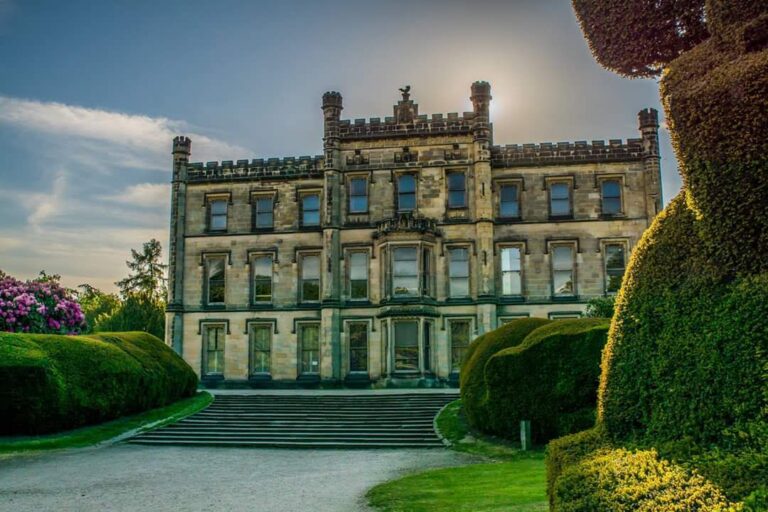
The medieval priory remains are understood to have been incorporated into the later house, which also bears the name Langley Priory. The present building therefore combines the site’s medieval religious foundation with later domestic rebuilding. Its visible fabric is predominantly associated with the sixteenth, seventeenth, and nineteenth centuries.
Central block
The central block was completely rebuilt in the early nineteenth century. This rebuilding forms the principal later phase of the house and gives the centre of the building its modern architectural character.
Wings
The two wings were largely rebuilt during the sixteenth and seventeenth centuries. They preserve the form of later additions to the former priory site and belong to the phases in which the religious house was transformed into a private estate residence.