Fort of São Paulo da Gamboa: A Portuguese Defensive Battery in Salvador
Site at a Glance
- Rating
- 4.5
- Popularity
- Low
- Country
- Brazil
- Primary era
- Early Modern
- External website
- Open
- Eras represented
- Early Modern
- Civilizations
- Portuguese
- Site type
- Military
- Remains
- Fort
On this page7 sections
History
The Fort of São Paulo da Gamboa is a Portuguese military fortification in Salvador, Brazil, built to protect the city against attacks from the sea. Its construction date is uncertain, but it replaced a smaller battery built in 1646 and extended the nearby Fort of Saint Peter. Together with São Marcelo Fort to the north and Forte de São Diogo to the south, it formed part of a continuous defensive line along Salvador’s southern side.
Construction and Portuguese Defences
The battery was designed by Jean Massé, a French military engineer employed by the Portuguese Crown in Brazil between 1713 and 1718. Miguel Pereira da Costa, a Portuguese military engineer, prepared its plans, while João Teixeira de Araújo served as project engineer. In 1714, Massé worked under Pedro António de Meneses Noronha de Albuquerque, the viceroy of Brazil, a senior governor who administered the territory on behalf of the Portuguese monarch.
The fortification was connected to the Fort of Saint Peter by trenches, creating a linked defensive system. These earthworks later disappeared as Salvador expanded and the surrounding urban area was developed. The battery’s position reflected its strategic purpose, guarding the approaches to the city from the waters of the Bay of All Saints.
Rearmament and Twentieth-Century History
In 1875, the fort was refortified and received a 250-millimetre Armstrong cannon. The weapon weighed thirteen metric tons, bore the date October 28, 1873, and was the first cannon from that manufacturer brought to Brazil. In Salvador it became known as the “Grandma Gun.” Its range was sufficient to reach Itaparica Island across the Bay of All Saints, although its powerful blast meant that it was rarely fired.
The fort was repaired in 1886 and again in 1906. During the First World War, it remained well maintained and was manned by troops of the 50th Battalion of Caçadores, a light infantry unit. The battalion added fifteen artillery pieces to the original Armstrong cannon, but this additional artillery was sold for scrap after the war. During the twentieth century, the Armstrong cannon was transferred to the garden of Army Headquarters in Salvador’s Mouraria neighborhood.
Heritage Status and Decline
The battery was transferred to Brazil’s National Treasury in 1937. The National Institute of Historic and Artistic Heritage, the federal institution responsible for protecting nationally important historic and cultural heritage, listed it as a historic structure in 1938 and as a national monument in 1939.
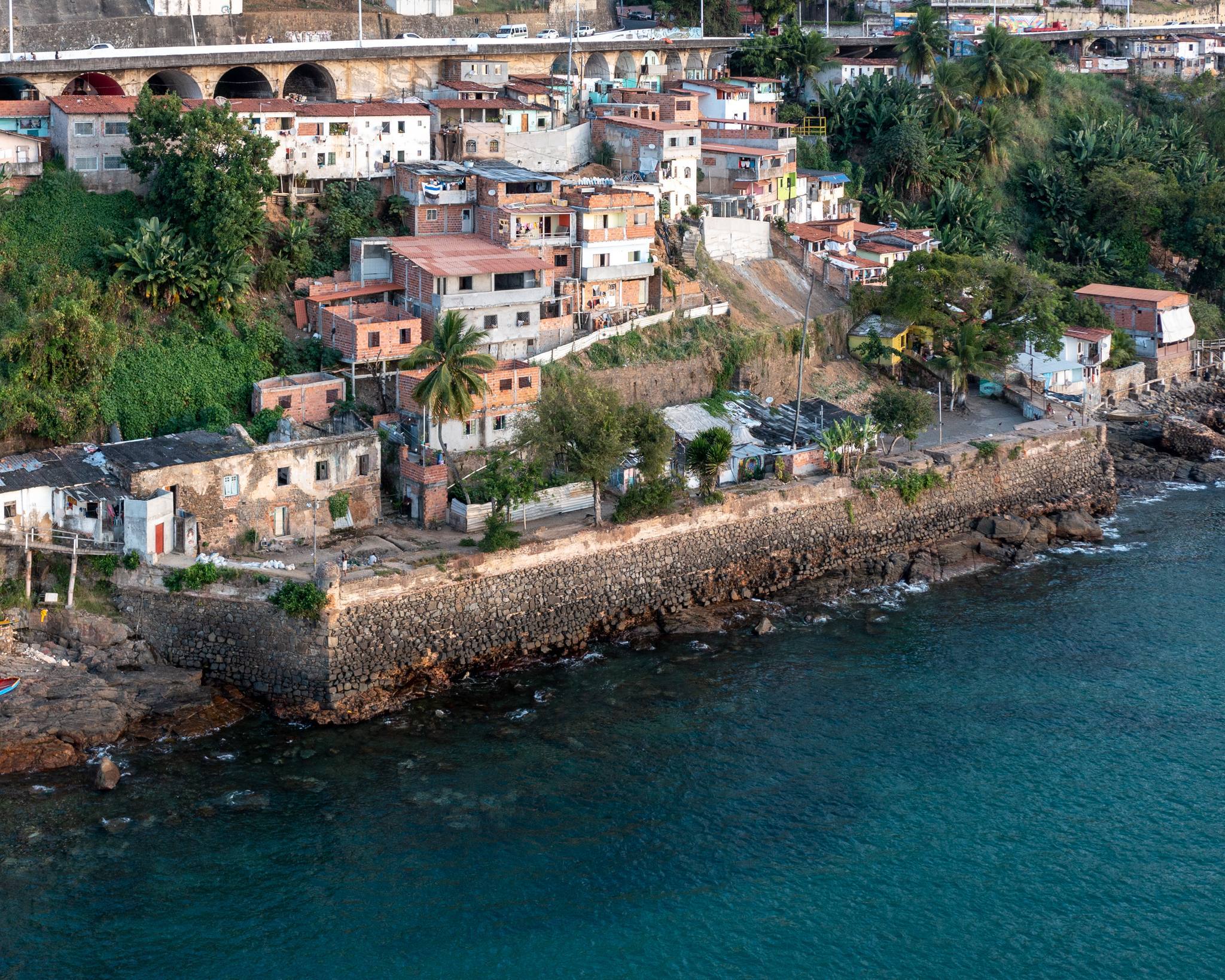
Later, the fort was abandoned by state and federal government agencies. Under Article 20 of Brazil’s 1988 Constitution, it remains a military installation owned by Brazil’s Armed Forces. It is administered as federal property by the Secretariat of Patrimony of the Union, the Brazilian body responsible for managing property belonging to the federal government, including military and historic sites. In 2020, the Secretariat stated that it did not intend to repair or maintain the battery. The fort is now in an advanced state of ruin, with walls at risk of collapse, and occupies an area prone to landslides.
Remains
Fortification Layout
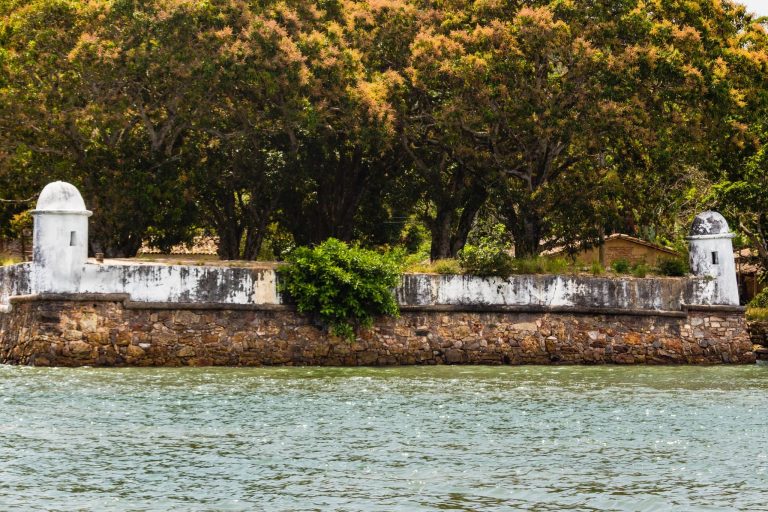
The fort stands on a small cliff in the narrow Gamboa de Baixo neighborhood, below Avenida Lafayete Coutinho and above the water level of the Bay of All Saints. It is set back a short distance from the shoreline. Its surviving structure includes a curtain wall, a defensive wall enclosing or linking the principal parts of a fortification, and is arranged on two levels.
The battery contained nineteen artillery emplacements, prepared positions from which cannons could be operated and fired. These positions were capable of firing simultaneously toward the sea, defining the fort’s principal military function. The surviving masonry is in an advanced state of ruin, and the walls are threatened with collapse.
Armstrong Cannon
The 250-millimetre Armstrong cannon installed in 1875 weighed thirteen metric tons and carried the date October 28, 1873. It was the first weapon from the Armstrong manufacturer in Brazil and was known locally as the “Grandma Gun.” Its range extended across the Bay of All Saints to Itaparica Island, while the force of its blast made firing it an unusual event.
The cannon was transferred during the twentieth century to the garden of Army Headquarters in Mouraria, Salvador. Its history belongs to the later defensive phase of São Paulo da Gamboa, when the earlier battery was adapted to carry heavy modern artillery.