Basagain: A Fortified Iron Age Settlement in Spain
Site at a Glance
- Rating
- 4.5
- Popularity
- Very Low
- Country
- Spain
- Primary era
- Iron Age
- Eras represented
- Iron Age
- Civilizations
- Unclassified
- Site type
- Military
- Remains
- Fortified Town
On this page7 sections
History
Basagain is a fortified Iron Age settlement in Spain, located on Basagain Mountain near Anoeta in Gipuzkoa and associated with the Varduli culture. Activity at the settlement lasted from about 300 BC to the first decades of the first century AD. The site formed part of a group of Iron Age hilltop settlements in the Oria valley, alongside Buruntza, Intxur, and Murumendi.
The Iron Age settlement
Basagain was a rural community whose inhabitants cultivated crops and raised livestock. Its position above the Oria valley and the valley beneath Mount Hernio gave the settlement control over important surrounding routes and landscapes. Iron also appears to have influenced the choice of location. No furnace has been found, but an iron ploughshare was recovered, showing that the metal was used in agricultural work.
Radiocarbon dating places activity at Basagain between approximately 300 BC and the early first century AD. Objects from the settlement belong particularly to the periods around 370–220 BC and 170–120 BC. Excavated materials indicate contact with nearby communities and possibly with more distant regions, including central Europe. Inter-settlement trade is considered likely.
Excavation and interpretation
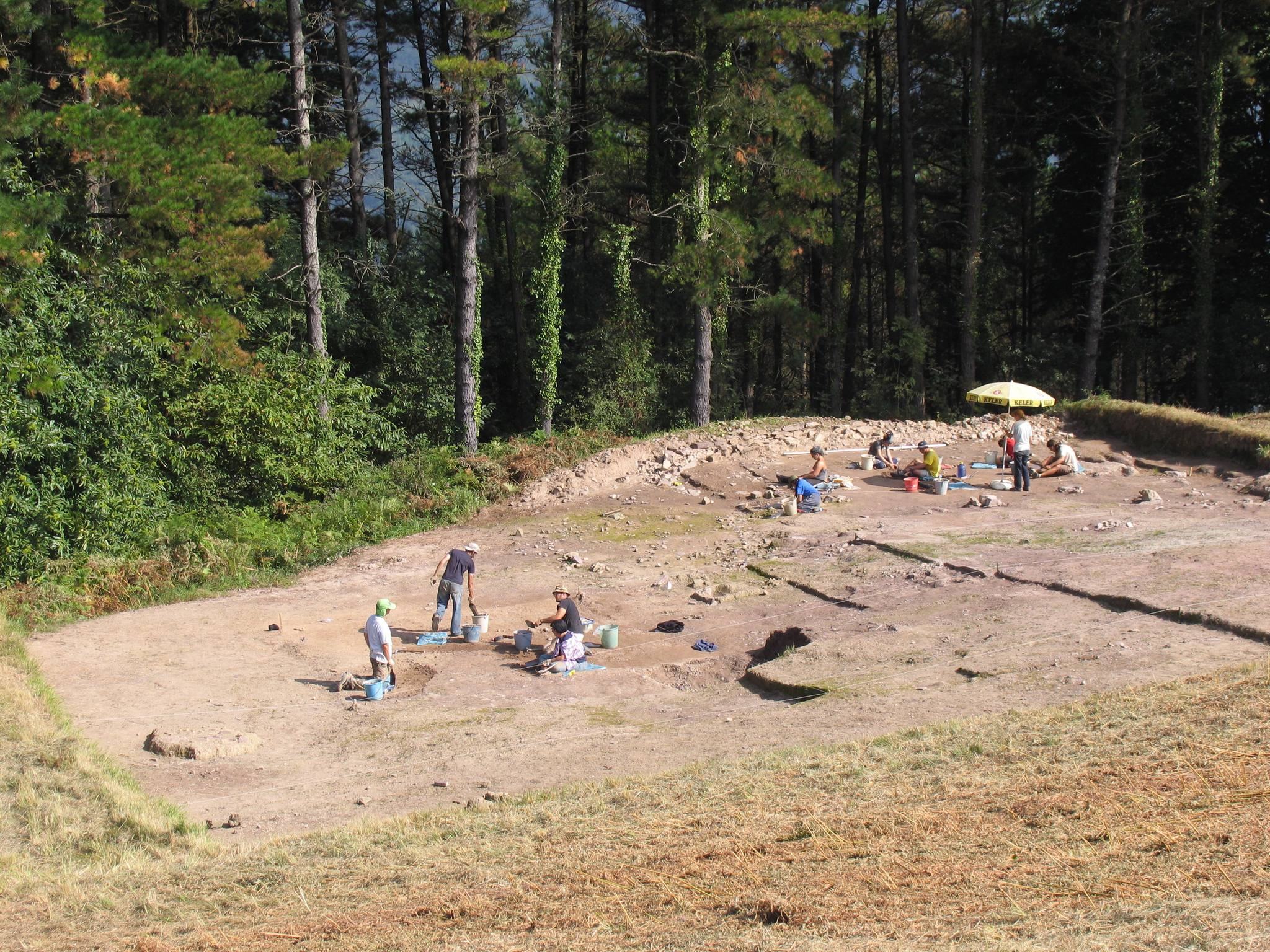
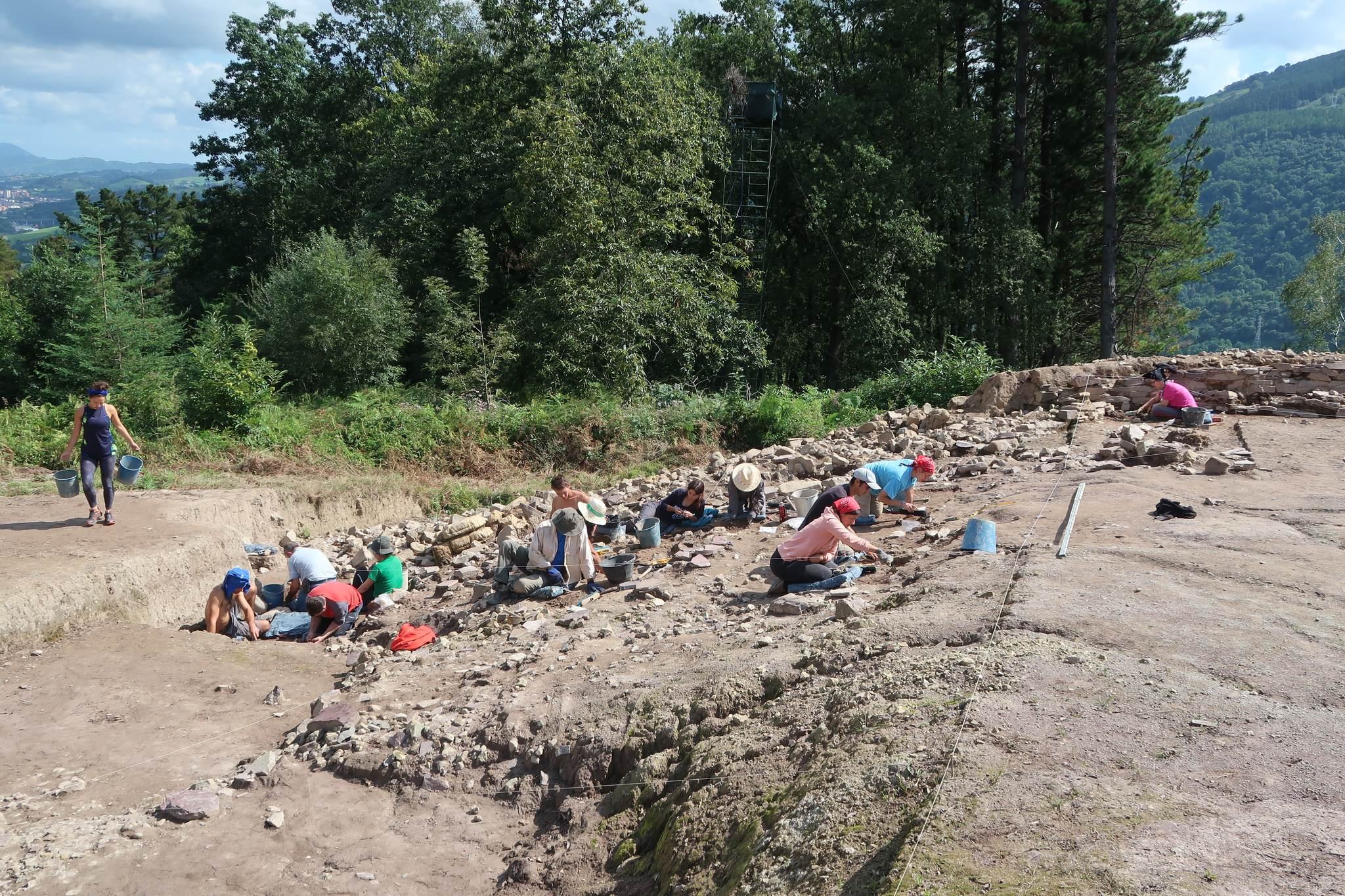
A possible wall around the summit first drew attention from Koldo Oria around 1989. An initial investigation recovered a millstone, leading to more extensive archaeological work. The Aranzadi Scientific Society began excavating Basagain in 1994. Since then, volunteer teams have generally undertaken three-week campaigns each September under the direction of archaeologist Xabier Peñalver.
Basagain was designated a classified cultural asset and monument complex by the Basque Government on 2 February 2010. Excavation and research have continued with support from the Gipuzkoa Provincial Council and Anoeta Municipality. The settlement also became part of Anoeta’s civic identity when the municipality adopted a coat of arms in 2004 showing the Oria River, Basagain Mountain, and the fortified settlement.
Remains
Hilltop enclosure
The settlement occupies the summit of Basagain Mountain at an elevation of 295 metres and covers approximately 2.8 hectares. Steep slopes made access difficult, while a free-standing perimeter wall enclosed the summit. The wall survives as a raised line partly formed by material that collapsed down the slopes, and an entrance was probably located on the eastern side. It was built as a double-faced dry-stone construction, with locally collected limestone slabs forming both faces and a more irregular mass of material filling the space between them. Excavation has exposed the wall directly at two points on the eastern side. The designated archaeological area covers about 7 hectares.
Settlement plan and houses
A decorated stone slab discovered in 2017 may preserve the earliest prehistoric urban plan identified in the Basque Country. Its markings are interpreted as a possible main axis or street crossing part of the settlement, with separate dwellings on either side, although this reconstruction remains a hypothesis. Subsurface remains show that the houses used branch frameworks coated with clay. Their smooth outer surfaces were probably painted, as comparable buildings elsewhere in the Basque Country appear to have been.
Objects and domestic activity
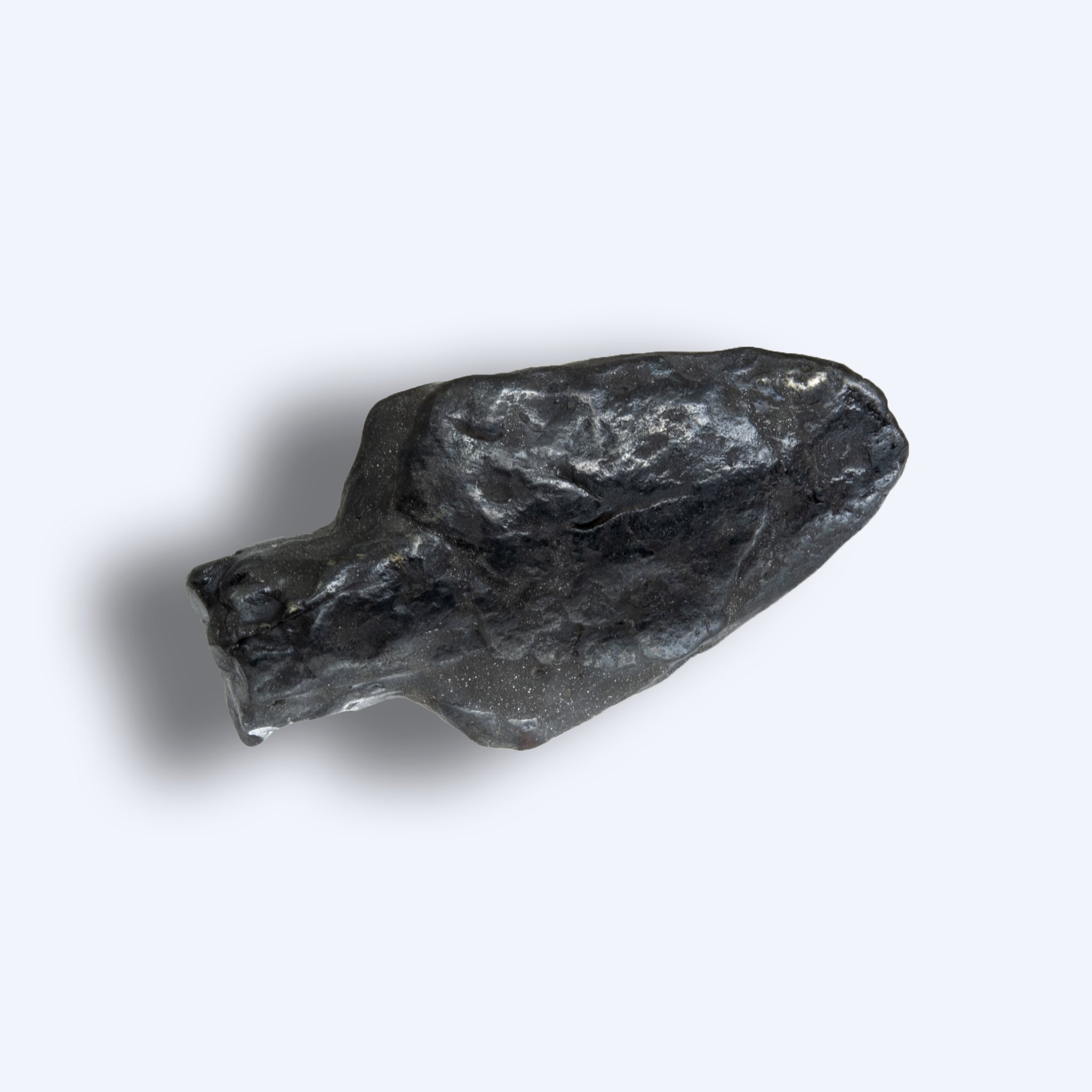
Excavations have recovered iron knives, ploughshares, nails, fibulae, which were brooches used to fasten clothing, arrowheads, and other weapons or tools. A fragment of a glass bracelet and a rounded glass object may reflect commercial connections with other parts of continental Europe. Ceramic finds include many fragments of handmade vessels, flat-bottomed pots used for cooking, and very large containers for water, grain, fruit, and other food. Wheel-made pottery also appears after 500 BC, with lighter red-orange surfaces and thin walls. Together, the finds relate to domestic work, food storage, agriculture, animal husbandry, construction, and weapon use. The recovered objects are preserved at Gordailua, the Gipuzkoa Cultural Heritage movable-property centre.