Palacio de Ayete: A Neoclassical Royal Summer Residence in San Sebastián


Site at a Glance
- Rating
- 4.7
- Popularity
- Low
- Country
- Spain
- Primary era
- Modern
- Eras represented
- Modern
- Civilizations
- Spanish
- Site type
- Domestic
- Remains
- Palace
On this page8 sections
History
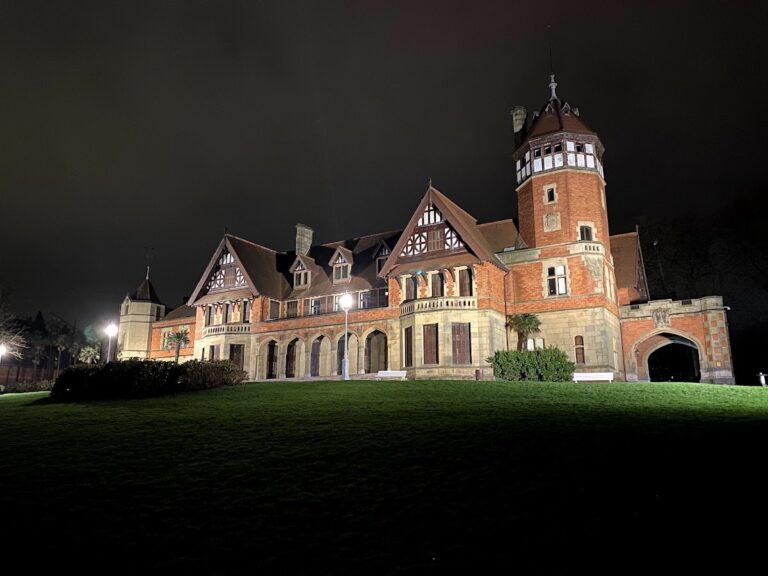
Palacio de Ayete is a residential palace in San Sebastián, Spain, built in 1878 for the Dukes of Bailén in a neoclassical-inspired style designed by the French architect Adolfo Ombrecht. Until Miramar Palace was constructed in 1893, it served as a summer residence for Queen Isabella II, King Alfonso XII, Queen Maria Cristina, and King Alfonso XIII.
Royal residence
The palace also received distinguished foreign guests during this period. Queen Victoria of the United Kingdom stayed there on 27 March 1889, while Eugénie de Montijo, empress of France and wife of Napoleon III, spent a night at the residence.
Palacio de Ayete later belonged to the Basa family through the dowry associated with the Travesedo marriage. In 1939, during the Spanish Civil War, the family left the palace and moved to Villa Itxas-ertz in San Sebastián’s Ondarreta district, a property previously known as Villa Emilia.
Municipal ownership and the Franco era
In 1940, the heirs of Emilio Alcalá Galiano sold Palacio de Ayete to the Municipality of San Sebastián. The municipality then offered it to Francisco Franco, Spain’s authoritarian head of state from 1939 to 1975. Franco used the palace during August each year from 1940 until 1975, and the Council of Ministers met there during this period.
Franco left Palacio de Ayete for his meeting with Adolf Hitler, the dictator of Nazi Germany, at Hendaye. The palace was also the setting where he decided during the 1950s to move toward a policy oriented toward the United States.
Protection and peace work
On 13 November 2006, a decree designated the palace and its gardens a Cultural Asset in the category of Monumental Complex. This status is described as the highest level of protection granted by the Basque Government.
On 17 October 2011, Palacio de Ayete hosted the San Sebastián International Peace Conference, which addressed the end of violence by ETA, a Basque separatist organization that had used terrorism and political violence before declaring a permanent cessation of armed activity in 2011. Participants included Kofi Annan, Bertie Ahern, Gro Harlem Brundtland, Pierre Joxe, Gerry Adams, and Jonathan Powell, as well as Basque political parties, trade unions, and representatives of major French political parties. After its interior was rehabilitated by the Municipality of San Sebastián, the building became the House of Peace and Human Rights.
Remains
Palacio de Ayete combines a neoclassical-inspired residential building with approximately 74,000 square metres of landscaped grounds. The gardens follow an irregular, picturesque design adapted to the terrain, while the rehabilitated palace interior accommodates the House of Peace and Human Rights.
Palace and landscaped grounds
Palace
The palace is a residential building constructed in 1878 and designed by Adolfo Ombrecht. Its rehabilitated interior now serves the House of Peace and Human Rights, preserving the building’s institutional use within the wider palace and garden complex.
Gardens
The grounds were designed by Pierre Ducasse, a royal gardener and landscape architect born in Bayonne, educated at La Réole, and trained at Versailles. His landscape-garden approach uses winding paths, irregular ponds, dovecotes, grottoes, and bridges. Existing trees were preserved alongside new specimens and exotic plants, while dense vegetation creates changing spaces and perspectives. A large meadow opens toward views of the sea. The northern gardens were later modified to permit construction of a partly underground House of Culture.
Nearby sites