Zlatá Koruna Monastery: A Former Cistercian Abbey in Czechia
Site at a Glance
- Rating
- 4.6
- Popularity
- Medium
- Country
- Czechia
- Primary era
- Medieval
- External website
- Open
- Eras represented
- Medieval, Early Modern, Modern
- Civilizations
- Austrian Empire, Habsburg, Holy Roman Empire, Kingdom of Bohemia
- Site type
- Religious
- Remains
- Monastery
On this page12 sections
History
Zlatá Koruna Monastery is a former Cistercian abbey in Czechia, near Český Krumlov in southern Bohemia. King Přemysl Otakar II founded it in 1263 as part of his policy to strengthen royal authority in the region, and its buildings preserve Gothic, Baroque, and Rococo phases. The monastery was dissolved under Emperor Joseph II in 1785.
Foundation and royal policy
The monastery was first called Svatá Koruna, or Sancta Corona, after a relic identified as a thorn from Christ’s Crown of Thorns. Přemysl Otakar II was said to have received the relic indirectly from Louis IX of France, although the exact route by which it reached the Bohemian king is uncertain. A request to establish the monastery had been submitted to the Cistercian general chapter in 1259, and the foundation probably followed the king’s victory over Hungary in 1260.
The new abbey served religious and political purposes. It strengthened royal influence in southern Bohemia, supported connections between the Bohemian and Austrian lands, and helped limit the expansion of the Vítkovci, a powerful noble family based in the region. Přemysl Otakar II endowed the monastery with Boleticko and part of Netolicko, including about 880 square kilometres of forest. He selected Heiligenkreuz as the mother house because of his claims to the Babenberg inheritance in Austria.
On 6 April 1263, monks from Heiligenkreuz left for the new foundation under their former abbot Henry and reached Zlatá Koruna in mid-April. The early Cistercian filiational chain connected the monastery with Cîteaux, Morimond, and Heiligenkreuz. After the loss of the Babenberg territories, the affiliation continued through Ebrach, Langheim, and Plasy. The original connection was restored in 1400 under Pope Boniface IX.
Destruction and reconstruction
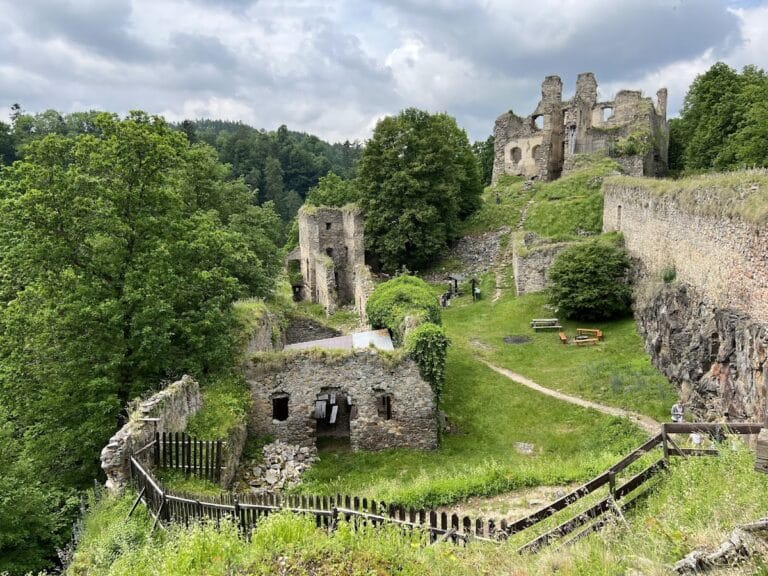
After 1276, the Vítkovci destroyed the monastery. A plan to move the community to a safer site was not completed because Přemysl Otakar II died before the project could be carried out. Monastic life resumed in 1291, when monks from Plasy restored the community. Further endowments came from the lords of Bavorov and Michalovice.
During the later thirteenth and fourteenth centuries, the monastery expanded its estates and promoted colonization. About 50 new villages were established in Boleticko, and by the end of the fourteenth century the monastery held possessions in roughly 160 settlements. This made it one of the largest Cistercian monasteries in Bohemia and Moravia.
A fire destroyed the monastery in 1354. Reconstruction followed, with the stonemason Michael Parler documented at the site during the work. Territorial disputes continued during the fourteenth century, including conflicts involving the Vitějovice estate, Vyšší Brod Monastery, and the Vyšehrad collegiate chapter. A dispute concerning the Prachatice region and 22 villages was settled in 1396.
War, economic decline, and secular control
The monastery’s economic position weakened around the beginning of the fifteenth century. Valuable objects were transferred to the Premonstratensian monastery at Schlägl in Austria, while part of the treasury and archive was deposited in Český Krumlov.
Hussite forces attacked and burned the monastery twice in 1420, including one assault led by Jan Žižka. The Hussite movement was a religious and political reform movement that began in Bohemia, and its wars brought attacks against Catholic institutions such as Zlatá Koruna. The monks left the monastery for a period after the assaults.
Oldřich II of Rožmberk took the monastic estates as a pledge from King Sigismund and incorporated them into the Český Krumlov domain. He refused to return them, and in 1493 King Vladislav II granted the Rožmberks patronage rights over the monastery and its possessions. Petr Vok of Rožmberk sold the Český Krumlov estates, including the Zlatá Koruna possessions, to Emperor Rudolf II in 1601. In 1622, Ferdinand II granted the domain to Johann Ulrich von Eggenberg, and the estates later passed to the Schwarzenberg family in 1719. The monastery did not regain its former possessions.
Baroque and Rococo renewal
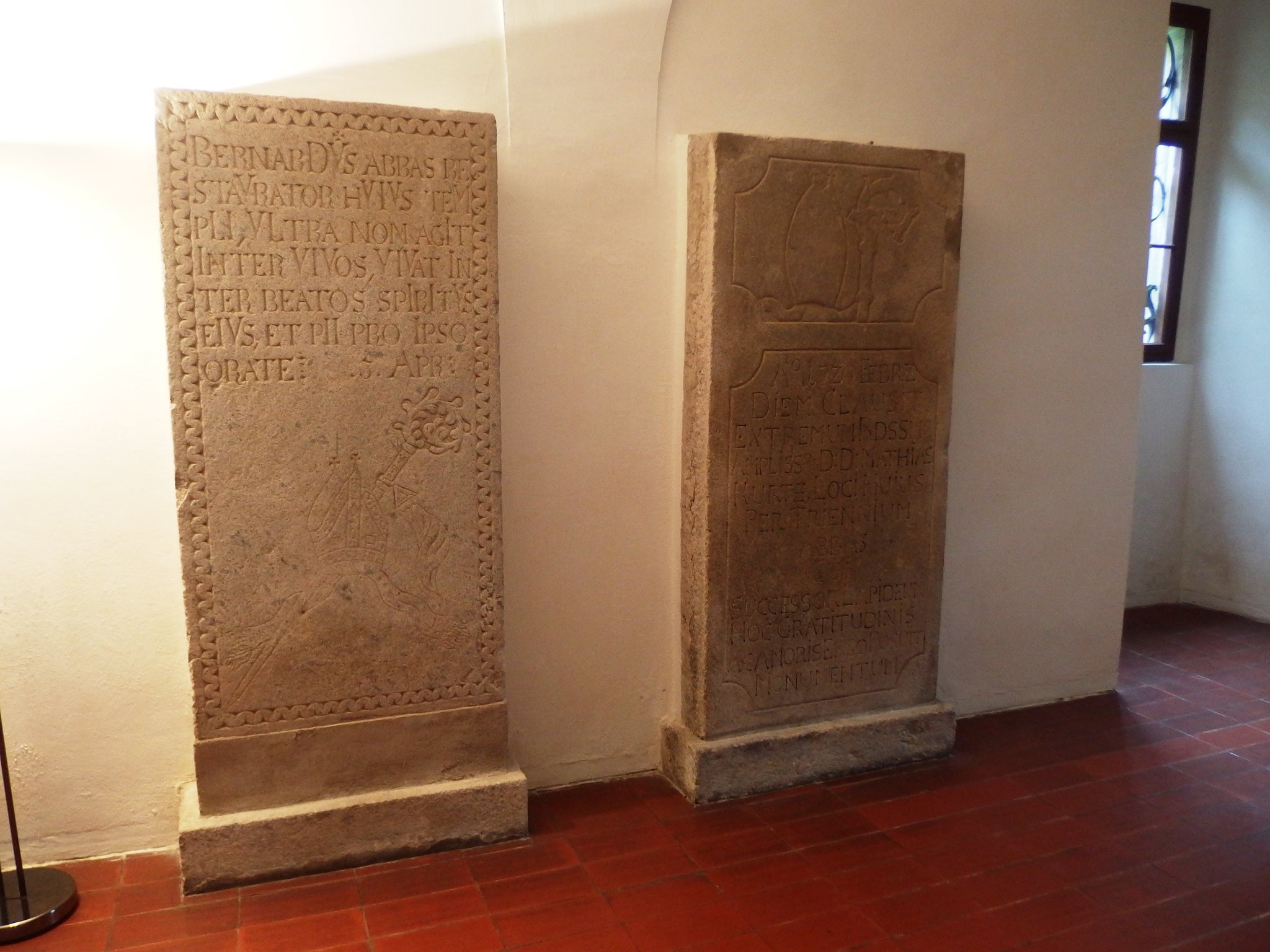
Despite the loss of its estates, the complex was altered and repaired. A small convent with a refectory was built in the second half of the sixteenth century, and the abbot’s residence was repaired. Major Baroque changes had been completed by 1665. After the Thirty Years’ War, further restoration began a new period of prosperity. Abbots Bernard Pachmann and Matthias Ungar played important parts in repairing the church and convent and enforcing monastic discipline.
Under Abbot Bohumír Bylanský, who served from 1755 to 1785, the monastery received extensive Rococo decoration and other improvements. A school for peasant children opened in 1774. The monastery also encouraged agricultural experiments, including the cultivation of potatoes and mulberry trees, and Bylanský established a small observatory on the slope opposite the complex. The gardens included aviaries, pheasant cages, greenhouses for exotic plants, and small fountains.
Dissolution and modern conservation
Joseph II’s reforms included the suppression of contemplative monasteries considered to have limited public or social functions. His decree dissolved Zlatá Koruna in 1785. The convent members were ordered to leave by April 1786, while Bylanský received a pension.
In 1787 the Schwarzenbergs acquired the complex and leased it for industrial use. A foundry and Peter Steffens’s machine works operated there, and industrial activity damaged several monastery buildings. Production continued until 1909. Restoration began after manufacturing ended and continued until 1938, recovering and repairing parts of the medieval and later fabric.
During the Protectorate, the Gestapo confiscated the monastery in 1940. Ownership passed to the Czechoslovak state in 1948 after the Schwarzenbergs were expropriated. In 1944, collections from scholarly libraries, including those of the Royal Bohemian Society of Sciences and the Czech Academy of Sciences and Arts, were placed in the monastery by order of the Ministry of Education.
Since 1945, the complex has been open to the public and has contained an exhibition on the monks’ lives and work in southern Bohemia. From 1979 to 2000 it was administered by the State Scientific Library in České Budějovice. It is now administered by the České Budějovice branch of the National Heritage Institute. The monastery has been protected as a National Cultural Monument of the Czech Republic since 1995.
Remains
Setting and enclosure
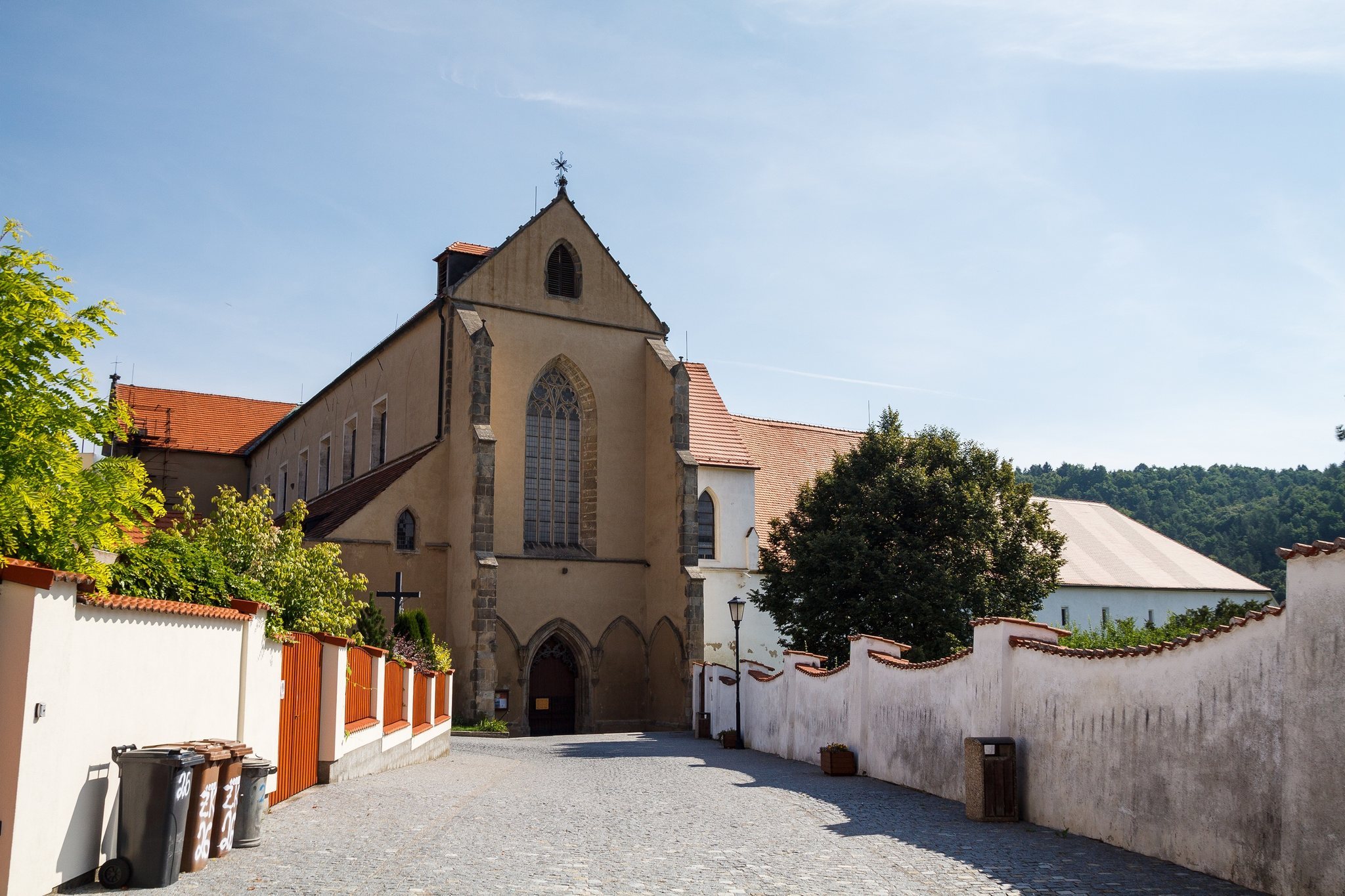
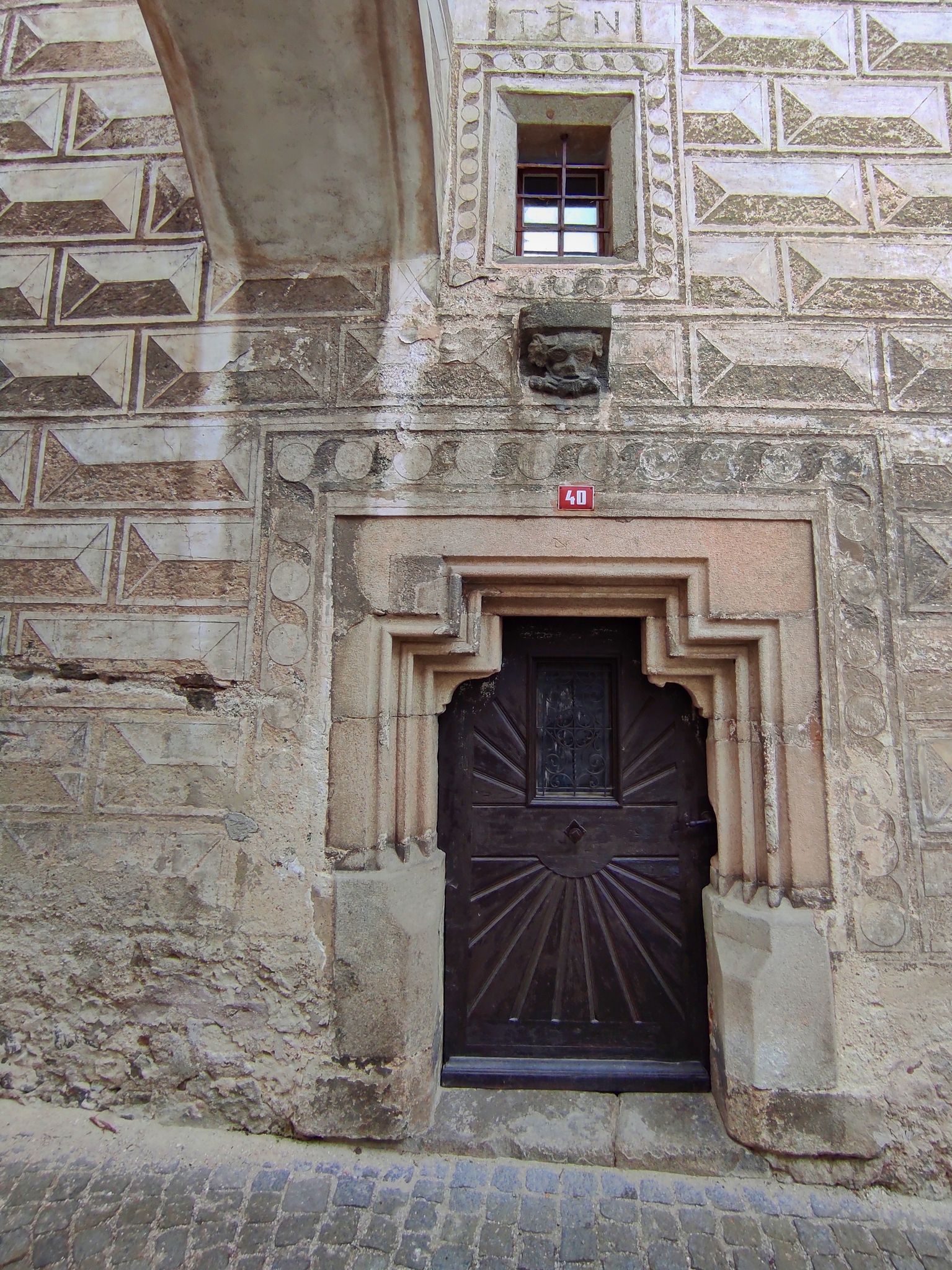
The monastery occupies a low promontory surrounded by the Vltava River, whose bend forms a peninsula. Its position at the eastern edge of the monastic estates followed the stated Cistercian approach to siting. The enclosed complex contains the Church of the Assumption of the Virgin Mary, the old convent, the two-storey Chapel of the Guardian Angels with the new convent, and the former parish Church of Saint Margaret, which served the village population. Other Gothic buildings and remnants of fortifications survive in the historic part of the village.
Church of the Assumption
The Church of the Assumption of the Virgin Mary is a Gothic three-aisled basilica with a transept, polygonal presbytery, choir chapels, and a western portal. Construction proceeded in several stages from the last third of the thirteenth century, and the church was completed after the middle of the fourteenth century. The presbytery, choir chapels, and transept date from around 1300, while the nave and western portal were built approximately between 1340 and 1370.
The church is not conventionally oriented. Its presbytery points north-northeast, following the direction of the adjacent river bend and the site’s Cistercian siting principle. The original building had rib vaults, eight bays, a transept, a polygonal choir, and an arcaded entrance porch. The east arm of the transept contains a large tracery round window with terracotta elements and a stucco frame.
Later Baroque alterations renewed the choir chapels and removed a fourth aisle on the north side. The church also received Baroque wall and ceiling paintings around 1772 by an unidentified master. The main altar has late-Baroque statues of saints of the order, made in 1772 by Jakob Eberle. The Assumption altarpiece was painted by Karl Philippot in 1854.
Convent and chapter house
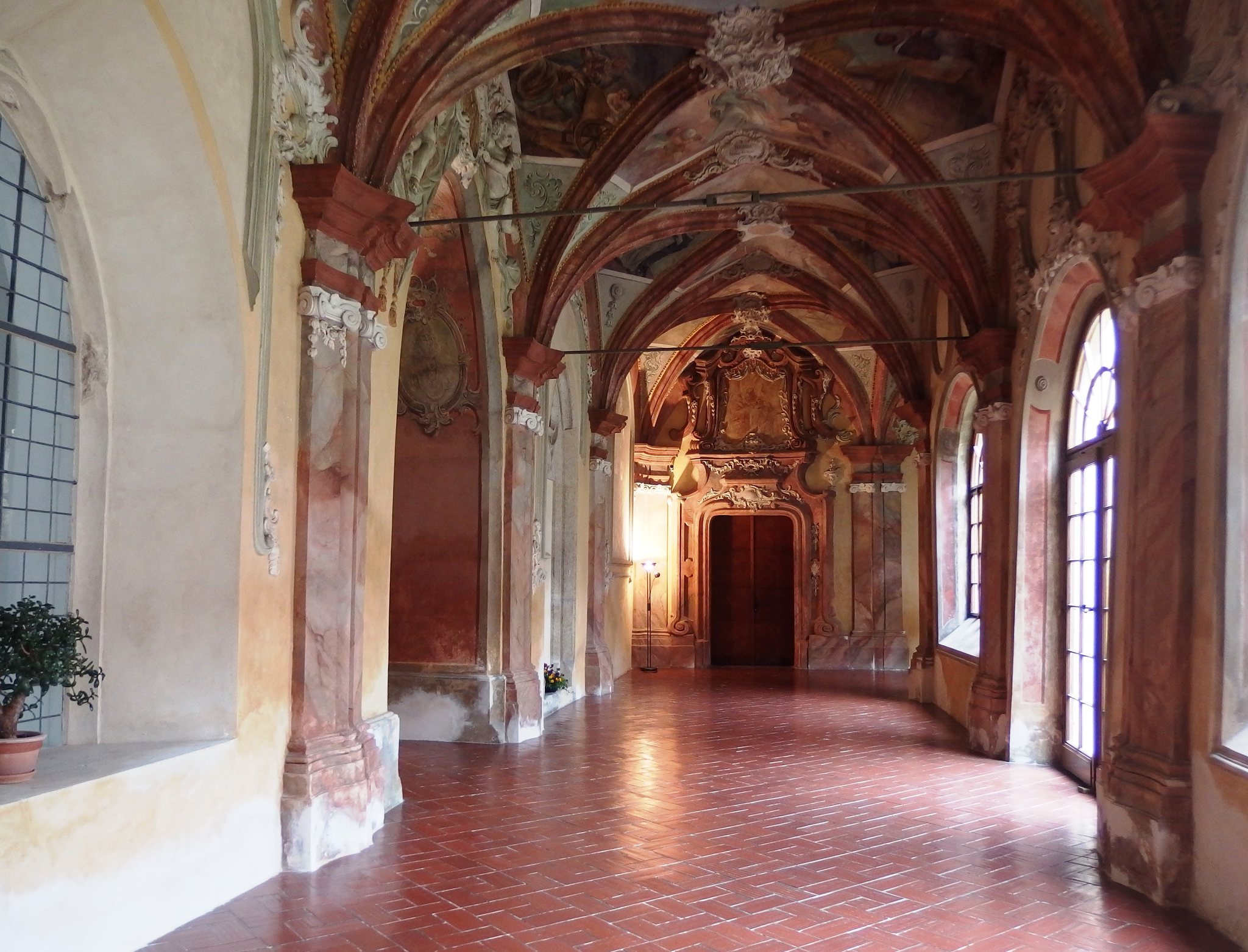
A three-winged, two-storey convent stands beside the church. Its cloister, a covered passage around an enclosed courtyard, retains Gothic cross vaults supplemented by Rococo stucco decoration and paintings. The cloister was remodelled between 1755 and 1785 during Bylanský’s abbacy.
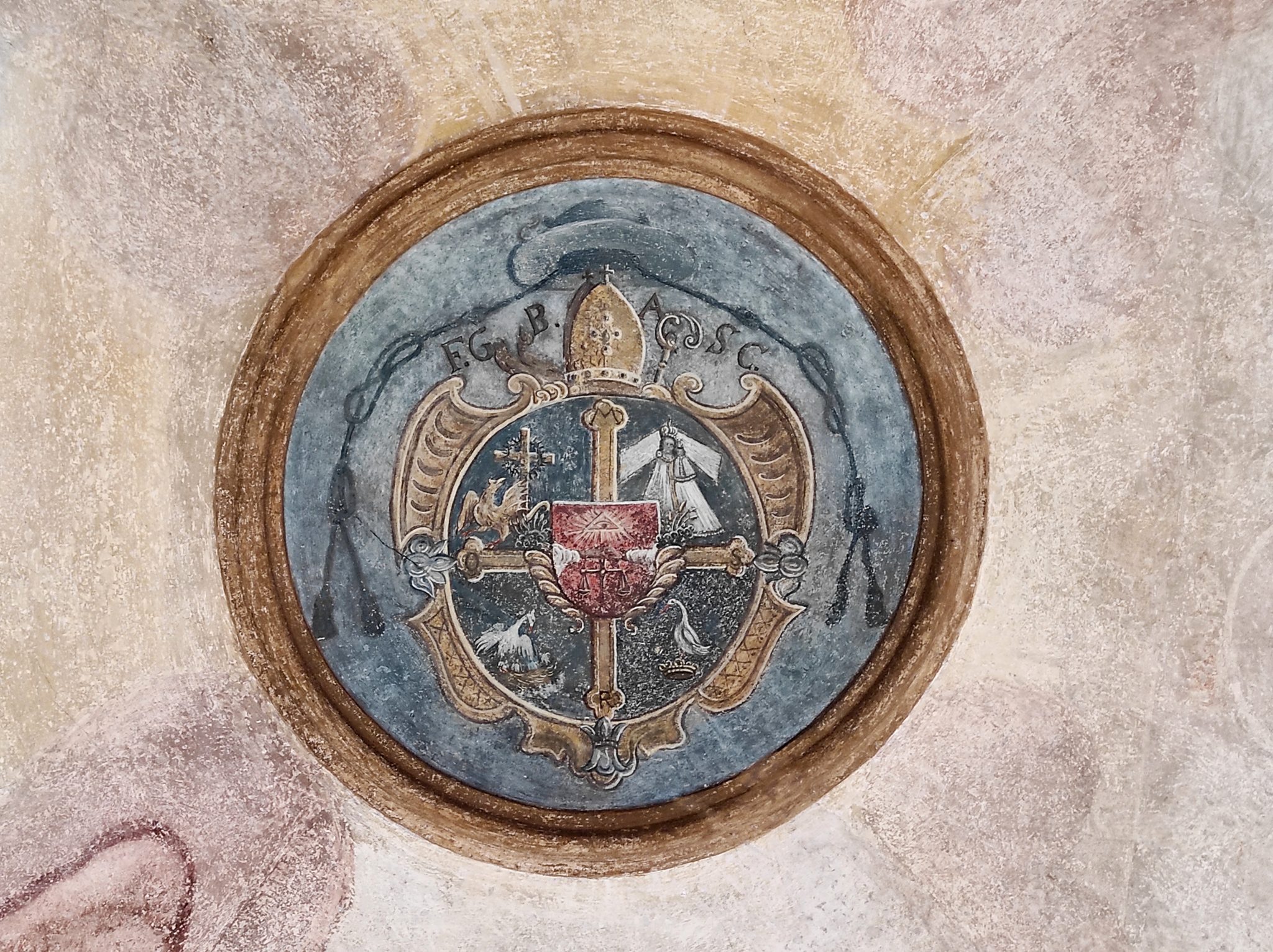
The chapter house, where the monastic community met for readings, discipline, and administrative business, contains two slender, fluted octagonal pillars with capitals. Eight pear-shaped ribs rise from the pillars, meet at smooth bosses, and descend to consoles of different forms. The consoles include carved granite masks, while a stucco monastic coat of arms appears above the entrance. Green-toned allegorical decoration occupies the centre of the Rococo vault ornament. Three tall pointed-arch windows and an entrance to the cloister are on the north side.
Chapel and ancillary buildings
The Chapel of the Guardian Angels is a large two-storey Gothic building with interiors covered by cross vaults. It is among the earliest surviving parts of the complex, although its construction date is uncertain. Its possible functions included housing the Crown of Thorns relic, following the example of the Sainte-Chapelle in Paris, and serving as a hospital chapel.
A refectory existed before 1350. The small convent was added during the second half of the sixteenth century, while the abbot’s house, service buildings, and entrance gate form further parts of the enclosure. The church, several convent buildings, and the refectory interiors were altered in the Baroque period. The complex’s present appearance combines these later changes with the surviving medieval structures.
Collections and later use
The Gothic Madonna of Goldenkron, made around 1420, was returned from the National Gallery in Prague to its original location in the monastery on 17 April 2016. The buildings also accommodated a branch of the State Scientific Library after later restoration, together with a memorial devoted to southern Bohemian literature. The monastery currently contains an exhibition on monastic life and the monks’ work in southern Bohemia.