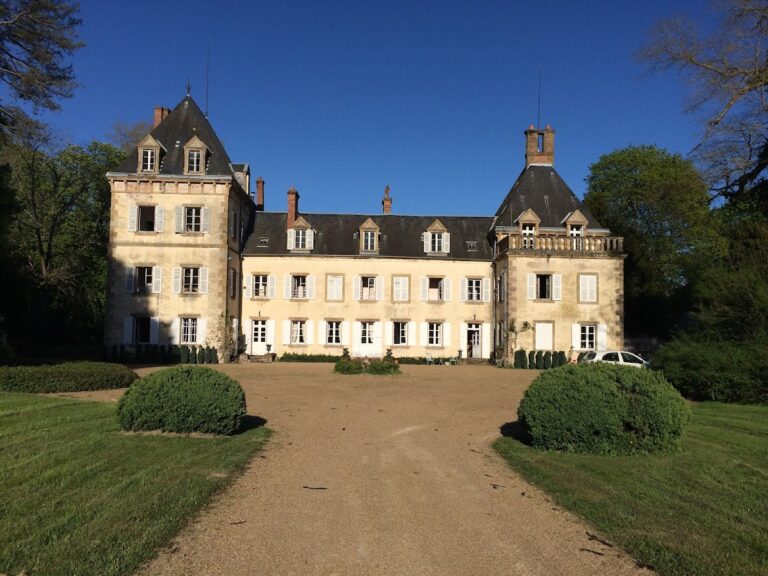
Sept-Fons Abbey: A Cistercian Monastery in France
Site at a Glance
- Rating
- 4.5
- Popularity
- Low
- Country
- France
- Primary era
- Early Modern
- External website
- Open
- Eras represented
- Early Modern, Modern
- Civilizations
- French
- Site type
- Religious
- Remains
- Monastery
On this page12 sections
History
Sept-Fons Abbey is a Catholic Cistercian monastery in Diou, France, founded in 1132 as the Cistercian Abbey of Notre-Dame de Saint-Lieu. Monks sent from Fontenay established it under Richard and Guillaume de Montbard, relatives of Saint Bernard, on an uninhabited marshy heath that was partly wooded and considered unhealthy. Fontenay was itself a daughter house of Clairvaux, placing Sept-Fons within the institutional lineage of the Cistercian reform movement, which emphasized communal religious life and strict observance of the Rule of Saint Benedict.
Foundation and medieval history
The founders endowed the new monastery sufficiently for its church and monastic buildings to be constructed. The community later became poor and sold portions of its endowment. Bernard of Clairvaux visited in 1138, and Pope Adrian III placed the monastery under papal protection in 1158. In 1164, Pope Alexander III confirmed the foundation and named several of its donating lords, including Rodolphe de Thoury, lord of Thoury-sur-Besbre, and the baron of Larochemillay.
The name Sept-Fons came into use alongside Notre-Dame de Saint-Lieu. It was associated with the monastery’s water supply, described as either seven fountains or seven channels leading water to the community. Until the seventeenth-century reform, the abbey remained small, with no more than fifteen monks.
War and disruption
From the middle of the fifteenth century, Sept-Fons suffered repeated disruption during the Hundred Years’ War, a prolonged conflict between the English and French crowns, as well as from the activities of military companies and the Wars of Religion, the sixteenth-century conflicts between Catholics and Protestants in France. The monastery was looted or burned during these disturbances and repeatedly recovered from the resulting damage.
The seventeenth-century reform
Eustache de Beaufort became commendatory abbot in 1656, when he was twenty, and took possession of the monastery in 1661. A commendatory abbot held the title and revenues of an abbey without necessarily living as its regular monastic superior. After initially making little progress, Beaufort adopted a comprehensive reform of monastic life and affiliated Sept-Fons with the strict observance associated with La Trappe. Trappists are Cistercians of the Strict Observance, a later reform especially associated with La Trappe and Armand Jean le Bouthillier de Rancé.
Beaufort consulted Rancé in 1667 and sent novices to La Trappe for formation. The reform attracted new vocations and led to the rebuilding and enlargement of the monastery with royal assistance. At Beaufort’s death in 1709, the community was described as having 100 monks, or 130 monks together with 50 lay brothers.
Revolution and restoration
The French Revolution suppressed the abbey in 1791. The monks were expelled, the property was confiscated and sold as national property, and some monastic buildings were demolished. Two monks were reportedly killed. The community remained without Sept-Fons until Trappists restored it in the nineteenth century.
Seven Trappist monks had settled at the former Abbey of Le Gard in 1816, after the Revolution and the First Empire. Railway construction between Amiens and Boulogne led to the partial expropriation of Le Gard in 1845. The community then purchased the ruins of Sept-Fons and moved there. Its new abbey church was consecrated on 15 September 1856.
Foundations and wider Cistercian influence
After its restoration, Sept-Fons developed an international network of foundations and attempted foundations. These included Masbaraud-Mérignat in 1862, Chambarand from 1868, Notre-Dame-des-Îles in New Caledonia from 1877 to 1890 and again from 1968 to 2001, Notre-Dame de la Consolation near Beijing from 1883, Latroun in Palestine from 1890, Beagle Bay in north-western Australia around 1890, Maristella near Tremembé in Brazil from 1903, and Nový Dvůr in the Czech Republic from 2002. A foundation in Pennsylvania was also proposed.
Chambarand moved during wartime, returned to Mérignat and then to Sept-Fons, and completed a new church consecrated in 1872. It became an abbey in 1877 but closed in 1903 under anticlerical legislation. Notre-Dame-des-Îles was abandoned in 1890 because of precarious living conditions, the Kanak revolt led by Ataï, and financial difficulties. The Brazilian foundation was wound down from 1927 because of insufficient local vocations, the climate, and the opportunity to establish a new foundation elsewhere.
In 1892, Sébastien-Henri Wyart, then abbot of Sept-Fons, became the first abbot general when the reformed Cistercian congregations were united. An abbot general is the superior of an entire religious order or united group of congregations rather than of one monastery. Wyart later became abbot of Cîteaux. From 1895 to 1898, Sept-Fons helped organize the recovery and refoundation of the historic Abbey of Cîteaux, and a group of monks left Sept-Fons for Cîteaux in October 1898.
Twentieth-century challenges and recent history
Dom Jean-Baptiste Chautard served as abbot from 1899 to 1935. He helped prevent Sept-Fons from closing in 1903 by interceding with Georges Clemenceau and supported the community financially through the sale of Germalyne, a wheat-germ food supplement whose particular manufacturing technique dates from 1930. During this period, the community also explored overseas refuges in response to anticlerical legislation.
Sept-Fons took responsibility for the revival of the former Abbey of Orval in Belgium after Dom Jean-Marie Clerc and Father Marie-Albert van der Cruyssen identified it as a possible site in 1926. The ruins and land were donated to the Cistercian Order in July that year. During the Second World War, German troops occupied Sept-Fons because the monastery lay at the extreme southern edge of the occupied zone. In 1962, the distinction between choir monks and lay brothers was abolished for Institutes of Consecrated Life, placing all the religious on an equal footing.
Jean Kiefer, a Swiss agricultural engineer who entered the monastery as Father Jérôme in December 1928, taught philosophy to novices and wrote works of spirituality. In 1954, he asked the Swiss artist Émile Aebischer, known as Yoki, to design the reconstruction of the church choir. The congregation legally recognized as Notre-Dame de Sept-Fons, headquartered at Diou, received official recognition by decree on 17 March 2008. The abbey remains an active Catholic monastery associated with the Diocese of Moulins and the ecclesiastical province of Clermont.
Dom Patrick Olive served as abbot from 1980 until his resignation on 11 July 2022. A 2022 election of Thomas Getti was invalidated after allegations of pressure during the vote. Dom Guillaume Jedrzejczak was appointed superior on 17 January 2023 to prepare a new election, and Thomas Getti was elected abbot for a six-year term in August 2024.
A July 2025 investigation by La Croix alleged spiritual control and institutional dysfunction within the community, including verbal violence, intrusive spiritual practices, misuse of the secrecy of confession, obstruction of dialogue, and a climate of fear or dependence. It described Father Nicolas, who became novice master in the 1980s, as a figure of decisive influence. He was excommunicated in 2018 for violating the secrecy of confession, and the sanction was later reportedly lifted. The abbey contested some interpretations in a response published in October 2025, while La Croix stated that it stood by its report.
Economic life
In the late nineteenth century, Sept-Fons established a brewery to support the community. It produced a low-fermentation beer, won gold medals in Paris in 1891 and Brussels in 1892, and reached a capacity of 40,000 hectolitres. The brewery was sold to the Brasserie de Sept-Fons company in 1904 and ceased production around 1935, after receiving another Paris gold medal in 1906.
The abbey also developed Germalyne and produced preserves, other wheat-germ supplements, honey, mustard, biscuits, snacks, and Tomette de Sept-Fons cheese. These activities provided continuing forms of economic support for the monastery.
Remains
Monastic complex and enclosure
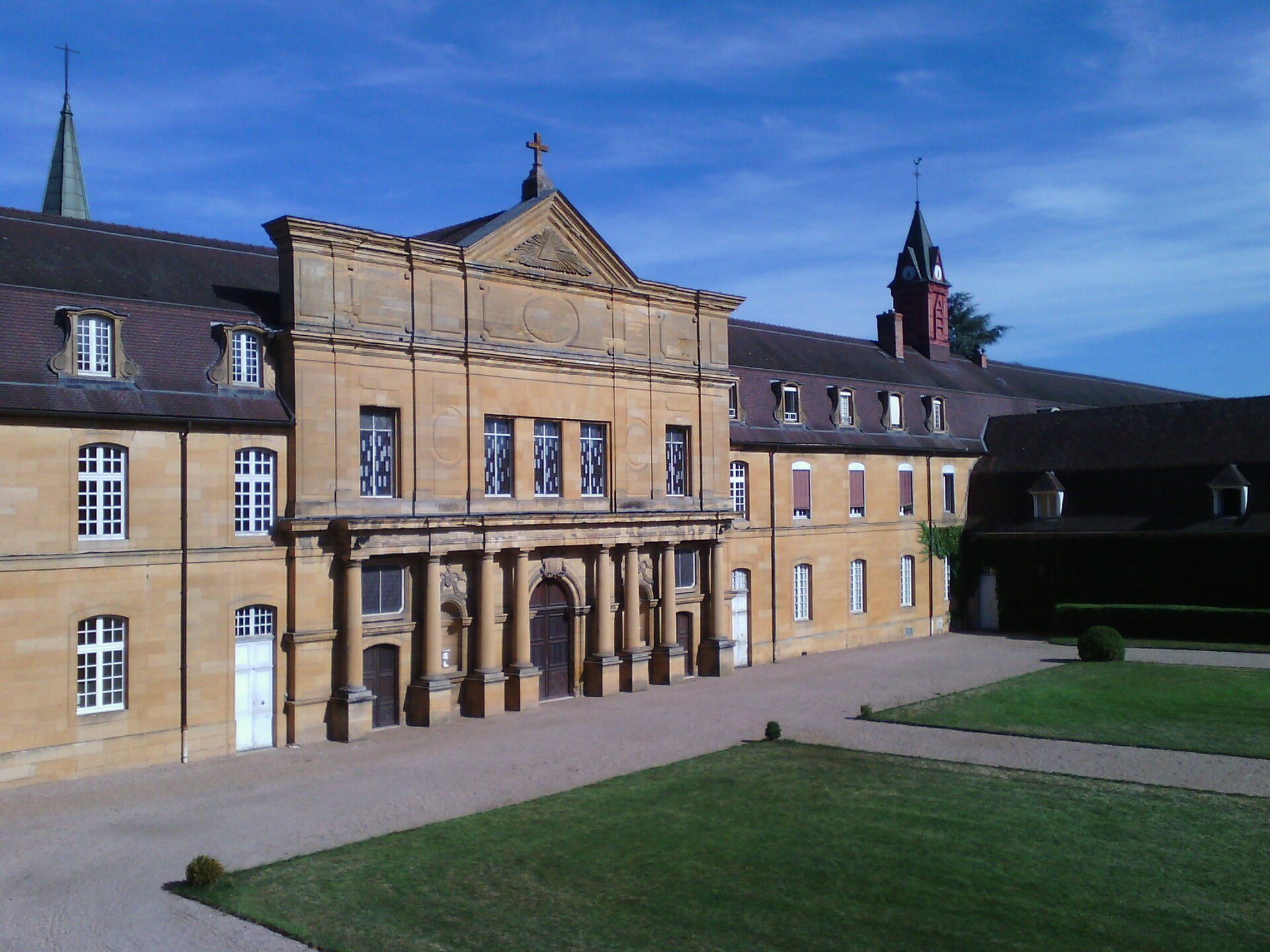
The surviving monastery is organized around an abbey church with a classical facade and a roof turret. Buildings extend on both sides of the church, forming the principal structure of the complex. Most of the surviving fabric belongs to the eighteenth century, when the abbey was rebuilt and enlarged during the period associated with Abbot Dorothée Jalloutz. The original twelfth-century buildings have almost entirely disappeared.
An eighteenth-century enclosure wall surrounds the monastery for approximately 3.3 kilometres and incorporates four towers. The wall and towers define the physical extent of the monastic precinct and preserve part of the later abbey’s planned setting.
Abbey church
The Trappist community rebuilt the abbey church after arriving from Le Gard, and the church was consecrated in 1856. Its choir was reconstructed in 1954 in a project designed by Yoki. The design provided space for a large stained-glass window showing the Virgin and Child.
Yoki created the window as part of the choir’s reconstruction. He used patina only for graphic signs and to soften areas of antique glass where excessive light might have been produced. Geometric forms frame the Virgin and Child and strengthen the flat, planar character of the wall.
Water supply
The name Sept-Fons remains physically associated with the monastery’s water supply. This feature is described as seven fountains or as seven channels that carried water to the community, linking the abbey’s name with the landscape on which the monastery was founded.