Basilica of San Gaudenzio: Novara’s Relic Church and Monumental Cupola
Site at a Glance
- Rating
- 4.6
- Popularity
- Medium
- Country
- Italy
- Primary era
- Early Modern
- External website
- Open
- Eras represented
- Medieval, Early Modern, Modern
- Civilizations
- Duchy of Milan, Italian, Kingdom of Sardinia, Spanish
- Site type
- Religious
- Remains
- Basilica
On this page21 sections
History
The Basilica of San Gaudenzio is a Roman Catholic church in Novara, Italy, dedicated to Gaudentius, the city’s early Christian bishop and patron saint. It belongs to the Diocese of Novara, has the status of a minor basilica, and remains an active parish church. The present building was begun in 1577 and developed through successive phases from the late sixteenth to the nineteenth century, culminating in Alessandro Antonelli’s vast masonry cupola.
From the early church to the fortified city
A church dedicated to Gaudentius existed by 841 near the present end of Via XX Settembre, about 500 metres east of the current basilica. It was rebuilt and reconsecrated in 1298. This earlier church stood outside the fortified centre when Novara was transformed into a military city between 1552 and 1554 under Charles V. Buildings beyond the walls were demolished to create open fields of fire, and the original basilica was among the structures destroyed.
The church’s reconstruction was placed under the Fabbrica Lapidea della Basilica di San Gaudenzio, a building commission responsible for overseeing the project and later works. After Novara was spared the plague of 1576, the new basilica was planned at the city’s highest point, on the north-western corner of the walls. A church dedicated to Saint Vincent the Martyr had stood there since at least 1019. Most of it was demolished for the new project, although three chapels survived, including the Chapel of Saint George. Gaudentius’s relics were temporarily transferred there.
Construction of the basilica
Pellegrino Tibaldi designed the new church, whose cornerstone was laid in May 1577. Bishop Cesare Speciano consecrated it on 13 December 1590, although the transept and presbytery were still unfinished. Economic difficulties, compounded by epidemics and wars, then halted construction until 1626. The principal structural work was completed in 1656.
The Chapel of the Scurolo, a shrine or crypt for a saint’s relics, was built between 1674 and 1711. Gaudentius’s relics were solemnly transferred there on 11 June 1711, after having remained in the Chapel of Saint George since the destruction of the earlier basilica. The main altar was completed and consecrated in 1725.
A separate bell tower was built by Benedetto Alfieri between 1753 and 1786. Its construction was prioritised because a temporary bell turret on the church’s south-western pier risked damaging the building through the vibrations of the bells. The campanile, meaning a freestanding bell tower, was suspended in 1773 when only the bell chamber remained to be completed.
Antonelli’s cupola
Funding for a new cupola was raised partly through a tax on meat. Alessandro Antonelli submitted his first design in 1841, and construction began in 1844. Financial problems and the wars of Italian independence interrupted the work. Antonelli revised the design in 1855 and again in 1860 and 1861, adding structural levels and increasing the planned height.
The cupola itself was completed in 1863, but disagreements then halted construction of the spire for about a decade. Work resumed in 1873. Antonelli added stucco floral decoration inside the cupola in 1873 and 1874, and the cupolino was completed in 1878. A statue of Christ the Savior was raised to the summit on 16 May 1878. Remaining structural and foundation work ended in early 1887.
The growing weight of the cupola raised concerns about the stability of the church. From 1881, Antonelli strengthened the four supporting piers and enlarged their foundations. The basilica was closed from 1937 to 1947 during a major consolidation campaign using reinforced concrete designed by Arturo Danusso. Later reassessment concluded that this reinforcement had not been necessary. Modern monitoring systems now detect subsidence, cracks, and oscillations.
Devotion, music, and modern interpretation
The annual feast of the basilica is held on 22 January. Its traditional ceremony of the flower commemorates the meeting of Gaudentius and Ambrose, bishop of Milan, and recalls the historic offering of wax by 59 surrounding municipalities and 12 patrician houses. During the ceremony, the large suspended chandelier is lowered and its iron flowers are replaced with flowers brought in procession. The crypt is opened for the feast, and a procession connects the cathedral with the basilica.
The basilica’s organs reflect several stages of its history. A small positive organ was installed in the seventeenth century. A larger two-keyboard Serassi organ with 50 stops was completed in 1829, and a smaller Serassi instrument was added in 1831. Both were dismantled during construction of the cupola and reassembled in 1888. Alessandro Mentasti later modified them in accordance with the Cecilian Reform, a movement that sought a more restrained Catholic liturgical style through the revival of Gregorian chant and older polyphony.
The principal organ was badly damaged during the consolidation works of 1937 to 1947. After the church reopened, it was replaced by an instrument built by Vincenzo Mascioni to a design by Ulisse Matthey. It was inaugurated in 1949 and restored in 1977. The Sala del Compasso was restored and opened to the public in 2013. Since 2021, a museum route has allowed controlled access to approximately 100 metres inside the cupola.
Remains
The complex brings together three principal elements from different periods: Tibaldi’s church, Alfieri’s isolated campanile, and Antonelli’s cupola. The church is a single-nave Latin-cross building with six interconnected side chapels, a broad transept, and a deep presbytery. Its strongly vertical, sculptural façades are articulated by niches, large windows, and projecting columns. The monumental entrance has a worked walnut door with rosettes and cast-iron heads made by Alessandro Antonelli.
The church and its chapels
Chapel of Saint George
The Chapel of Saint George stands at the base of the transept and is reached from outside through the Sala Moroni. It is one of the chapels that survived the demolition of the church of Saint Vincent. Its fifteenth-century frescoes are attributed to the workshop of Giovanni De Campo. Restoration in 2007 recovered part of its decorative scheme. The chapel housed Gaudentius’s body from 1553 until 1711, when the relics were moved to the Scurolo.
Chapel of the Good Death
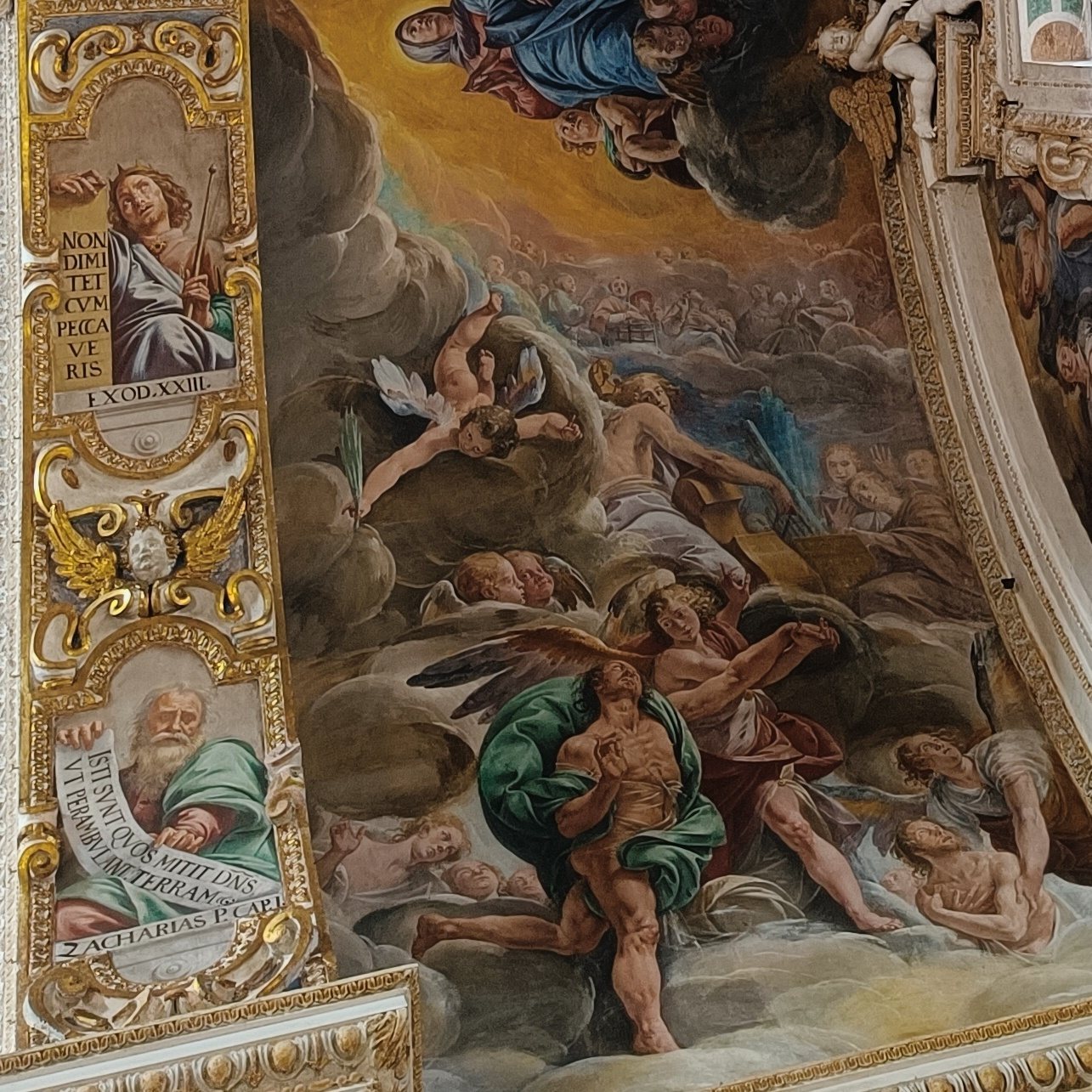
The first chapel on the right is the Chapel of the Good Death, inaugurated in 1620 and commissioned by Bishop Carlo Bascapè. It contains a deposition attributed to Moncalvo and frescoes by Morazzone. The decoration includes a Last Judgment, the Trinity, decomposing bodies, an angel and a devil beside a dying person, Death with a sickle, and biblical and saintly figures associated with meditation on mortality.
Chapel of the Circumcision
The second chapel on the right is the Chapel of the Circumcision. A large Baroque wooden frame encloses its painting of the Circumcision of Jesus by Giovan Battista Della Rovere, known as Fiammenghino.
Chapel of the Crucifix
The third chapel on the right is the Chapel of the Crucifix. It contains a crucifix traditionally attributed to Gaudenzio Ferrari, angels by Grazioso Rusca, and a fifteenth-century fresco of the Madonna transferred from the Oratory of Saint Luke.
Chapel of the Guardian Angel
The first chapel on the left is the Chapel of the Guardian Angel, endowed by Ottavio Nazzari. Tanzio da Varallo was commissioned to paint its frescoes in 1627. They include Christ in glory between the Virgin and Gaudentius, Franciscan saints, Saint Ottavio and Saint Nazarius, angelic interventions, the Sacrifice of Isaac, and Judith decapitating Holofernes. Tanzio completed the Battle of Sennacherib in 1629, while Giacinto Brandi made a further large painting around 1680.
Chapel of the Nativity
The second chapel on the left contains a two-level polyptych painted by Gaudenzio Ferrari in 1516 and transferred from the earlier basilica. Its upper register shows the archangel Gabriel, the Nativity, and the Annunciation. The lower register presents Saint Peter, Saint John the Baptist, the Madonna and Child with Ambrose and Gaudentius, Saint Paul, and Saint Eusebius or Saint Agabius. Ten small monochrome panels in the predella depict saints and episodes from Gaudentius’s life. The chapel’s frescoes are by Paolo Camillo Landriani.
Chapel of Our Lady of Loreto
The third chapel on the left, the Chapel of Our Lady of Loreto, has altar frescoes by Stefano Legnani and architectural illusion decoration by Pietro Francesco Prina. Its Nativity fresco by Bernardino Lanino was transferred from the monastery of Saint Agatha.
The relic shrine and presbytery
Chapel of the Scurolo
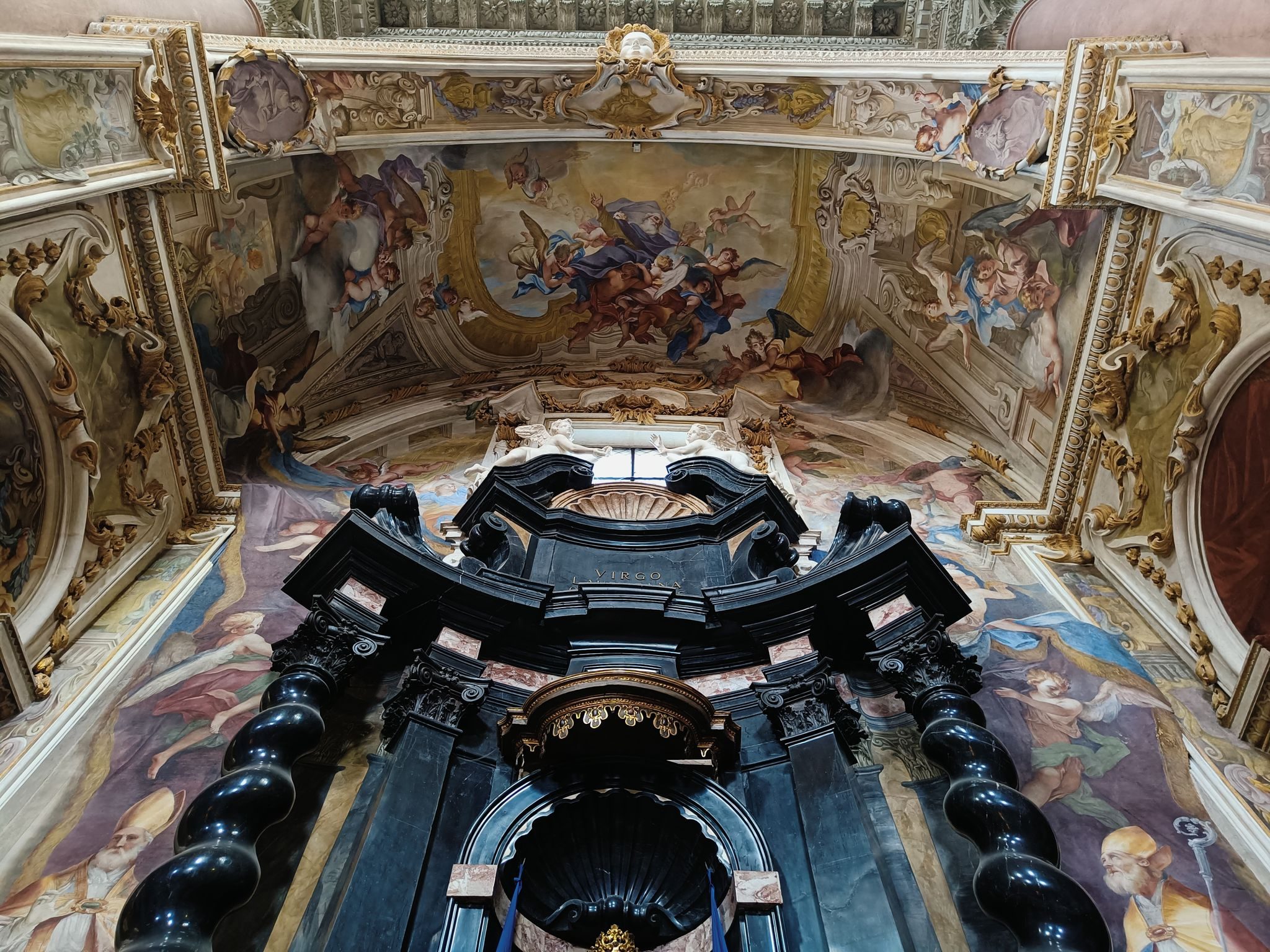
The octagonal Chapel of the Scurolo is reached by a stairway beside the right transept. Built between 1674 and 1711, it has steel and bronze doors, richly veined marble revetment, and bronze decoration. Its altar has bronze reliefs set against lapis lazuli and supports an octagonal silver-and-crystal urn containing Gaudentius’s body. Four niches hold statues of Saints Adalgisus, Agabius, Lawrence, and Julius by Carlo Beretta. The vault bears Stefano Legnani’s fresco of the Triumph of Gaudentius.
High altar and transept
The Baroque high altar in the presbytery is decorated with marble and bronze. Its reliefs were designed by Carlo Beretta and cast by Carlo and Francesco Pozzi, Giovanni Battista Agazzini, and Carlo Esartier. A marble episcopal throne stands on the left wall, and the altar contains relics of Saint Anterus, a third-century pope. The left transept contains Pelagio Palagi’s large 1833 painting of Saint Adalgisus presenting the possessions of Cesto to the canons of San Gaudenzio, together with the original summit statue of Christ the Savior.
Sacristy and Chapel of the Blessed Sacrament
The sacristy, reached from the left wall of the right transept, contains a Saint Jerome attributed to Jusepe de Ribera, known as the Spagnoletto. The Chapel of the Blessed Sacrament has eight panels by Giovan Mauro Della Rovere depicting episodes from the life of Gaudentius.
The campanile
The campanile stands separately to the left of the apse. Approximately 92 metres high, it is built of brick and Baveno granite and crowned by bronze angels made by Giovan Battista Agazzini. Its eight bells are tuned in a theoretical G-major scale under the Ambrosian system, the traditional bell-ringing system associated with Milan and its surrounding region, while a ninth bell is used as a summons. The largest bell has been unusable since an irreparable crack developed in 1987. The sixth bell, in E3, ceased ringing in 2024, and the fourth, in C3, ceased ringing in 2026.
Antonelli’s cupola
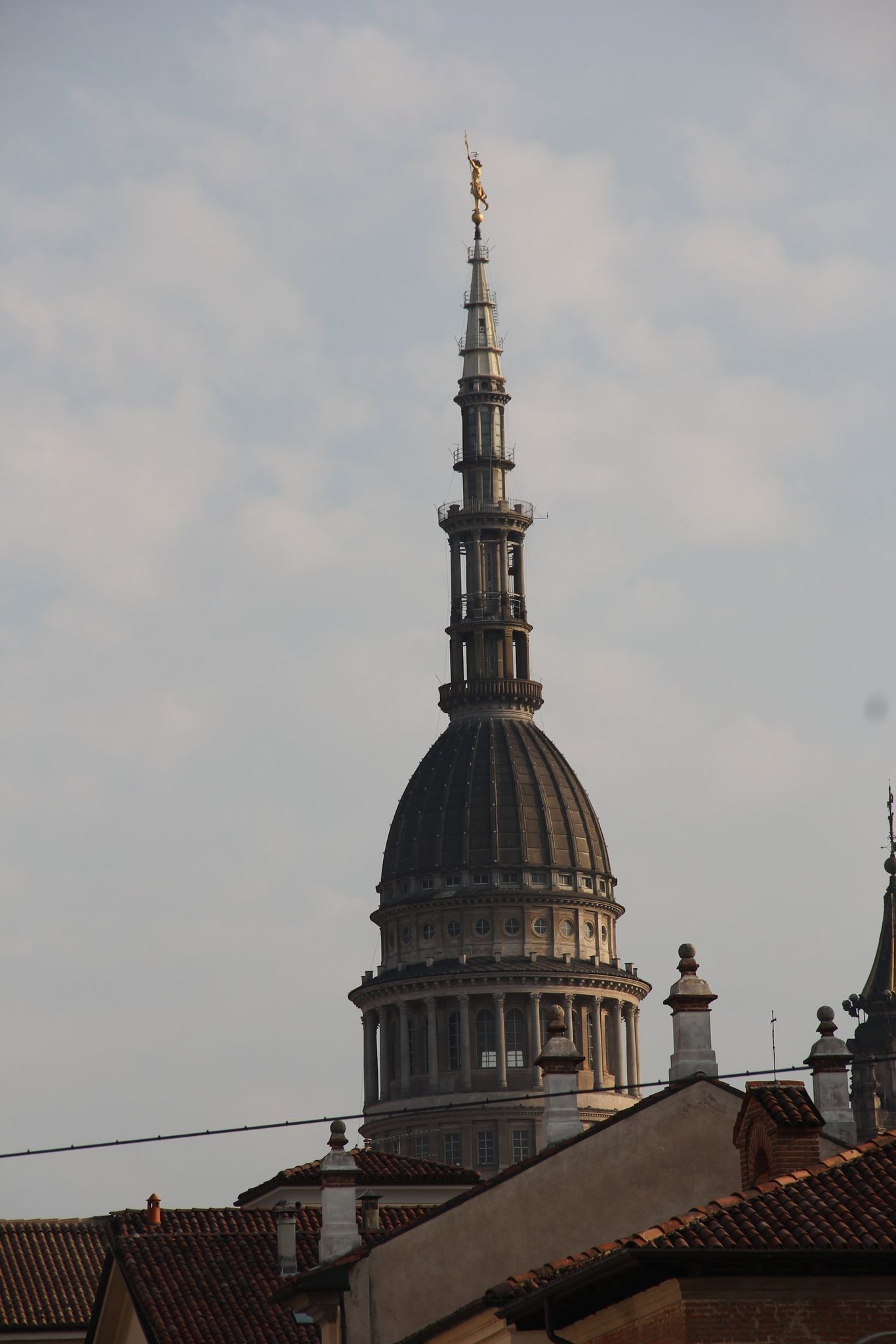
The cupola rises 121 metres and has a diameter of 22 metres. With the statue of Christ the Savior, its total height reaches approximately 126 metres. It is one of Italy’s tallest church structures and one of the world’s tallest load-bearing masonry constructions. The structure was built entirely of local brick and lime, without iron. Successive concentric rings of decreasing diameter rise above four arches supported by four piers arranged on a square plan. Internal arched and ribbed structures distribute the load. The cupola required approximately 2,046 cubic metres of brick and weighs more than 5,500 tonnes, excluding the supporting arches.
Externally, a brick drum supports a stepped circular tower. Three progressively smaller rings rise above it. Two have double orders of windows and colonnades, while the upper ring has lunettes. A pointed dome, a multi-level lantern, and a spire complete the composition. The first internal shell has stucco floral relief decoration. The upper section remains white because the intended fresco cycle, designed to be seen from the church below, was never executed. The external colonnades were also intended to receive statues that were never installed.
The original summit statue of Christ the Savior is almost five metres high. Designed by Pietro Zucchi and raised in 1878, it is made of bronze covered with gold leaf. A modern fibreglass copy now occupies the summit, while the original is preserved inside the basilica in the left transept. Above the apse, the Sala del Compasso preserves an eleven-metre compass used by Antonelli to draw the cupola’s supporting vaults at full scale.
Organs and interior furnishings
The principal organ has electric transmission, a console in the presbytery, three keyboards of 61 notes each, and a concave-radial pedalboard of 32 notes. The smaller Serassi organ retains its original tonal characteristics but is in poor condition. The suspended central chandelier has forged-iron flowers and commemorates both the meeting of Gaudentius and Ambrose and the historic communal offering of wax.