Faneromeni Monastery: A Fortified Orthodox Monastery on Salamis, Greece
Site at a Glance
- Rating
- 4.8
- Popularity
- Low
- Country
- Greece
- Primary era
- Early Modern
- External website
- Open
- Eras represented
- Early Modern
- Civilizations
- Ottoman
- Site type
- Religious
- Remains
- Fortified Monastery
On this page12 sections
History
Faneromeni Monastery is a historic Eastern Orthodox monastery on Salamis, Greece, dedicated to the Dormition of the Theotokos, the Orthodox belief in Mary’s death and bodily assumption into heaven. The monastery belongs to the Metropolis of Megara and Salamis and occupies the island’s northwestern coast. Its origins are connected by tradition with an earlier church and with the discovery of an icon of Mary, while its present foundation dates to 1682.
Origins and foundation
Local tradition places an ancient temple dedicated to Athena on the site. A Christian church was reportedly built there in the thirteenth century, but by the seventeenth century it had become very old and partly ruined. According to ecclesiastical tradition, Lambros Kannelos, a devout Christian from Megara, was directed in three dreams by the Panagia, an Orthodox name for Mary, to travel to Salamis. While excavating among the ruins, he found an icon of the Virgin. This discovery gave the monastery its name, Faneromeni, meaning “Revealed.”
In 1682, Kannelos restored the church and founded the monastery. He and his wife then entered monastic life. Kannelos took the name Lavrentios and withdrew to the Hermitage of the Prophet Elias southeast of the monastery. He died on March 6, 1707, and was buried at Faneromeni. The Church of Greece later recognized him as Venerable Lavrentios and commemorates him on March 7. Orthodox believers attribute numerous miracles to him.
The monastery during Ottoman rule and the revolution
During Ottoman rule and the Greek War of Independence, which began in 1821 and led to the creation of the modern Greek state, Faneromeni was a flourishing male monastery. Its strong fortifications made it a secure place for sacred vessels, religious heirlooms, and the transfer of the library of Athens. The monastery also provided money and materials for the Greek struggle.
During the revolution, the monastery sheltered civilians from Athens, Megara, and nearby areas. Monks supplied food and medical care to civilians and combatants, and the institution also operated an orphanage. Bread, grain, oil, wine, horses, timber, ammunition funds, soldiers’ maintenance, and other necessities were supplied through the monastery. Its financial assistance was also credited with helping to establish a primary school in Megara.
Gregorios Kannelos, a great-great-grandson of Lavrentios, was abbot during the revolution. He provided pastoral services and is identified in the records of the Filiki Eteria, the clandestine society that organized support for Greek independence, as a prominent member involved in initiating new members. He was also associated with the Battle of Acrocorinth, the struggle for the fortified citadel above Corinth.
Revolutionary leaders who stayed at Faneromeni or held meetings there included Ioannis Makriyannis, Kitsos Tzavelas, Kriezotis, Dimitrios Ypsilantis, Mavrovouniotis, and Georgios Karaiskakis. With Gregorios Kannelos’s consent, Karaiskakis used the abbot’s quarters as his “general headquarters,” more precisely as a center for provisioning. Ypsilantis acknowledged the monastery’s contribution in three signed notes.
Wartime care and later transformation
A basic treatment center and hospital operated at the monastery from 1822 until at least early 1826. Gregorios, who practiced medicine empirically, was assisted by the Athenian physicians Anargyros Petrakis and Athanasios Zografos. The hospital may have been connected with contemporary belief in the healing powers of Lavrentios’s holy skull.
Ottoman commander Kioutachis repeatedly tried to capture the monastery during the siege of the Acropolis but failed. Faneromeni’s resistance was also preserved in popular poetry. After Karaiskakis was killed in May 1827, Gregorios and the monks gradually left for security reasons. They returned after early September 1828 and resumed the monastery’s religious and national work, despite its financial collapse.
The Hermitage of the Prophet Elias survived intact until 1944, when German forces destroyed it. Faneromeni remained a male monastery until July 27, 1944, when Metropolitan Iakovos of Attica and Megarid converted it into a women’s monastery. In the twenty-first century it continues as a women’s monastic community. The monastery’s feast of the Dormition is celebrated locally on August 23.
Art, memory, and protection
The church paintings were created in 1735 by Georgios Markou of Argos and his pupils. The monastery also preserves old documents and historical relics. From 1933 to 1950, the poet Angelos Sikelianos lived in an old building on the shoreline in front of the monastery, where King Paul met him while visiting the Salamis naval station.
Faneromeni is recognized as an archaeological site and as a protected historic building. Its continuing religious identity is expressed through its dedication to the Dormition of the Theotokos and through the veneration of Lavrentios, whose memory remains associated with the monastery’s foundation.
Remains
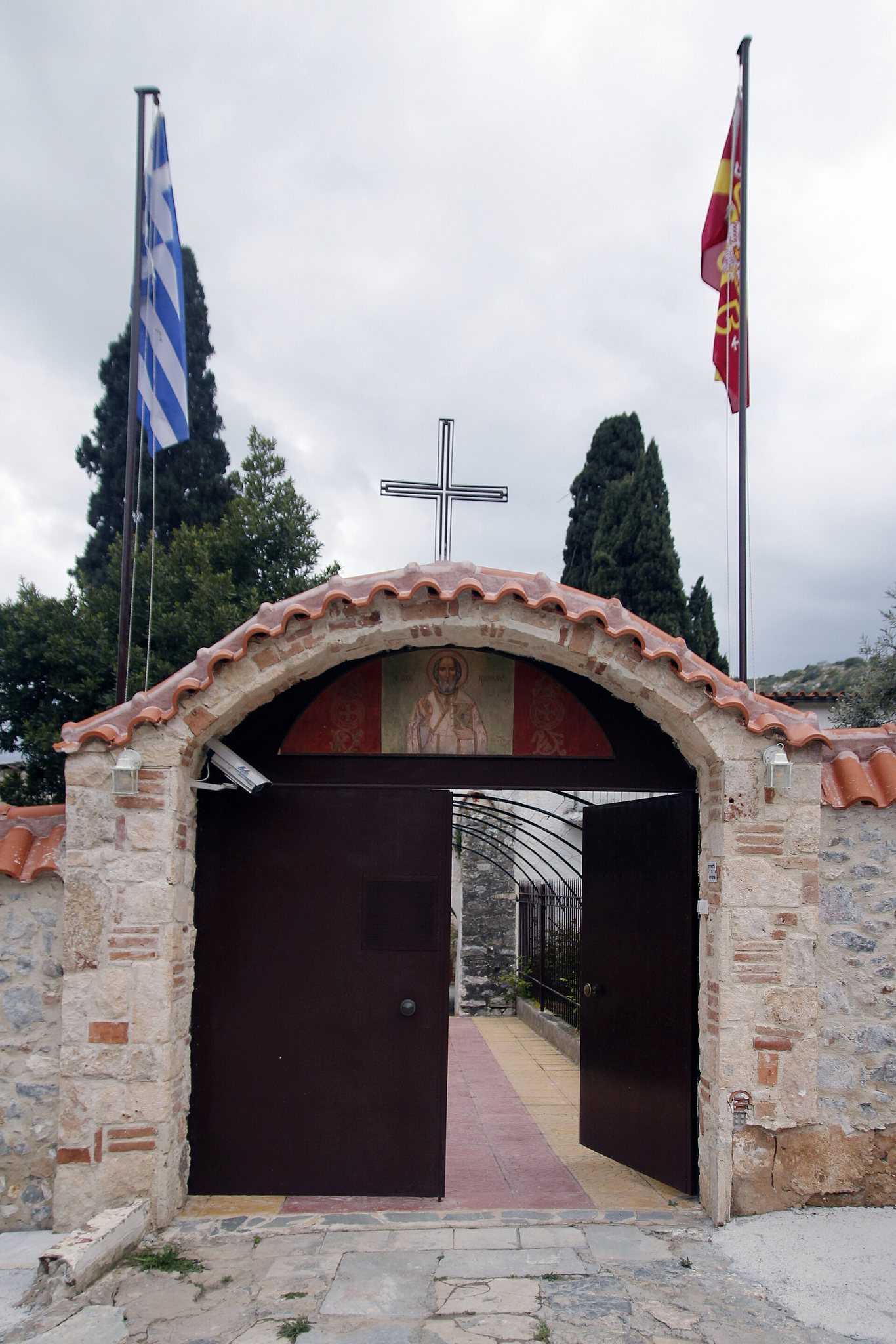
The monastery is arranged as a fortified complex around a central courtyard. It contains monastic cells, kitchens, a communal dining hall, workshops, storerooms, and the chapel of the Holy Apostles. The buildings rise to two or three stories and face the courtyard through galleries. These galleries are now arched and made of reinforced concrete. Towers occupy the southwestern and southeastern corners of the enclosure.
Principal churches and courtyard buildings
The catholicon
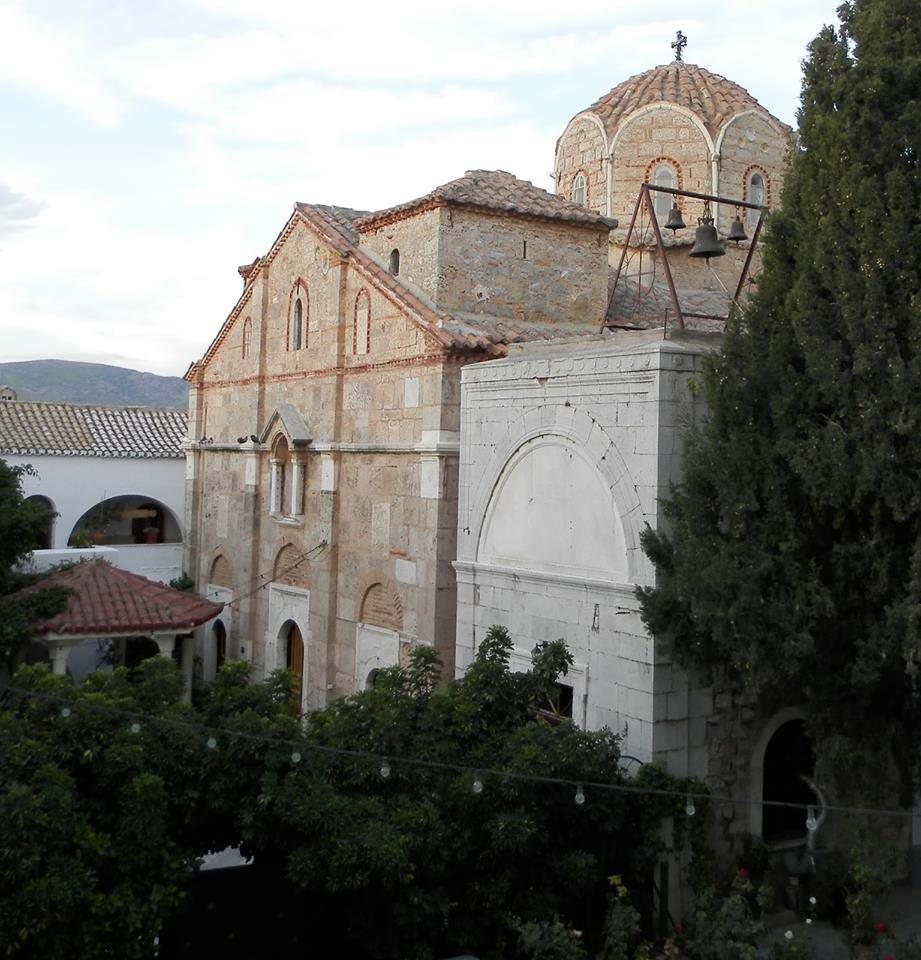
The catholicon, the principal church of an Orthodox monastery, stands in the northern part of the enclosure. It is a three-aisled domed basilica with a gabled roof. Its octagonal dome follows the Athenian type and rises above the surrounding buildings. Square turret-like structures stand at the four roof corners and are probably former hermitages. Three turrets, on the northwestern, northeastern, and southeastern sides, have small three-sided apses on their eastern walls.
The interior contains surviving post-Byzantine paintings from 1735. Post-Byzantine art continued Orthodox religious traditions after the fall of Constantinople in 1453. The paintings were made by Georgios Markou of Argos and his pupils and include approximately 3,530 figures and representations.
Churches and museum
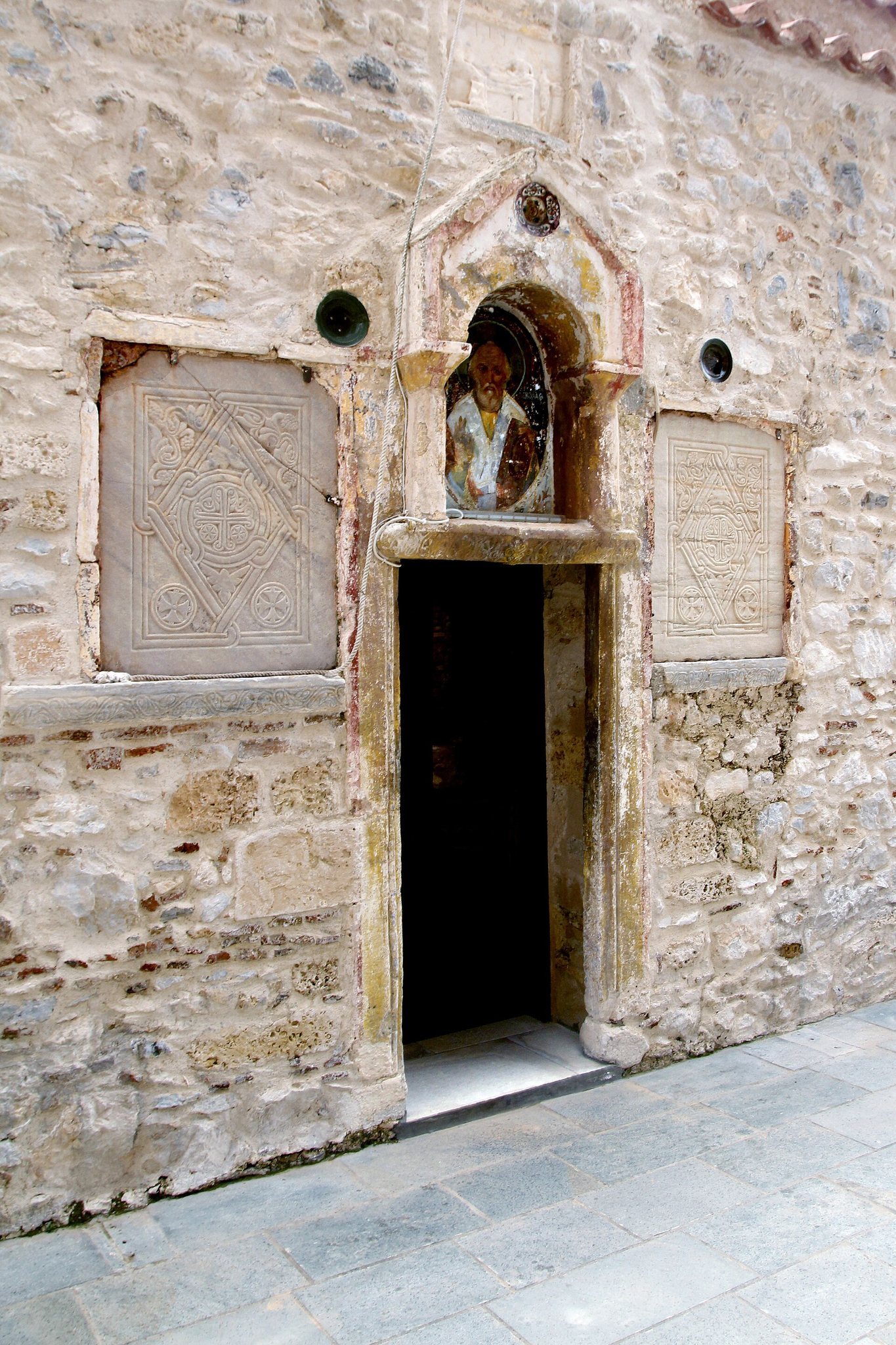
The complex also includes the church of Saint Nicholas, which contains a relic of Lavrentios, and the church of Saint Sophia. The church of the Holy Apostles functions as a museum containing ecclesiastical objects, icons, and manuscripts. Old documents and historical relics are preserved within the monastery.
Courtyard tomb
The tomb of the military leader Ioannis Gkouras is located in the monastery courtyard, within the fortified enclosure.
Shoreline building
Sikelianos’s residence
An old building stands at the monastery entrance in front of the shoreline. It served as Angelos Sikelianos’s residence from 1933 to 1950, linking the surviving monastery complex with the poet’s long association with Salamis.