Paskov Castle: Historic Seat of the Paskov Estate in Czechia
Site at a Glance
- Rating
- 4.5
- Popularity
- Low
- Country
- Czechia
- Primary era
- Early Modern
- External website
- Open
- Eras represented
- Early Modern, Modern
- Civilizations
- Austria-Hungary, Austrian Empire, Habsburg, Holy Roman Empire
- Site type
- Domestic
- Remains
- Castle
On this page12 sections
History
Paskov Castle is a historic aristocratic residence in Paskov, Czechia, whose principal rebuilding in the seventeenth century produced an early Baroque chateau with surviving Renaissance elements. It served as the seat of the Paskov estate, a property that passed through the hands of bishops, noble families, military officers, merchants, and state officials before becoming a museum.
Medieval Fief and Renaissance Fortress
Paskov appears in a charter issued in 1267 by Bruno of Schauenburg, bishop of Olomouc. For several centuries, it was a fief of the Olomouc bishopric, an ecclesiastical principality centered on Olomouc in Moravia. Land held as a bishopric fief carried obligations and allegiance to that institution. The estate successively belonged to families including the Černohorskýs of Boskovice, the Žerotíns, and the Pernštejns.
A fortress at Paskov is first mentioned in 1484. In 1530, Bishop Stanislav I Thurzo released Paskov from its feudal obligations, making it the hereditary property of Jan of Pernštejn. Jan sold the estate to the Čely of Čechovice in 1547. The Silesian humanist, scholar, and diplomat Ondřej Dudič of Hořehovice owned Paskov from 1577 to 1579. He lived at the fortress and used it as a meeting place for his social contacts before selling the estate to Ctibor Syrakovský of Pěrkov.
Syrakovský, who served as Moravia’s highest provincial scribe from 1579 to 1601, expanded the fortress toward the end of the sixteenth century. His sons later became heavily indebted, and Kateřina Onšíková of Bělkovice purchased Paskov in 1614. Kryštof Cedlar of Hof inherited it in 1617. He and his sister and heir, Anna Cedlarová of Hof, supported the Estates’ opposition, the resistance of the Bohemian and Moravian estates to Habsburg authority. After the defeat of the Bohemian Revolt, Anna’s property was confiscated, and the Court Chamber administered Paskov with other confiscated estates from 1622 to 1624.
Seventeenth-Century Chateau
Václav Bruntálský of Vrbno acquired Paskov in 1624. His ownership coincided with re-Catholicization, pressure on the estate’s subjects, and the Thirty Years’ War, the European conflict fought from 1618 to 1648. During the 1620s or 1630s, he began transforming the older fortress into an early Baroque chateau with late Renaissance features. The work proceeded in stages until 1640–1646.
Military movements near the end of the Thirty Years’ War damaged the chateau. After Václav’s death, his wife Alžběta, née Dembinská, continued the building campaign, giving particular attention to the fortifications. Jan František Bruntálský of Vrbno took control in 1656. He rarely lived at Paskov and sold the estate in 1690 to Count Bedřich of Oppersdorf, who held high provincial offices in Moravia.
Aristocratic Residence and Estate Centre
Bedřich’s heir, František Josef Oppersdorf, served for many years as Moravia’s provincial governor and became a permanent resident of Paskov. An image made around 1700 shows the chateau, while a probate inventory from 1714 describes a richly furnished aristocratic residence with an ornamental garden. František Josef left substantial debts, and his widow, Anna Františka, eventually had to sell the estate.
Knight Filip Ignác Hoch bought Paskov at public auction in 1717. The estate then included the town of Paskov and seven villages, together with a brewery, malt house, mill, farmyards, granaries, an ornamental garden, an orangery, and greenhouses. An orangery was a glazed or heated garden building used to cultivate and protect citrus and other sensitive plants. Hoch sold Paskov to Baron Samuel František Rebentisch in 1731.
Rebentisch’s official duties kept him in Hungary, so he never lived at Paskov. After his death in 1734, his wife Marie Paula, née Gallanegh, administered the estate for their underage sons and later resided there. Following her second marriage to Field Marshal Jan Daniel Fürstenbusch, she commissioned a new church and rectory at Paskov.
Achác Jan Nepomuk Rebentisch inherited the estate after his mother’s death but quickly burdened it with debt. He sold furnishings from the chateau, including equipment from its chapel, and was eventually forced to sell the entire property. Karel Pamesberger of Kettenburg, a wealthy Olomouc merchant and entrepreneur, acquired Paskov in 1765. Because Pamesberger’s heirs lacked the legal right of domicile in Moravia, the estate changed hands again in 1779, when Count Josef Antonín Mitrovský of Nemyšle purchased it.
Mitrovský, a former army officer who became an imperial-royal field marshal, settled permanently at Paskov and built up a substantial library. His heir, Antonín Bedřich Mitrovský, held high state offices and offered the estate for sale in 1809. Count Filip Ludvík Saint-Genois d’Anneaucourt, a Belgian nobleman, bought it for 500,000 gulden. He introduced Classical alterations, expanded the chateau collections, and developed the park.
Nineteenth- and Early Twentieth-Century Changes
Filip Ludvík transferred management to his son Mořic in 1848. A fire in 1869 led to further alterations, and Mořic later sold the chateau to his son-in-law, Count Günther Stolberg-Stolberg. Günther purchased the estate in 1880 and lived permanently at Paskov. His works included a balcony added between 1888 and 1893, a new kitchen building, and the enlargement of the park in 1907–1908.
In 1913, the Stolberg period brought a Neo-Baroque chapel dedicated to Saint Elisabeth of Thuringia, a medieval Christian princess and charitable figure associated with care for the poor and sick. In 1910, the chateau housed the count’s family and 17 staff members. Its profitable enterprises included a brewery and a mill, the latter converted into a hydroelectric power station in 1904. Although the estate still covered more than 1,000 hectares toward the end of the nineteenth century, land reform reduced its holdings, while the chateau and industrial enterprises remained with the Stolbergs.
War, Confiscation, and Reconstruction
The last private owner was Günther’s son, Dr. jur. Otto Stolberg-Stolberg. During the German occupation in the Second World War, part of the chateau was used as a military hospital for wounded German soldiers. Otto was arrested at the end of the war and died shortly afterward in Ostrava under unclear circumstances.
The chateau was looted at the end of the Second World War, and its original furnishings were lost. In 1945, the Beneš decrees, postwar Czechoslovak decrees that provided the legal basis for confiscating property belonging to members of German and other enemy populations, made the chateau state property. It was subsequently adapted for use as an oncology treatment facility. The medical institution operated there until 2004, after which the building stood empty for several years.
The town of Paskov acquired the chateau in 2013 and commissioned its reconstruction. The building opened in 2018 as the Museum of the Paskov Estate. Paskov Castle has been protected as a cultural monument since 1958, and the town remains its owner.
Remains
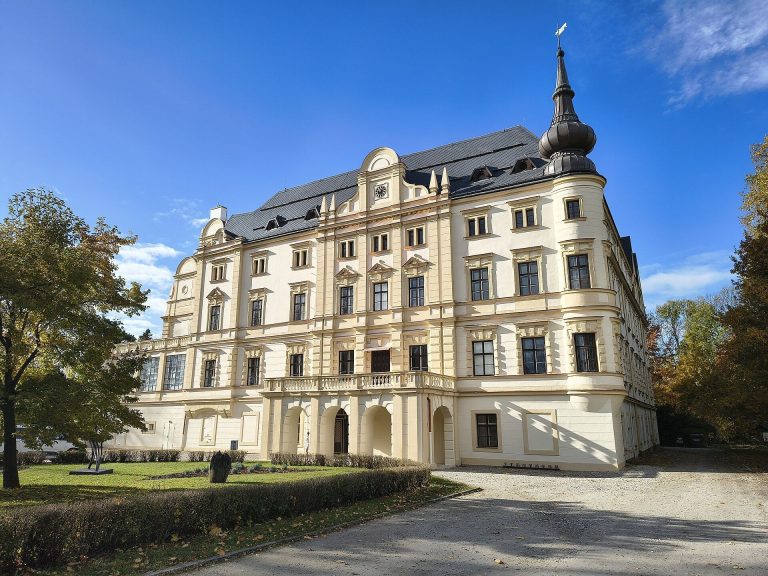
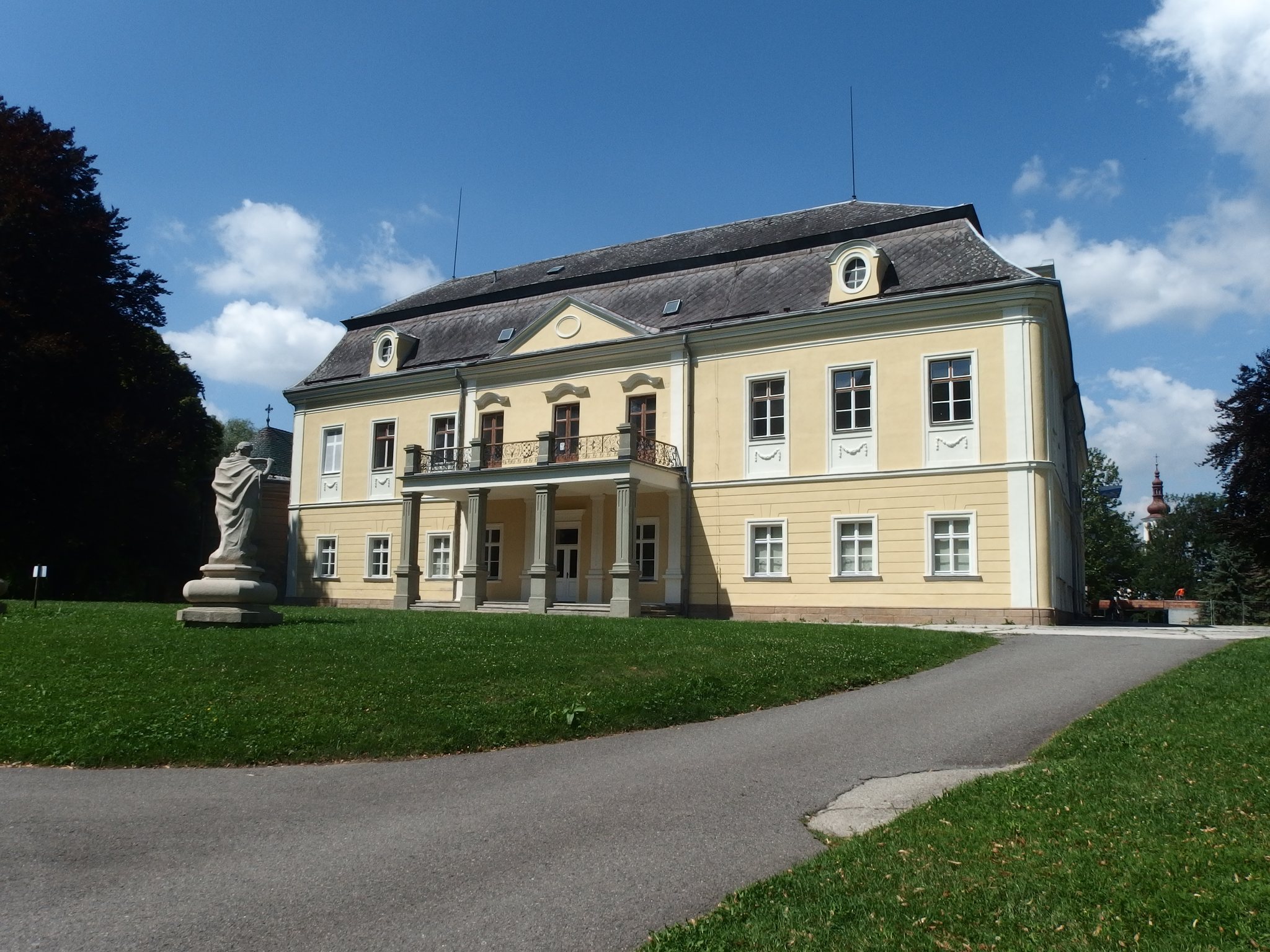
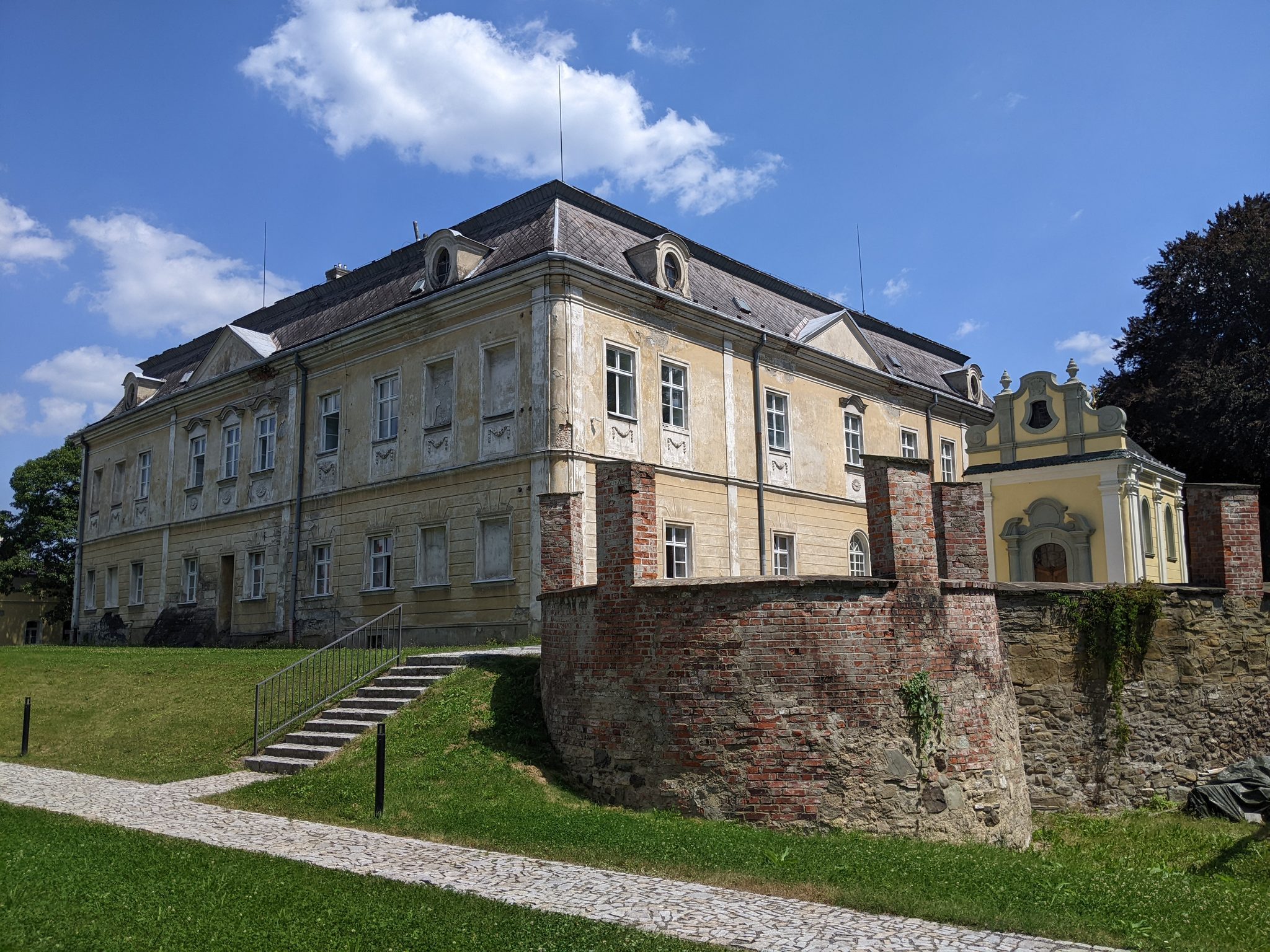
Paskov Castle is a single-storey building of four wings arranged around a closed courtyard. Its architectural character combines early Baroque and residual Renaissance features, with later Classical and Neo-Baroque interventions. The earlier fortress defenses were partly reshaped into an outer bailey, an enclosed area outside the principal stronghold, incorporating an entrance tower and corner bastions, or projecting fortified platforms intended to strengthen defensive fire.
Chateau Building and Courtyard
The former courtyard was later adapted as an entrance vestibule. Above the main entrance is an alliance coat of arms combining the arms of the Stolberg and Schaffgotsch families. A stone lintel, the horizontal structural element spanning a doorway or window, carries the Syrakovský family arms and the initials “CZ.” This element belongs to the late-sixteenth-century expansion of the earlier fortress.
The chateau was represented in an image made around 1700, and the 1714 probate inventory describes a richly furnished interior. Those furnishings did not survive the looting that followed the Second World War. During the twentieth-century conversion into an oncology treatment facility, additional buildings were erected within the complex without regard for its heritage values. Reconstruction commissioned by the town of Paskov prepared the building for its present use as the Museum of the Paskov Estate.
Park and Associated Buildings
Park and Garden Features
The estate’s grounds included an ornamental garden, an orangery, and greenhouses. Under the Saint-Genois family, the park became known for its varied collection of trees and its designed arrangement of small ancillary structures. It was enlarged in 1907–1908. A statue of Hercules stands in the park.
Neo-Baroque Chapel
The chateau complex includes a Neo-Baroque chapel dedicated to Saint Elisabeth of Thuringia. Built in 1913 during the Stolberg period, it forms part of the late architectural development of the residence.
Kitchen Building and Power Station
A separate kitchen building was added during the Stolberg ownership. The estate mill was converted into a hydroelectric power station in 1904, allowing moving water to generate electricity and adding an industrial function to the long-established estate economy.