Portrane Castle: A Medieval Archiepiscopal Fortress in Ireland
Site at a Glance
- Rating
- 3.7
- Popularity
- Very Low
- Country
- Ireland
- Primary era
- Medieval
- External website
- Open
- Eras represented
- Medieval
- Civilizations
- Norman
- Site type
- Military
- Remains
- Castle
On this page10 sections
History
Portrane Castle is a medieval castle in Ireland, located at Portrane in County Dublin. Rebuilt in the thirteenth century, it was linked to the Archbishops of Dublin and formed part of a defensive line of four castles extending through Donabate and Lanestown to Belinstown. Its history reflects the changing control of church lands, monastic property, and private estates from the eleventh century until its abandonment.
Medieval church ownership
The Black Book of Christ Church, the records of Christ Church Cathedral and its ecclesiastical institution in Dublin, states that the King of Dublin granted Portrane Castle and the lands of Baldoyle to Donatus, the first bishop of Dublin, in 1040. Strongbow confirmed the grant in 1170, and it was confirmed again in 1178 for Archbishop Lawrence O’Toole.
A papal bull of 1186 listed Portrane among the possessions of Christ Church, although Pope Clement III apparently granted it to the Crown in 1190. In 1197, Archbishop John Comyn claimed the castle. Christ Church agreed to withdraw its claim in exchange for an annual payment of 100 rabbits from the castle’s estates. In 1204, Patrick of Christ Church renounced the institution’s rights to Portrane Castle and its possessions on Lambay, which Comyn claimed.
Soon afterward, Comyn granted possession of the castle to the prior of Grace Dieu, an Augustinian religious house near Dublin that he had founded at Ballyboghill in 1190. In 1216, Pope Innocent III confirmed that Portrane Castle and its surrounding lands belonged to Henry de Loundres, Archbishop of Dublin. The thirteenth-century rebuilding followed within this period of ecclesiastical control, and the castle became one link in a chain of fortifications intended to protect the surrounding territory and routes.
Edward III confirmed Portrane Castle and its lands as possessions of the Archbishop of Dublin in 1337. Richard II did the same during his visit to Dublin in 1394. In 1403, rents from Portrane formed part of the ecclesiastical revenues associated with Archbishop Thomas Cranley. In 1490, Archbishop Walter Fitzsimons transferred the castle, its house and courtyard, and the Ballycanam farm to Margaret, prioress of Grace Dieu. The transfer increased the income of the monastery. The rent included roses delivered each year on Saint John’s Day.
Grace Dieu and the Reformation
Before the Reformation in Ireland, which included the Tudor dissolution of monasteries and the transfer of their property to the Crown or private grantees, Portrane remained associated with the wealthy community of Grace Dieu. The Cusack family lived in the castle, and the parish church beside its gate was known as Saint Canice’s Church.
During the dissolution, the castle and its lands were granted to Sir Patrick Barnwall of Turvey, ancestor of the Lords Kingsland. Sir John Barnwall, third Baron Trimlestown and Lord Chancellor of Ireland, later became its owner. The Cusacks continued to occupy the castle. James Cusack was living there when he received the office of judge in 1544. Former nuns of Grace Dieu also apparently remained at Portrane with their chaplain until at least 1577, when they finally dispersed.
In 1576, Elizabeth I granted Portrane’s castles, estates, lands, and tithes to Francis Agard, together with the church and priest of Portrane. Agard paid an annual rent of £8 on Saint John’s Day, and the holdings included 18 acres. The parish church was later renamed Saint Catherine’s Church. Portrane subsequently belonged to Sir Henry Harrington of Grange Con, a descendant of Agard, who sold it in 1608 to the Dublin alderman Nicholas Ball.
Private ownership and abandonment
Nicholas Ball’s grandson, Thomas Ball, sold Portrane Castle to Charles Wallis for £40 during the seventeenth century. William Petty’s survey of 1654 listed Ralph Wallis as its owner. George Wallis was living in the castle by 1677, when it had apparently been restored, and Charles Wallis owned it at the beginning of the eighteenth century. The Archbishops of Dublin nevertheless remained the nominal landlords and continued to receive rent from the castle and its lands.
In 1709, financial difficulties led the Wallis family to mortgage the castle and estate to Robert Saunders of County Cavan. Ralph Wallis eventually cleared the debt, but further financial problems forced him to sell Portrane Castle and its estate in 1728 to Eyre Evans, a member of Parliament for Limerick, for £395. The Evans family built a new residence, known as Mount Evans or Portrane House. Portrane Castle was abandoned soon afterward, while the replacement house was still standing in the 1950s, more than half a century after a hospital had been built on the land.
Stella’s Castle
Portrane Castle became associated with Esther Johnson, known as Stella, the close companion and mistress of the writer Jonathan Swift. Honoria Swanton was living at the castle in 1712, and later that year Johnson spent several weeks there with her. The association gave the building the local names Stella’s Castle and Stella’s Tower. Swift and Johnson exchanged letters during October and November 1712 while she was staying at Portrane. The nature of their relationship, including the possibility of a secret marriage in 1716, remains uncertain.
Samuel Lewis wrote in 1837 that the castle’s last resident had been Lady Acheson, although her identity and even her existence are uncertain. A tombstone for Catherine Acheson, who died in 1735, survives in the cemetery of Saint Patrick’s Church at Donabate, but she was not known as Lady Acheson. In the modern period, Portrane Castle was described as ruined and abandoned, and it may have undergone restoration in 2022.
Remains
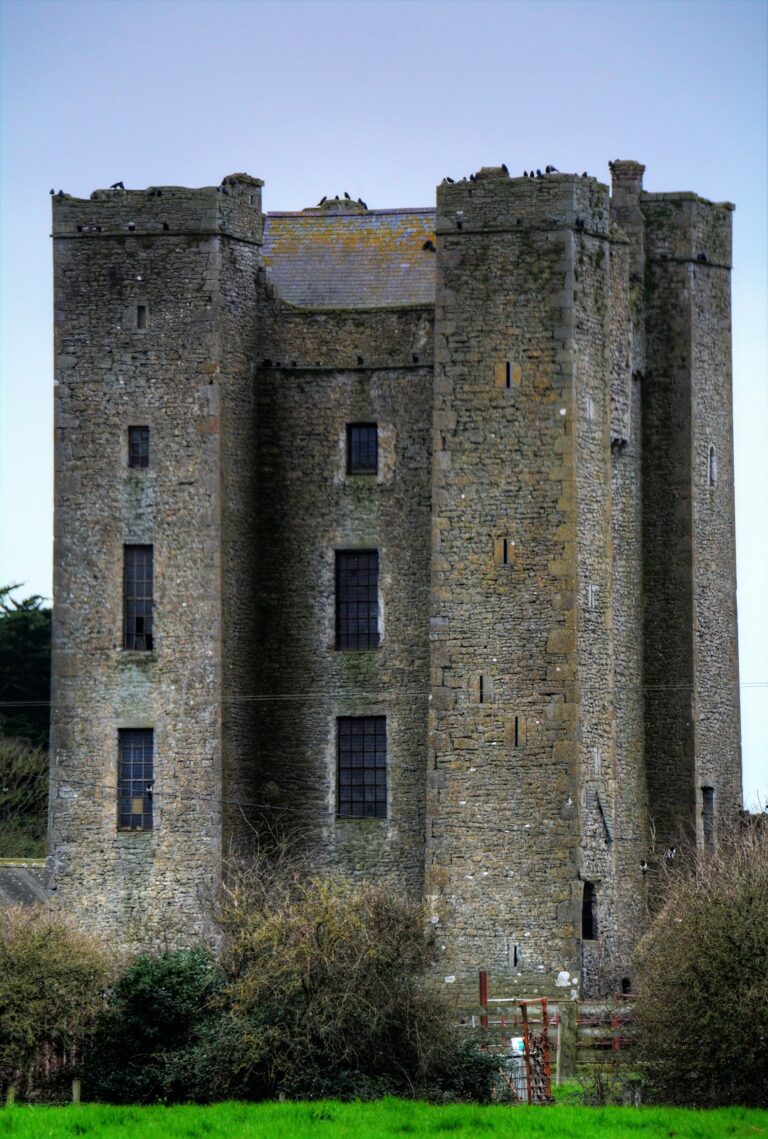
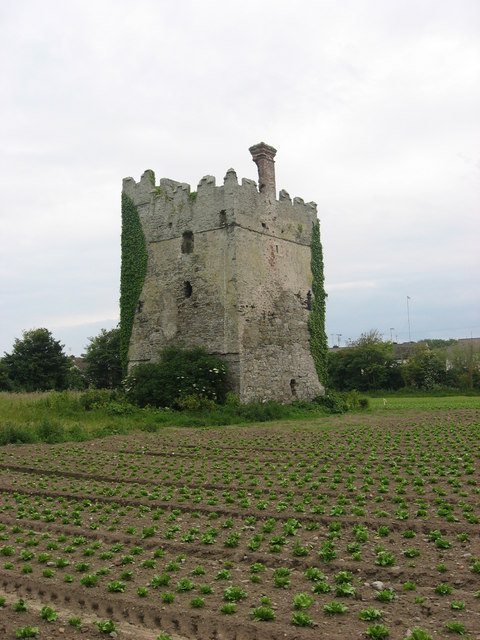
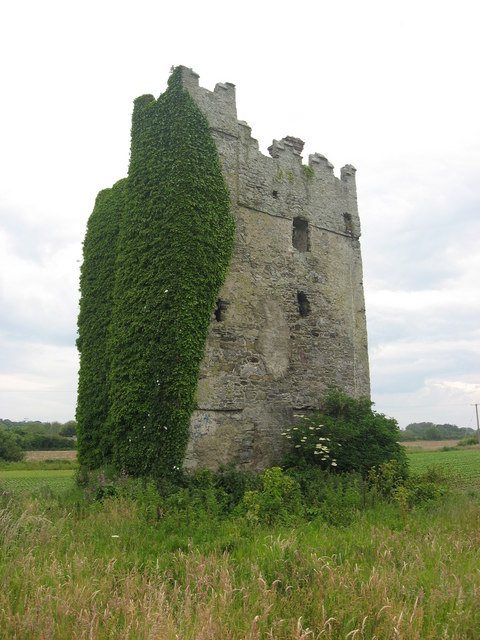
Portrane Castle survives as a solitary square tower standing in a field. The ruined building is covered with ivy and has been described as dilapidated and abandoned. Its surviving form represents the castle that occupied the medieval estate and belonged to the defensive chain extending from Portrane through Donabate and Lanestown to Belinstown.
Castle buildings and estate
Square tower
The principal surviving structure is the square tower, a fortified building rebuilt in the thirteenth century. It now stands in a ruined condition, with ivy covering its exterior. Earlier descriptions place the tower within a larger holding that included domestic and agricultural buildings, although the surviving castle is presented as a solitary structure.
Domestic and agricultural buildings
Sixteenth-century descriptions of the Portrane holdings refer to halls, stables, a manor house, a kitchen, and buildings called New Hall. These structures belonged to the wider castle estate, which included 18 acres of land. The parish church stood beside the castle gate and was first known as Saint Canice’s Church before taking the name Saint Catherine’s Church.
Portrane House
The Evans family’s replacement residence was known as Mount Evans or Portrane House. It stood on the estate after Portrane Castle had been abandoned and remained standing in the 1950s. The house represents the later residential phase of the property, distinct from the earlier fortified tower.