Palace of Blachernae: Byzantine Imperial Residence in Istanbul
Site at a Glance
- Rating
- 4.4
- Popularity
- Very Low
- Country
- Turkey
- Primary era
- Medieval
- Eras represented
- Medieval
- Civilizations
- Byzantine
- Site type
- Domestic
- Remains
- Palace
On this page17 sections
History
The Palace of Blachernae was a Byzantine imperial residence in Istanbul, Türkiye, built on the northern slope of the city’s Sixth Hill around 500. The Byzantine Empire was the medieval Roman Empire centred on Constantinople, and the palace formed part of its imperial landscape in the Blachernae suburb, an area now occupied mainly by Ayvansaray.
Early Imperial Residence
The hill was repeatedly remodelled, with terraces constructed to support the palace buildings. Although the Great Palace remained the principal imperial residence from the fourth to the eleventh century, Blachernae was used periodically. Its ceremonial buildings were described in the tenth-century protocols of Emperor Constantine VII.
By that period, the complex included the Hall of Anastasius, built by Emperor Anastasius I, the Hall of the Ocean, the Portico of Joseph, and the Hall of the Danube. These were formal halls used for imperial ceremonies, banquets, and receptions. Stairways connected the Hall of the Danube with the nearby shrine of St. Mary of Blachernae.
The Komnenian New Palace
In the late eleventh century, Emperor Alexios I Komnenos transferred his main residence to Blachernae. Alexios and his grandson Manuel I Komnenos expanded and fortified the complex. Manuel was particularly associated with an elaborate outer wall and new halls, including the Hall of Irene and the Precious Hall. The enlarged residence became known as the New Palace.
During the Second Crusade, Manuel I received Louis VII of France and Eleanor of Aquitaine at Blachernae. After the Fourth Crusade captured and sacked Constantinople in 1204, the Latin emperors, who ruled the city until the Byzantine reconquest of 1261, preferred the Bucoleon Palace.
Palaiologan Residence and Destruction
After the Byzantine reconquest in 1261, the Palaiologan emperors restored Blachernae as their principal residence. The Palaiologan dynasty ruled the restored Byzantine Empire from 1261 until the Ottoman conquest of Constantinople in 1453. Michael VIII initially returned to the Great Palace, but the court soon moved to Blachernae. Under his successor Andronikos II, Blachernae became the definitive imperial residence because the Great Palace had deteriorated to the point of being uninhabitable.
The final Byzantine emperor, Constantine XI, resided at Blachernae until the Ottoman conquest under Sultan Mehmed II in 1453. The palace was then destroyed and pillaged, after which it was abandoned and deteriorated into ruins. Its buildings had received additions and renovations under successive emperors and were generally identified by the ruler responsible for each phase.
Church of St. Mary of Blachernae
The Church of St. Mary of Blachernae was closely associated with the palace and was regarded as Constantinople’s second most important church after Hagia Sophia. Empress Aelia Pulcheria established its first building in 452 to house garments and cloths associated with the Virgin Mary. Emperor Leo I built a new church nearby in 473.
From the late fifth century, the church complex housed the Maphorion, a traditional Marian relic understood as the Virgin Mary’s veil or mantle. It was kept in a rotunda called the Hagia Soros. Justinian I, Basil I, and Leo VI later renovated and embellished the church.
During the siege of the Fourth Crusade, the Abgar image was brought to the church. This was a Christian image traditionally associated with King Abgar of Edessa. It disappeared after Constantinople was captured and plundered in 1204. John VI Kantakouzenos was crowned emperor there in 1347. A fire destroyed the church in 1433, including the Blachernae icon, which was regarded as the original prototype.
A tradition defended by Ian Wilson identifies the Shroud of Turin with the Abgar image and holds that the shroud was kept in the church from 1150 to 1204 behind bronze and silver doors. The historian Averil Cameron rejected this identification because historical descriptions of the Abgar image differ substantially from the shroud.
Remains
The palace district covered approximately 2 square kilometres between the Theodosian Land Walls, Constantinople’s principal land fortifications, and the Walls of Herakleios. Most of the area is now built over, and only a small part of the monumental complex survives. Consequently, descriptions of much of the palace depend on literary and historical evidence as well as the surviving structures.
Palace Buildings and Fortifications
Komnenian Palace
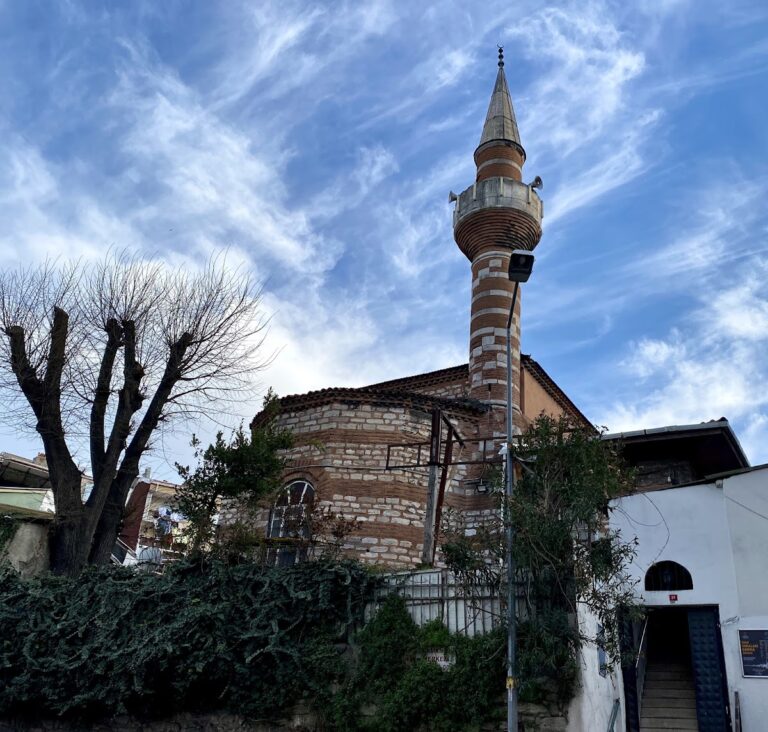
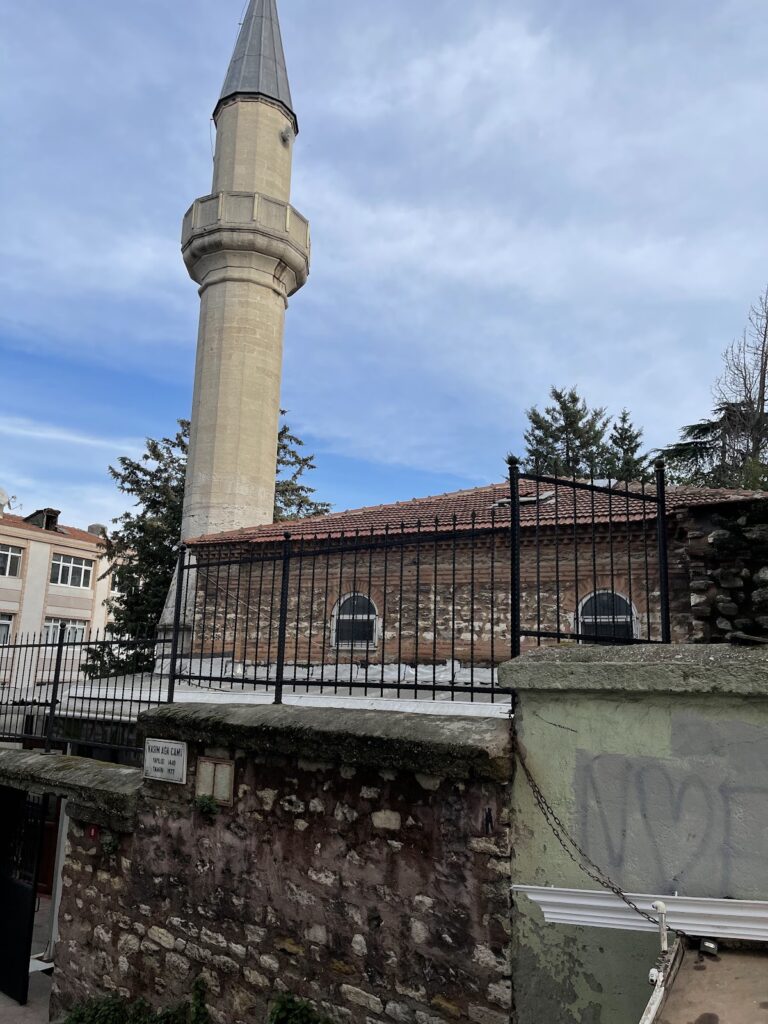
The principal Komnenian palace contained imperial apartments, a throne room, and other reception halls. Another reception building stood to its west. After the palace was abandoned in 1453, the main building was converted into a three-storey prison containing twelve rooms. The Ayvaz Efendi Mosque and the ruins of the Emin Buhari Monastery now occupy its place.
Palace of the Porphyrogenitus
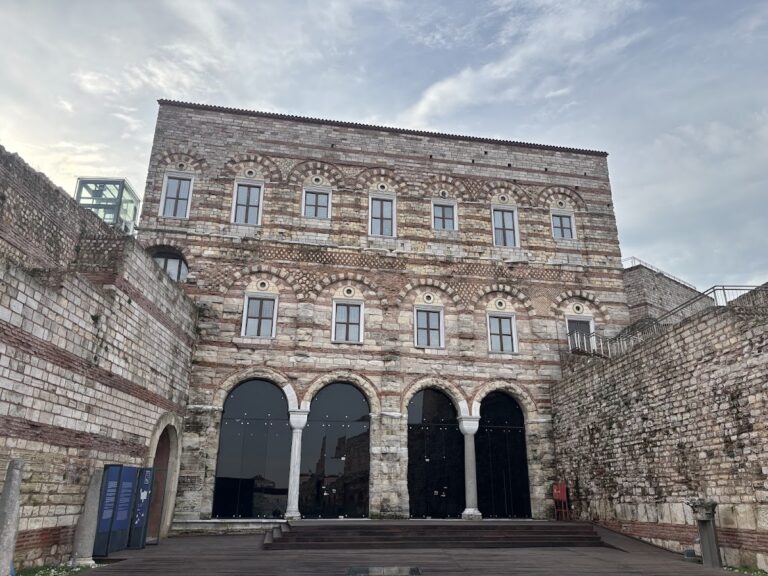
The Palace of the Porphyrogenitus, usually identified with Tekfur Saray, stood slightly south of the main palace complex between the Adrianople Gate and the Kaligaria Gate. Its foundations date from the tenth or eleventh centuries, while the surviving palace probably dates from the late thirteenth century. It is the sole relatively intact and significant surviving example of secular Byzantine palace architecture in Constantinople.
Anastasios Palace
The Anastasios Palace formed part of the wider complex, although its location is now difficult to determine.
Anemas Tower
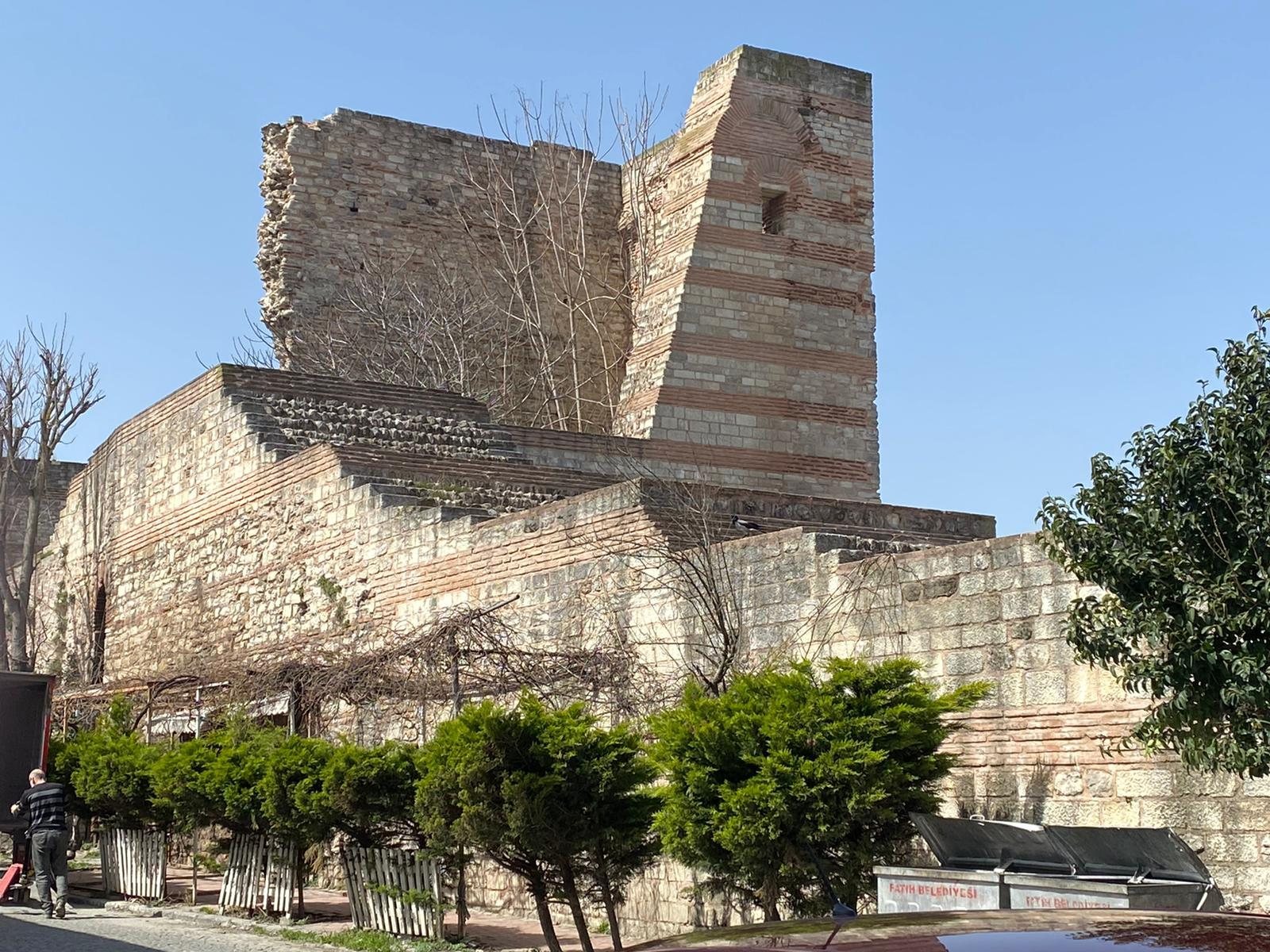
The Anemas Tower, also called the Prison of Anemas, formed part of the palace’s substructure. It was named after Michael Anemas, a Byzantine general and member of the imperial family who rebelled unsuccessfully against Alexios I and was imprisoned there. Isaac II Angelos later created hanging gardens around the tower, planting trees around it. Remains of these gardens were still visible in Istanbul.
From August 1376 to June 1379, Andronikos IV imprisoned his father, Emperor John V, and his brother Manuel II in the Anemas Tower.
Tower of Isaac Angelos
The Tower of Isaac Angelos was named after Emperor Isaac II Angelos, who was imprisoned there. Its ruins survive.
Kastellion
The Kastellion was a small fortress within the palace complex from which the Blachernae Gate could be monitored. Its fortifications comprised four large towers and three smaller ones.
Blachernae Gate
The Blachernae Gate began as an ordinary city gate. After Blachernae became the imperial residence, its use was reserved for the emperors.
Church Complex
Church of St. Mary of Blachernae
The church complex included Pulcheria’s early building of 452, the later church erected nearby in 473, and the Hagia Soros rotunda that housed the Maphorion. The buildings were repeatedly renovated and embellished before the church was destroyed by fire in 1433.
Hall of the Danube Connection
The Hall of the Danube belonged to the palace’s ceremonial group and was linked to the shrine of St. Mary of Blachernae by a series of stairways. This connection joined the imperial complex to the nearby church precinct.