Bective Abbey: A Cistercian Monastery in Ireland
Site at a Glance
- Rating
- 4.7
- Popularity
- Medium
- Country
- Ireland
- Primary era
- Medieval
- External website
- Open
- Eras represented
- Medieval, Early Modern
- Civilizations
- English, Norman
- Site type
- Religious
- Remains
- Fortified Monastery
On this page16 sections
History
Bective Abbey is a medieval Cistercian monastery in Ireland, founded in 1147 by Murchad O’Maeil-Sheachlainn, king of Meath. Dedicated to the Virgin Mary, it was established as the first daughter house of Mellifont Abbey, a daughter house being a monastery founded from and institutionally linked to an older mother abbey. Bective belonged to the Cistercian affiliation of Clairvaux, one of the order’s senior foundations. Its strategic position in the Knightsbrook River valley, near a ford across the River Boyne, helped give the monastery both agricultural value and military importance.
Foundation and medieval development
The abbey was founded under the name Beatitudo Dei, meaning “the blessedness of God.” This name is associated with the later English and Irish forms of Bective. Earlier activity in the area is indicated by prehistoric objects and by structures predating the monastery, including a well dated to approximately 1040–1230. The excavations did not establish that these earlier buildings were monastic.
Hugh de Lacy, the Anglo-Norman Lord of Meath, was buried at Bective in 1195. The monastery also became involved in political and ecclesiastical tensions. In 1227 its abbot took part in a revolt connected with the foundation of Jerpoint Abbey and was imprisoned. The following year Bective was recognized as a stronghold and underwent major fortification works, changing the character of the monastic complex.
The abbey’s abbot held the right to sit in the Parliament of the Pale, the English-controlled parliament associated with the area around Dublin. At its height, Bective controlled approximately 1,600 acres around the monastery. Its more distant granges, agricultural estates managed by the monastery, brought the total area under its administration to approximately 1,800 hectares.
Community, economy, and political change
Bective’s economy depended chiefly on sheep raising, supported by poultry and other domestic fowl production. Fish was also an important part of the diet despite the site’s distance from the sea. A well-stocked kitchen garden supplied cultivated plants, and the vegetation represented in the cloister’s carvings corresponds with plant remains recovered during excavation.
The community’s character was affected by the political divisions of medieval Ireland. During the reign of Richard II, Irish people and those classified as enemies of the king were barred from becoming monks in an effort to make the community exclusively Anglo-Norman. From 1335, numerous sheep bones indicate that the monks had begun eating meat, a change from the earlier strictness of the Cistercian rule.
The monastic community declined during the fifteenth century. In 1488 the abbot supported Lambert Simnel’s rebellion, an attempt to challenge Henry VII’s rule, and later received a royal pardon. Around this period the church’s southern aisle was demolished, and the arcades that had separated it from the nave were blocked.
Dissolution and later ownership
Bective was dissolved in 1536 during the dissolution of the monasteries, the sixteenth-century suppression of religious houses under Henry VIII and the confiscation of their property. The community nevertheless continued a clandestine monastic existence in a nearby residence. In 1619, the Cistercian monk and poet Sebastian Shortall was elected “abbot” by the surviving community.
After the Dissolution, the abbey’s estates were confiscated and leased to Thomas Asgarde. Andrew Wyse later purchased them in 1552, and subsequent owners included the Dillon and Bolton families. The buildings were adapted into a Tudor-style manor house, a residence influenced by the architecture of the Tudor period. Additional fireplaces and large windows were introduced, while the former abbey gradually deteriorated into ruin.
Archaeology and preservation
Excavations carried out between 2009 and 2012 recovered approximately 3,400 objects and 38,000 animal fragments. They greatly expanded knowledge of Bective’s agricultural history, revealing an extensive system of granges, drainage works, and ploughing. The evidence also clarified the monastery’s production of food and management of its wider estate. The excavations recovered very few human remains, suggesting that the abbey cemetery was not immediately beside the surviving buildings.
The Office of Public Works acquired the abbey in 1894. The Irish state purchased the site and a nearby car park in 2012, and the Office of Public Works manages the property. The ruins were designated a National Monument in 2009 and are included in Ireland’s Record of Monuments and Places. The complex is also a protected structure.
Remains
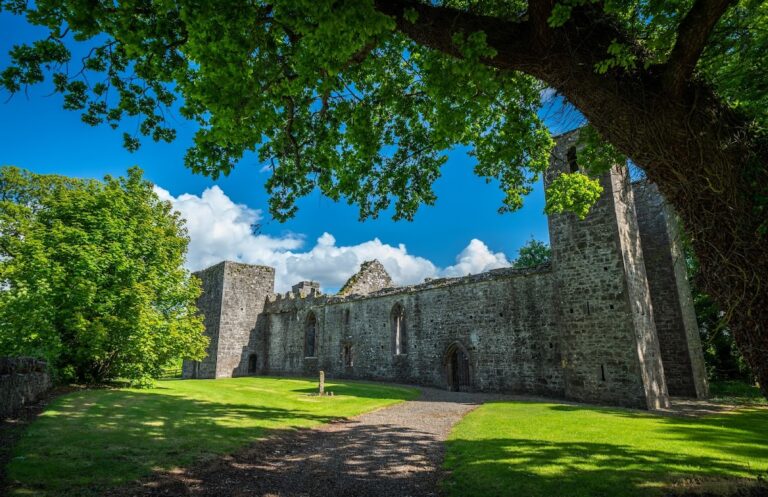
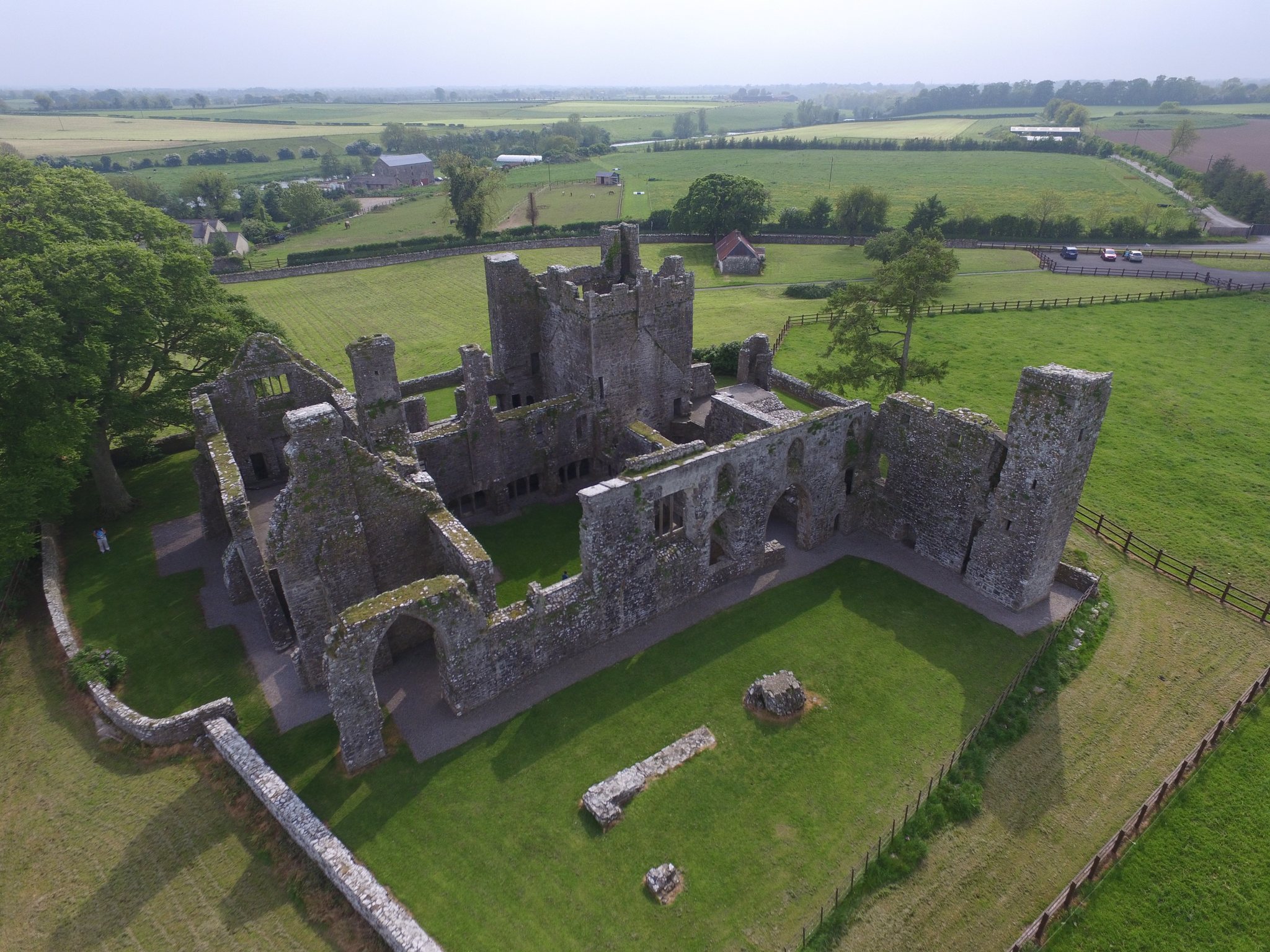
Bective Abbey occupies the northwestern bank of the River Boyne near Bective village, approximately eight kilometres from Trim and Navan. The buildings stand in the Knightsbrook River valley, close to a strategic crossing of the Boyne, within pasture enclosed by agricultural fencing. The surviving complex is organized around a small cloister, with the abbey church, chapter house, western lay-brothers’ range, eastern monastic range, and defensive towers forming its principal elements. Most visible remains belong to the late thirteenth, fifteenth, and sixteenth centuries. The earliest surviving fabric dates from 1274, while nearly all visible evidence of the original twelfth-century buildings has disappeared.
Church and cloister
Abbey church
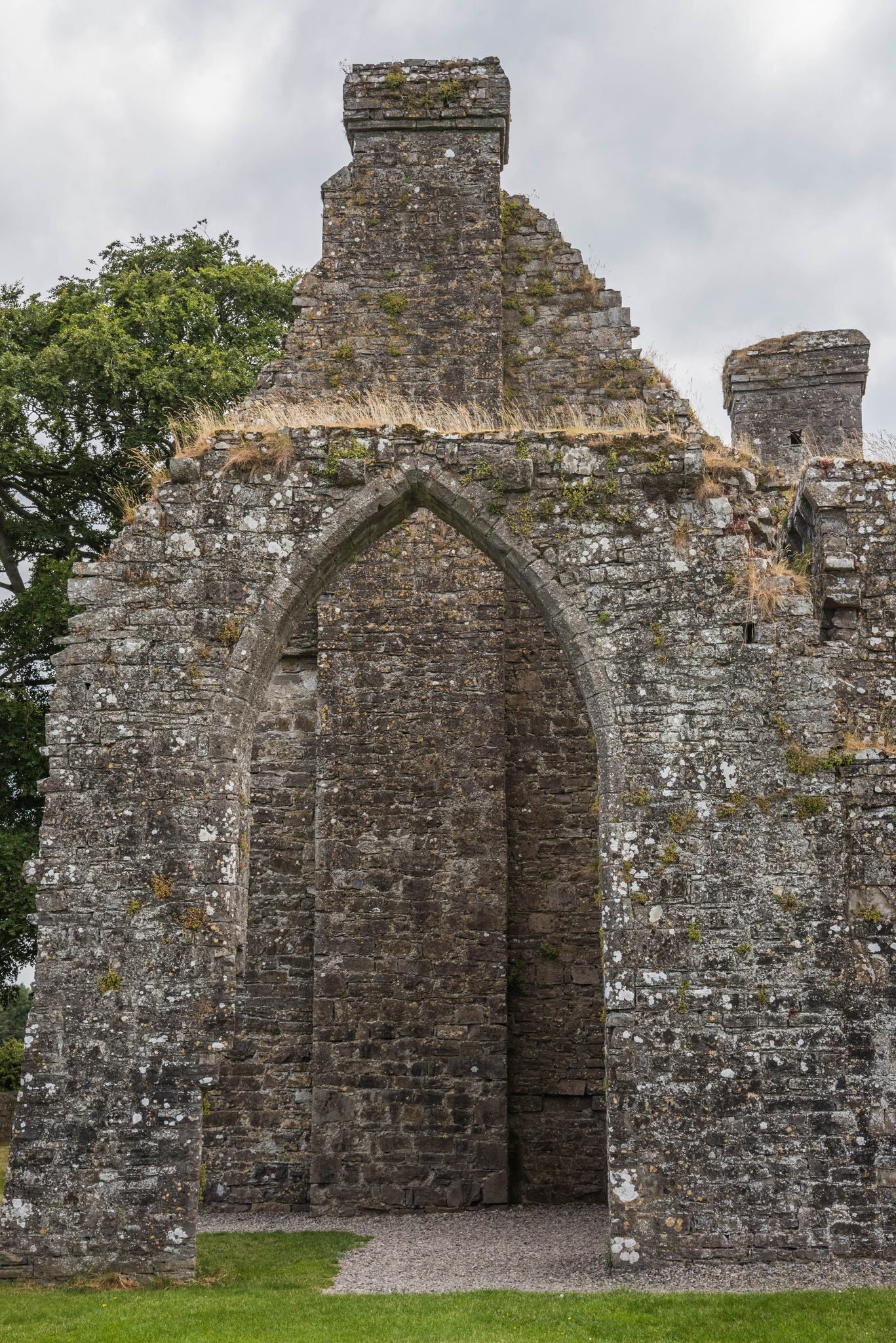
The early thirteenth-century abbey church survives in ruined form. Five bays of the southern cloister arcade correspond with surviving parts of the church, while blocked arcades in the nave record the demolition of the southern aisle. The church lost its roof shortly after the monastery was dissolved. Compared with other parts of the complex, the church remained relatively less altered during its later conversion and decline.
Fifteenth-century cloister
The fifteenth-century cloister contains a triple arcade regarded as exceptionally well preserved among Irish Cistercian abbeys. Its carved colonnettes include figurative and vegetal imagery, with plant forms comparable to carving at Jerpoint Abbey. The cloister’s sculpture also corresponds with plant remains recovered from the former kitchen garden, linking the surviving architectural decoration with the monastery’s cultivated vegetation.
Monastic ranges and defenses
Chapter house and eastern range
The eastern monastic range has unusually thick walls. The former chapter house, where the community met for readings, discipline, and administrative business, was converted into a casemate after the Dissolution. A casemate is a fortified chamber designed for protection or defensive use. The chapter house and parts of the eastern range retain some of the complex’s early surviving fabric.
Western lay-brothers’ range
The western range was associated with the lay brothers, who supported the monastery’s religious and economic life. Parts of this range preserve some of the earliest surviving remains at Bective. Its position beside the cloister reflects the division of functions within the wider monastic complex.
Defensive towers and buttresses
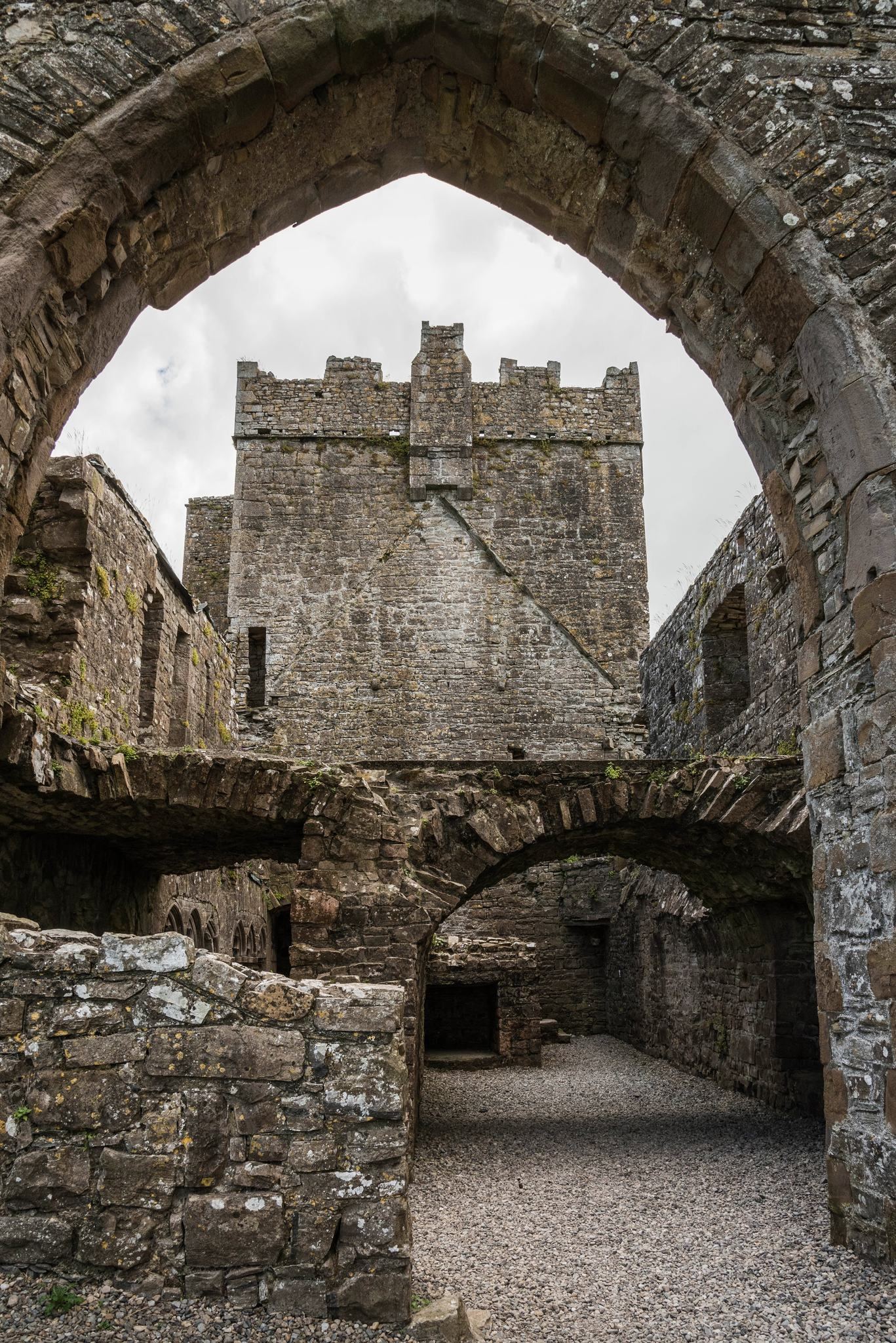
The thirteenth-century fortification works raised the cloister and added towers above it. They also required massive buttresses along the cloister and church walls. A strong defensive tower survives at the southwestern corner, and a second defensive tower also remains. A third tower may have stood above the church crossing. These features reflect Bective’s recognition in 1228 as a stronghold as well as a religious foundation.
Archaeological evidence
Earlier occupation and water management
A well dated to approximately 1040–1230 predates or overlaps the early history of the abbey. Prehistoric objects and buildings earlier than the monastery indicate activity at the site before the Cistercian foundation. Excavation also identified drainage features, granges, and traces of ploughing, revealing the infrastructure that supported the abbey’s agricultural estate.
Food production and material remains
Animal remains include abundant sheep bones, along with evidence for poultry, fish consumption, and other domestic production. These finds illuminate the monastery’s changing diet and its reliance on farming. Plant remains correspond to vegetation represented in the cloister’s carved decoration. Together with approximately 3,400 objects from widely differing periods, the archaeological material gives physical substance to the religious, domestic, and agricultural history of the ruined complex.