Kloster Bersenbrück: A Former Cistercian Women’s Monastery in Germany
Site at a Glance
- Rating
- 4.7
- Popularity
- Very Low
- Country
- Germany
- Primary era
- Medieval
- External website
- Open
- Eras represented
- Medieval, Early Modern, Modern
- Civilizations
- Holy Roman Empire
- Site type
- Religious
- Remains
- Monastery
On this page14 sections
History
Kloster Bersenbrück in Germany is a former Cistercian women’s monastery dedicated to Saint Mary, founded in 1231 in the Early Gothic period. Count Otto II of Ravensberg and his wife, Sophia of Oldenburg-Wildeshausen, established the monastery with an extensive endowment that included a church, a principal farm with a mill, two estates, farms, dependent peasants, meadows, fisheries, woods, pastures, and related property. Its foundation followed a peace treaty concluded at Glandorf in 1231, which ended longstanding feuds between the Ravensberg and Tecklenburg comital families and strengthened the territorial authority of the bishops.
Foundation and medieval development
Clementia, probably a sister of Ludolf von Holte, bishop of Münster, served as the first abbess from 1231 until 1272. Donations from members of the clergy and nobility allowed the monastery to prosper. In 1243, Pope Innocent IV granted the convent the Great Privilege and confirmed its incorporation into the Cistercian Order, a Western Christian monastic movement that emphasized communal discipline, prayer, and an austere religious life. Ecclesiastical oversight initially belonged to the abbot of Altenkamp and passed around 1440 to the abbot of Marienfeld.
The monastery adopted the Bursfeld reforms in 1484. This fifteenth-century movement sought to strengthen monastic discipline and observance in the German-speaking lands. The reform increased Bersenbrück’s standing, and its nuns were sent to other convents to assist with similar changes.
Reformation and Catholic restoration
During the late sixteenth century, Lutheran ideas spread within the convent. Under Abbess von Meverden, who led from 1595 to 1614, almost all the nuns adopted Lutheran teaching. Disputes and weak administration contributed to the monastery’s decline. In 1609, Father Severinus Raeckmann became the first confessor from Marienfeld admitted to Bersenbrück in fifteen years, prompting an episcopal visitation. The visitation blamed the disorder on the abbess, who was ordered to leave in September 1614.
Only three Catholic nuns remained, so the convent was replenished with women from neighboring Cistercian houses. Lucretia Elisabeth von Vincke became abbess in 1614 and governed for fifty-five years. She reduced the monastery’s debts and guided the community through the Thirty Years’ War, the European conflict of 1618 to 1648 whose military movements, requisitions, plundering, and protection payments badly affected religious institutions. Bersenbrück suffered theft, repeated looting, and heavy payments for protection, and the community had to leave the monastery temporarily on three occasions. Peter Severinus Raeckmann remained its confessor until his death in 1693 and composed an extensive chronicle of the monastery.
Dissolution and later administration
The monastery recovered economically after the war, but the Osnabrück cathedral chapter selected the wealthy Bersenbrück convent for dissolution to improve its own finances. The abbess and the abbot of Marienfeld opposed the decision without success. Monastic life ended on 22 February 1787, when the community consisted of nine nuns and one novice. Three nuns remained at the monastery, and the last died in 1806. Pope Pius VI and Emperor Joseph II consented to the dissolution on the stated condition that the released revenues would support a Catholic school fund.
A rescript issued on 10 June 1791 transformed the institution into a secular women’s foundation. Its members no longer had to live there and were intended to be widows and daughters of Catholic, middle-class scholarly officials serving the territorial and municipal authorities of Osnabrück. In 1802, King George III of Great Britain, acting as Elector of Hanover, took possession of the former Prince-Bishopric of Osnabrück’s ecclesiastical property, including the foundation at Bersenbrück. Administration passed through several state bodies before reaching the Hanover Monastery Chamber on 1 July 1824. The foundation was finally abolished in 1964.
The end of monastic life also helped create the present town of Bersenbrück. The requirement of monastic seclusion had kept farmers several hundred metres from the monastery. After the dissolution, houses were built in front of the monastery gate, while the former monastic buildings increasingly served administrative and judicial purposes.
Remains
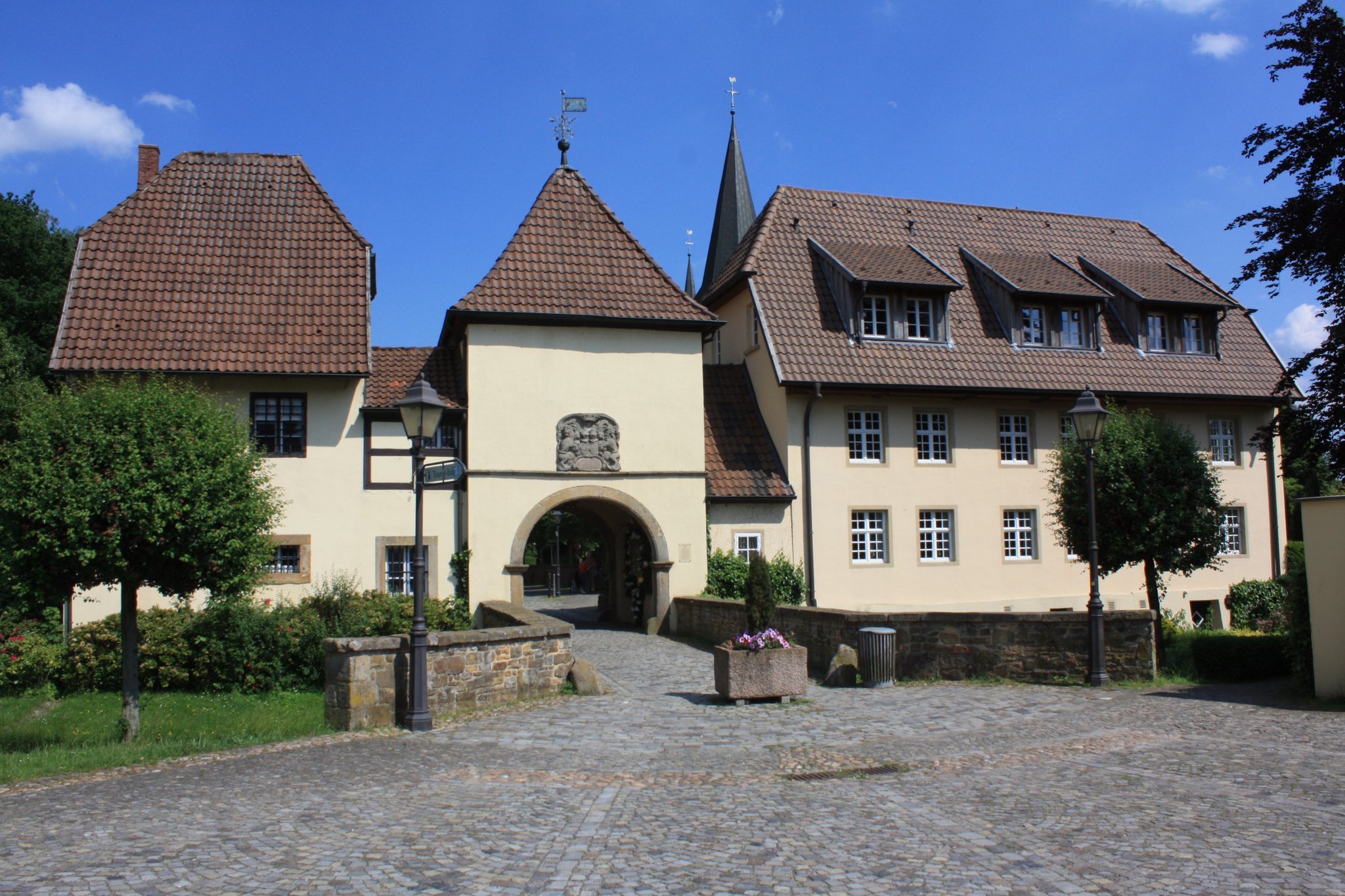
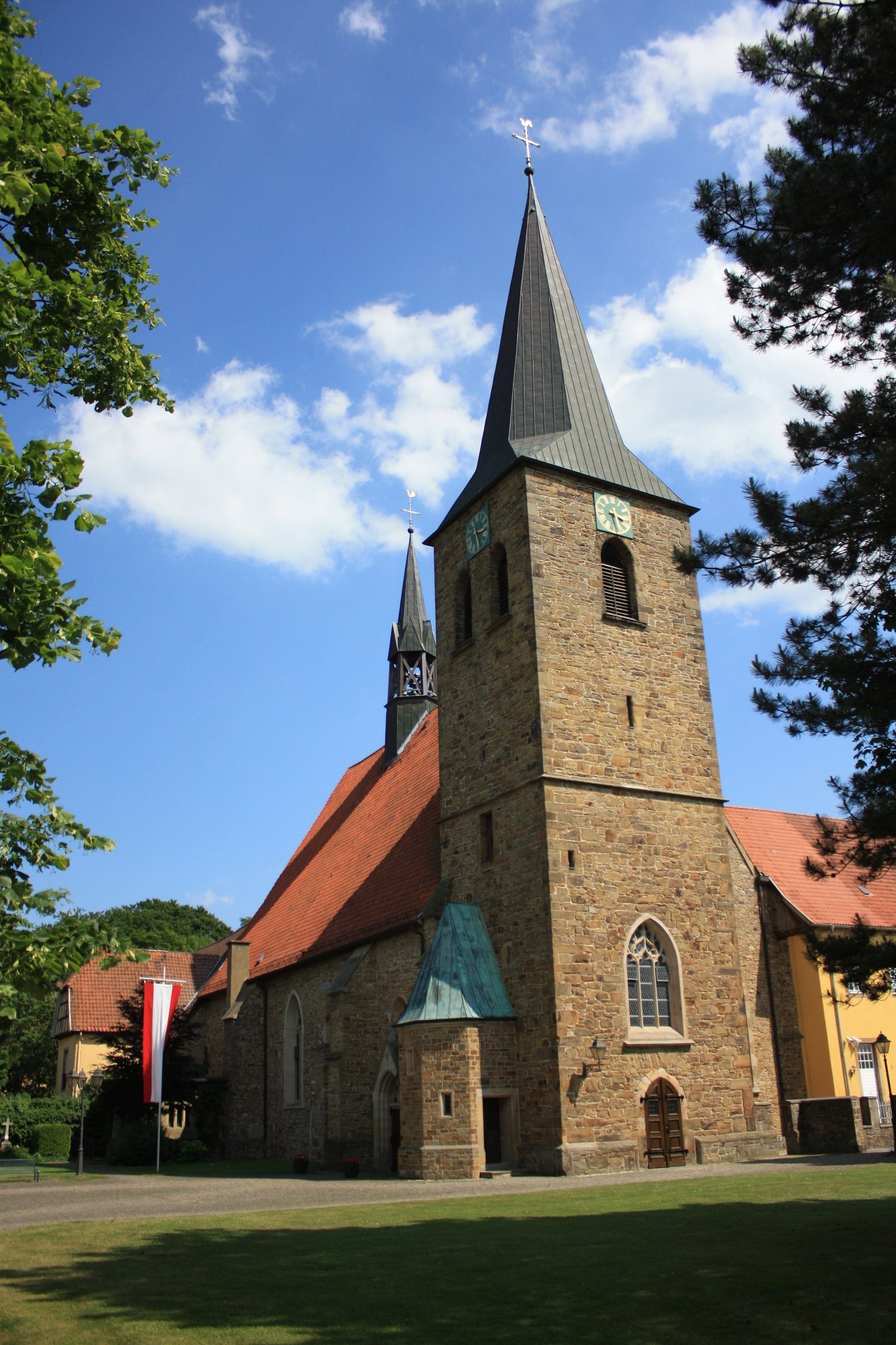
The surviving precinct combines two adjoining churches with monastery buildings on the south and east sides. Its approach crosses a stone bridge over the former monastery moat and passes through a Baroque gatehouse. The complex preserves medieval, early modern, and eighteenth-century fabric, including an Early Gothic cloister and later changes that joined the two churches into a single hall church.
Approach and entrance
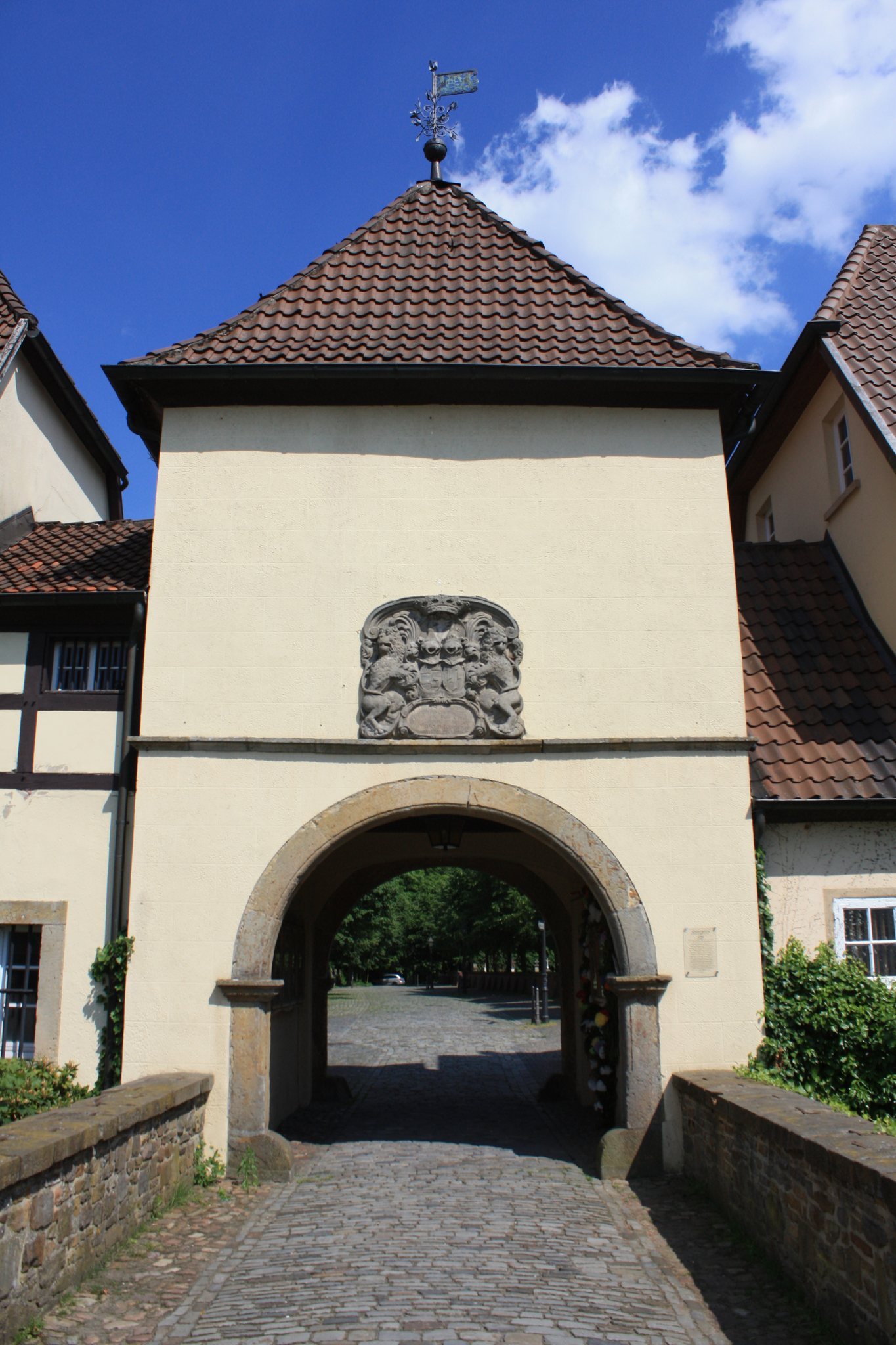
A stone bridge built in 1728 crosses the monastery moat. Beyond it stands the Baroque gatehouse, constructed in 1700. A heraldic stone above the arch gives the gatehouse’s date and marks the principal entrance into the former monastic precinct.
Church complex
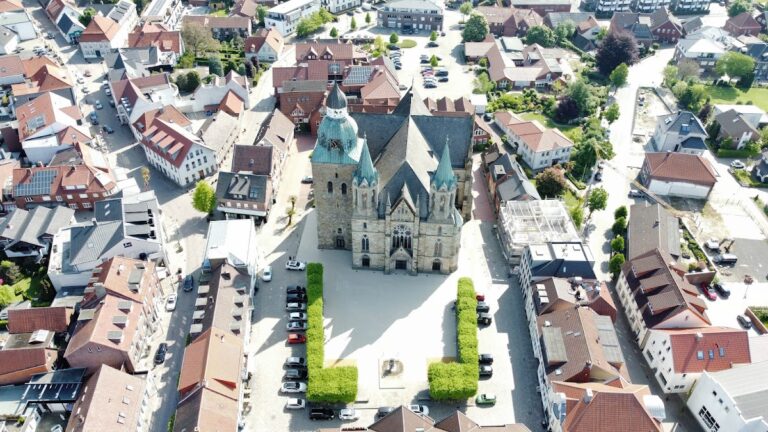
The church complex developed from the former Ravensberg proprietary and parish church on the north and a convent church added along its southern wall. Their separate origins remain visible in the west and east gables, although later construction gave the building a unified exterior form.
Former parish church
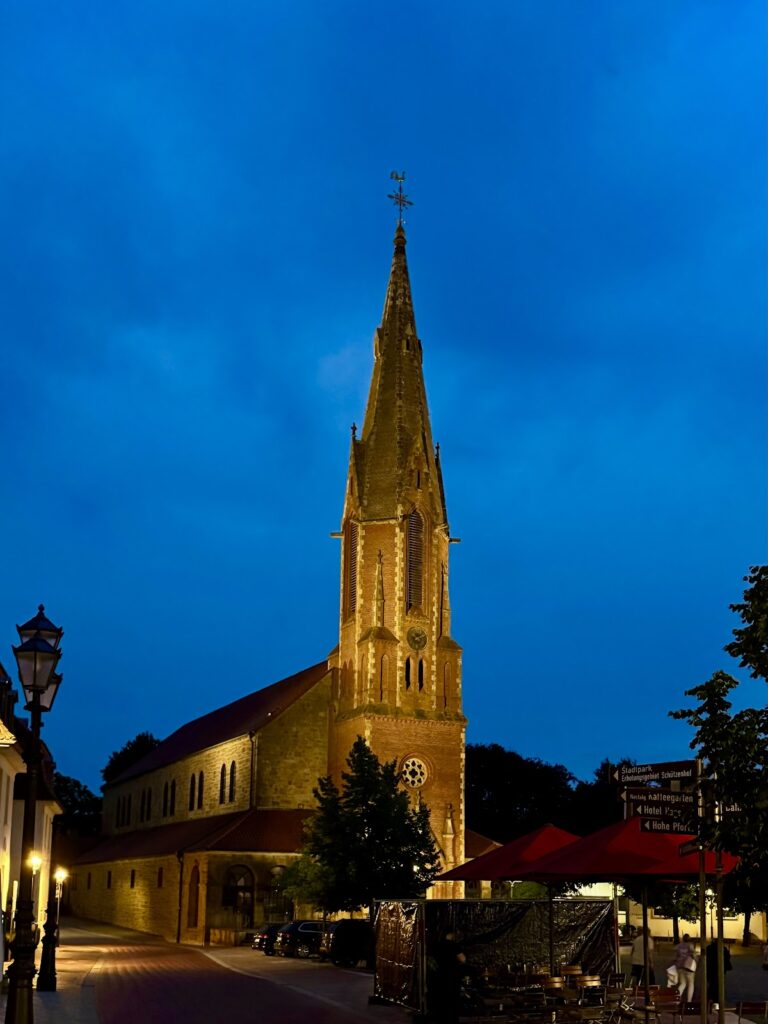
The northern church began in the twelfth century as a three-bay nave with a straight-ended choir. Some of its original narrow windows were replaced during the fourteenth and fifteenth centuries by larger pointed-arch openings filled with Gothic tracery. A 49-metre-high tower was erected in 1510 in front of its west gable, completing the principal medieval and early modern building works.
Convent church
The convent church was built between 1264 and 1287 with two bays and a crypt, a vaulted chamber below a church choir used for burial or religious purposes. Both churches probably received their Early Gothic vaults during this extended building phase. A partition wall with a barred window continued to separate them at the choir, reflecting their distinct functions within the complex.
Unified church
A third western bay was added to the convent church in the fourteenth century, bringing both churches to the same overall length. Around 1495, builders placed one tall gabled roof over the two structures and moved the small roof turret from the former convent-church roof to the new roof at choir level. Around 1800, the partition began to be demolished, the crypt was filled, and the convent-church floor was lowered. Raised pillar bases still show the earlier floor level. The result is a two-aisled hall church measuring about 28 by 18 metres, now belonging to the Catholic Saint Vincentius parish of Bersenbrück.
Monastic buildings
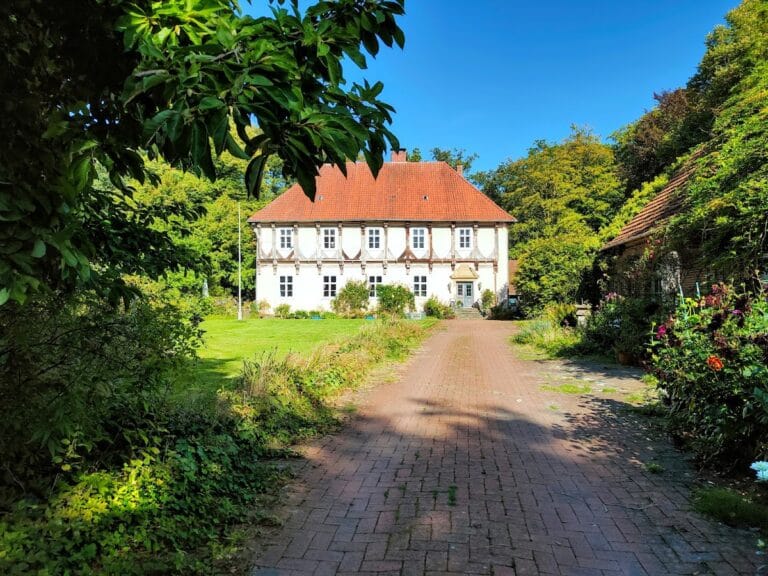
The monastery buildings adjoining the church on the south and east are well preserved. Their arrangement encloses part of the former monastic precinct and retains evidence of both medieval communal life and later administrative use.
South and west wings
The south and west wings were renewed in 1781 to 1783. They are two-storey rendered buildings with narrow, tall windows framed in sandstone, giving the late monastic rebuilding a consistent appearance.
North wing
The north wing was enlarged during the seventeenth century and has two symmetrically arranged half-timbered gables. Its eastern side borders the Mühlenhase, a canal diverted from the Hase in the thirteenth century to operate the monastery’s second mill and supply the moat.
East dormitory and cloister
A thirteenth-century dormitory closes the enclosure on the east. Built of rubble stone, it incorporates an Early Gothic cloister and preserves part of the architectural framework in which the Cistercian community lived and worshipped.
The former monastery buildings now accommodate the local court and the Museum at Bersenbrück Monastery, continuing the complex’s long association with civic and institutional functions.