Juditten Church: A Medieval Gothic Church in Kaliningrad, Russia
Site at a Glance
- Rating
- 4.8
- Popularity
- Low
- Country
- Russia
- Primary era
- Medieval
- External website
- Open
- Eras represented
- Medieval, Early Modern, Modern
- Civilizations
- Crusader, German, Kingdom of Prussia, Teutonic Order
- Site type
- Religious
- Remains
- Church
On this page15 sections
History
Juditten Church is a Gothic church in Kaliningrad, Russia, founded by the Teutonic Order in the late thirteenth century. Its construction is generally associated with 1288, although the exact date remains uncertain, with other proposed ranges placing it between 1276 and 1294 or between 1288 and 1298. The church was first recorded in 1402 and is regarded as one of the oldest surviving structures in Kaliningrad.
Medieval foundation and pilgrimage
The Teutonic Order, a medieval Catholic military and religious order that established and administered territories in Prussia, founded Juditten as a Roman Catholic parish church dedicated to the Virgin Mary. Its religious importance made it an important medieval pilgrimage destination. Knights and other pilgrims travelled to it from across the Holy Roman Empire, the central European political entity that existed until 1806 and included much of the German-speaking world.
The settlement around the church grew in response to its religious importance. By the beginning of the twentieth century, it had acquired the rights of an urban suburb of Königsberg, the historic German name for Kaliningrad. The district is now part of Kaliningrad and is known as Mendeleyevo.
Several traditions explain the name Juditten. The most plausible connects it with a settlement of the Jud tribe. Another derives it from the Prussian Judetus or Judo, who was traditionally said to have received land there from Landmeister Meinhard von Querfurt in 1288. A further tradition links the name with Saint Jutta, or Juditta Botisher, who died in 1260.
Reformation and parish administration
Juditten Church became Lutheran during the Reformation around 1525 or 1526. The Reformation was the sixteenth-century religious movement that led many northern European churches from Roman Catholicism to Protestant forms of worship. The pilgrimage tradition continued after the change of confession, and the church also drew interest for its historic art and architecture.
Before the twentieth century, the church belonged to the parish administration of Schaaken. It later formed part of the Königsberg-Land II church district within the Church Province of East Prussia, the former German province in which Königsberg was located before 1945. Until 1945, its parish included thirty affiliated settlements. From 1928, one of Juditten’s pastors also served the subsidiary parish of Metgethen.
The church grounds were once surrounded by a cemetery. Erhard von Roeder, commandant of Königsberg, was buried there in 1743, and the Prussian field marshal von Lehwaldt, associated with the Battle of Gross-Jägersdorf, was buried there in 1768. The sculptor Stanislaus Cauer was buried in the cemetery in 1943. Johann Christoph Gottsched, an important figure of the German Enlightenment, was born in the rectory in 1700 and baptized at the church.
War, abandonment, and Orthodox use
Juditten Church was largely spared during the capture of Königsberg in April 1945. It was later looted, but services continued for German residents until 1948. The church was then abandoned after the remaining German population had been expelled.
The building deteriorated severely after abandonment. The nave roof collapsed, followed by the choir roof and the passage between the tower and nave. By the early 1960s, the tower roof and upper section had also fallen, and parts of the walls failed during the 1970s.
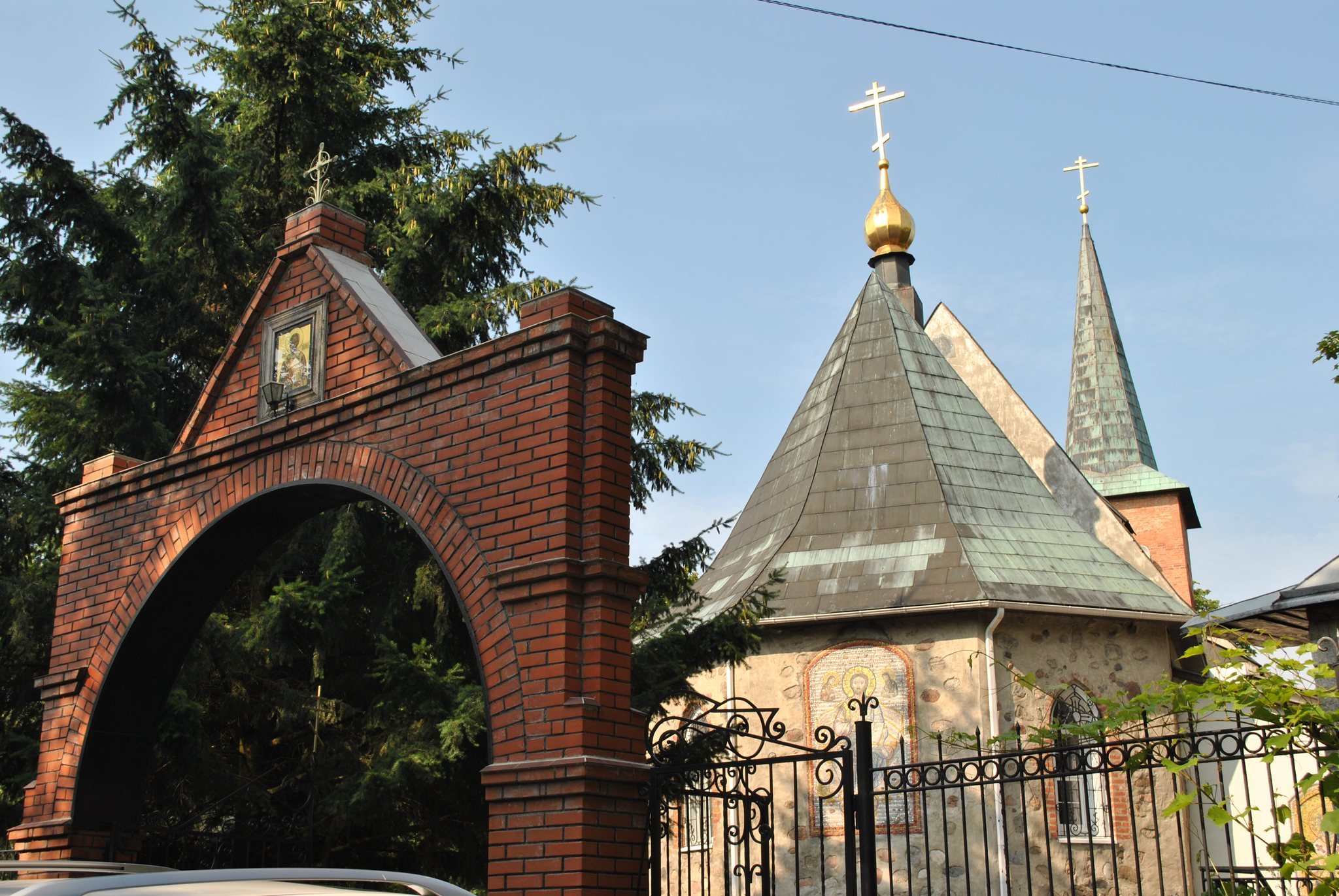
In 1985, the ruined building was transferred to a newly registered Russian Orthodox community. It was consecrated as an Orthodox church dedicated to Saint Nicholas on 6 October 1985. Saint Nicholas was a fourth-century Christian bishop traditionally associated with charitable acts and later venerated as a patron of travellers and children. Restoration continued until 1990, and the first Orthodox service was held in 1988 during commemorations of the millennium of the Christianization of Rus, the adoption of Christianity by the medieval polity of Rus traditionally dated to the baptism of Vladimir of Kyiv in 988.
A diocesan convent was established at the church in 1999. In 2009, it was merged with the convent dedicated to the Icon of the Mother of God “Reigning” at Izobilnoye and became that convent’s Saint Nicholas metochion, or branch. The church is now the convent’s principal church and an active Orthodox parish. Its later religious identity is associated with the Russian Orthodox Church, an Eastern Orthodox Christian church.
Juditten Church has protected cultural-heritage status in Russia. Church registers, including baptismal records from 1681 to 1874, marriage records from the nineteenth and early twentieth centuries, and burial records from 1768 to 1877, survive in the Evangelical Central Archive in Berlin. The grounds also contain a Soviet military burial from 1945, while some older German memorial slabs remain near the church.
Remains
Church structure
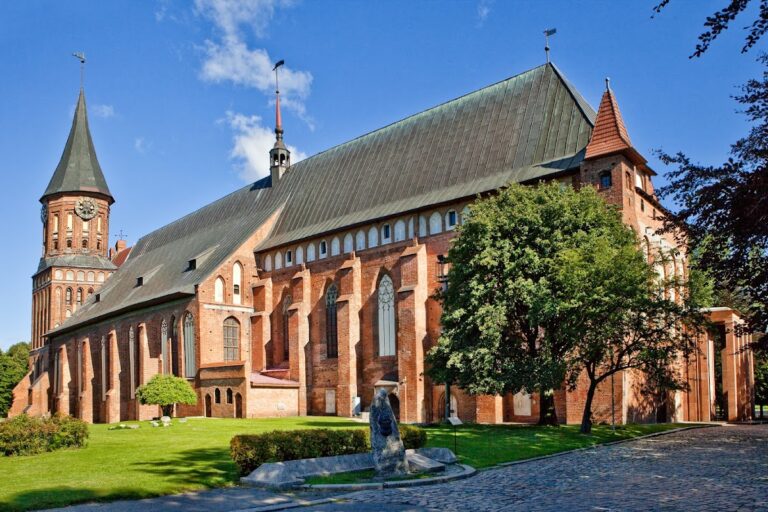
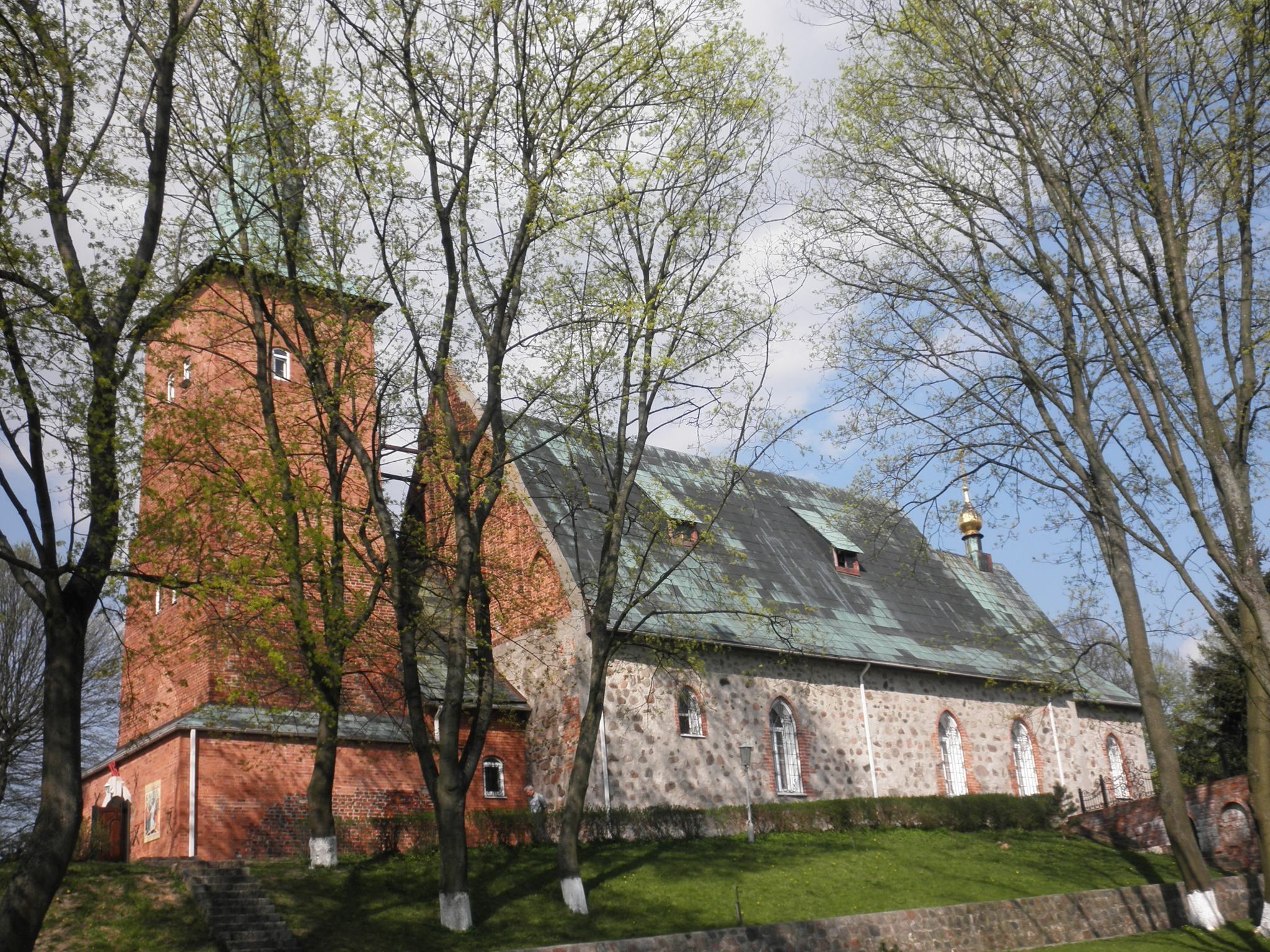
Juditten Church stands on a sloping cemetery site and is a single-nave Gothic building constructed mainly from fieldstone and brick. The nave and choir were built from fieldstones, while the west wall uses large-format brick laid in Gothic bond. Brick also forms the corners and window niches of the polygonal choir. The relatively low, broad nave leads to the polygonal choir, with a western tower and a gabled roof over the main body. Entrances formerly opened from the west and south, and a brick sacristy was added on the north side. A sacristy is a service room for liturgical furnishings and vestments.
Nave and choir
The original church was probably flat-roofed. Vaulting was introduced around 1330, and the choir later received a star vault, a ribbed vault whose ribs form a star-like pattern, generally dated to about 1330 to 1340. The nave eventually received a five-bay vault with triangular ribs, probably after the middle of the fourteenth century. The exterior was altered comparatively little during the later Orthodox restoration, but the vaults were not reconstructed.
West gable and sacristy
A triangular brick west gable was built after the nave vaulting and formerly carried pinnacles. The western gable, northern porch, and sacristy were rebuilt or altered during the reconstruction of 1819 and 1820. The church’s windows were enlarged in 1709.
Bell tower and entrance structures
Bell tower
The bell tower originally stood separately from the nave, a configuration useful for a fortified church. It had no staircase beginning at ground level; instead, a narrow stone staircase rose from the nave. Around 1400, a timber-framed tower on a masonry base was erected in the west, later to be rebuilt in brick. The tower was altered in the sixteenth century, when repairs included a weather vane dated 1577. Its upper section was rebuilt at the end of the nineteenth century, and it contained two bells.
Transverse vestibule and burial chapel
In 1820, a low, barrel-vaulted transverse vestibule was built between the formerly separate tower and nave. A barrel vault is a continuous curved vault resembling the lengthwise half of a barrel. The vestibule incorporated the Roeder family burial chapel, or crypt, which had a broad and shallow barrel vault.
Wall paintings and historic furnishings
Medieval paintings
Late-fourteenth-century wall paintings were uncovered and conserved in 1906 and 1907. They occupied two zones in the choir and depicted scenes from the lives of Christ and the Virgin Mary, apostles, and chivalric subjects. The upper zone included scenes associated with knights. A Last Judgment occupied the triumphal arch, while the nave contained an image of Mary as Mater Misericordiae, meaning “Mother of Mercy,” along with representations of Teutonic Knights bearing coats of arms.
The name Peter appeared in an inscription on the choir vault and is associated with the painter of the frescoes. The paintings also included the arms of Teutonic Order grand masters, including Ulrich von Jungingen, who died at the Battle of Grunwald in 1410.
Sculpture and liturgical objects
The church formerly held a large polychrome wooden Madonna and Child standing above a crescent moon. Made by an unknown artist before 1454, it was regarded as one of the oldest sculptures in Prussia and as a masterpiece of fifteenth-century sculpture. It was also credited with miraculous cures. The sculpture was transferred to Juditten in 1504 after its earlier association with Königsberg Cathedral.
Other medieval furnishings included a late-Gothic wooden crucifix and a fragment of choir stalls. The church also contained a Baroque altar commissioned by the Schimmelpfennig family in 1672. It was replaced by a neo-Gothic altar in 1882 and later restored to its Baroque form. A carved wooden pulpit from 1686 stood beside the pointed arch and included portraits of the Evangelists.
Further furnishings included a confessional from about 1670, an angel sculpture associated with the font dated 1769, epitaphs of the Roeder family and others dating from the late sixteenth to the eighteenth century, seventeenth-century paintings, and tomb slabs. The organ, built by the Scherwiet firm, dates from 1840.
Cemetery and present interior
The historic interior was almost entirely lost after 1945, when the church was looted. Most of the historic German furnishings were destroyed or lost. During the Orthodox restoration, the interior furnishings were replaced with Orthodox furnishings. The initial arrangement referred to early Russian icon painting, but it was later replaced by a different arrangement set within neo-Gothic frames.
A high cross marks the former burial ground, and a small number of older German gravestones and memorial slabs have been collected near the church. These surviving elements stand alongside the restored church building and its Orthodox interior, while the fabric of the medieval structure preserves the church’s earlier Gothic form.