Igreja de São Domingos: A Baroque Dominican Church in Lisbon
Site at a Glance
- Rating
- 4.7
- Popularity
- Medium
- Country
- Portugal
- Primary era
- Early Modern
- External website
- Open
- Eras represented
- Medieval, Early Modern
- Civilizations
- Portuguese
- Site type
- Religious
- Remains
- Church
On this page12 sections
History
Medieval foundation and expansion
Igreja de São Domingos is a Roman Catholic church in Lisbon, Portugal, whose present Baroque form developed from a medieval Dominican foundation begun in 1241. King Sancho II ordered the church and monastery to be established, and the church was consecrated in 1251. The Dominicans, a Roman Catholic mendicant order also known as the Order of Preachers, remained closely associated with the institution.
The church was enlarged and rebuilt several times between the thirteenth and fifteenth centuries, including during the reigns of Afonso III and Manuel I. By this period, it was regarded as the largest church in Lisbon. Its position in the Tagus valley exposed it to flooding, and major floods affected the building in 1343 and 1384 as water descended from the surrounding hills.
Religious conflict and earthquake damage
In April 1506, the church and its square became the starting point of the Lisbon massacre. During this violence, thousands of New Christians, meaning converted Jews and their descendants, were killed. The church later remained connected with the religious institutions that shaped early modern Lisbon.
The Lisbon earthquake and associated tsunami of 1531 severely damaged the building. Part of the ceiling collapsed, and major cracks extended from the ceiling toward the floor. Reconstruction began in 1536, supported by charitable donations, religious communities, and royal subsidies. The church’s ornaments were reportedly preserved during this rebuilding.
Before the earthquake of 1755, the Dominican monastery housed the Inquisition, a system of ecclesiastical tribunals that investigated and punished perceived religious offenses, including heresy. Sentences were announced there before executions took place nearby in Rossio Square. In 1761, the Jesuit Gabriel Malagrida was condemned for heresy and executed by garrotting followed by burning.
The eighteenth-century rebuilding
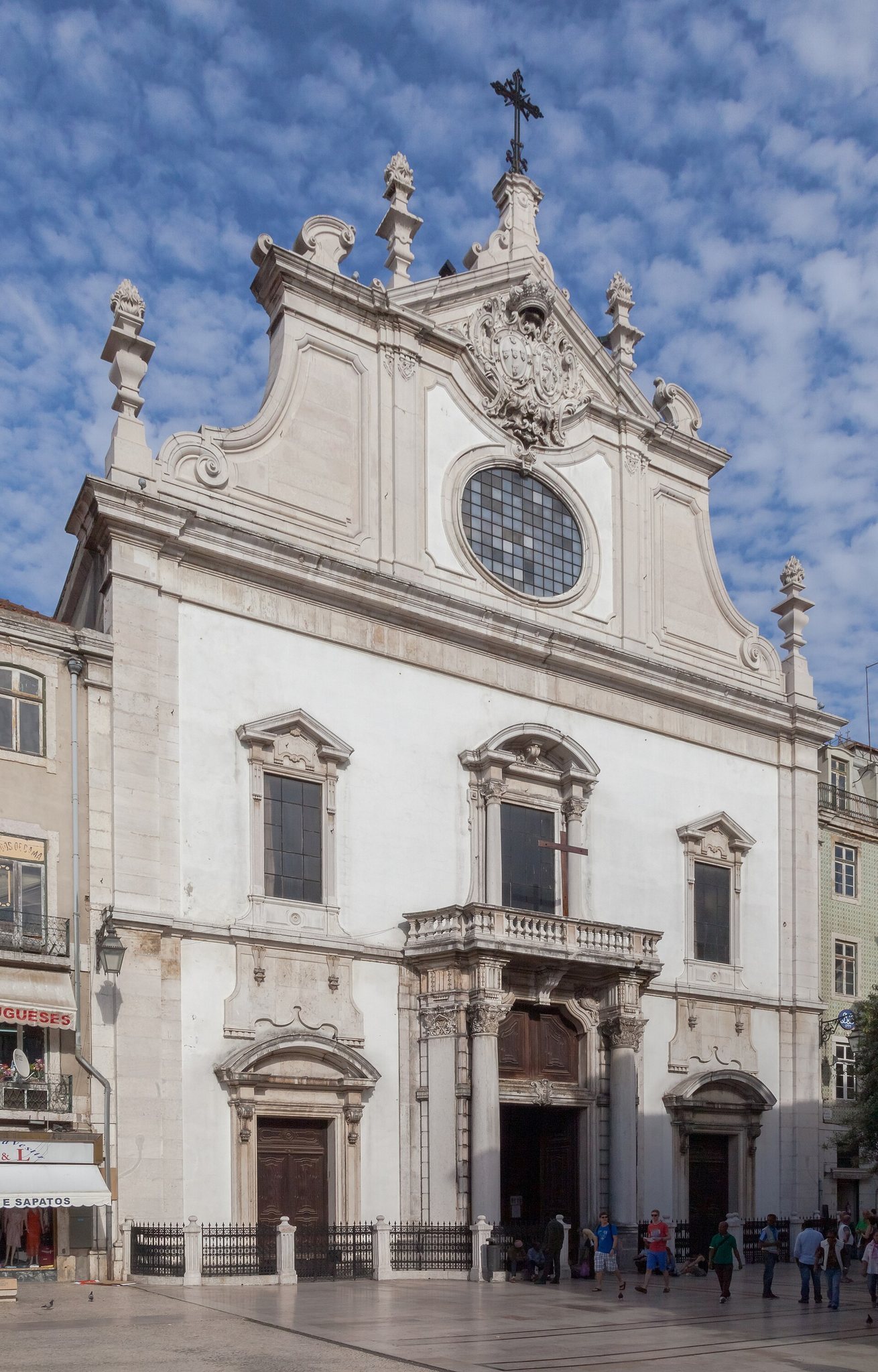
The earthquake of 1 November 1755 almost completely destroyed the church and monastery. The altar and sacristy survived, and reconstruction was directed by the architect Carlos Mardel. The rebuilt church was completed in 1807. Its renewed form became an important Baroque model for the construction and restoration of other Portuguese churches.
The rebuilding incorporated marble columns at the altars, a new facade and presbytery, and a portal with the balcony above it transferred from the royal chapel of the Ribeira Palace. The facade and presbytery are attributed to Johann Friedrich Ludwig, also known in Portugal as João Frederico Ludovice, a German-born architect active in Portugal. The church continued to host royal baptisms, weddings, and funerals until the establishment of the Portuguese Republic in 1910. Among these ceremonies was the 1862 wedding of King Luís I and Maria Pia of Savoy, an Italian princess and daughter of King Victor Emmanuel II of Italy.
Fire, restoration, and continuing use
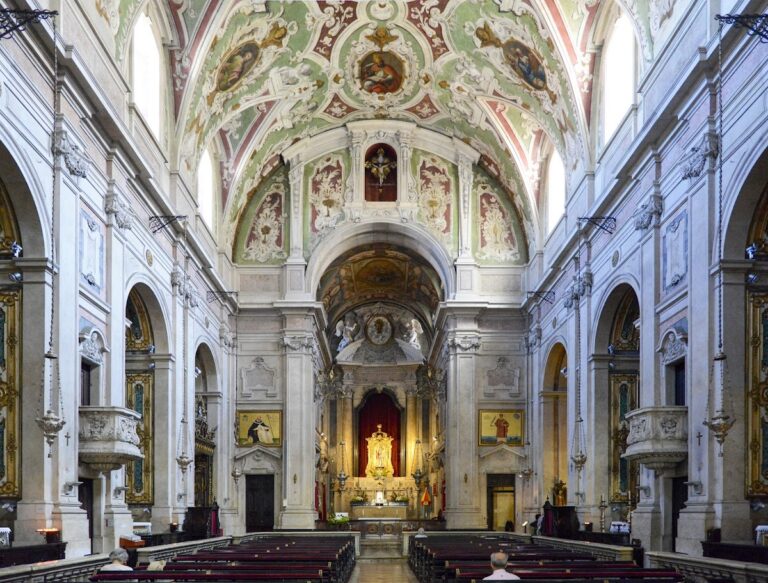
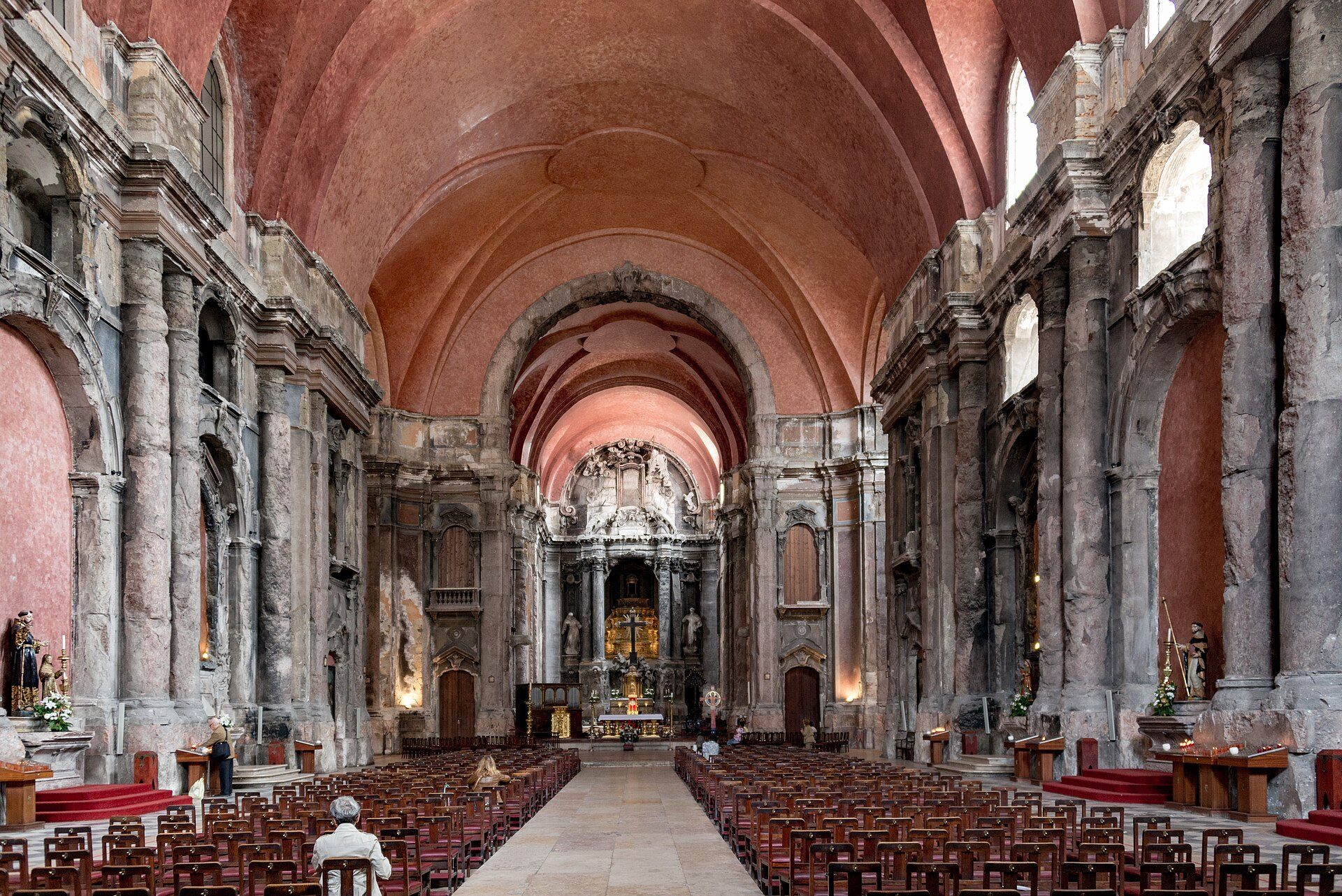
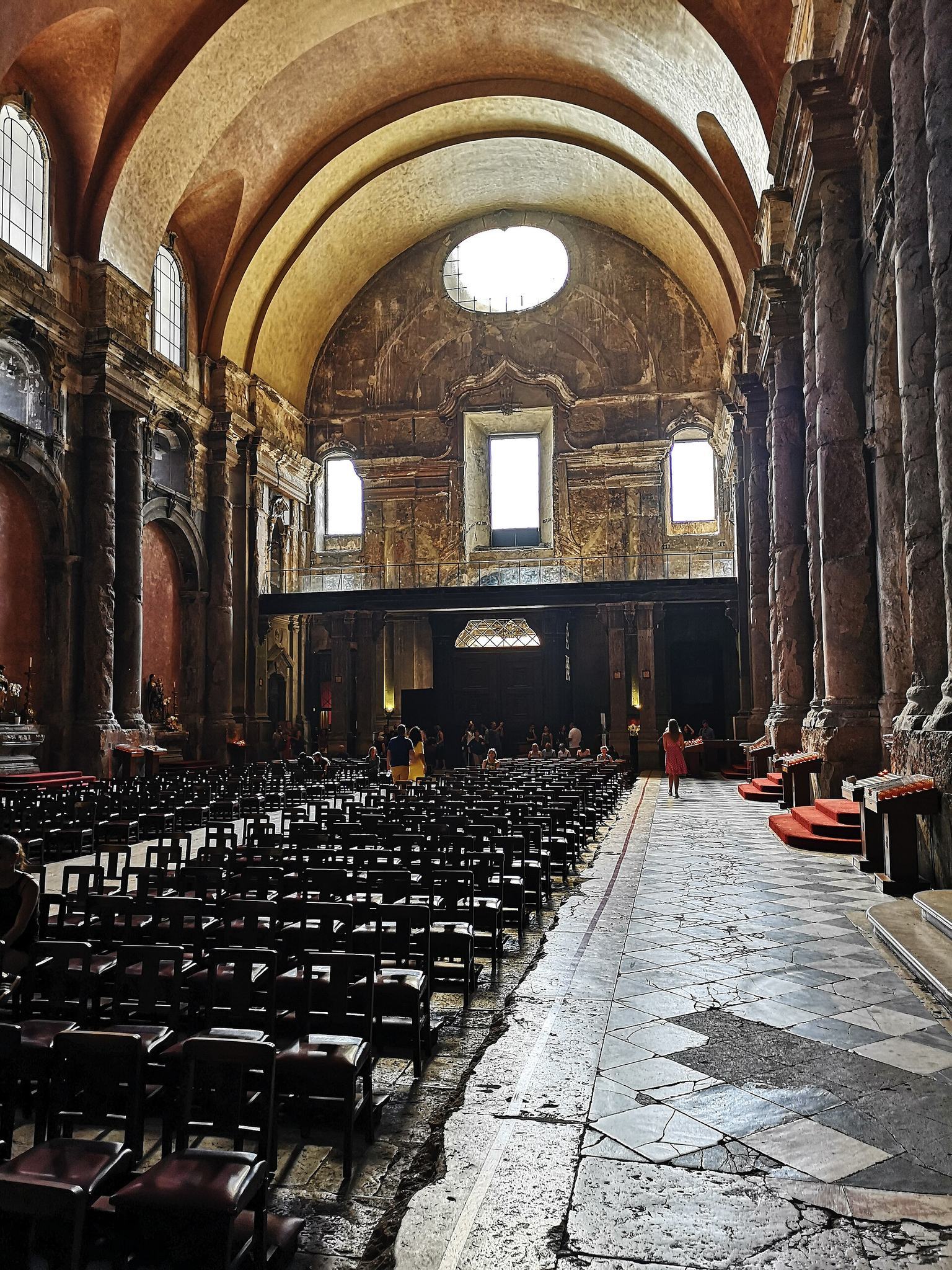
A fire on 13 August 1959 devastated the church. It destroyed the interior decoration, gilded altars, paintings by Pedro Alexandrino de Carvalho, and other sacred furnishings. The restoration was deliberately partial rather than a complete reconstruction. Cracked columns, damaged structural elements, and fragments affected by the fire were left visible, preserving evidence of the disaster in the building’s present appearance. The church reopened in 1994.
Igreja de São Domingos remains an active parish church of Santa Justa and Santa Rufina. It was designated a Portuguese National Monument in 1918 and retains that protected status. The historical Dominican connection continued in a separate institution when the Dominicans built a new monastery and church, Igreja do Convento de São Domingos, in 1994.
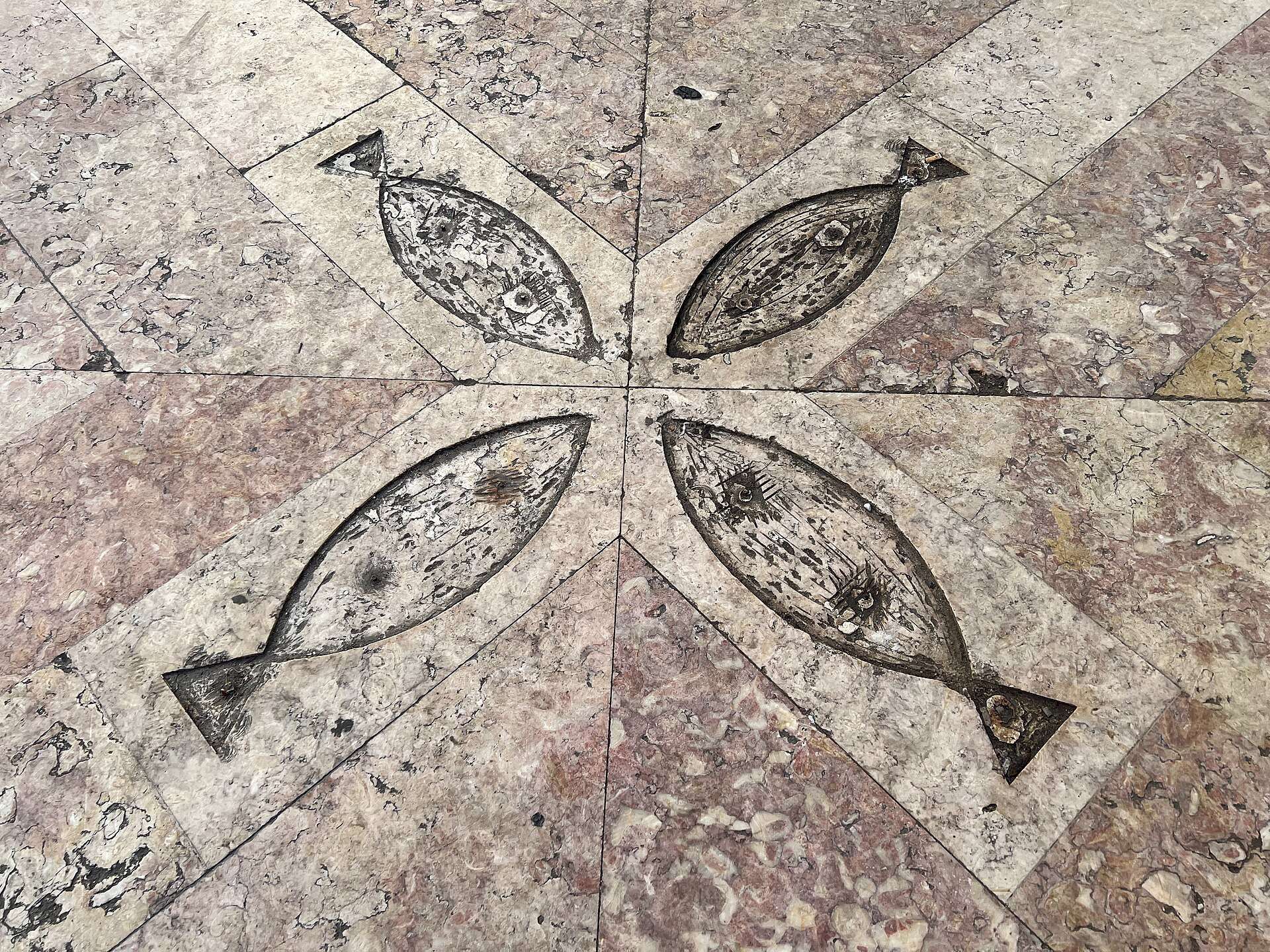
In 2006, a memorial to the victims of the 1506 massacre was opened beside the church. It consists of an olive tree brought from the Holy Land and a wall inscription in 34 languages reading, “Lisbon, City of Tolerance.”
Remains
Layout and surviving Baroque fabric
The church stands at Largo de São Domingos in Lisbon’s Baixa district, beside Rossio Square. It is a brick Baroque building arranged on a Latin-cross plan, with a long central axis crossed by a shorter transverse arm, and a single nave. The post-1755 reconstruction reshaped the facade and presbytery and added marble columns at the altars. The building could accommodate more than 2,000 worshippers after the eighteenth-century rebuilding.
Chapel of Nossa Senhora da Escada
The chapel of Nossa Senhora da Escada dates from 1748 and was designed by Johann Friedrich Ludwig. It survived the 1755 earthquake and was preserved during the subsequent reconstruction. Its survival provides a physical link between the pre-earthquake church and the building rebuilt in the late eighteenth and early nineteenth centuries.
Choir and interior traces of the fire
The high choir has a rectangular plan and rests on a wooden beam supported by two large columns. Three openings in the upper register and the principal window provide its lighting. The 1959 fire altered the church’s black marble, giving it a dark red, blood-like coloration. The restored interior retains cracked columns, damaged structural elements, and fire-affected fragments, making the effects of the blaze part of the building’s present physical character.
Tombs and commemorative features
Burials within the church
Behind the altar is the tomb of Afonso, son of King Afonso III. Near the sacristy are tombs associated with the Dominican preacher Luís de Granada and the reformer João de Vasconcelos. Luís de Granada was a sixteenth-century Dominican preacher and writer, while João de Vasconcelos was a Dominican reformer. A tomb identified with the military commander and colonial administrator João de Castro is also located in the church.
The church has also been associated with devotional objects connected with the Fatima apparitions, including objects linked to Lúcia dos Santos and Jacinta Marto, two of the children associated with the reported Marian apparitions at Fatima in 1917.
Memorial to the victims of 1506
The memorial beside the church combines an inscription wall with an olive tree brought from the Holy Land. Together, these features commemorate the victims of the 1506 Lisbon massacre and give the adjacent public space a permanent memorial function connected with the church’s history.