Trei Ierarhi Monastery: A Moldavian Orthodox Monastery in Iași
Site at a Glance
- Rating
- 4.8
- Popularity
- Medium
- Country
- Romania
- Primary era
- Early Modern
- External website
- Open
- Eras represented
- Early Modern
- Civilizations
- Principality of Moldavia
- Site type
- Religious
- Remains
- Church
On this page12 sections
History
Trei Ierarhi Monastery is a Romanian Orthodox monastery in Iași, Romania, built in the Moldavian architectural tradition between 1637 and 1639 under Vasile Lupu, the ruling prince of Moldavia. Its church served as a princely necropolis and was dedicated to the Three Holy Hierarchs, Basil the Great, Gregory the Theologian, and John Chrysostom. The monastery belongs to the Metropolitanate of Moldavia and Bukovina and is included in Romania’s National Register of Historic Monuments and on the country’s tentative UNESCO World Heritage list.
Foundation under Vasile Lupu
Vasile Lupu founded the church as an expression of his support for the Orthodox Church and his aspirations toward the Byzantine world. These aims shaped the building’s use of traditional forms, costly materials, and elaborate decoration. A votive inscription on the south facade states that the church was founded in the name of the Three Holy Hierarchs and consecrated by Metropolitan Varlaam on 6 May 1639.
During Lupu’s rule, the Patriarchate of Constantinople faced debt and political disorder. The Moldavian prince supported its recovery and later paid the debts of the Holy Sepulchre and monasteries on Mount Athos. He also made religious and charitable donations in Poland, Bulgaria, and Greece, extending the monastery’s connections across the Orthodox world.
School, printing press, and religious centre
The monastery became an important centre of education and publishing. A printing press and the Vasilian College were established there in 1640. The press was brought from Kyiv with the support of Metropolitan Petru Movilă and was directed by Sofronie, a monk who also served as the monastery’s abbot and school director. The first work printed in Moldavia in Greek appeared at Trei Ierarhi, followed by Metropolitan Varlaam’s Cazanie in 1643.
In 1641, the relics of Saint Paraskeva arrived from Constantinople in recognition of Vasile Lupu’s support and donations. They travelled by ship through the Black Sea with three Greek metropolitans and were placed in the church on 13 June. They remained there until 1887, when they were transferred to Iași Metropolitan Cathedral after its consecration on 23 April.
The former monastery complex also contained a school, printing establishment, and refectory, later known as the Gothic Hall. The Inter-Orthodox Synod of Iași met in the refectory in 1642 and adopted the Orthodox Confession of Faith. In 1645, Paisie, who later became patriarch of Jerusalem, was consecrated there after previously serving as abbot of Galata Monastery.
Conflict, restoration, and later history
The church was looted and burned by invaders from the east in 1650 and by invaders from the north in 1686. Earthquakes caused further damage in 1711, 1781, 1795, and 1802. The building also remained associated with major political and religious events. On 24 February 1821, Alexander Ypsilantis, a Greek military leader and revolutionary, issued a proclamation at the monastery calling Greeks and Christians to rise against the Ottoman Empire. This act marked the beginning of the Greek Revolution of 1821.
The church was restored from 1882 to 1887, while interior painting and redecoration continued until 1898. It was reconsecrated in 1904. Restoration directed by André Lecomte du Noüy between 1882 and 1890 destroyed the original interior frescoes, provoking public debate and helping encourage more protective principles for the restoration of historic monuments in Romania.
The monastery was re-established in 1991 after functioning for a long period only as a church. A symposium held in January 1993 brought together Romanian UNESCO authorities, Iași institutions, and the Metropolitanate of Moldavia and Bukovina to discuss the building’s condition and conservation. In 1997, a bust of Mihai Eminescu was unveiled within the precinct; the nineteenth-century Romanian poet and writer had lived there for a period.
The church contains the burials of members of Vasile Lupu’s family, including his first wife, Tudosca, and their son, Ștefan Vodă. It also holds the burials of Dimitrie Cantemir, a Moldavian prince, scholar, and historian, and Alexandru Ioan Cuza, the nineteenth-century ruler who united Moldavia and Wallachia as the basis of modern Romania. The church influenced the construction and decoration of the monastery church at Cetățuia, built near Iași between 1669 and 1672, and the monastery church at Putna. Paul of Aleppo recorded his admiration for the building during his travels through the Romanian principalities.
Remains
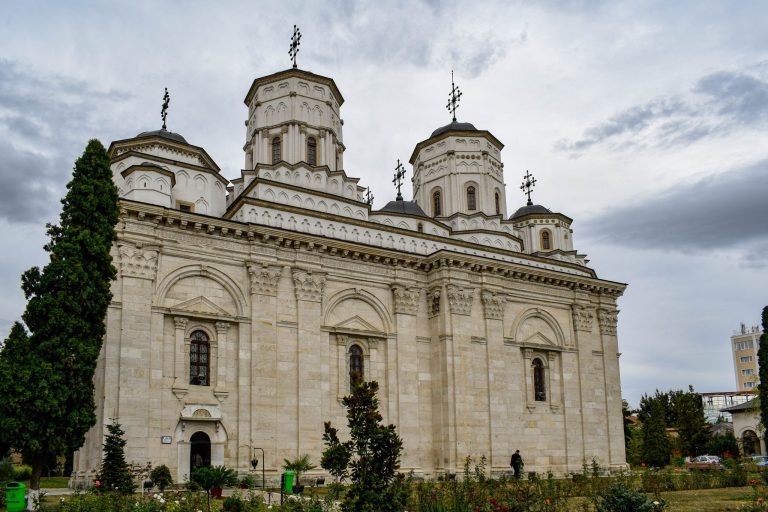
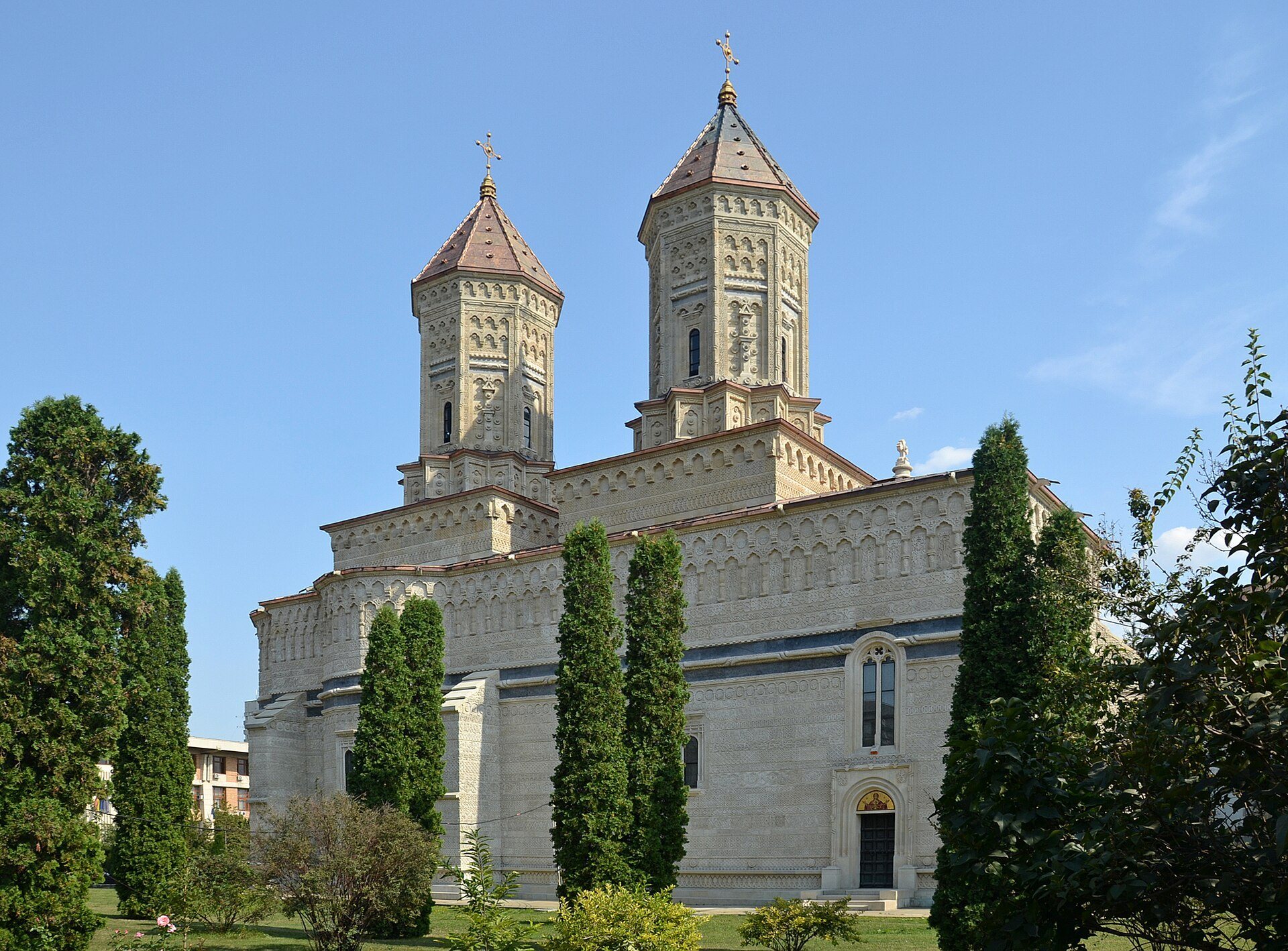
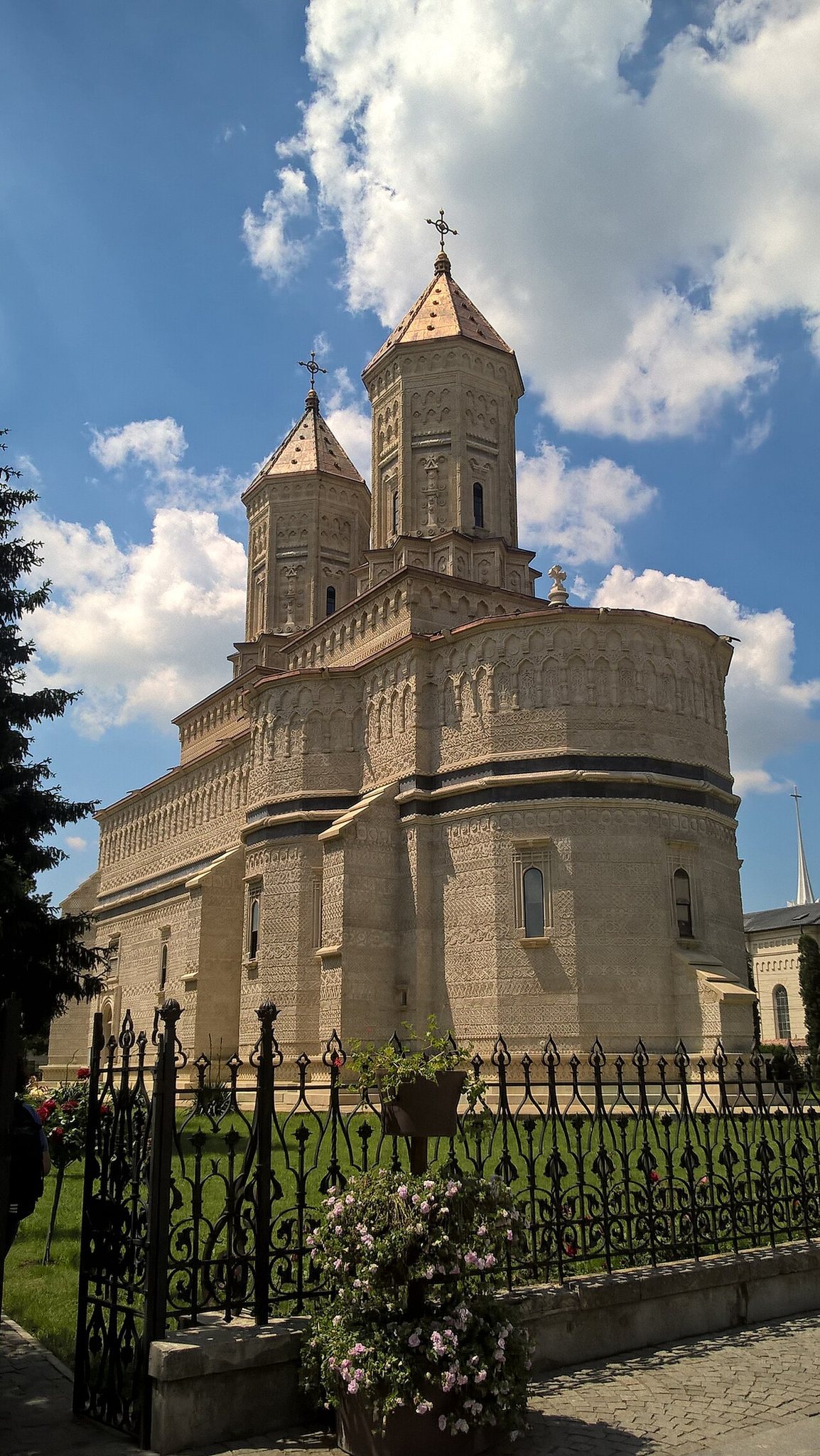
The surviving complex is centred on a stone-and-brick church whose Moldavian plan combines a triconch layout, a design with three apsidal projections, with an additional tower above the pronaos, the entrance chamber of an Orthodox church. Its tall profile and horizontal bands of ornament remain defining features. The exterior decoration extends across all four facades, including the buttresses and the arched surrounds beside and beneath the bell towers.
The church
Plan and vault
The church broadly follows the plan of sixteenth-century Moldavian churches and reflects the influence of the Galata church. Its vault uses the Moldavian construction system, with two superimposed levels of four and eight obliquely arranged arches. Together with the pendentives, curved structural elements that support an upper vault, these arches gradually reduce the span toward the bell tower.
Exterior ornament
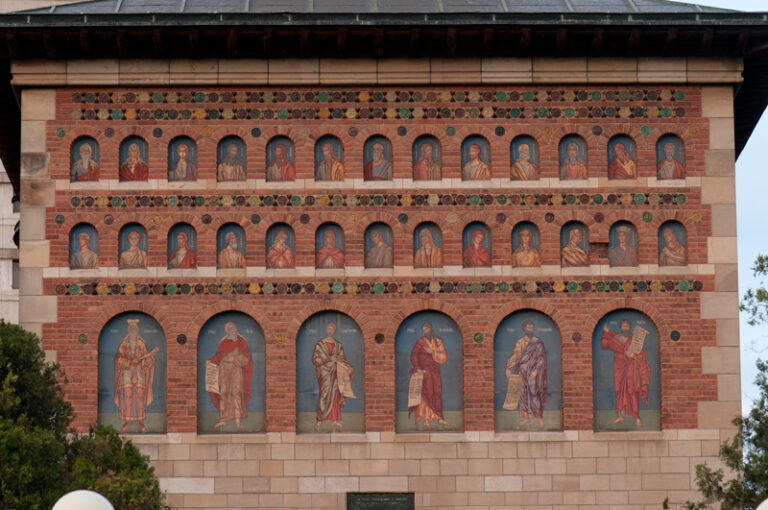
Deep niches with clustered arches, small columns, Persian vessels bearing flowering branches, and geometric motifs associated with Georgia and Armenia form part of the carved exterior. A twisted-rope belt is framed by two marble bands in Renaissance and Baroque styles. More than 30 non-repeating registers of decorative motifs can be counted across the facades.
The arrangement recalls the exterior decoration of Dragomirna Monastery Church, built between 1606 and 1609, while the division of the wall surfaces by a belt resembles churches in Muntenia. Transylvanian Gothic influence appears in the buttresses, stone window frames, door profiles, moulded surrounds, and pointed ogee arches. The overall scheme combines Armenian, Georgian, Persian, Arabian, Ottoman, Gothic, Renaissance, and Baroque elements. Lapis-lazuli colouring and gilding once heightened the ornament, whose brilliance has been subdued by time.
Interior and paintings
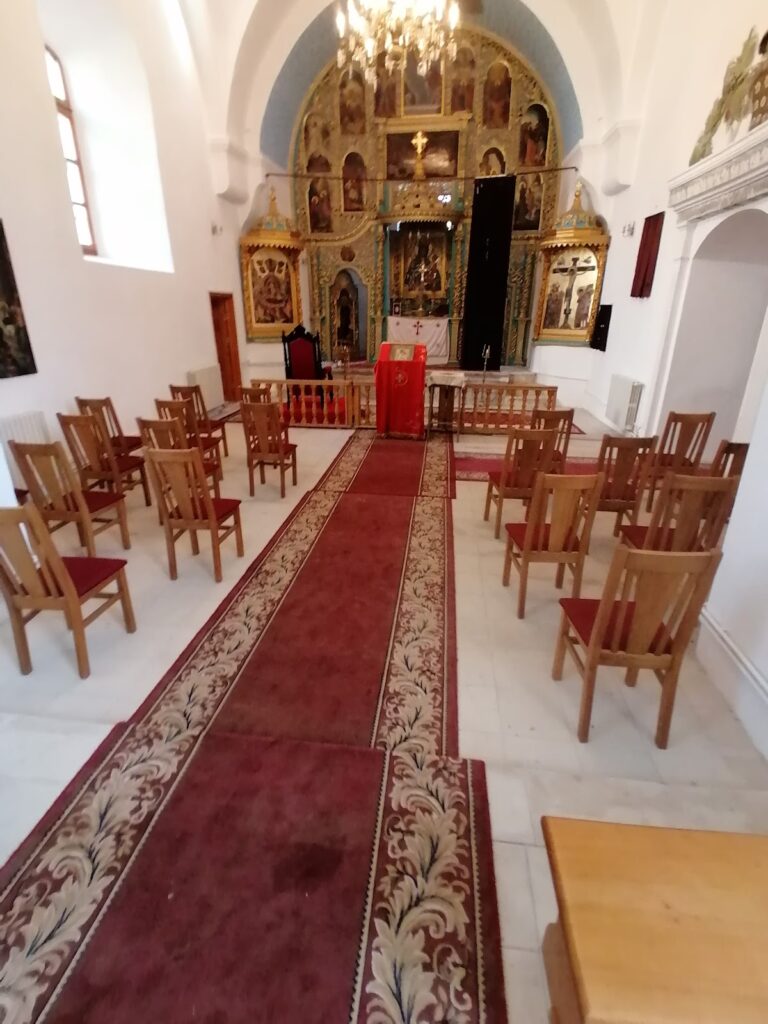
The church’s paintings were produced by Sidov Pospeev, Iacob Gavrilov, and the Moldavian painters Nicolae Zugravu the Elder and Ștefan. The original interior frescoes were destroyed during the restoration of 1882 to 1890, while some fragments survive in the monastery museum.
Former monastery buildings
Gothic Hall
The Gothic Hall is the surviving building associated with the former Vasilian Academy and the monastery’s refectory. It now houses a religious art museum and objects connected with the history of Trei Ierarhi Monastery. Its earlier use also connects the building with the Inter-Orthodox Synod of Iași held in 1642.
Gate tower and clock
A former gate tower served as the monastery’s belfry and contained a large clock installed by Vasile Lupu in 1654. The clock is described as the first publicly used clock in the Romanian principalities. During the restoration of 1882, its mechanism was dismantled and transported to France, where it remained.