Castle of San Juan de Ulúa: A Colonial Fortress, Prison, and Arsenal in Mexico
Site at a Glance
- Rating
- 4.6
- Popularity
- High
- Country
- Mexico
- Primary era
- Early Modern
- External website
- Open
- Eras represented
- Early Modern
- Civilizations
- Spanish
- Site type
- Military
- Remains
- Fort
On this page20 sections
History
Castle of San Juan de Ulúa is a fortified island opposite Veracruz in Mexico, developed by Spanish authorities from the sixteenth century as part of the defensive system of Villa Rica de la Vera Cruz. Built principally in the Italian trace tradition of bastioned military architecture, it protected New Spain’s principal Atlantic port and the Spanish silver fleet. Its successive roles as anchorage, fortress, prison, arsenal, and military headquarters made it a central site in the history of Veracruz.
Indigenous setting and the Spanish arrival
The island was named by Juan de Grijalva’s expedition in 1518. Its earlier Nahuatl name was Chalchiwehkan, while San Juan was added to the existing name. In April 1519, Hernán Cortés landed there and exchanged gifts with representatives associated with Moctezuma II, the ruler of the Aztec Empire, including Teudile and a priest from Yohualichan.
A small settlement opposite the island was built largely from timber salvaged from ships. It became known as the City of Tables. San Juan de Ulúa initially served as an anchorage, shelter, and landing place for vessels carrying people and goods from Spain. Navigation remained difficult because of northerly winds and hurricanes, but the reefs around the island offered protection from natural hazards and maritime raiders.
A Franciscan oratory was reportedly built in 1524 with enslaved labor from Guinea. In 1526, a revolt by enslaved Wolof people caused serious damage on the island. These early events formed part of the settlement’s development before the large stone fortifications that later defined San Juan de Ulúa.
Expansion into a colonial fortress
Spanish fortification work began during the sixteenth century and continued through the eighteenth. The defensive system protected Veracruz, the principal port of New Spain, a Spanish viceroyalty administered from Mexico City and connected by Atlantic shipping to Spain and the wider empire. The island’s boundaries were enlarged repeatedly as officials responded to pirates, privateers, and other maritime attackers.
In the 1580s, Battista Antonelli redesigned the fortress during a stopover in the Gulf region. Later reforms produced a closed fortified enclosure with towers, curtain walls, bastions, and semi-bastions. A bastion is a projecting part of a fortress that allows defenders to fire along the faces of neighboring walls, while a curtain is the defensive wall between two towers or bastions.
San Juan de Ulúa was drawn into the growing conflict between England and Spain on 23 September 1568. Spanish forces commanded by General Francisco Luján attacked an English privateer fleet under John Hawkins, which included Francis Drake, in the harbor. Several English vessels were destroyed or sunk. Hawkins and Drake escaped aboard the Minion and Judith, while the English crews suffered heavy casualties. The engagement became an important episode in the later maritime struggle between the two countries.
During the late seventeenth century, the engineer Jaime Franck added three curtains and two semi-bastions to the towers and the Muro de las Argollas. These works created an enclosed compound, although the landward semi-bastions were later judged unsatisfactory. Early-eighteenth-century proposals called for stronger defenses. French engineers proposed full bastions, and the Baluarte de la Soledad was built as part of these reforms. Later engineers, including Manuel de Santisteban, regularized the defenses and enlarged the outer works.
Lighthouse, independence, and foreign occupations
Between 1793 and 1796, the Baluarte de San Pedro received the first modern lighthouse in New Spain and Spanish America. Acquired in London, the lighthouse used oil-burning lamps mounted on a triangular glass base and a clockwork mechanism that produced intermittent beams. Its installation strengthened the maritime functions of the fortified harbor.
After Mexican independence in 1821, San Juan de Ulúa remained the last major Spanish stronghold in Mexico. Mexican forces blockaded and besieged the island, and the Spanish garrison capitulated on 23 November 1825. The surrender ended Spain’s territorial foothold in what is now Mexico.
The fortress continued to be drawn into foreign military interventions. French forces occupied it during the Pastry War in 1838. Spanish troops occupied the fortress and port in December 1861, and British and French forces joined them in early 1862, beginning the French intervention in Mexico. French troops occupied Veracruz again in 1863 during the installation of Maximilian I as emperor. United States forces occupied San Juan de Ulúa during the Mexican-American War and during the occupation of Veracruz in 1914.
Prison, arsenal, and federal headquarters
During the nineteenth century, parts of the fortress were converted into a prison, particularly for political prisoners. Those associated with its history included Fray Servando Teresa de Mier, a priest and independence advocate, Benito Juárez, the liberal statesman and president who resisted the French intervention, and Jesús Arriaga, popularly known as Chucho el Roto. A popular tradition concerning the prisoner called the Mulatta of Córdoba tells that she escaped the Inquisition by painting a ship on her cell wall and sailing away in it.
During the 1914 United States occupation, several hundred prisoners were found in severely unsanitary conditions. Their cells were approximately 12 meters long and 4.5 meters wide, without bathrooms, and infested with vermin. Malaria, tuberculosis, and gastrointestinal diseases affected many prisoners. United States personnel and prisoners cleaned the cells and floors with steam, creoline, high-pressure water, and sulfur fumigation, using approximately 1,200 pounds of sulfur. Political prisoners were released, some common prisoners were transferred to the city jail, and the fortress was subsequently used as a barracks.
In 1882, San Juan de Ulúa began its transformation into the Arsenal Nacional, an industrial naval facility serving the merchant marine and the Mexican navy. Administered by the Secretariat of War and Navy, the arsenal stimulated Veracruz’s economy. Its equipment included a floating self-docking dry dock acquired from Société Nouvelle des Forges et Chantiers de la Méditerranée for 800,000 pesos.
The fortress briefly became the seat of Mexico’s federal executive power in 1915, when President Venustiano Carranza used it as his government headquarters. That year also ended its use as a prison. The floating dock sank in 1923, a dry dock was built in 1929, and another dock opened in 1942. A merchant ship named México was built at the naval yard and launched in 1958.
Museum and conservation
The naval yard was dismantled in 1962, after which San Juan de Ulúa was transferred to Mexico’s National Institute of Anthropology and History, the federal institution responsible for archaeological, historical, and anthropological heritage. Reconditioning works in 1975 were followed by the establishment of a local museum. The Baluarte de San Crispín remained occupied by the Mexican Navy after the museum opened.
San Juan de Ulúa now functions as the Museo Local Fuerte de San Juan de Ulúa under the National Institute of Anthropology and History. Its preservation reflects the site’s successive history as a colonial fortress, prison, arsenal, and place associated with resistance to foreign intervention. The former naval facilities have been dismantled, while the surviving fortress and prison areas remain under heritage conservation and museum management.
Remains
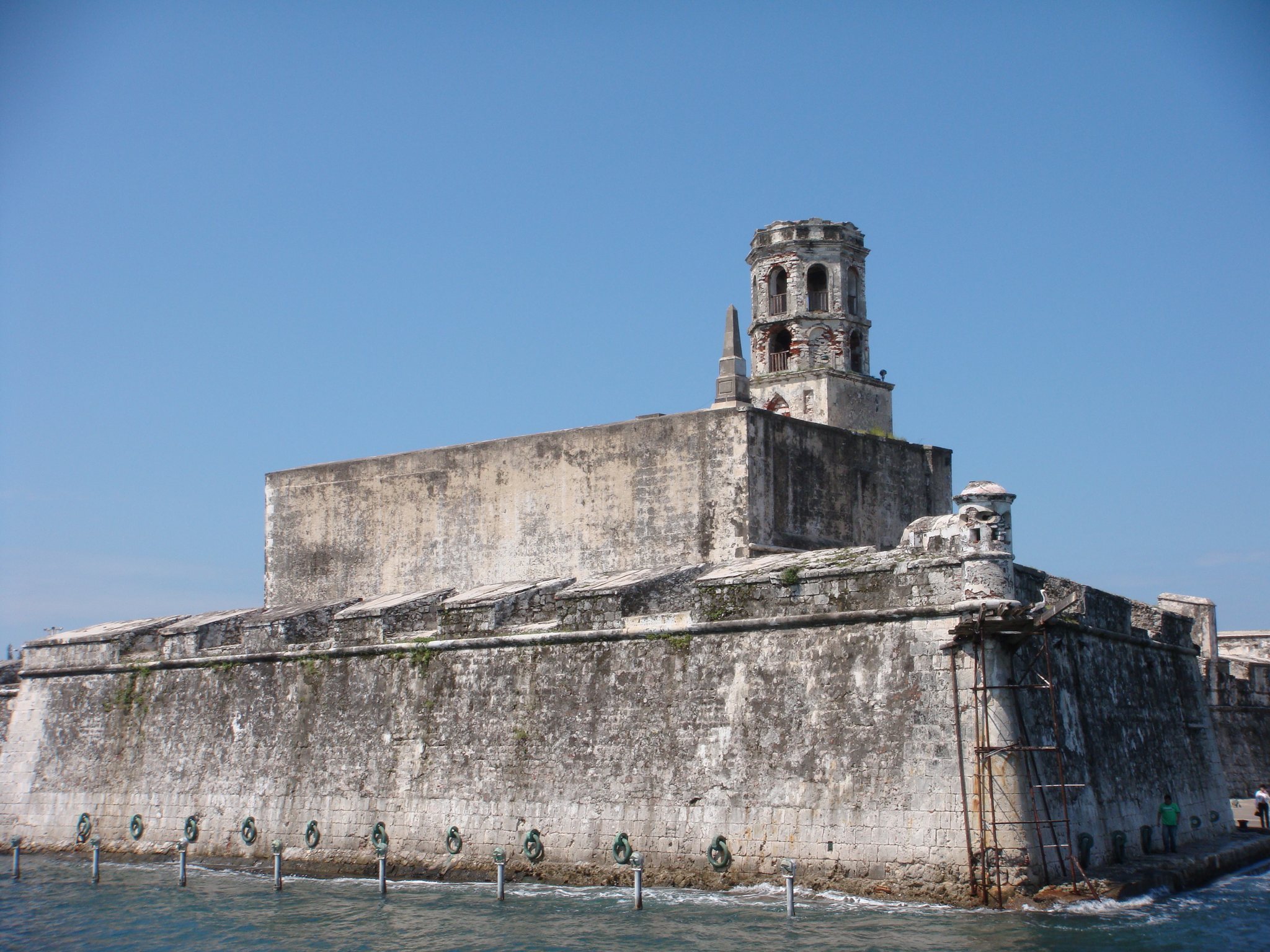
San Juan de Ulúa occupies an island overlooking Veracruz harbor. The complex combines a large stone fortification with prison spaces, a former palace, chapel areas, and the remains of naval facilities. Locally obtained coral stone formed part of its construction. Repeated expansion between the sixteenth and eighteenth centuries produced a closed defensive enclosure based on the Italian trace system, whose angled bastions and connecting curtain walls were designed to withstand and return cannon fire.
Fortified enclosure
Muro de las Argollas and curtain walls
The Muro de las Argollas formed part of the late-seventeenth-century defensive works. Jaime Franck incorporated it with three curtains and two semi-bastions, joining the earlier towers into an enclosed fortified compound. Later reforms regularized the defenses and enlarged the outer works, leaving the walls as part of the complex’s layered defensive plan.
Baluarte de la Soledad
The Baluarte de la Soledad was built as a full bastion during the early-eighteenth-century reforms that followed criticism of the landward semi-bastions. Its projecting form belonged to the system intended to give defenders fire along adjoining walls. The bastion remains part of the stone enclosure and its successive defensive additions.
Baluarte de San Pedro
The Baluarte de San Pedro contained the lighthouse of San José, installed between 1793 and 1796. Oil lamps stood on a triangular glass base, while a clockwork mechanism created intermittent beams. The lighthouse’s position within the bastion connected the fortress’s defensive architecture with the practical needs of ships entering the harbor.
Baluarte de San Crispín
The Baluarte de San Crispín includes a chapel entrance beneath the stone staircase leading toward the bastion. The bastion remains occupied by the Mexican Navy and is excluded from the museum route. Its continued military occupation forms part of the complex’s modern physical history.
Early settlement and religious features
Settlement and oratory
An early settlement on or near the island included houses, a chapel, and a gun battery. The island also had an oratory associated with the Franciscan presence recorded in 1524. These elements belong to the site’s early phase, before the successive stone expansions that produced the later fortress.
Chapel of the Staircase
A small chapel beneath the staircase to the Baluarte de San Crispín stood near the chancery, ammunition room, and treasury room. It formerly held the Marian icon known as the Virgin of the Staircase. When ships entered the bay, the image was raised to the upper tower and cannon fire greeted the arriving vessels. The original image has been missing since the period after Mexican independence.
Prison and palace
Prison areas
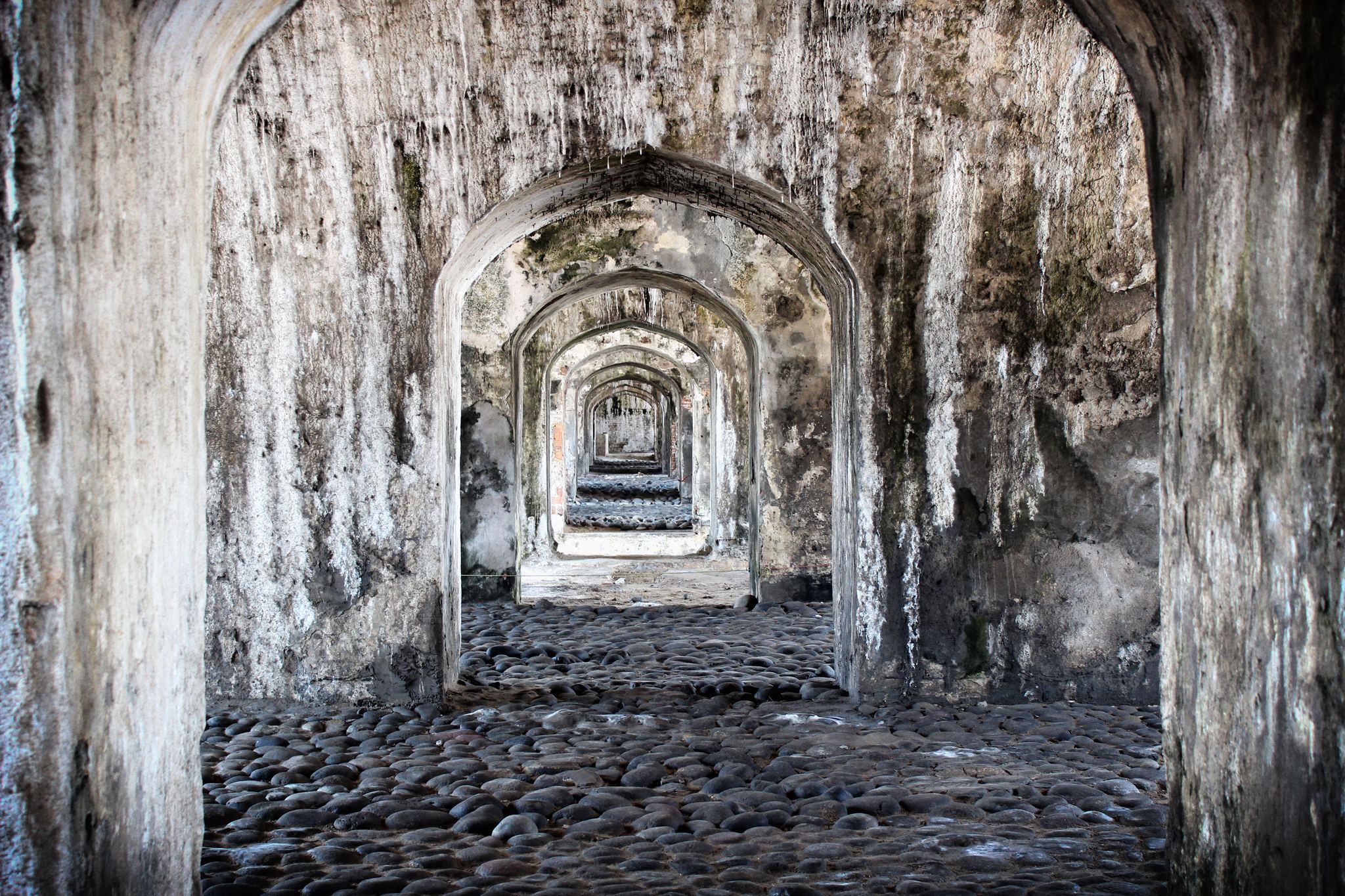
The prison areas contain cavernous cells. Those examined during the 1914 occupation measured approximately 12 meters in length and 4.5 meters in width and lacked sanitary installations. The cells and floors were later cleaned, disinfected, and sealed. The prison spaces remain among the physical features through which the fortress’s nineteenth- and early-twentieth-century penal use is understood.
Former presidential palace
The complex includes a former palace that served as the headquarters of Venustiano Carranza in 1915, when the fortress briefly housed Mexico’s federal executive power. The building had suffered severe deterioration and was undergoing restoration as of 2020. The remaining fortress and prison areas have been opened to the public in a partly deteriorated condition.
Naval arsenal
The former naval arsenal incorporated a floating self-docking dry dock, a later dry dock built in 1929, and another dock opened in 1942. These facilities belonged to the Arsenal Nacional’s industrial phase, when San Juan de Ulúa served the merchant marine and Mexican navy. The naval installations were dismantled in 1962, leaving the fortress complex under heritage conservation and museum management.
Museum
The local museum displays the history of the fortress within the surviving complex. Its interpretation brings together the island’s colonial defenses, prison structures, naval facilities, and later conservation. The Baluarte de San Crispín remains outside the museum route because it continues to be occupied by the Mexican Navy.