Charles Church: Plymouth’s Post-Reformation Parish Church and War Memorial
Site at a Glance
- Rating
- 4.5
- Popularity
- Very Low
- Country
- United Kingdom
- Primary era
- Early Modern
- Eras represented
- Early Modern, Modern
- Civilizations
- English
- Site type
- Religious
- Remains
- Church
On this page16 sections
History
Charles Church is a seventeenth-century Gothic parish church in Plymouth, United Kingdom, founded around 1640 as the town’s second parish church. Its creation followed religious and political disputes between Plymouth’s predominantly Puritan community and Charles I, who supported High Anglican policies. The church was built in the post-Reformation Gothic tradition and became an important centre of Plymouth’s religious, educational, and missionary life before its destruction by fire during the Plymouth Blitz in 1941.
Foundation and royal parish division
The project began with a 1634 petition from Plymouth’s mayor and thirty council members to divide the old parish and establish a second church. The new parish was planned east of the existing parish of St Andrew’s, which became known as the “Old Church,” while the new building was called the “New Church.” Charles I insisted that it bear his name. The division reflected disputes over the appointment of ministers and lecturers, who were preachers appointed to deliver additional sermons alongside parish clergy, rather than a simple shortage of space at St Andrew’s.
Robert Trelawny, Plymouth’s Member of Parliament and a royalist sympathizer, helped secure the king’s approval after a seven-year delay. Letters patent were signed and sealed on 21 April 1641. Parliament passed the necessary Act on 6 July, and it received royal assent on 7 August. The Act prohibited one clergyman from holding both livings, and the town paid £150 towards the project.
An initial plot near Sutton Pool was rejected because the enlarged parish would have made the church difficult for some parishioners to reach. William Warren then provided a site of about one acre. In return, he received a burial plot inside the church and a seat there. Construction began in 1641, but work stopped the following year when manpower was needed to defend Plymouth during the English Civil War, the conflicts fought between supporters of the monarchy and Parliament from 1642 to 1651.
War, completion, and consecration
Plymouth supported Parliament and Oliver Cromwell, the leading Parliamentarian commander, during the siege by the king’s forces. The unfinished church was probably used partly as a stable, although religious activity also took place there. A wedding was recorded on 10 May 1644, baptisms began in January 1645, and the first recorded burials took place on 4 August 1646. Francis Porter served as preaching minister from 1643, while financial difficulties after the war slowed the building work. The church was completed in 1657.
Porter had originally been Presbyterian but conformed to the restored Church of England and retained his living. Bishop Seth Ward of Exeter consecrated the church on 2 September 1665, and the churchyard was consecrated in 1670. A dispute over the dedication was settled in favour of the name required by the 1641 letters patent, rather than the title proposed by the bishop, “Charles, King and Martyr.” Thomas Martin played an important part in completing the tower and raising its wooden, lead-covered spire.
Parish growth and evangelical ministry
Charles Church became a major centre of Plymouth’s spiritual life for roughly three centuries and helped establish eight daughter churches. Charles Chapel was built after a dispute following the death of Robert Hawker and later became St Luke’s Church. The later institutional successor of the parish was Charles with St Matthias.
Hawker served as minister from 1784 until his death in 1827 and became known for evangelical preaching. His ministry was associated with education, aid for poor people, and a growing congregation. Galleries were created in 1815, and Charles Chapel was built during this period. James Carne succeeded Hawker in 1827 and served until 1832. He carried out extensive repairs and, with his wife, died within four days of her while caring for poor and deprived families affected by the cholera epidemic of 1832.
Septimus Courtney, Hawker’s curate, was widely expected to succeed him, but Charles Chapel was built for him instead. Henry Addington Greaves served from 1846 to 1878, restored the tower and spire, undertook further building work, and initiated three daughter churches, St John’s, Emmanuel, and St Jude’s.
Education, missions, and parish life
The church’s evangelical ministry supported missionary and educational work. On 17 October 1661, a collection was given to John de Kavino Kavainsley of the Duchy of Lithuania for printing the Bible in Lithuanian. The “Charles Own Missionary” Fund later sent Emily Bazerley to Bihar and Orissa in 1896, Ada Pitts to China in 1901, and Alison Dow with the Church Missionary Society to the Bhils in India in 1961.
The “Household of Faith” Sunday school began in May 1784 with twenty children and was described as Plymouth’s first school of its type. A school of industry followed in 1788, and a permanent school building opened on 7 March 1798. Charles National School in Tavistock Place was built in 1837, while Charles Shaftesbury School opened for senior boys in 1855.
A church census in 1851 returned 52,221 people for Plymouth as a whole, with 23,805 sittings and 2,480 attendances on 30 March. Charles Church was estimated to contain about 900 sittings, or possibly more than 1,000 when its three galleries were included. The parish itself was estimated to contain 10,000 people in 1827.
Destruction and memorial use
During the Plymouth Blitz, the intensive German bombing of Plymouth in the Second World War, incendiary bombs destroyed Charles Church by fire on 21 March 1941. The fire burned the church’s woodwork, gutted the tower, damaged or destroyed the bells, and harmed every mural monument. All but one of the bells were broken, and the surviving bell was cracked. The congregation temporarily joined St Luke’s and later St Matthias, while the church was not rebuilt after the war because Plymouth’s population had shifted towards the suburbs.
The city, working with the Ministry of Works, partially restored the ruins in 1957. At a service in 1958 conducted by J. Allen James, vicar of the parish, Charles Church was dedicated as a memorial to the 1,200 civilians killed in air raids on Plymouth during the Second World War. The parish became known as Charles with St Luke on 11 August 1954. When St Luke’s was considered for demolition, its congregation united with St Matthias, creating the Church of Charles with St Matthias on 22 April 1962.
Charles Church remains derelict but is used occasionally for remembrance services and other important services. A reconciliation service between Germany and Plymouth took place there in 2001, and the site has also hosted university carol concerts. A campaign in the mid-1990s proposed partial restoration with modern glazed roofing and a Blitz museum. The church has been a Grade I listed building, England’s highest category of statutory protection for buildings of exceptional architectural or historic interest, since 25 January 1954.
Remains
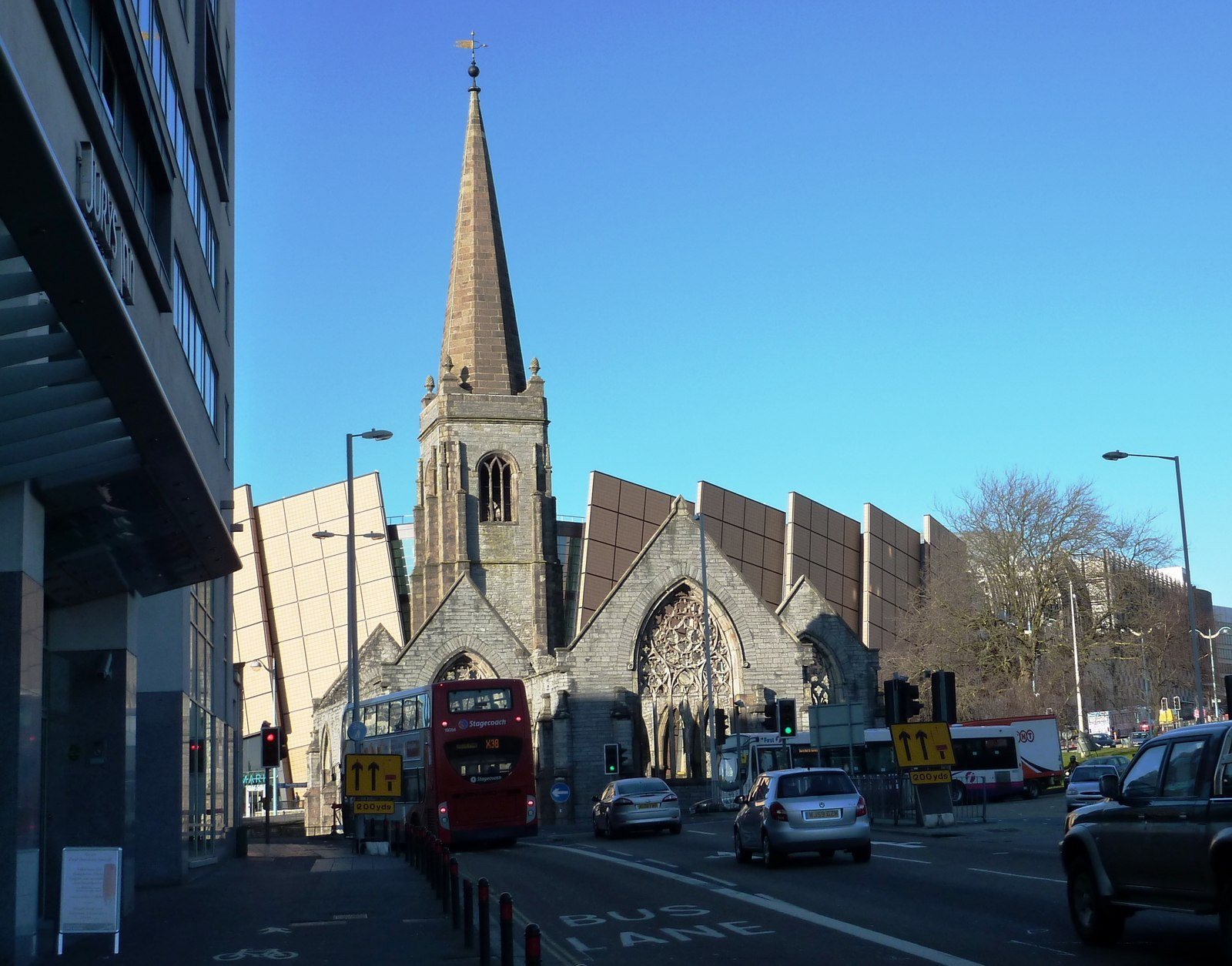
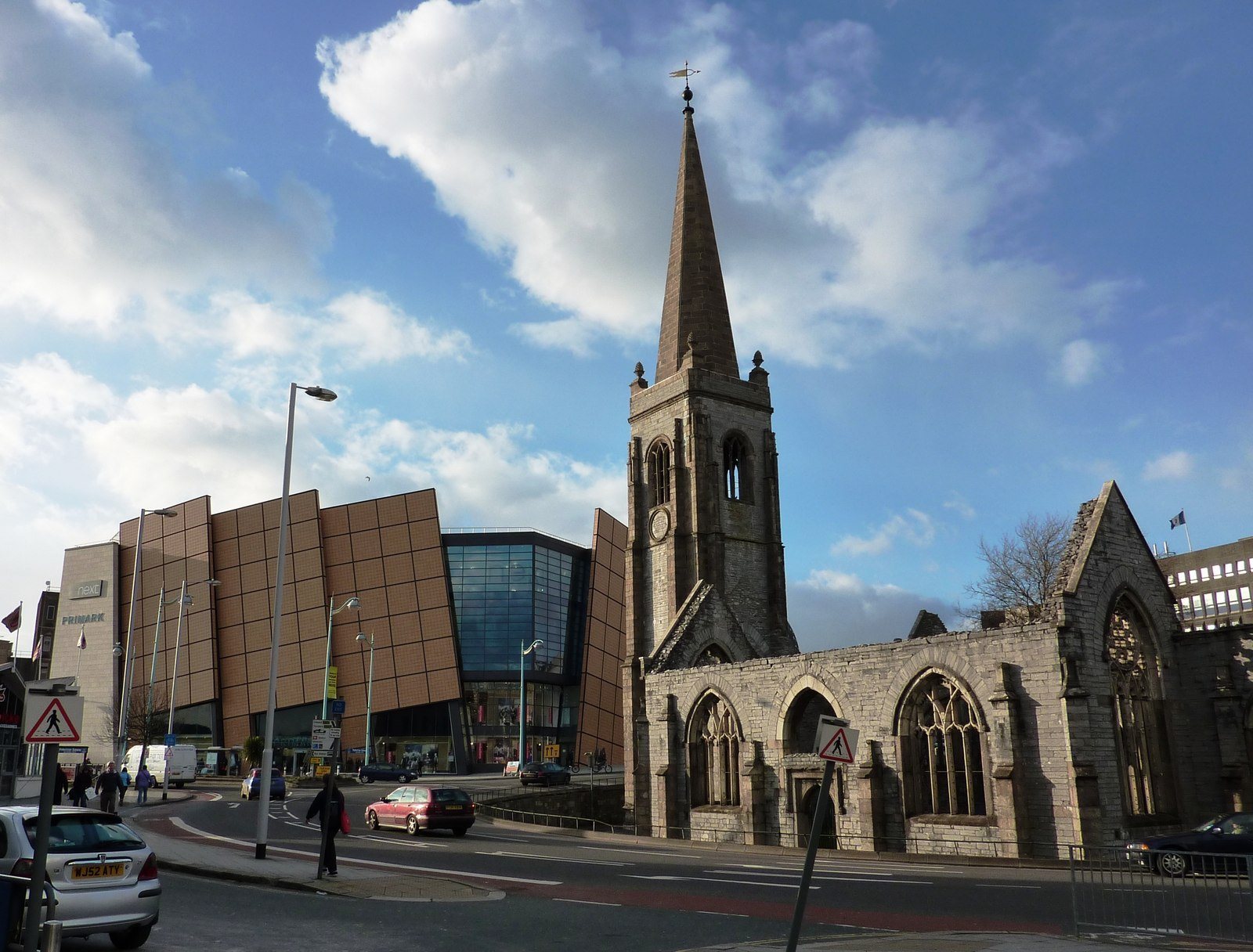
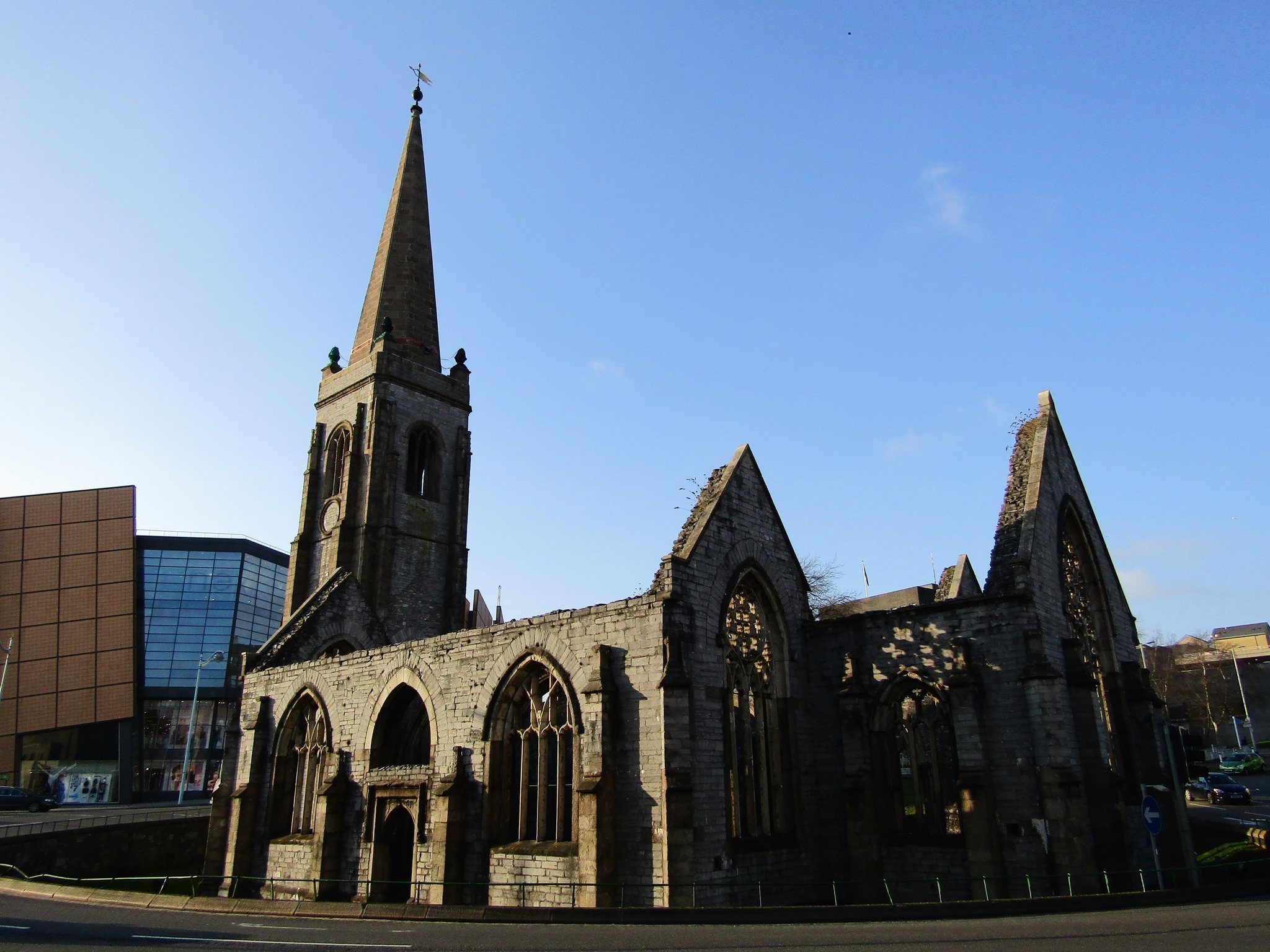
Charles Church survives as a partially restored Gothic ruin enclosed by a roundabout constructed about ten years after the Second World War. The building consisted of a west tower and spire, a nave with north and south aisles, north and south porches, and a chancel with a north vestry. Its design continued medieval Gothic forms after the Reformation, and it was regarded as a leading example of post-Reformation Gothic architecture in England. The architect was thought to have been a disciple of William of Wykeham, the fourteenth-century bishop and patron of Gothic building.
Tower and spire
West tower
The west tower was built from limestone and granite in three stages divided by moulded horizontal strings. Paired buttresses marked each corner. Date stones on the north and south sides bear the years 1657 and 1708, reflecting the building’s completion and later work on the tower. A west gallery was erected in 1708, six bells were added in 1709, and a chiming clock was installed in 1719.
Spire
The original spire was wooden and covered with lead, and its completion in 1708 formed part of the tower’s later development. Strong winds subsequently blew it down, after which it was replaced in 1766 by a stone spire. The replacement was octagonal and carried a ball and vane. Henry Addington Greaves later restored the tower and spire during his ministry.
Church fabric and surviving details
Nave, aisles, and porches
The nave was flanked by north and south aisles, with porches added in 1864. The south porch stood at the centre of the south aisle and retained a seventeenth-century pointed outer doorway. Galleries added in 1815 expanded the interior seating. The east window was unusually elaborate for a seventeenth-century church. A doorway beneath it had been walled up in 1665, and its position became visible again after the Blitz damage.
Vestry and font
The modern vestry on the north side of the chancel survived the destruction of the main building. The Blitz also revealed a doorway in the north wall. The font was broken into small fragments during the fire, and the pieces were later gathered into a small cairn.
Memorials and commemorative features
War and civic memorials
A damaged brass tablet in the north aisle commemorated Admiral Robert Blake and recorded the installation of a memorial window in 1889 by descendants of English and American branches of the family. A commemorative plaque on the north wall gives the church’s main dates, including construction in 1641, consecration in 1665, completion of the tower in 1708, dedication to Charles I, destruction by enemy action on 21 March 1941, and partial restoration in 1957.
Funerary monuments
Other monuments included a tablet to William Rowe, a seventeenth-century merchant and benefactor of poor people, and Frances Rowe; a marble tablet to John and Elizabeth Nicolls; and tablets to members of the Hawker, Winne, and Williams families, including James Hawker, a post-captain in the Royal Navy. A Latin-inscribed black marble monument commemorated Moses George Vincent de Batens and his brother Matthias. Further tablets commemorated Samuel and Henrietta Brent; Vice-Admiral Richard Arthur, Elizabeth Fortescue, Catherine Elizabeth Caroline Henn Gennys, and Richard William Arthur; William Spark; Anna Harris Rains and Captain Stephen Rains; Andrew and Sarah Tracey; and Elizabeth Seymour.