Smeaton’s Tower: Memorial to the Eddystone Lighthouse
Site at a Glance
- Popularity
- High
- Country
- United Kingdom
- Primary era
- Early Modern
- Eras represented
- Early Modern
- Civilizations
- British
- Site type
- Civic
- Remains
- Monument
On this page7 sections
History
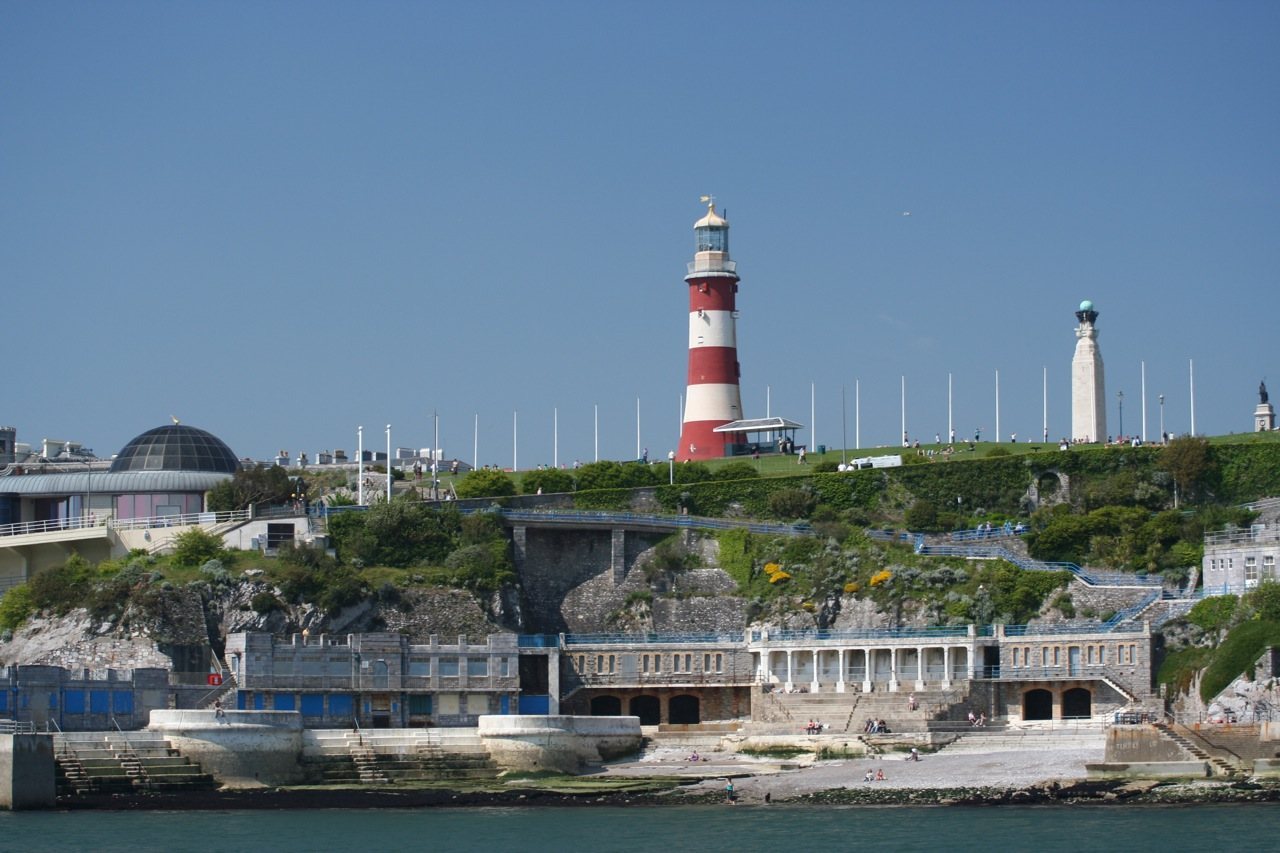
Smeaton’s Tower is the reconstructed upper section of the third Eddystone Lighthouse, now standing as a memorial on Plymouth Hoe in Plymouth, United Kingdom. Civil engineer John Smeaton designed the original lighthouse, whose construction began in 1756 and was completed in August 1759. Often regarded as one of the founders of civil engineering, Smeaton shaped the tower to withstand the exposed conditions of the Eddystone Rocks.
The third Eddystone Lighthouse
The new lighthouse followed two earlier structures on the reef. A storm destroyed Winstanley’s lighthouse in 1703, and its successor, the Rudyard Lighthouse, was lost to fire in 1755. After the fire, the Royal Society, Britain’s learned society for scientific research, recommended Smeaton to design a replacement.
Work began at Millbay, where Smeaton set up a jetty and a workyard in the harbour’s southwest corner to receive and shape the stone. Wooden rails with a 107-centimetre gauge carried four-wheeled flat trucks. The 10-ton vessel Eddystone Boat then transported the worked stone to the reef. On 12 June 1756, it took out the 2.25-ton foundation stone.
Many of the builders were Cornish tin miners. To protect them from press-ganging, the forced recruitment of men into naval service, Trinity House, the British lighthouse authority, and the Admiralty, the government department responsible for naval affairs, arranged an exemption from naval impressment. Each worker received a medal confirming his contribution to the lighthouse. The completed project cost £40,000.
Service and relocation
The lighthouse served at the Eddystone Rocks from 1759. In 1877, erosion of the supporting rocks became a concern, and large waves made the tower shake. It ceased operating in February 1882, after a temporary light began operating in Douglass’s Tower, its successor under construction on a nearby rock.
In 1882, workers dismantled the old lighthouse’s upper section and reassembled it on Plymouth Hoe as a memorial to Smeaton. It took the place of a triangular Trinity House obelisk erected there in the early nineteenth century as a navigation aid. Plymouth’s mayor opened the memorial site to the public on 24 September 1884.
The memorial’s later history
A bomb found at the tower entrance on 19 April 1913 bore the words “votes for women” and “death in ten minutes.” It was thought to be linked to the women’s suffrage campaign, which sought voting rights for women. The fuse had been lit, but wind extinguished it before the bomb detonated. Smeaton’s Tower received Grade I listing in 1954, the highest listing category in England for buildings of exceptional interest.
The lighthouse’s image also appeared on currency. A penny issued in 1860 showed it behind Britannia, the female personification of Britain, and retained the design until 1894. Nineteenth-century tokens from Devon also depicted the lighthouse, with face values from two pence to one shilling. On 15 October 2009, candles lit the lantern to mark 250 years since the original lighthouse’s first illumination.
Remains
The site includes the reconstructed upper part of the lighthouse on Plymouth Hoe and the remains of the original structure on the Eddystone Rocks. The tower at Plymouth stands about 15 metres high, roughly two-thirds the original lighthouse’s 22-metre height.
The tower on Plymouth Hoe
Smeaton shaped the lighthouse with a curved, trunk-like outline intended to resemble an oak tree and withstand the elements. The original tower measured 8 metres across at its base and 5 metres at the top. Its granite blocks were joined with dovetail joints, which interlock, and marble dowels, or connecting pins. Hydraulic lime, a lime-based material that hardens in wet conditions, bound the masonry.
The original light came from 24 candles, each weighing between 0.91 and 2.27 kilograms. A timepiece beside them chimed every half-hour to alert the keeper to replace burned-out candles. Oil lamps and reflectors took their place in 1810; an improved lamp and a Fresnel lens assembly followed in 1845. A Fresnel lens uses concentric optical sections to concentrate and direct light. The lantern chamber in the Hoe tower is reached by 93 steps, including steep ladders. A granite bust of Smeaton by Philip Chatfield was installed there in 2020, based on an earlier plaster bust donated by the Institution of Civil Engineers around 1980 and later removed for safety.
Remains at the Eddystone Rocks
The original foundation and the stump of the former tower remain on the rocks near the current lighthouse. The foundation was left in place because it proved too strong to dismantle.