Real Felipe Fortress: A Spanish Colonial Defense in Callao, Peru
Site at a Glance
- Rating
- 4.5
- Popularity
- High
- Country
- Peru
- Primary era
- Early Modern
- External website
- Open
- Eras represented
- Early Modern, Modern
- Civilizations
- Spanish
- Site type
- Military
- Remains
- Fort
On this page16 sections
History
Real Felipe Fortress is an eighteenth-century Spanish colonial fortification in Callao, Peru, built in the Vauban style to defend Callao Bay, the principal colonial port, and Lima from pirate and corsair attacks. Its construction followed the earthquake and tsunami of 1746, which destroyed much of Callao’s earlier defenses. The fortress became one of Spain’s largest military-architectural projects in the Americas and later witnessed the end of Spanish imperial rule in South America.
Construction after the 1746 disaster
Viceroy José Antonio Manso de Velasco ordered the new fortress after the 1746 catastrophe. The design approved on 29 December 1746 was prepared by the French mathematician and architect Louis Godin with José Amich and Juan Francisco Rossa. Construction began on 21 January 1747, and the first stone was laid on 1 August of the same year.
The first phase continued until 1774, followed by a later completion phase dated from 1776 to 1811. The work cost approximately three million pesos. The fortress was named for King Felipe V of the Bourbon dynasty, who had died in 1746. In 1782, Viceroy Manuel Guirior ordered two smaller forts, San Miguel and San Rafael, to protect its vulnerable flanks. San Miguel stood to the north and San Rafael to the south, and the three defenses were collectively known as the Castles of Callao.
In 1806, Viceroy José Fernando de Abascal y Sousa ordered an arms and artillery storehouse and a cistern capable of supplying 2,000 men for four months during a siege. These additions strengthened the fortress’s ability to withstand a prolonged attack.
Attacks and the struggle for independence
Real Felipe was involved in several confrontations during the crisis of Spanish rule. On 21 January 1816, Admiral Guillermo Brown blockaded Callao, captured several Spanish ships, and bombarded the port. The fortress guns and coastal batteries returned fire, forcing the attackers to withdraw.
On 16 January 1819, the fortress repelled an attack by the squadron commanded by Admiral Lord Thomas Cochrane during the administration of Viceroy Joaquín de la Pezuela. The failed assault contributed to José de San Martín’s decision to enter Lima through Pisco rather than Callao. A siege is a sustained military effort to surround and force the surrender of a defended place, and the later sieges of Real Felipe formed part of the wider struggle against Spanish rule.
After Peru declared independence, the fortress remained under Spanish control under General José de La Mar and was besieged by the independence forces. On 19 September 1821, shortages of food and the threat of epidemic disease led La Mar to surrender the plaza and join the independence forces. San Martín then renamed the fortress the Castle of Independence.
The change was temporary. In 1824, a revolt in Callao led by Sergeant Dámaso Moyano returned the fortress to Spanish control. Brigadier José Ramón Rodil y Campillo refused to recognize the capitulation of Ayacucho and defended Real Felipe during the second siege of Callao. Rodil surrendered on 22 January 1826 after the expected assistance from Spain failed to arrive. His surrender ended Spanish imperial rule in South America, and the fortress returned to republican control.
Republican conflicts and changing functions
From 1826 to 1833, Real Felipe served as a political prison. In 1834, it sheltered the newly elected president Luis José de Orbegoso y Moncada, who feared a coup by former president Agustín Gamarra. During Orbegoso’s absence in 1835, Sergeant Pedro Becerra seized the fortress in a Callao mutiny. General Felipe Santiago Salaverry suppressed the revolt within days.
On 31 August 1838, forces associated with Manuel Bulnes besieged the fortress, where troops loyal to Andrés de Santa Cruz were stationed under Colonel Manuel de la Guarda. Foreign powers prevented an effective blockade of Callao, allowing the besieged forces to receive supplies, and Bulnes’s army failed to capture Real Felipe.
President Agustín Gamarra decreed the conversion of the fortress into a customs house on 10 May 1839. Its buildings were adapted for customs operations, and neighboring areas of land were sold to private owners. The complex later formed part of Peru’s defensive line during the Battle of 2 May 1866, when the country faced the Spanish fleet commanded by Admiral Casto Méndez Núñez.
During the War of the Pacific, the fortress prevented the Chilean squadron commanded by Admiral Galvarino Riveros Cárdenas from landing at Callao. Real Felipe survived the war, while the forts of San Rafael and San Miguel were completely destroyed by Chilean troops.
Military, institutional, and commemorative use
Real Felipe continued as a customs house until 1934, when customs operations moved to a new facility at the Callao maritime terminal. Afterward, parts of the complex housed customs offices, the harbor master’s office, a police station, a political prison, and other state institutions. On 20 February 1931, a military-police revolt against President Luis Miguel Sánchez Cerro took place inside the fortress under Brigadier General Pedro Pablo Martínez y Ledesma. After several hours of fighting, the rebels surrendered following an aerial bombardment by the army.
The fortress housed the School of Non-Commissioned Officers of the Peruvian Aeronautical Corps until 31 December 1945 and also contained deposits belonging to the Ministry of Aeronautics. It later served as a military barracks. The Parachute Infantry Battalion “3 de Octubre” occupied it until 1980, followed by the “Guardia Chalaca” Commando Infantry Battalion from June 1980 to 1983. Since 1984, part of the complex has been occupied by the Peruvian Army’s Motorized Infantry Battalion “Peruvian Legion” No. 1 and the Flying Artillery Battery of the “Peruvian Legion of the Guard.”
General Jaime Salinas Sedó was imprisoned in the fortress for nearly three years after his capture following an attempt to restore democratic order after Alberto Fujimori’s 1992 self-coup. The fortress was declared a National Historic Monument on 19 May 1952 under Law No. 11841. It later became the home of the Peruvian Army Museum and was identified as a national cultural-heritage property and as a site on Peru’s tentative World Heritage list.
Restoration took place in 1925, when the original name was restored, and again in 1962 under the direction of architect Víctor Pimentel Gurmendi. Further work began in 2007 under the Army Engineering Service, in coordination with the Army Museums Directorate and under the supervision of the National Institute of Culture. The restoration of 2007 and 2008 prepared the fortress for use as a venue during the 2008 Asia-Pacific Economic Cooperation forum. The museum and many objects in its collection, including military uniforms and Bolognesi’s handwritten letters, were restored again in 2016.
Since 2023, archaeological excavations have revealed a brick floor thought to date from the seventeenth century, along with ceramic fragments, military implements, and precious stones. The Peruvian Army governs the complex. It functions as the Peruvian Army Museum and as a cultural venue, while military units continue to occupy part of the fortress.
Remains
Plan, walls, and entrances
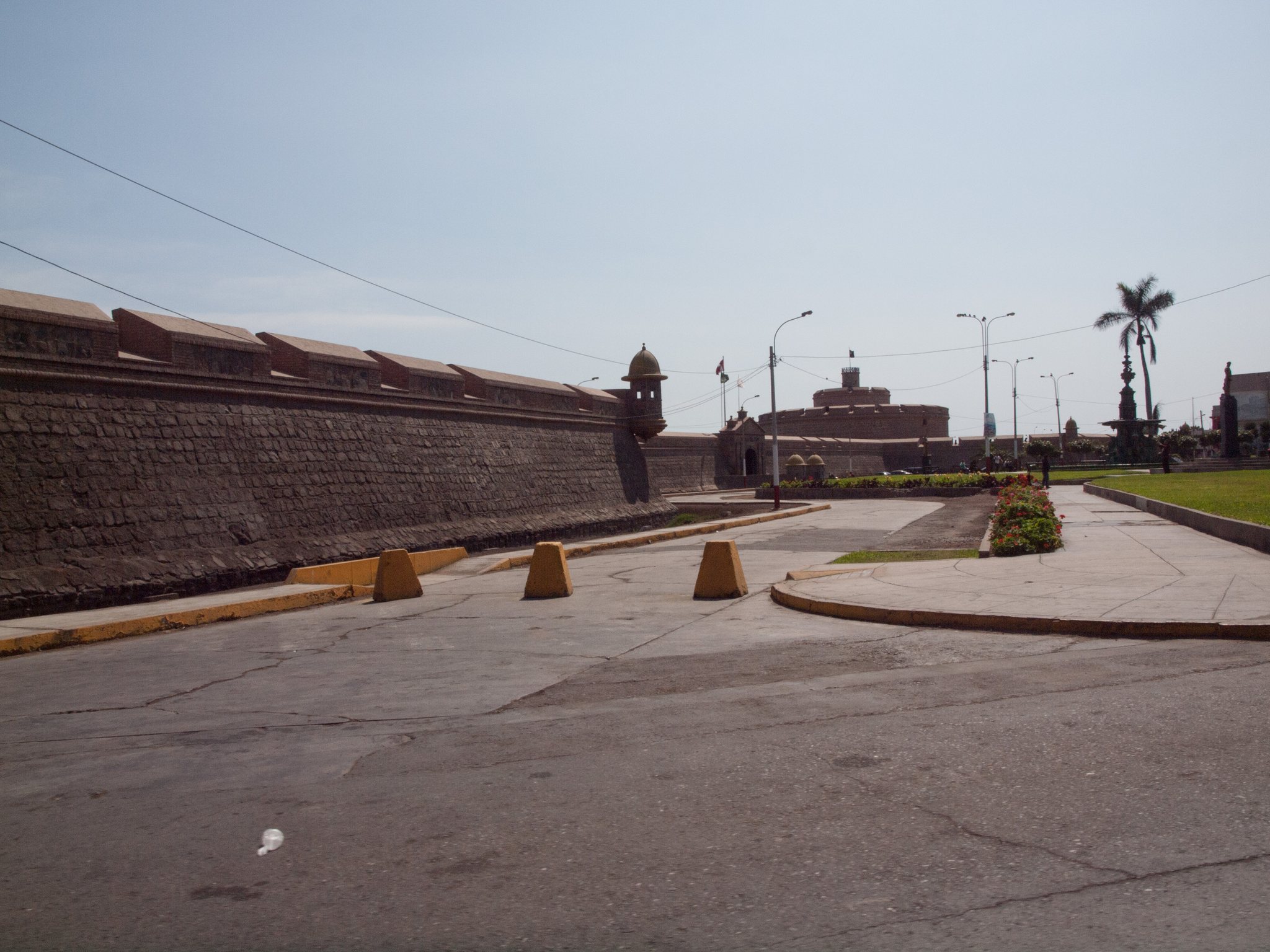
Real Felipe stands in the central part of Callao Bay. It is a Vauban-style fortification, a defensive system using angled bastions, layered protection, and artillery positions, built principally of stone. The fortress has an irregular pentagonal plan, covers approximately 70,000 square metres, and has a perimeter of about 1,580 metres. Its stated height is 4 metres.
Each vertex carries a bastion, a projecting section of a fortification from which defenders could cover adjoining walls. The five bastions are El Rey, La Reina or La Patria, San Felipe or Jonte, San Carlos or La Tapia, and San José or La Natividad. The defensive perimeter includes the walls named Camino Real, Marina, Camino de Chucuito, Marcelosa, and Camino de la Magdalena.
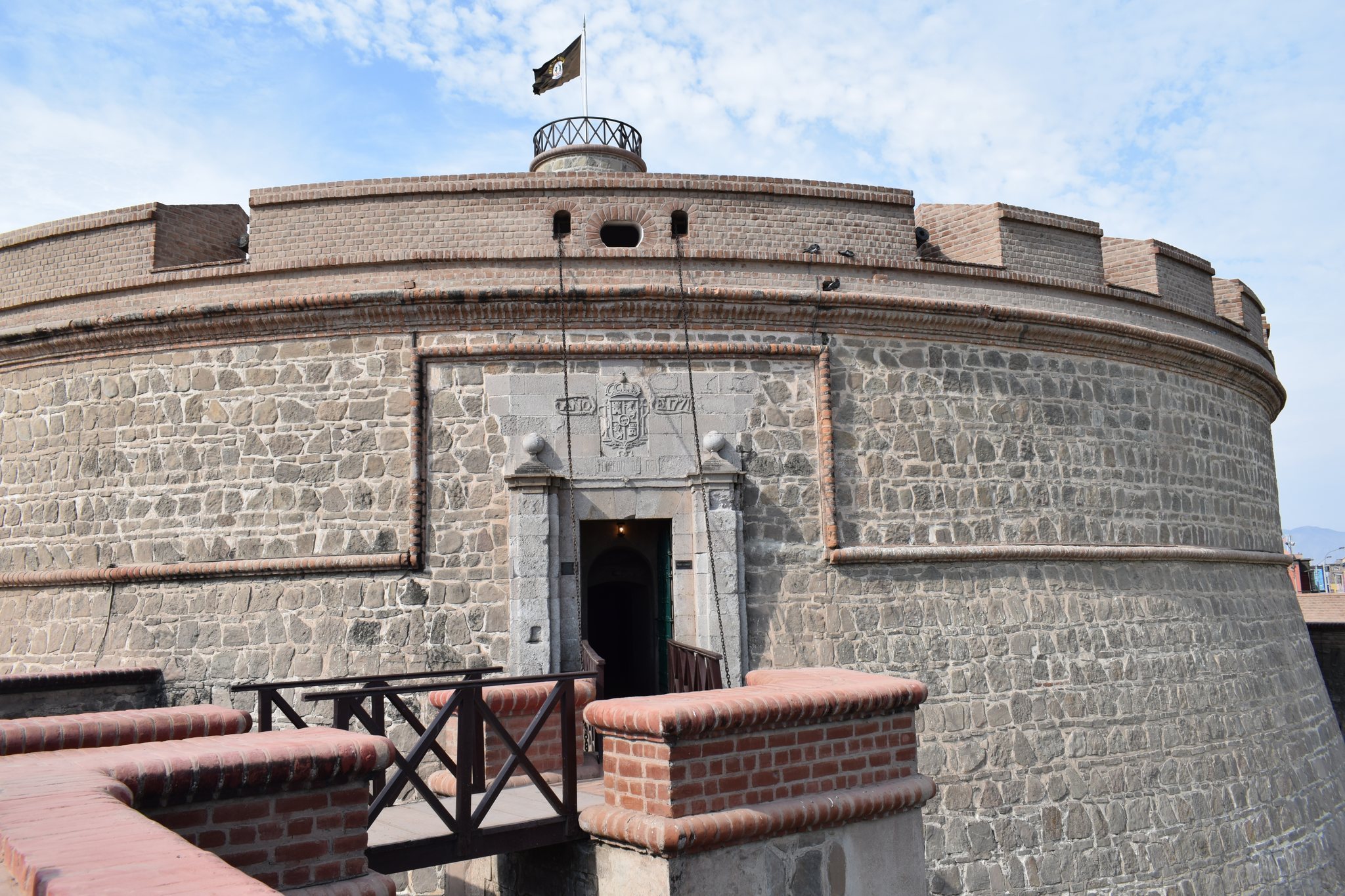
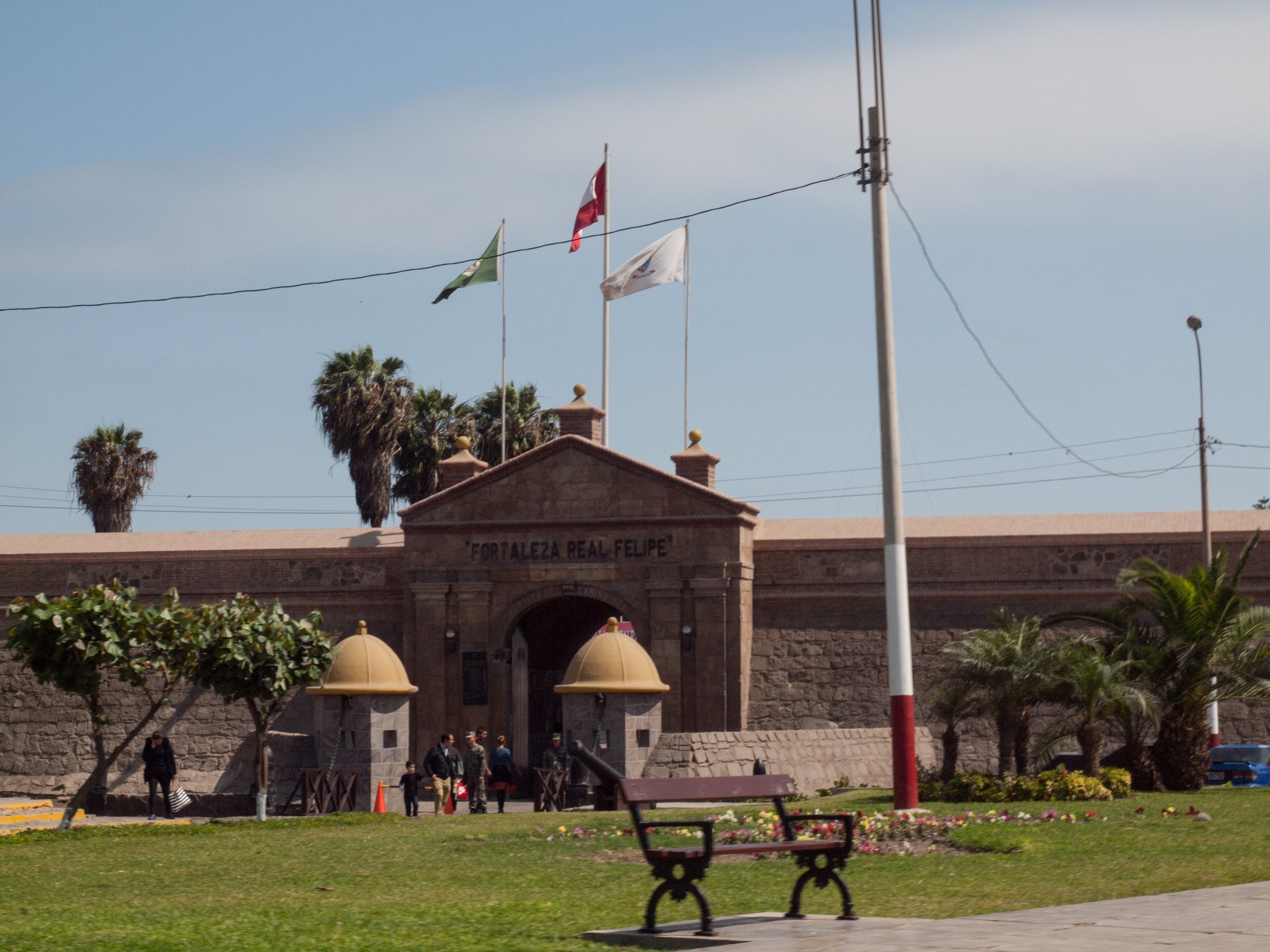
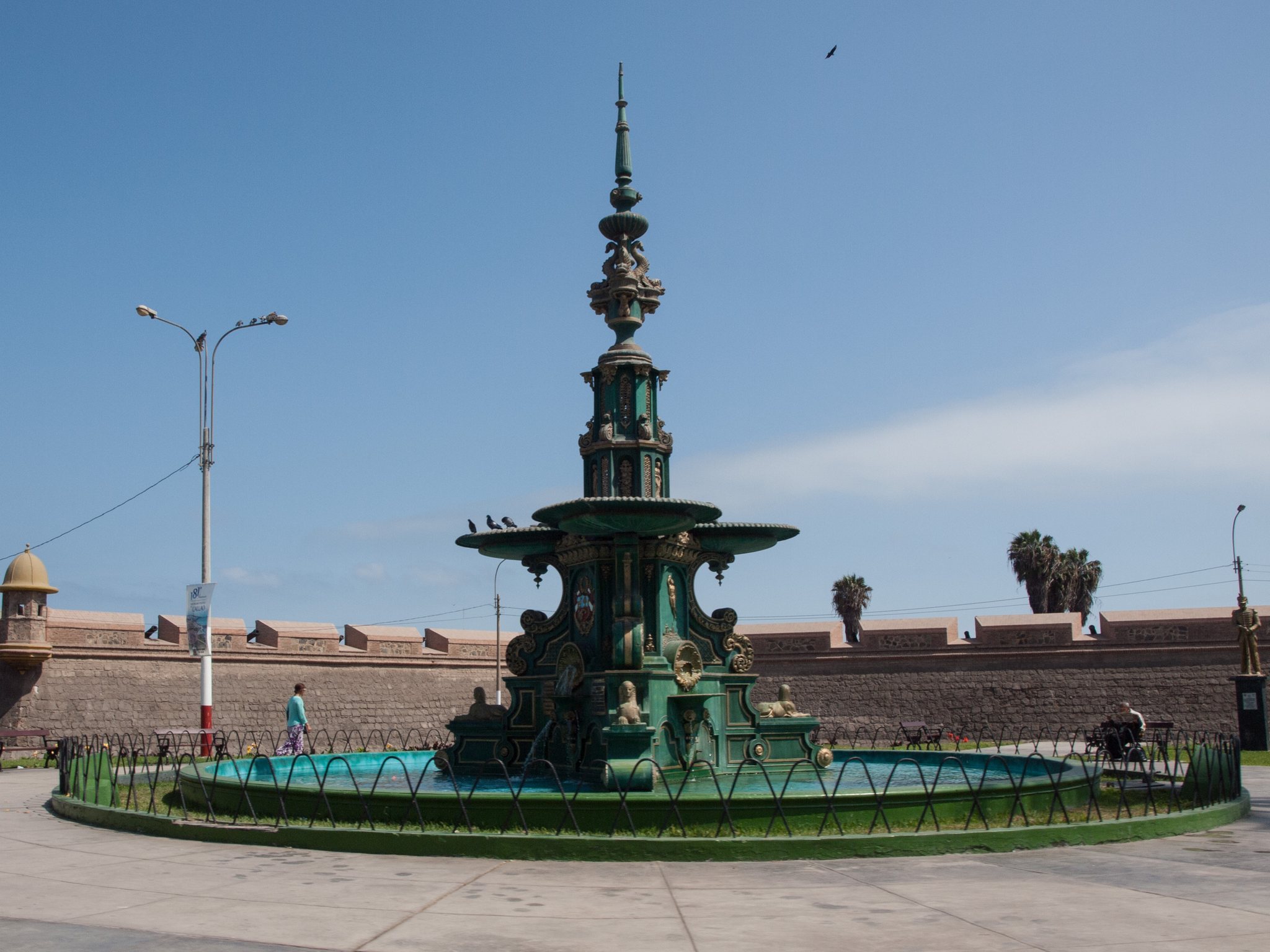
The main entrance lies in the Camino Real wall between the El Rey and San José bastions. Its facade has a triangular pediment and a symbolic drawbridge preceded by two sentry boxes. The entrance originally faced the road between Lima and Callao and crossed a water-filled moat that formerly surrounded the fortress. Plaza Independencia is now located in front of it. The secondary entrance, the Puerta del Perdón, is in the Camino de Chucuito wall at the rear. During the siege of Callao, deserters used this gateway to pass to the patriot side.
Fortified towers and artillery positions
Torreón del Rey
The Torreón del Rey occupies the El Rey bastion and rises through three levels. Two levels contained gun platforms, one equipped with twenty-four iron cannon and the other with eight bronze cannon. Its interior formed a maze-like bunker prepared for prolonged resistance. A drawbridge provided its only access.
Torreón de la Reina
The Torreón de la Reina occupies the bastion of the same name. It contained stores of ammunition and provisions, a water well, and a semicircular dungeon in which prisoners had to remain standing. The tower originally had two levels with gun platforms.
Both towers were designed as fortified redoubts within the main enclosure. If the principal fortress were captured, their drawbridges could be raised, isolating the towers and allowing their defenders to continue fighting. During the War of the Pacific, their upper levels were altered. Torreón del Rey received two platforms for rotating cannon, while the upper level of Torreón de la Reina was removed and replaced by four platforms for Vavasseur rotating cannon. One of those cannon remains in the museum.
Command buildings and protected chambers
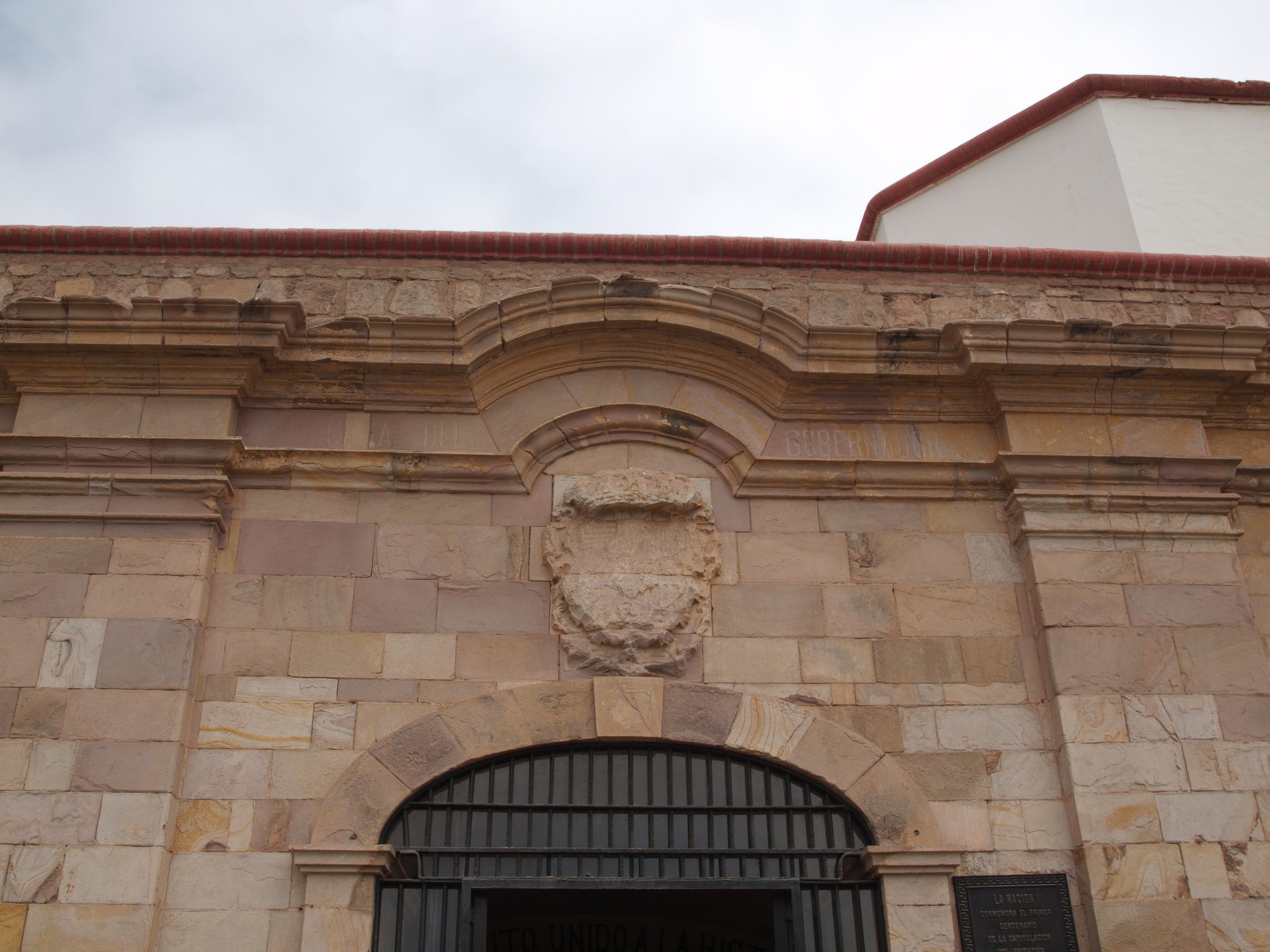
Casa del Gobernador
The Casa del Gobernador stands at the vertex of the San Carlos bastion. It was built as the residence of the military commander of the plaza. Its facade originally carried carved shields of the Spanish kings. The building now displays objects from military periods extending from the Inca era to the republican period.
Caballero de los Doce Cañones
The Caballero de los Doce Cañones is a raised artillery platform above the Casa del Gobernador. Built during the administration of Viceroy Manuel de Amat, it carried twelve cannon directed toward the four sides. It also had three lines of retreat, each equipped with cannon aimed at attackers. A caballero is an elevated position within a fortress that gives artillery a higher firing position and a wider field of fire.
San Carlos casemates
Four casemates were built in the lower part of the San Carlos bastion. A casemate is a heavily protected vaulted chamber used for artillery, storage, or other military purposes. These chambers initially served as storerooms and were later converted into prisons.
Materials and museum areas
The fortress was built with stone blocks brought from the quarries of San Lorenzo Island and with material recovered from earlier walls destroyed by the 1746 earthquake and tsunami. The blocks consist of quartzite and sandstone reinforced with calicanto, a binding mixture made from lime, sand, and egg white.
Beside the former cistern is the museum’s oploteca, or collection of portable weapons. It displays pistols and revolvers, rifles and carbines, and support weapons such as machine guns, grenade launchers, and mortars. The complex also contains the Casa de la Mujer, which commemorates Peruvian women’s participation during wartime.
Other museum areas include a Park of Armored Vehicles displaying tanks of different origins and an Artillery Park containing cannon used by the Peruvian Army during different historical periods. A replica of the facade of the Casa de la Respuesta in Arica is also displayed. The original building is associated with Colonel Francisco Bolognesi’s celebrated response during the defense of Arica. Beside the replica stands the Monument to the Unknown Soldier, representing soldiers who died in the service of the army.
Later adaptations and archaeological evidence
A convention center was established inside the fortress in 2008. It includes an auditorium for 1,500 people, a press room, restaurants, and spaces for selling handicrafts. These later uses occupy part of a complex whose principal surviving form remains the pentagonal defensive enclosure, its bastions, walls, towers, entrances, and protected chambers.
Archaeological excavations have exposed a brick floor believed to date from the seventeenth century. Ceramic fragments, military implements, and precious stones were found with the excavated remains, providing material evidence of activity at the site before the eighteenth-century fortress was constructed.