Marienturm: A Former Defensive Tower in Aachen
Site at a Glance
- Rating
- 4.1
- Popularity
- Very Low
- Country
- Germany
- Primary era
- Early Modern
- External website
- Open
- Eras represented
- Medieval, Early Modern, Modern
- Civilizations
- German, Holy Roman Empire
- Site type
- Military
- Remains
- Tower
On this page9 sections
History
Marienturm, also called Marienburg, is a former defensive tower in Aachen, Germany, built as part of the city’s outer fortifications. The outer wall developed during the thirteenth and fourteenth centuries, while the present tower was constructed in 1512. It is one of the few surviving towers of Aachen’s former defenses and is listed among the city’s historic monuments.
From the outer wall to the Marienturm
The foundation stone of the present tower was laid on 14 August 1512, one day before the Feast of the Assumption of Mary, a Christian feast observed on 15 August. This date gave the tower its names, Marienturm and Marienburg.
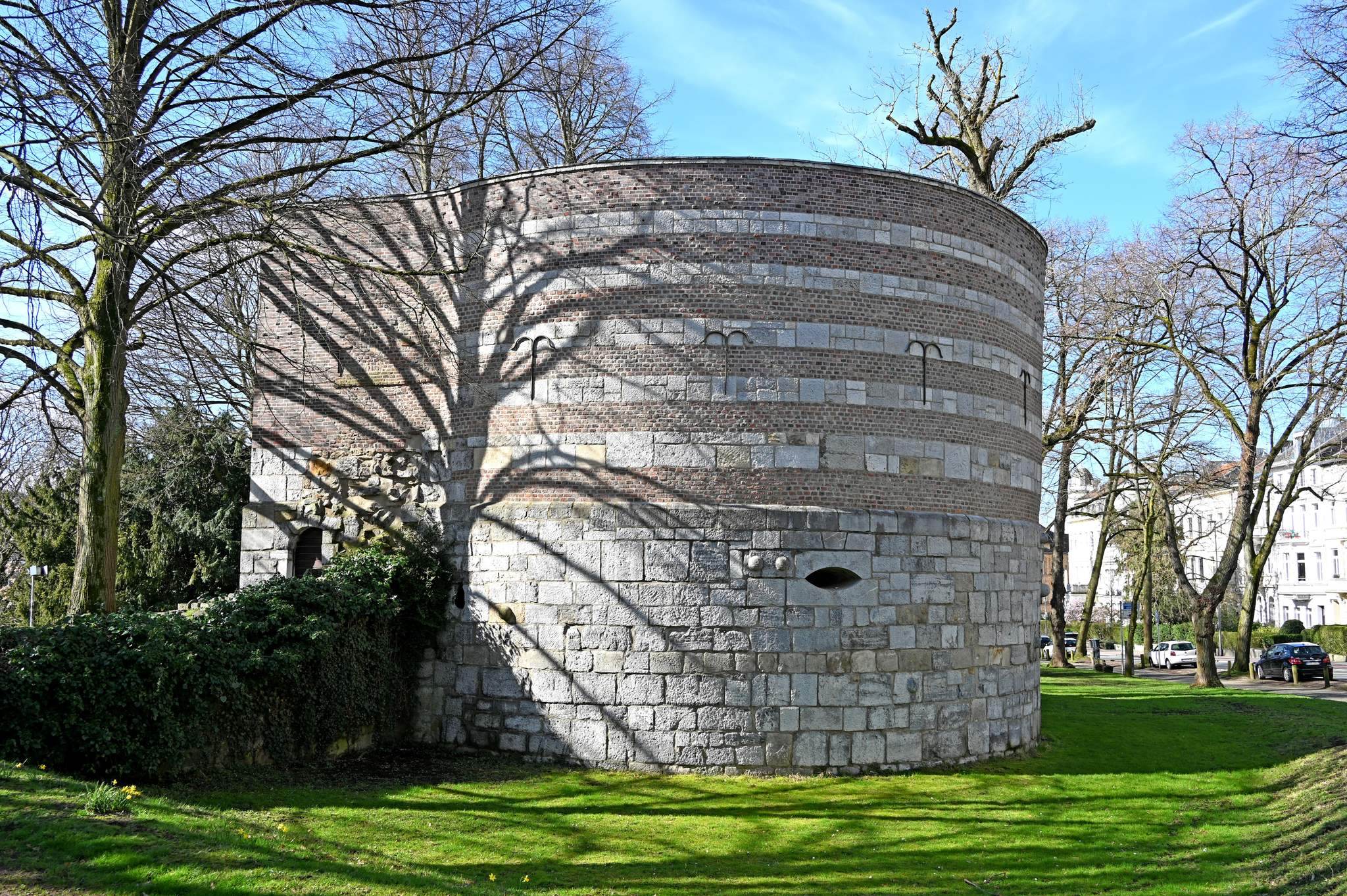
Before the present structure was built, the site was occupied by a tall watchtower known as Breuerturm, Brewersturm, or Brauersthorm. Its height allowed defenders to observe and oppose attackers approaching from the neighboring Lousberg. As cannon warfare spread, Aachen’s citizens demolished the older tower and replaced it with the lower Marienturm. Its four-metre-thick walls provided a more stable structure against cannon fire.
Warfare and later landscape changes
Marienturm was involved in fighting against the Spanish general de Grana in 1638. Stone-ball impact marks that remain on its exterior provide physical evidence of this conflict.
In 1908, a garden and pond were created below the tower during the conversion of Aachen’s outer ditch ring into a continuous green belt with waterways. The redesign was associated with Maximilian Friedrich Weyhe, the Düsseldorf court gardener.
War memorial and restoration
During the Weimar Republic, Germany’s democratic state from 1919 to 1933, Aachen residents decided to establish a war memorial inside the tower. On 6 August 1933, Aachen mayor Quirin Jansen inaugurated a memorial to German dead of the First World War. Its inscription identifies him as a National Socialist mayor and stresses that the decision to create the memorial had been made before National Socialist influence.
The memorial later came to commemorate victims of both world wars. Marienturm suffered heavy damage during the Second World War, particularly in 1944, and was restored to its earlier condition between 1950 and 1955.
Remains
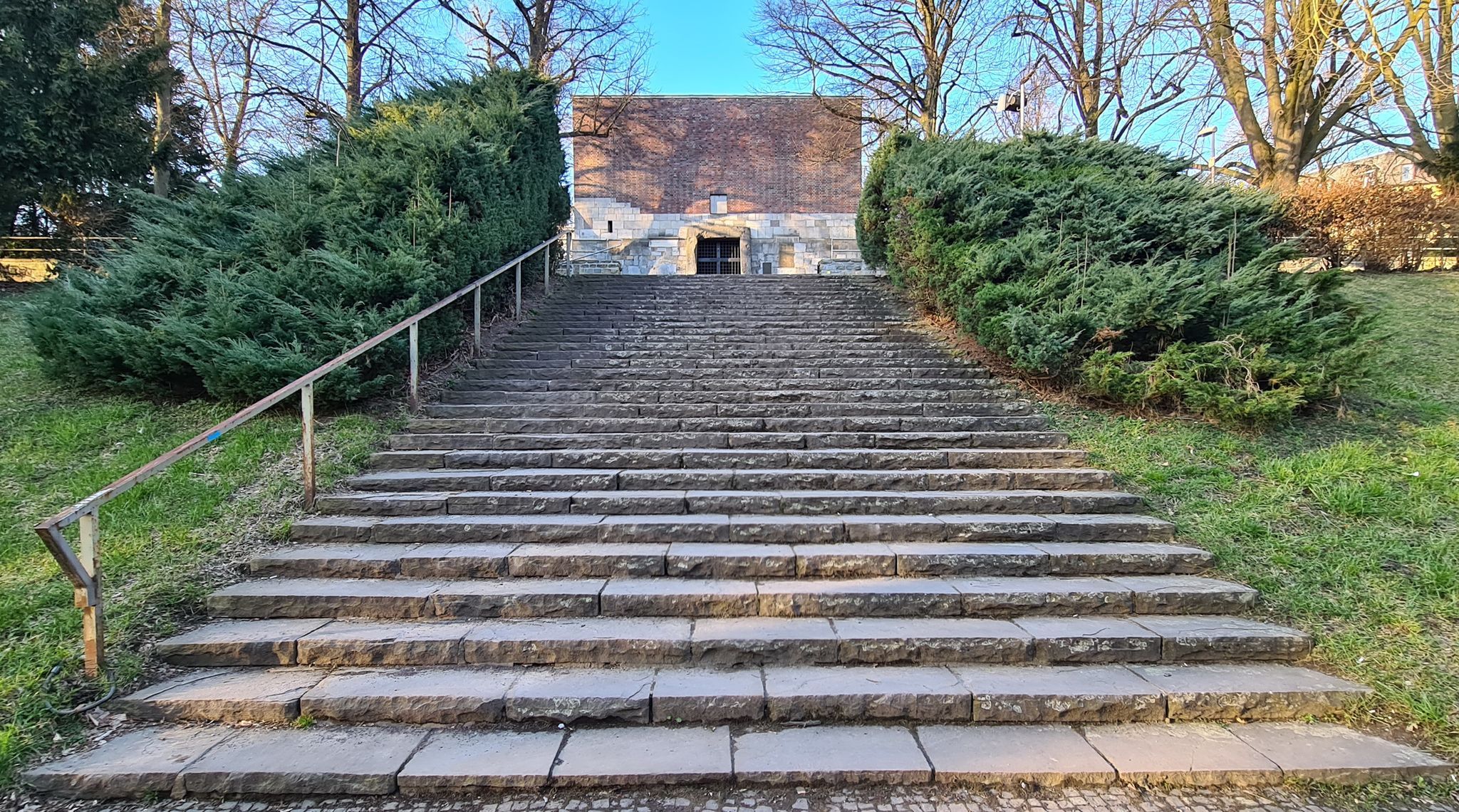
Marienturm stands within Aachen’s outer ring wall in the northern part of the city, between Ponttor on the west and the former Bergtor on the east. It lies between Ludwigsallee and Saarstrasse and faces the Lousberg. Surviving sections of the outer city wall extend from both sides of the tower. A former watch house, known as Wachthaus Posthäuschen, stood between Marienturm and Ponttor, while a projecting defensive structure occupied the section toward Bergtor.
Fortified tower
Structure and defenses
The tower combines a rounded section with a rectangular projection facing the city. The rounded part measures 14.7 metres across, while the projection is 13.4 metres wide. Four-metre-thick walls form its principal defensive fabric.
The lower storey, at ditch level, contains two narrow loopholes, or firing slits through which defenders could use weapons from protected positions. The upper storey has five firing openings. Alternating openings were adapted for cannons, while the others served rifle defense. When the tower was converted into a war memorial, the openings were sealed on the outside and changed into niches for memorial flames on the inside.
Memorial interior and inscriptions
Numerous inscriptions and commemorative plaques cover the tower. One states that the 1512 fortification, named Marienburg, became a memorial in 1932, suffered heavy damage in 1944, and was restored from 1950 to 1955. Other inscriptions refer to the periods 1914–1918 and 1939–1945 and describe the memorial’s creation and its inauguration during the National Socialist period. Another inscription invokes a saviour and identifies the structure as Marienburg.
Inside the memorial stands a stone sarcophagus containing a warrior. Mathias C. Korr created it in 1933.
Garden and pond
The garden around the tower includes a pond and three specifically dated trees. A European hornbeam and a cornelian cherry date from 1900, while a horse chestnut dates from 1850. Together with the pond, they form part of the landscape created below the tower in 1908.