Zvečan Fortress: A Medieval Serbian Stronghold in Kosovo
Site at a Glance
- Rating
- 4.8
- Popularity
- Low
- Country
- Serbia
- Primary era
- Medieval
- Eras represented
- Medieval
- Civilizations
- Serbian
- Site type
- Military
- Remains
- Castle
On this page11 sections
History
Zvečan Fortress is a medieval Serbian fortification in Kosovo, commonly dated to the eleventh century and built on a site occupied for military purposes since at least Classical antiquity. Its exact construction date is unknown. The stronghold controlled caravan routes running south toward Kosovo and Metohija, north along the Ibar toward the Morava Valley, and west toward Bosnia. It also later helped protect the nearby Trepča mining area.
Early frontier stronghold
The fortress is first associated with Simeon I, the Bulgarian ruler who reigned from 893 to 927, in a reference to territory reaching Zvečan at the meeting point of the Ibar and Sitnica rivers. More secure references place Zvečan on the Serbian-Byzantine frontier between 1091 and 1093. During this period, the Serbian grand prince Vukan, a high-ranking ruler of the era, used the fortress as a base for campaigns into Byzantine-held Kosovo.
In the late twelfth century, Stefan Nemanja gathered forces at Zvečan during his conflict with his brothers. His army defeated Byzantine troops and their allies near Pantina, after which a thanksgiving service took place in a fortress church. As the Serbian state expanded southward, Zvečan gradually lost its primary frontier role and became one of the intermittent royal residences of the Nemanjić dynasty, the medieval Serbian ruling family that consolidated and expanded the state between the twelfth and fourteenth centuries.
Royal residence and dynastic conflict
A royal court stood inside the fortress. In the early 1320s, Constantine, a son of King Milutin and a claimant to the throne, was killed and buried in the fortress church. In 1331, his brother, King Stefan Dečanski, was imprisoned at Zvečan after being overthrown by his son, King Stefan Dušan. Stefan Dečanski died there, giving the fortress a direct place in one of the Nemanjić dynasty’s major succession struggles.
Control of Zvečan changed hands repeatedly during the fourteenth century. In 1337, Dušan entrusted administration of the town to the younger son of the noblewoman Danica. Authority later passed to Musa, a Serbian nobleman and son-in-law of Prince Lazar, followed by the regional lords Vojislav Vojinović, Nikola Altomanović, and Vuk Branković.
Ottoman occupation and abandonment
The Ottomans captured Zvečan in the late fourteenth century, probably soon after the Battle of Kosovo in 1389. An Ottoman military garrison occupied the fortress intermittently through the seventeenth century and into the eighteenth. During the Austrian advance into the Balkans in 1689, the abandoned stronghold briefly received an Ottoman garrison again. It was permanently abandoned during the eighteenth century.
Zvečan also entered Serbian epic tradition, which associates the fortress with Marko Kraljević, a semi-historical medieval prince who became a major hero of South Slavic poetry. This tradition preserves the alternative names “Marko’s City” and “Marko’s Tower.” Archaeological excavations began after 1945, when the fortress was placed under state protection. It is recognized in Serbia as a cultural monument of exceptional importance and remains protected through the national heritage system.
Remains
Fortified layout
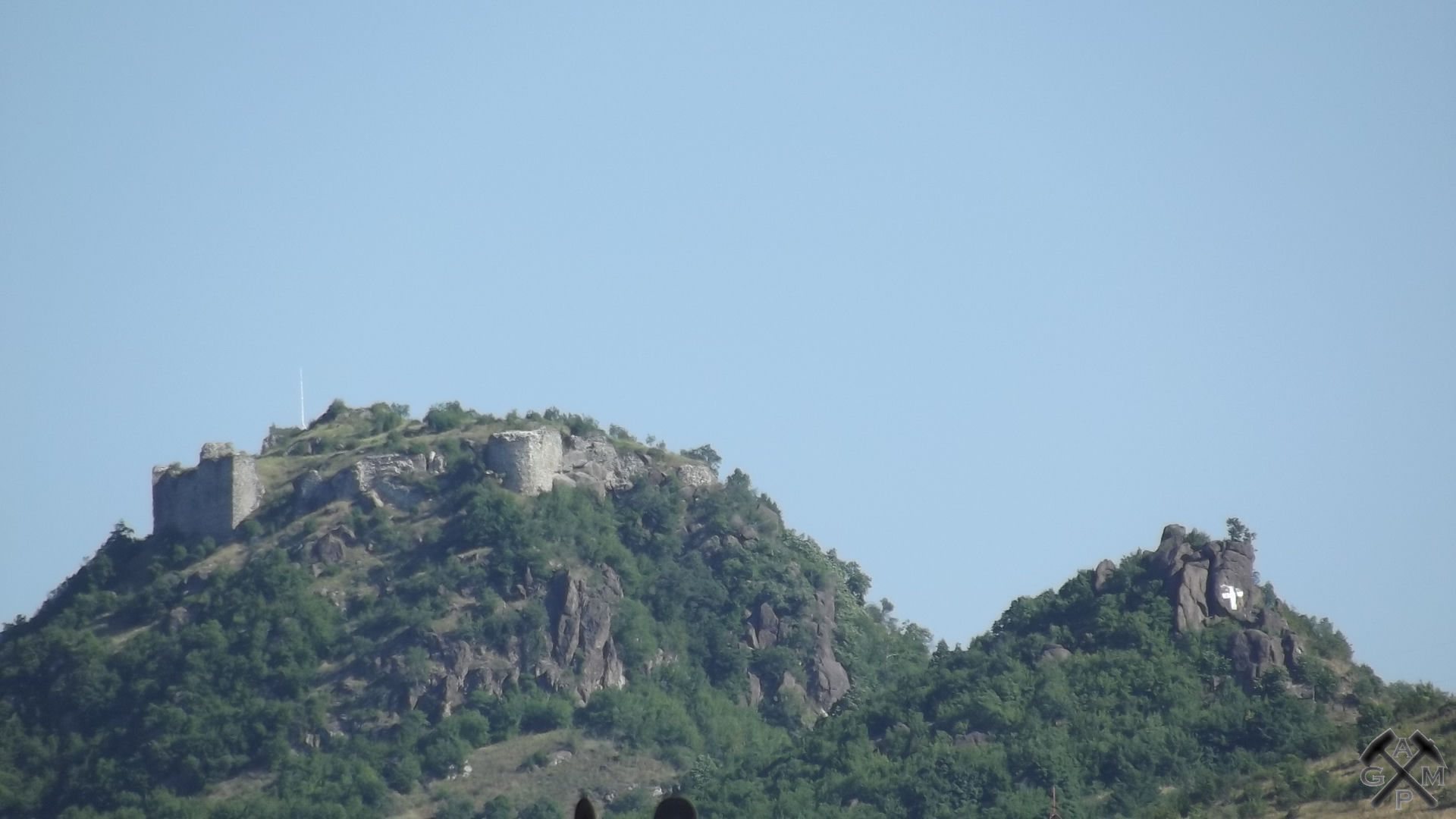
Zvečan occupies the summit of an extinct volcanic cone about 800 metres above sea level, immediately above or near the Ibar River. Its elongated and irregular plan follows the rocky ground. The fortress was arranged in three connected sections at different elevations: the Upper Town on the summit, the Lower Town below it, and a Suburb at the foot and on the southwestern slope. Together, these areas formed a strategically unified settlement.
Upper Town
The Upper Town was enclosed by five towers. Its remains include the principal octagonal keep, or donjon, the main fortified tower used for defence, residence, and administration; the Church of Saint George; and two cisterns, constructed reservoirs for collecting and storing water. The Church of Saint George had a compact inscribed-cross plan, in which the arms of the cross were incorporated into the surrounding building, together with a small altar apse, a dome over the central area, and painted interior decoration.
A Church of Saint Stephen stood beside Saint George’s Church. Stefan Nemanja built it in the late twelfth century. Its presence belongs to the period when Zvečan was also functioning as a royal and dynastic centre rather than solely as a frontier fortification.
Lower Town
The Lower Town was protected by fortified walls reinforced with towers and contained residential spaces. Its principal entrance lay at the western end. Other buildings survive in the area, although their functions are uncertain. The lower enclosure formed the middle level between the summit citadel and the settlement at the foot of the hill.
Suburb
The Suburb occupied the foot and southwestern slope of the volcanic cone. A lower defensive wall protected it, while a market square and wells supported settlement activity. The Church of Saint Demetrius stood in this lower area. The later name Mitrovica for the settlement was associated with the church.
Water supply and underground passages
Two springs on the slope strengthened the fortress’s defensive capacity. Secret underground passages connected the citadel with the springs at the foot of the hill, while other underground routes led toward the Ibar bank and could provide escape during a siege. In the northern part of the fortress, an underground passage known as a lagum was found descending toward a spring. Remains of another possible exit from the underground system were also identified.
Surviving structures
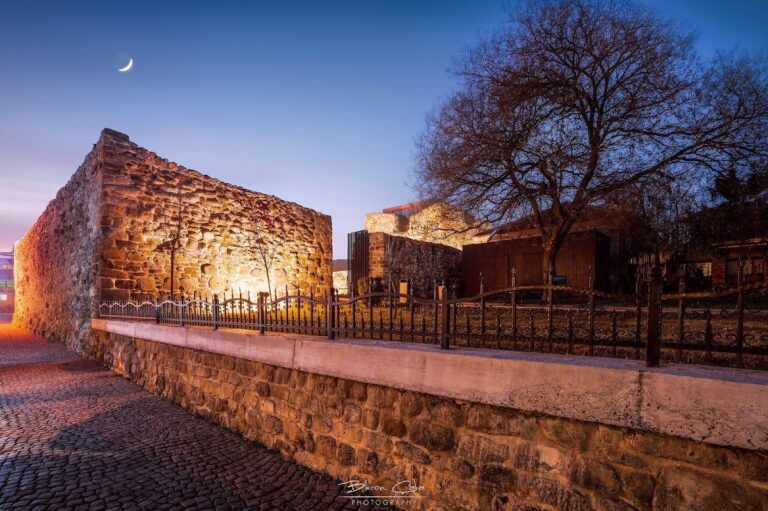
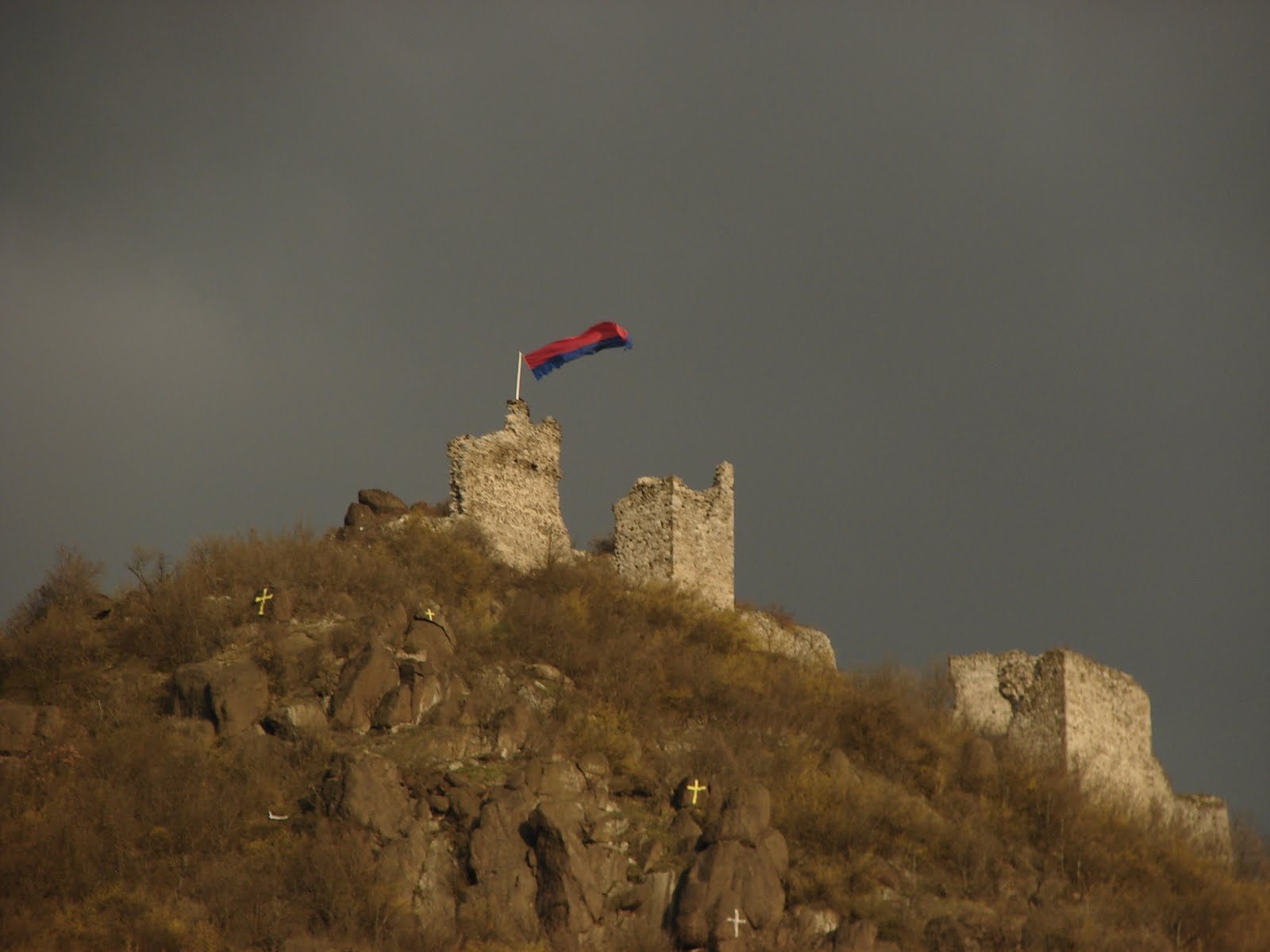
The fortress is now largely ruined. Three towers and sections of the walls survive, together with remaining masonry across the elevated site. These fragments preserve the scale of the former stronghold and the relationship between its upper, middle, and lower defensive areas. In 1840, the traveler Ami Boué observed the remains of a church at Zvečan. In 1859, the Russian historian and traveler Alexander Hilferding described the remains of a two-storey palace built of brick.