Royal Palace of Kandy: The Kandyan Kingdom’s Royal Residence
Site at a Glance
- Rating
- 4.4
- Popularity
- Low
- Country
- Sri Lanka
- Primary era
- Early Modern
- Eras represented
- Early Modern, Modern
- Civilizations
- British
- Site type
- Domestic
- Remains
- Palace
On this page17 sections
History
Royal Palace of Kandy is a Kandyan royal complex in Sri Lanka whose earliest palace buildings were constructed in the fourteenth century under Vickramabahu III. It served as the official residence of the monarchs of the Kingdom of Kandy, the last independent Sri Lankan kingdom before British annexation in 1815. The earliest palace stood across from the present site, while the later complex developed around the royal institutions and the Temple of the Tooth.
Early development and Portuguese influence
In the late sixteenth century, Vimaladharmasuriya I took up residence in the palace and began improvements to the royal complex. Its development during this period was strongly influenced by Portuguese architectural aesthetics. During the reign of King Senarat, Portuguese incursions caused the palace to be destroyed. Rajasinha II rebuilt it in 1634, and later Kandyan monarchs repeatedly reconstructed or altered the complex after further invasions and destruction.
From about 1760, the palace shifted from the western part of the royal area to its eastern side. Under Sri Vikrama Rajasinha, the final Kandyan monarch, the complex underwent major changes and included the Queen’s Palace, the Royal Audience Hall, and the Temple of the Tooth. The palace was closely connected with custody of the Tooth Relic of the Buddha, a relic whose possession carried political and religious importance in Sri Lanka. Until 1815, the king was regarded as its guardian and the only person permitted to view it.
The end of the Kandyan monarchy
The palace complex is believed to have originally contained 18 buildings. Twelve were completely destroyed by the British after the fall of the Kandyan Kingdom, while many surviving buildings were modified. The Kandyan Convention was signed in the Magul Maduwa on 2 March 1815 by British representatives and Kandyan chiefs. The agreement ended the Kingdom of Kandy and transferred control of the palace from the monarchy to the British administration.
Administration began with the British Resident, Sir John D’Oyly, and later passed to the Government Agent in Kandy, whose authority continued until 1947. The Maha Wasala served as D’Oyly’s official residence during the early British period, and later Government Agents also used it in that capacity. The palace accommodated senior visitors, including the Governor of Ceylon, until the King’s Pavilion was built.
Continuing religious and institutional associations
After 1815, guardianship of the Tooth Relic passed from the king to an assembly of senior dignitaries and sages. The annual Esala Perahera, a ten-day Buddhist procession traditionally held in July and August, remains associated with the Temple of the Tooth and the royal complex. During the procession, the relic is ceremonially carried through Kandy, sometimes represented by a copy while the original remains in the temple.
Several palace buildings acquired new institutional roles. The Palle Vahale became the National Museum of Kandy in 1942 under the Department of National Museums, while the Maha Wasala was later repurposed as a museum under the Department of Archaeology. The Royal Palace complex and the adjacent Temple of the Tooth are recognized as UNESCO World Heritage Sites. Other royal residences connected with the wider historical landscape included the Hanguranketha, Kundasale, and Binthanne palaces. Kundasale served as a summer palace, while Binthanne was associated with the birth of Rajasinha II.
Remains
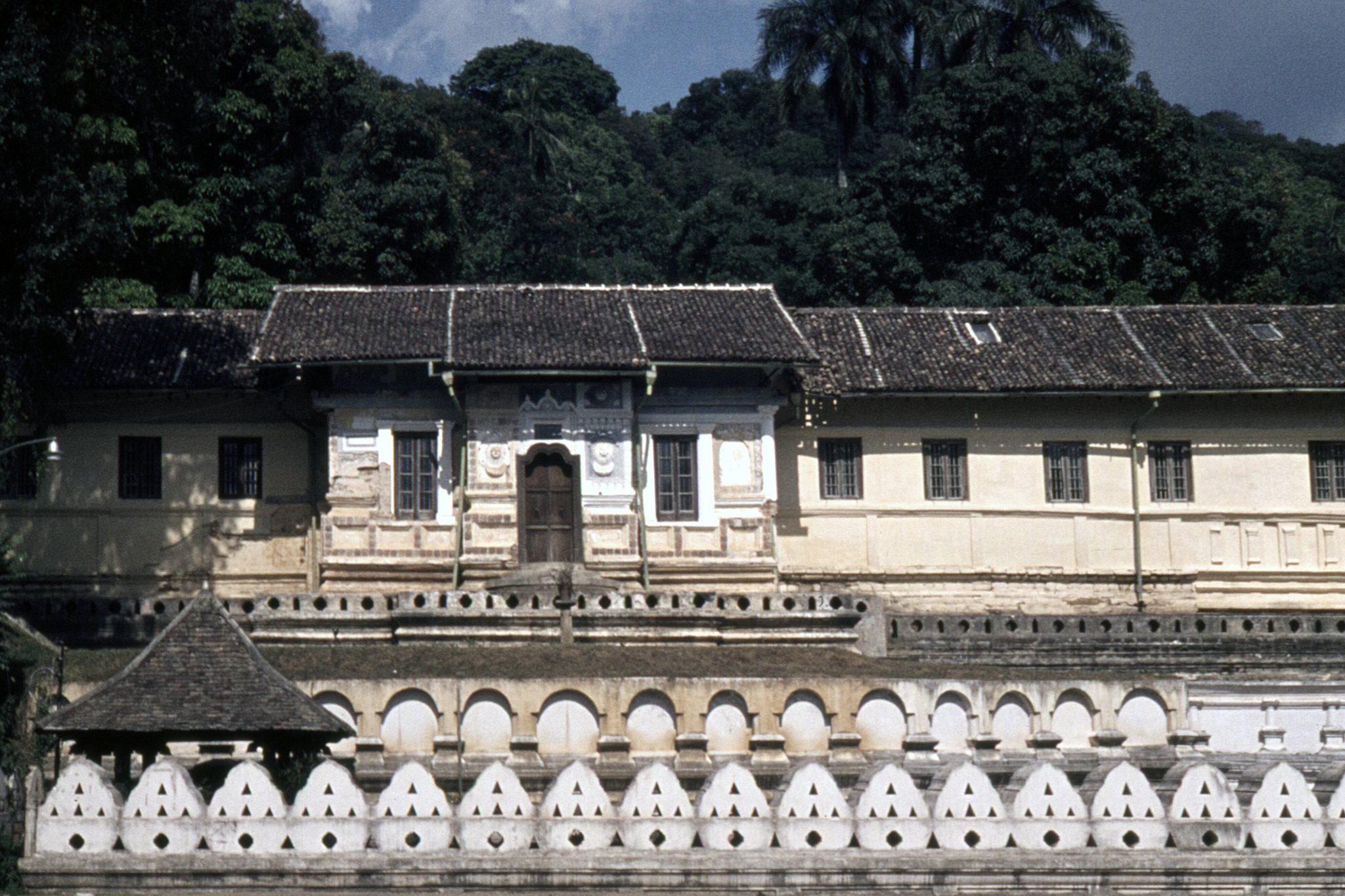
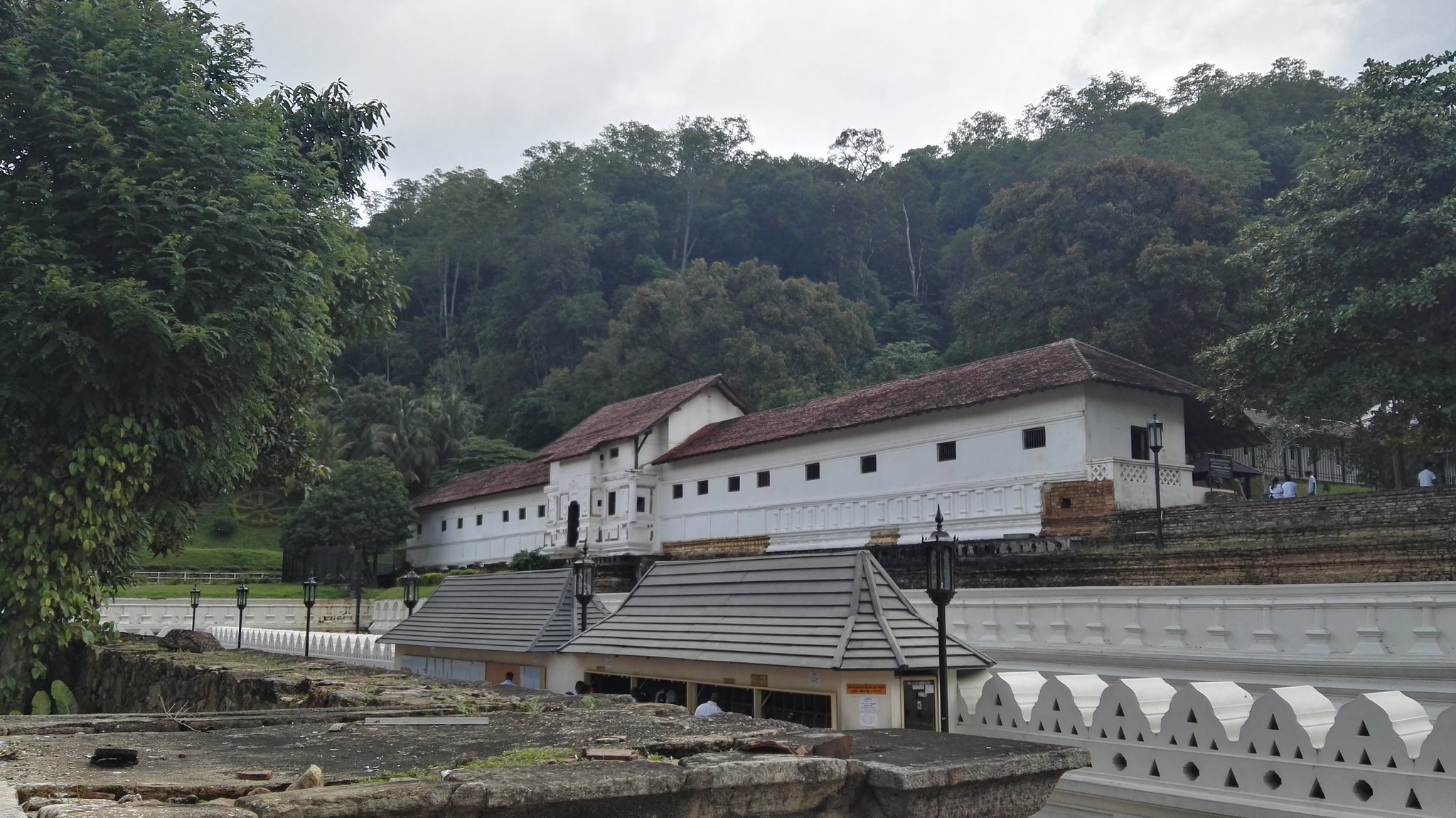
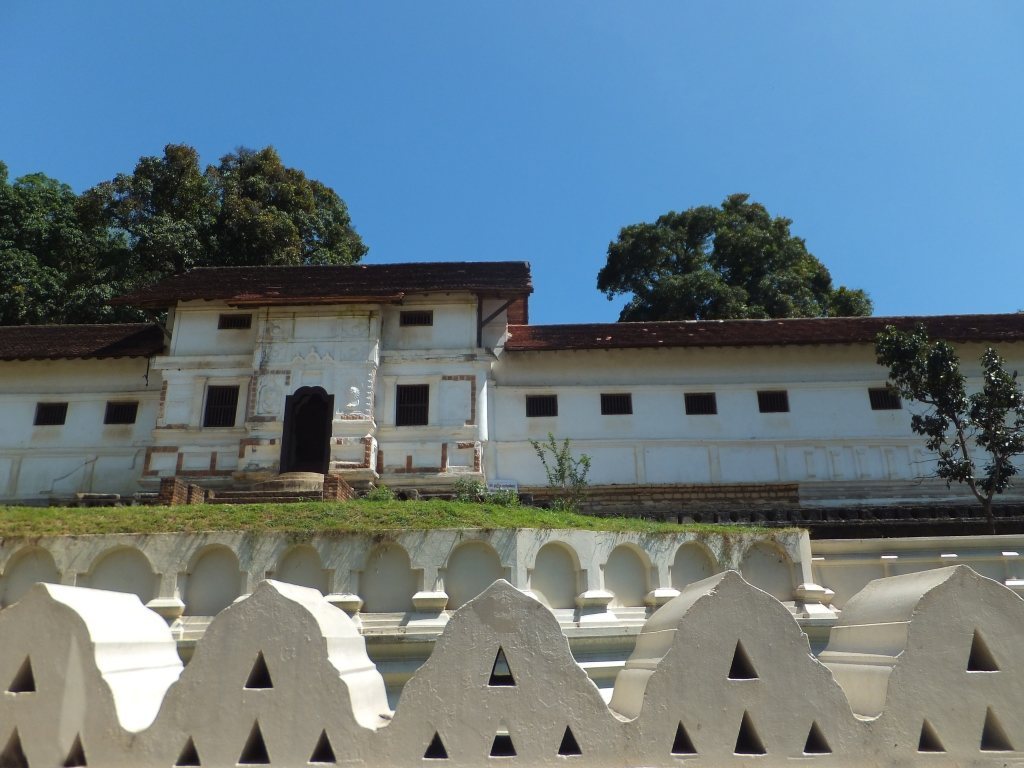
The surviving complex is enclosed by a surrounding wall and includes the King’s Palace or Maha Wasala, the Royal Audience Hall or Magul Maduwa, the Queen’s Chambers or Meda Wasala, the Lower Palace or Palle Vahale, the Royal Armoury or Ran Ayuda Maduwa, the Queen’s Bathing Pavilion or Ulpange, the Temple of the Tooth, and other palace buildings. Its Kandyan architectural character appears in carved timber, stonework, stucco, terra-cotta ornament, courtyards, verandas, elaborate roofs, and wall murals. Three principal gateways, called wahalkadas, stood along the enclosure wall and were approximately 2.4 metres high. The oldest part of the palace is traditionally described as facing the Natha Devale.
Royal and administrative buildings
Maha Wasala
The Maha Wasala stands at the northern end of the palace area, to the right of the Magul Maduwa. A central gateway leads to a staircase and a hall decorated with stucco and terra-cotta work. Long wings contain chambers, while a veranda overlooks an inner courtyard. Observation windows known as Siv Maduru Kawulu allowed the king to view the Queen’s Palace, the Temple of the Tooth, the city, and the Udawatta Kele Sanctuary.
Magul Maduwa
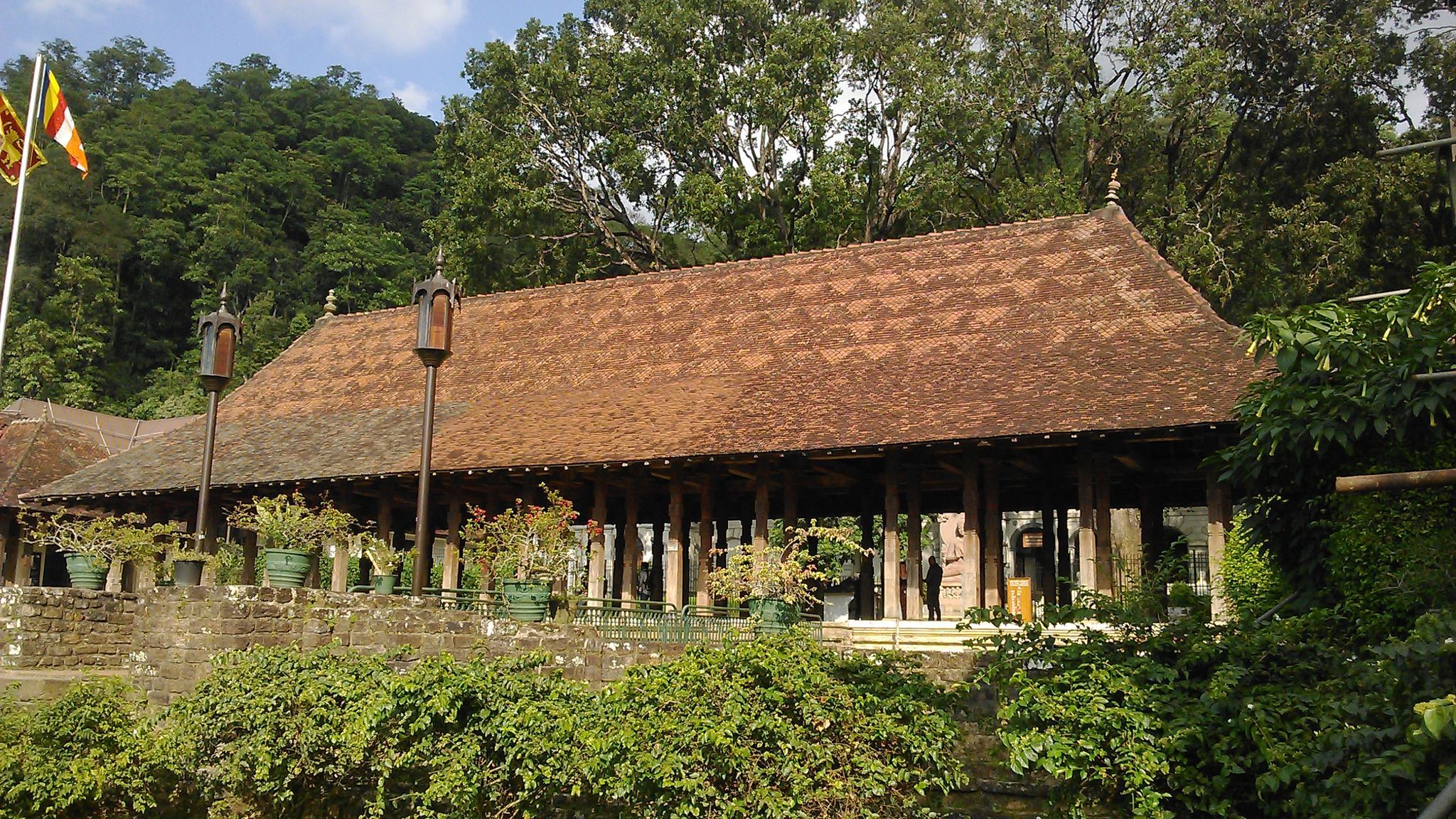
The Magul Maduwa, also called the Maha Naduwa or Royal Court, is a finely carved wooden audience hall. Construction began in 1783 under Sri Vikrama Rajasinha. The original hall measured approximately 18 by 10.9 metres. In preparation for the visit of Prince Albert Edward, Prince of Wales, in 1872, the British extended it by 9.6 metres.
The extension incorporated 16 carved wooden columns removed from the Palle Vahale, with eight placed on each side. The building now has two rows of 32 elaborately carved columns supporting a Kandyan-style roof. The hall hosted royal administrative business, public audiences, religious and national festivities, occasional public displays of the Tooth Relic, and receptions for foreign ambassadors.
Wadahindina Mandappe
The Wadahindina Mandappe stands near the Maha Wasala and Magul Maduwa, north of the Temple of the Tooth within the same compound. It served as a waiting and resting place for the king while adigars, senior Kandyan officials, and other visitors awaited audiences. Foreign visitors could also meet the king there. The building now houses the Raja Tusker Museum, which preserves the stuffed remains of Raja, the chief elephant of the Kandy Esala Perahera, who died in 1988.
Queen’s and residential buildings
Meda Wasala
The Meda Wasala, or Queen’s Chambers, lies north of the Palle Vahale. This small timber building has an open central courtyard surrounded by verandas and contains one bedroom. The bed rests on four stone foundations, while substantial log beams mark the entrance. A small door attached to the roof by wooden hinges could be locked only from inside. Frescoes decorate the courtyard corridor, an unusual feature for a residential building.
Other details express the character of Kandyan architecture, including carved wooden pillars, pebble-decorated piyassa, a central courtyard with a padma boradam or lotus pond, and drainage around the courtyard. Floral designs on a red ground survive beneath the plaster on the walls. Four copper sheets preserved in the archaeological museum are believed to have been protective spells concealed in pits within the four pillars supporting the bed.
Palle Vahale
The Palle Vahale, or Lower Palace, has a principal entrance leading into a small hall before the central structure, with wings on either side. Interior verandas on all four sides overlook a central courtyard, and the windows are made from cracked wooden poles. The building primarily accommodated the king’s royal concubines, known as Ridi dolis and Yakada dolis. Tradition associates its initial occupation with King Kirti Sri Rajasingha. The building became the National Museum of Kandy in 1942.
Ulpange
The Ulpange, or Queen’s Bathing Pavilion, is a two-storey structure south of the Temple of the Tooth and surrounded by water on three sides. Its upper floor served as a dressing room, while the lower floor was used for private bathing. Column-supported arches admitted light to the bathing areas.
Its rectangular, eight-sided bathing pool measures approximately 19 metres long, 9.4 metres wide, and 3.45 metres deep. Carefully cut stone slabs form the pool, which is surrounded by a stone deck following its outline. A semicircular opening allowed excess water to escape and helped maintain a constant level. The pool is believed to have been supplied by a natural spring beneath its foundation, producing a continuous flow of fresh water.
The pavilion was built in the Tigol Wela paddy field on formerly marshy ground and predates Kandy Lake by six years. Its name refers to spring water and a house or structure. A British depiction from 1817 shows a high-roofed square pavilion beside a bathing pool that was open to the sky, with columns around its deck. Whether those columns supported a roof over the pool or belonged to an earlier roof remains uncertain. Under British administration, the original stone deck was altered into floor space, and the pavilion may also have served as a waiting area for queens.
Ran Ayuda Maduwa
The Ran Ayuda Maduwa, or Royal Armoury, lies beyond the Meda Wasala. Its central porch is supported by timber columns, and the building is currently used by the District Courts of Kandy.
Open spaces and memorial features
Maha Maluwa
The Maha Maluwa, or Great Terrace, is an open park of approximately 0.4 hectares in front of the Temple of the Tooth. It was formerly the threshing floor of a large paddy field in the area later occupied by Kandy Lake. A stone-pillar memorial in the park holds the skull of Keppetipola Disawe, a leader of the 1818 Uva Rebellion who was executed for his role in the uprising. The Maha Maluwa also contains a statue of Madduma Bandara and statues of Princess Hemamali and Prince Danthakumara, whom tradition credits with bringing the Buddha’s Tooth Relic to Sri Lanka.
Adjacent court building
A Victorian-era building beside the Royal Palace formerly housed the High Court of Kandy, adding a later administrative structure to the historic royal area.