Wignacourt Aqueduct: Malta’s Seventeenth-Century Water-Supply System
Site at a Glance
- Rating
- 4.5
- Popularity
- Very Low
- Country
- Malta
- Primary era
- Early Modern
- Eras represented
- Early Modern
- Civilizations
- Knights Hospitaller
- Site type
- Infrastructure
- Remains
- Aqueduct
On this page20 sections
History
The Wignacourt Aqueduct in Malta was a seventeenth-century water-supply system built by the Order of Saint John to carry spring water from Dingli and Rabat to Valletta. The Order of Saint John, a Catholic military-religious order that governed Malta from the sixteenth century until 1798, founded Valletta on the Sciberras Peninsula in 1566. The city’s cisterns and collected rainwater could not meet the needs of its growing population, while the threat of an Ottoman siege made a dependable water supply a military priority.
Planning and construction
On 19 October 1596, an order was issued to build the aqueduct. Grand Master Martin Garzez commissioned the Jesuit Padre Giacomo to design it. A Jesuit was a member of the Society of Jesus, the Catholic religious order to which both Giacomo and Padre Natale Tomasucci belonged. Construction began but was soon suspended because of financial difficulties.
Work resumed on 9 January 1610 under Padre Natale Tomasucci. After Garzez died, Grand Master Alof de Wignacourt succeeded him and financed most of the undertaking. In July 1612, the Bolognese hydraulic expert Bontadino de Bontadini took charge, probably on the recommendation of Inquisitor Evangelista Carbonesi. Bontadini redesigned the system so that underground pipes could carry the water through much of the route, while stone arches crossed depressions in the uneven countryside.
Bontadini worked with the Maltese master builder Giovanni Attard, described by the title capomastro, and with other Sicilian engineers. About 600 local workers took part in the construction. The aqueduct was completed in 1614 and inaugurated on 21 April 1615. Its cost reached 434,605 scudi, most of which was paid by Wignacourt, whose name the system bears.
Water supply and urban growth
The aqueduct delivered approximately 1,400 cubic metres of water each day and served about 30,000 people. Its steady flow supported population growth in Valletta, Floriana, and other settlements along the route. Water reached public and private cisterns, fountains, and ships in Marsamxett Harbour and Grand Harbour.
The system remained in use until the early twentieth century. Grand Master Emmanuel de Rohan-Polduc improved it in 1781, and an obelisk was erected near the Hamrun inspection tower in 1780 in connection with this work. On 4 September 1798, during the early stages of the Maltese uprising against French rule, insurgents ambushed French soldiers near the aqueduct at Mriehel, within the limits of Birkirkara.
Modern changes and commemoration
In 1907, the Office of Public Works proposed constructing buildings over the aqueduct and using the arches as an arcade. The proposal was not implemented. Sections at places including Mosta Road in Attard were later demolished after the Second World War as housing development and road construction altered the surrounding areas.
Surviving arches were restored and illuminated from 2004 to 2005. Pollution from a major road beside the aqueduct later required further conservation, and a section extensively damaged by a car accident in December 2013 was repaired. Various sections are protected as Grade 1 national monuments and are included in the National Inventory of the Cultural Property of the Maltese Islands. The Floriana water tower has been on the Antiquities List since 1925 and has been a Grade 1 scheduled property since 1994.
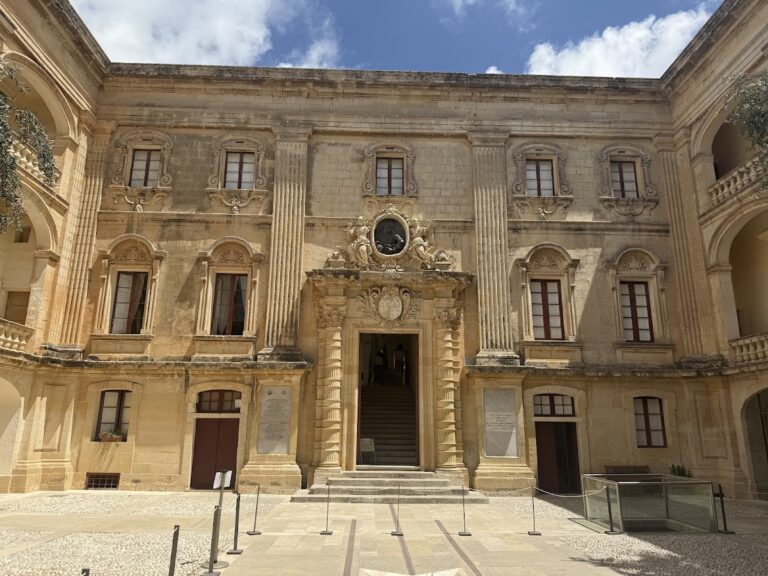
The aqueduct’s four-hundredth anniversary was commemorated in Valletta on 21 April 2015 with a ceremonial reenactment in which schoolchildren carried water from City Gate to St George’s Square. The anniversary was also marked by a Central Bank of Malta silver coin and a MaltaPost set of two stamps showing the aqueduct’s arch and the Floriana water tower. The aqueduct appears in a ceiling painting in the Archbishop’s Palace in Valletta. A painting in the National Library of Malta, displayed beside Vilhena’s Cabreo, an illustrated administrative record or inventory, depicts aspects of Valletta’s historical water-storage technology.
Remains
Route and arcades
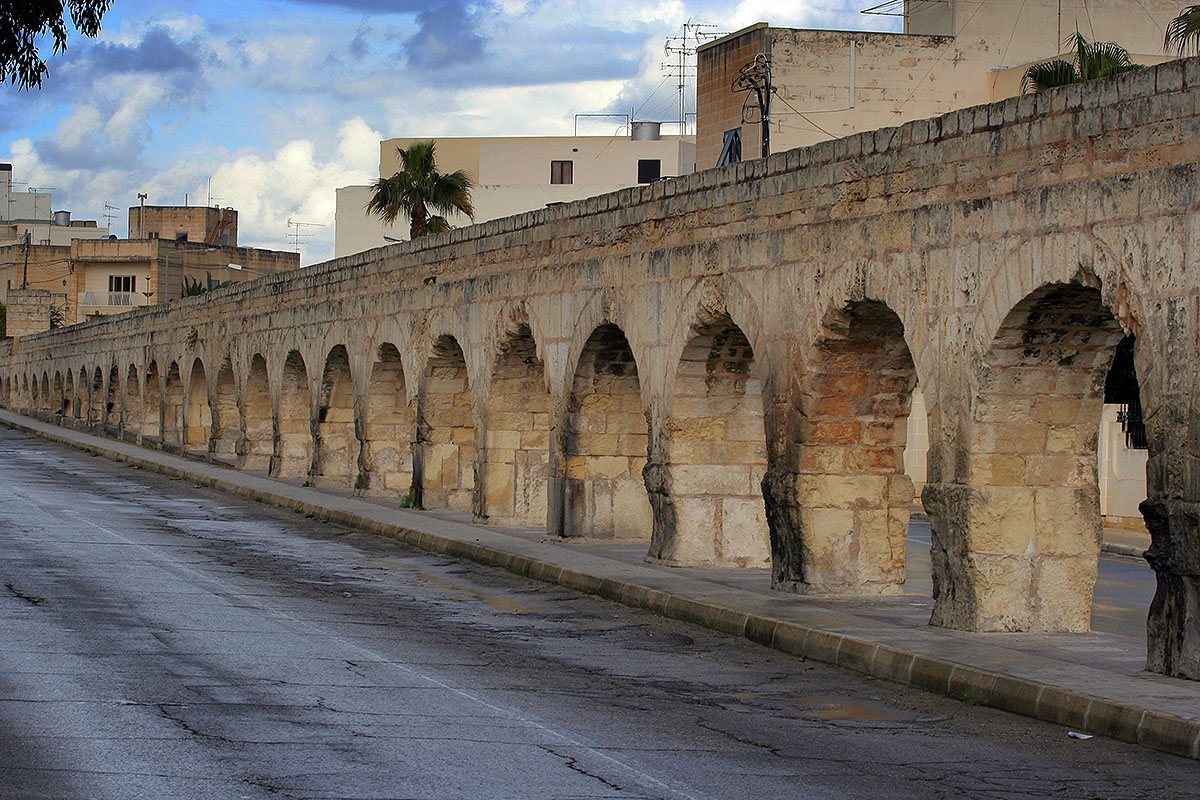
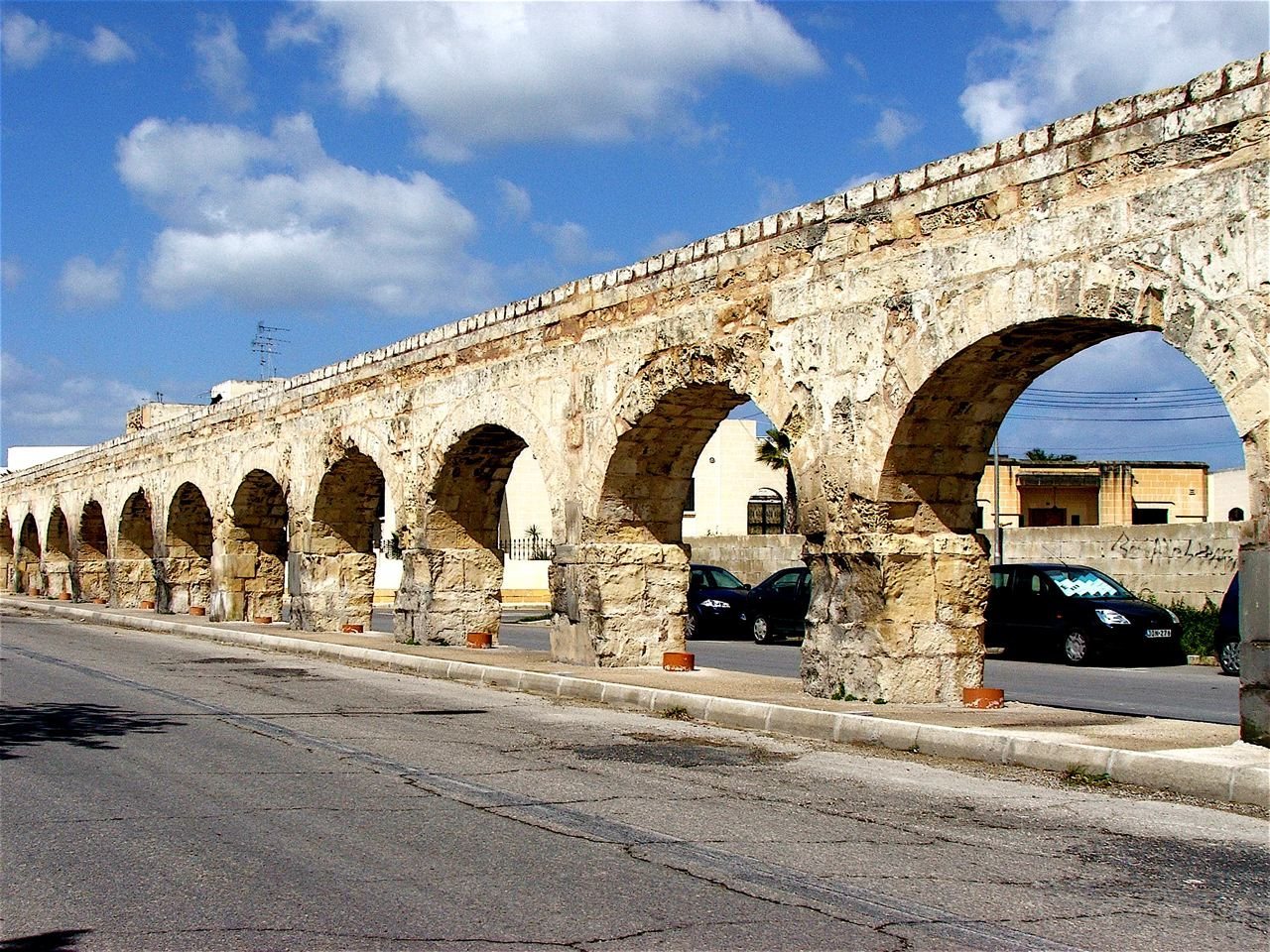
The aqueduct extended for approximately 26.5 kilometres from springs at Dingli and Rabat to Valletta. Underground pipes carried the water through the countryside until the route reached the area near present-day Peter Paul Rubens Street in Attard. There, stone arcades crossed depressions in the uneven terrain. The arcades are initially low, follow Mdina Road through Balzan and Birkirkara, and gradually rise as the ground level descends.
The structure was built from local limestone, with the stones bonded using pozzolana, a volcanic ash traditionally used as a binding material in masonry and concrete. At Fleur-de-Lys, the aqueduct crossed a road and continued along St Joseph High Road in Santa Venera, ending near the Tower of St Joseph. From there, underground pipes carried water onward to Hamrun, Blata l-Bajda, Floriana, and Valletta.
Fleur-de-Lys Arch
Wignacourt Arch
The Wignacourt Arch, also called the Fleur-de-Lys Gate, stood at the boundary between Fleur-de-Lys and Santa Venera. Its three openings, Wignacourt’s coat of arms, and three sculpted fleurs-de-lis commemorated the aqueduct. An original plaque honoured Bontadino de Bontadini. The arch, the aqueduct’s water towers, and its fountains formed an early expression of Baroque architecture in Malta, a style known for dramatic forms, sculptural ornament, and elaborate visual effects. The suburb of Fleur-de-Lys took its name from the arch.
Arch reconstruction
The original arch was demolished in 1944, and a roundabout was later built on its site. A replica was approved in 2012, reconstructed in 2015, and inaugurated on 28 April 2016. In 2014, local authorities agreed on the designation “Wignacourt Arch Known as the Fleur-de-Lys Gate” after a dispute over its name.
Rohan coat of arms
A late-eighteenth-century coat of arms belonging to Grand Master Emmanuel de Rohan-Polduc was probably installed on the side of the arch facing Mdina after his improvement of the aqueduct. This attribution remains uncertain. The coat of arms survives a few metres away, attached to a wall outside a police-station entrance near the Tower of St Joseph.
Inspection towers and obelisk
Tower of St Joseph
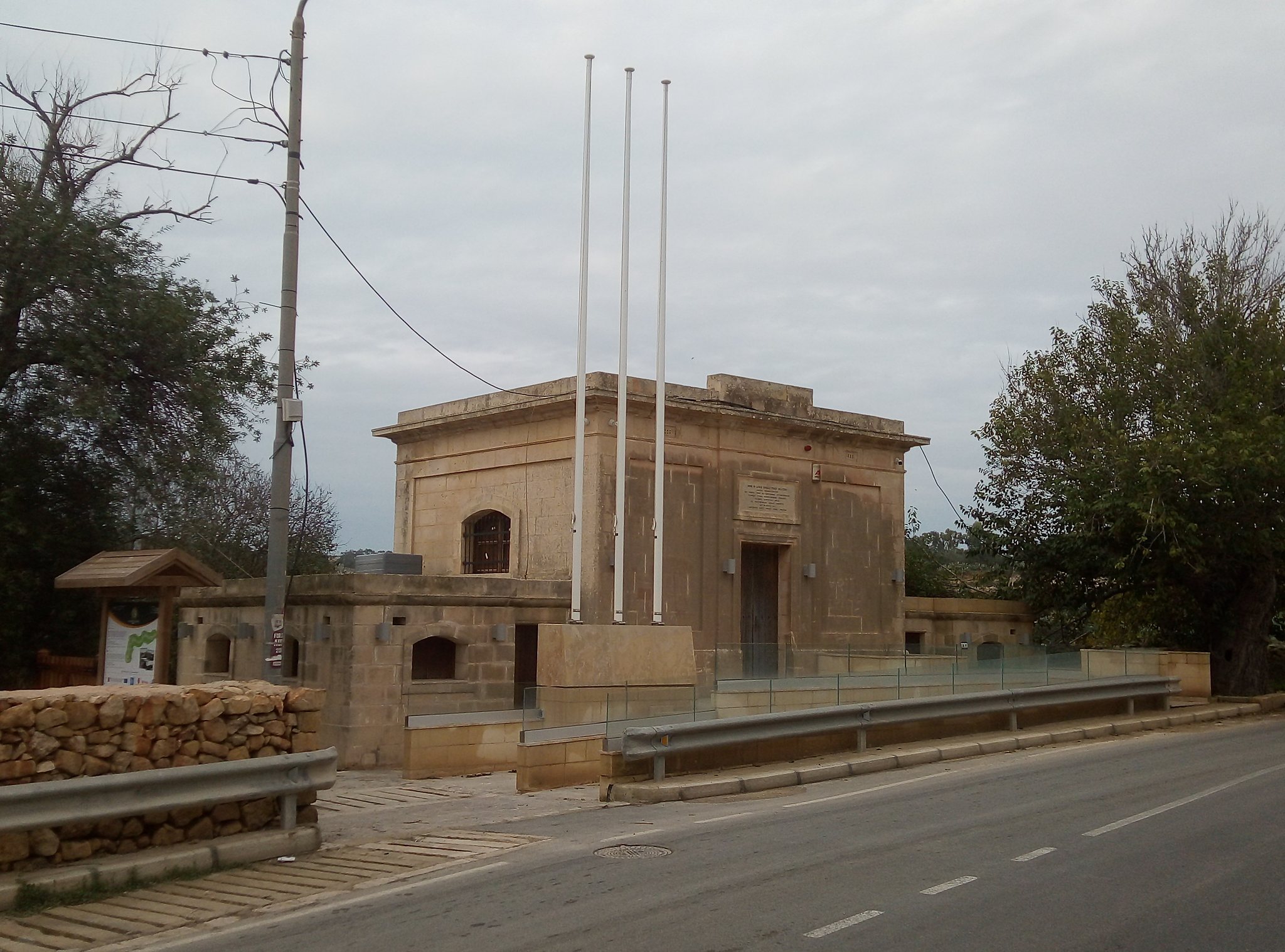
The Tower of St Joseph in Santa Venera, also known as it-Turretta or Torretta, is connected to the aqueduct’s arches. It has two storeys and a buttressed lower level resembling a coastal watchtower. The present structure may not be the original tower, since the aqueduct’s original designs show a somewhat different building. An inscription once associated with Bontadini is no longer visible.
Hamrun inspection tower
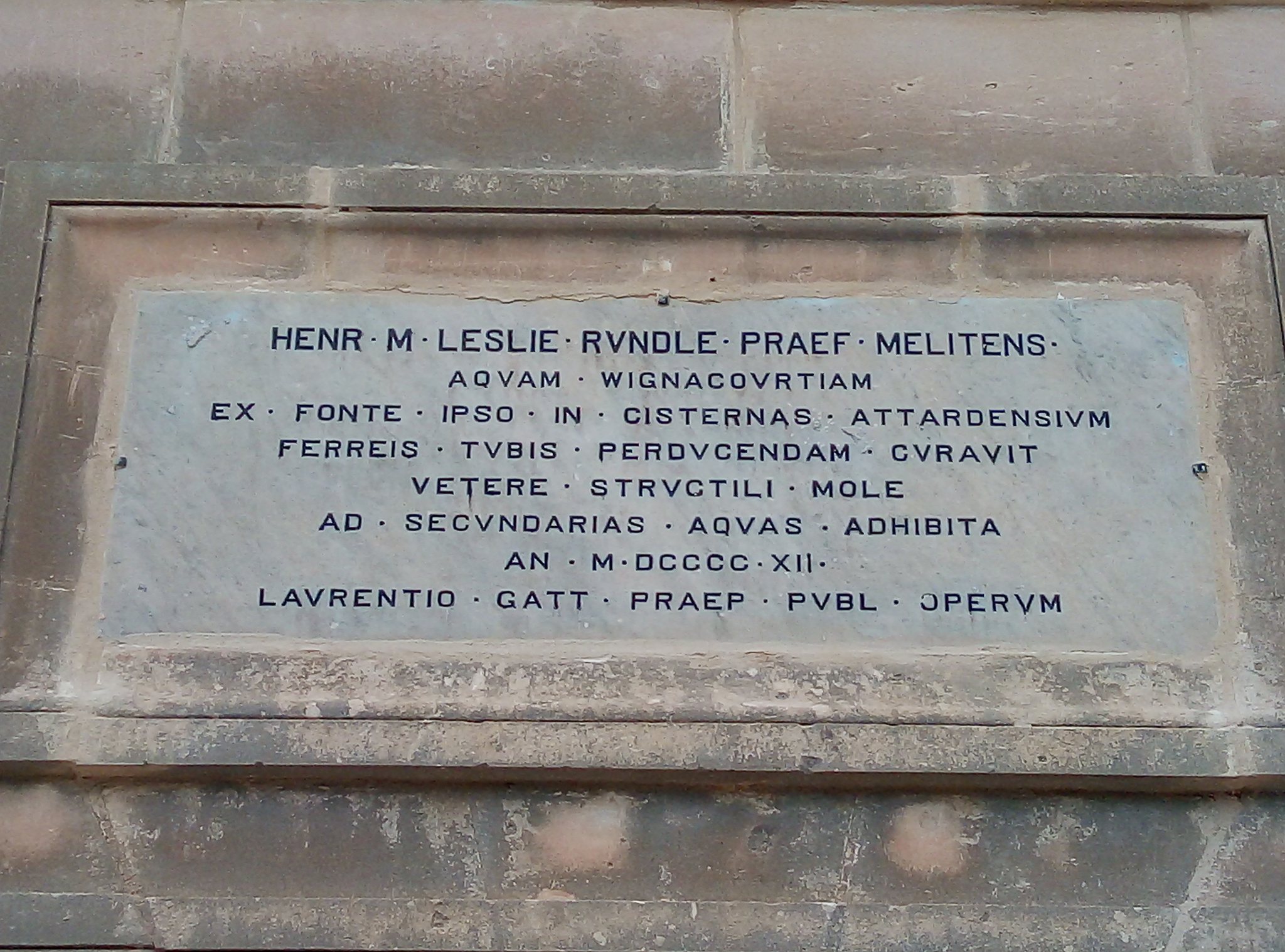
The second inspection tower stands on St Nicholas Hill in Hamrun. Known as il-Monument tat-Tromba or it-Turretta ta’ Atoċja, it is a circular structure that originally contained an open water tank. Its walls bear Wignacourt’s coat of arms and a commemorative inscription. The tower survives in a dilapidated condition surrounded by modern buildings.
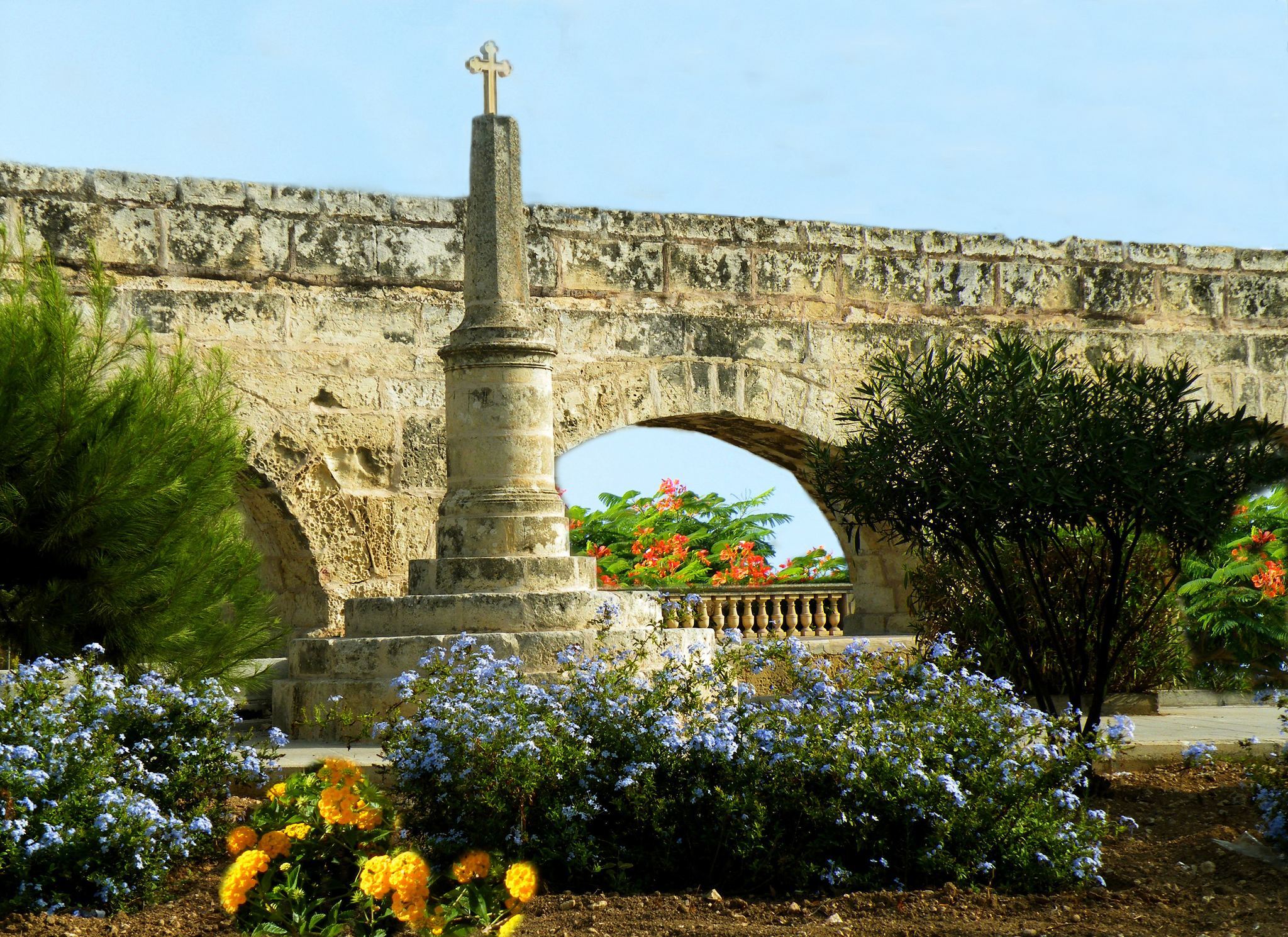
1780 obelisk
The obelisk erected near the Hamrun tower in 1780 stands in a private backyard. Its coat of arms was damaged during the Second World War. The inscription commemorates Emmanuel de Rohan-Polduc’s strengthening and improvement of the aqueduct for the health of his people.
Floriana water tower
The Wignacourt Water Tower in Floriana stands near the Argotti Botanical Gardens and Sarria Church. It is circular and supported by pilasters. A fountain and horse trough are incorporated into the structure, while a sculpted fleur-de-lis crowns its summit. The decoration also includes the arms of the Order of Saint John and of Wignacourt.
The tower was restored between June 2015 and June 2016. In 2016, the eroded lion relief that pours water into the attached trough was replaced by a replica, and the interior spiral staircase was restored.
Valletta fountains
Wignacourt Fountain and Pinto Fountain
The original Wignacourt Fountain stood in St George’s Square in Valletta, opposite the Grand Master’s Palace. It was officially inaugurated on 21 April 1625 to mark the arrival of water in Valletta, although the aqueduct’s inauguration ceremony in 1615 also took place at this fountain. The first structure was a relatively simple Baroque fountain and was ordered to be demolished on 2 January 1745.
Grand Master Pinto inaugurated the replacement, known as the Pinto Fountain, on 18 January 1746. It was later moved near the Palace of Justice and then to St Philip’s Gardens in Floriana, where it remains. The fountain has a large circular basin, three smaller shell-shaped basins, and a pedestal decorated with dolphins. The third basin was added later. Its original fleur-de-lis was removed and replaced, and the fountain was restored after a period of neglect. The history of its alteration is uncertain: one interpretation holds that Pinto renovated the earlier fountain, while another maintains that the original Baroque structure was destroyed. The fountain is a Grade 1 monument.
Marina fountain and Neptune
A fountain beside Valletta’s marina, outside Del Monte Gate near the fish market, appears in a 1664 view of Valletta. It had an ornate basin, a marble spout shaped like a cannon barrel, and a bronze figure of Neptune, the Roman god of the sea. Neptune held a trident and rested his other hand on a shield bearing Wignacourt’s arms. A Latin inscription on the spout described water replacing cannon fire. The fountain supplied surplus water from the Wignacourt Fountain to ships in Grand Harbour.
The statue was probably sculpted by Leone Leoni in 1584, although it has also been attributed to Giovanni Bologna. Its design was based on a portrait of the Italian admiral Andrea Doria as Neptune. A small breakwater built beside the fountain in the seventeenth century protected boats taking on water. Strong waves destroyed the breakwater and seriously damaged the fountain in 1686, preventing ships from using it until repairs financed by Grand Master Gregorio Carafa. The fountain was later dismantled and replaced by a covered fish market during the nineteenth century.
In 1858, the Neptune statue was moved to the lower courtyard of the Grand Master’s Palace, now called Neptune’s Courtyard. The fountain’s spout is held at the Malta Maritime Museum in Birgu. The area around the original fountain site retained a name meaning “on the giant” into the twentieth century. The Perellos Fountain, which also formerly stood at Valletta’s marina, is now beneath the loggia of the Grand Master’s Palace.
Ferreria fountain
Another fountain sometimes called the Wignacourt Fountain was attached to the Ferreria building near Porta Reale in Valletta. A lion’s head poured water into a stone basin beneath the arms of Wignacourt and the Order of Saint John. Floral and shell ornament completed the design, while the inscription Omnibus Idem stated that the water was freely available to everyone.
The Ferreria fountain was moved in 1874, during the rebuilding of City Gate in the 1960s, in 2000 during the renovation of Saint James Cavalier, and again in the early 2010s during the City Gate Project. Repeated relocations and alterations mean that none of the original fountain remains.
Later fountains
The aqueduct also supplied later fountains, including the Lion Fountain in Floriana. Built in 1728 during the magistracy of Grand Master António Manoel de Vilhena, it forms part of the wider network of public water features connected to the Wignacourt system.