Santa Maria dell’Anima: The National Church of the Holy Roman Empire in Rome
Site at a Glance
- Rating
- 4.8
- Popularity
- Low
- Country
- Italy
- Primary era
- Early Modern
- External website
- Open
- Eras represented
- Early Modern, Modern
- Civilizations
- Holy Roman Empire, Papal States
- Site type
- Religious
- Remains
- Church
On this page22 sections
History
Origins as a Pilgrims’ Hospice
Santa Maria dell’Anima is a Renaissance church in Rome, Italy, built for the religious community associated with the Holy Roman Empire during the sixteenth century. Its origins lie in a private hospice founded in the fourteenth century by Johannes and Katharina Petri of Dordrecht for pilgrims from the Empire. A tradition places its foundation during the Jubilee of 1350, when the couple bought three houses, while the hospice was established on its present site by 1386 under the name Beatae Mariae Animarum.
Pope Boniface IX confirmed and promoted the hospice in 1399. In 1406, Pope Innocent VII placed it under the immediate protection of the Holy See, exempting it from every jurisdiction except that of the pope. The institution then became a national foundation linked to a confraternity, a voluntary religious association supporting worship, charity, burial, and related activities. A substantial legacy from Diedrich of Niem enriched it in 1418.
During the fifteenth century, the hospice widened its role beyond pilgrims from the Low Countries and the Rhineland to serve visitors from across the Holy Roman Empire. A church was built beside it in 1431–1433 and consecrated by Pope Eugene IV in 1444. It was joined to the German hospice of Saint Andrew, founded in 1372 by the priest Nicholas of Kulm. Santa Maria dell’Anima consequently developed into the national and religious centre of the Empire in Rome, as well as a major burial place for its communities. Its clergy provided worship, confession, and the sacraments to their compatriots.
The Imperial Church and Its Rebuilding
In 1496, the provost Johannes Burckard organized the clergy as a chaplains’ college. Three years later, the confraternity decided to rebuild both the hospice and its church for the Jubilee of 1500. Matthias Scheidt, prince-bishop of Seckau and envoy of Emperor Maximilian I, laid the foundation stone in 1500. The original plan called for five bays, but Roman road officials opposed the longer design, and the completed building had four. Construction finished around 1523, and the church received its overall consecration on 25 November 1542.
Maximilian I, Holy Roman Emperor from 1508 until 1519, placed the church under the special protection of the Holy Roman Empire in 1518 and declared it immediately subject to the Empire. This connection reinforced Santa Maria dell’Anima’s position as an imperial institution. In 1699, Emperor Leopold I announced that the church would stand under his personal protection, strengthening its Habsburg character.
The church also became a major place of burial for prominent pilgrims and merchants from the Empire, together with bishops, cardinals, and other members of the German-speaking community. Pope Adrian VI, a Dutch-born pope who reigned from 1521 to 1523 and was the last pope from the Holy Roman Empire, was transferred there in 1533. Other burials included Cardinals Willem van Enckevoirt, Andrew of Austria, Johannes Walter Sluse, and Matthäus Schiner, while the scholar and librarian Lukas Holste was also buried at the church. Jakob Fugger endowed the Markus Chapel for his brother Markus and his nephew Markus, and Cardinal Albrecht of Brandenburg endowed the Margrave Chapel.
War, Alteration, and Repeated Disruption
The church and three adjoining Anima houses were devastated during the Sack of Rome in 1527. This violent capture and plundering of the city was carried out by mutinous troops serving Emperor Charles V during the Italian Wars. Almost all the liturgical vessels and vestments were lost, although the archive survived. The graves of Captain Heinrich von Flitzingen and Melchior von Frundsberg, both associated with the imperial forces, were later included among the church’s monuments.
During the transition from the sixteenth to the seventeenth century, flooding damaged the building. A new sacristy was added in the seventeenth century, and a crypt, a subterranean chamber associated with a church, was excavated to counter severe damp and ground moisture. The church underwent major internal changes during the seventeenth and eighteenth centuries, and numerous monuments were altered or lost. In 1710, the church came into the possession of Palazzo Gambirasi.
The chapel dedications expressed a political and ecclesiastical programme concerning relations between church and state. The Benno Chapel commemorated Benno of Meissen, whose canonization by Adrian VI in 1523 provoked theological controversy during the early Reformation. The Lambertus, or Maastricht, Chapel commemorated Lambert of Liège, who was murdered after defending the immunity rights of his diocese. The chapels of Saint John Nepomuk and Saint Barbara evoked traditions of martyrdom.
French troops occupied Rome in 1798, and the church was systematically looted during the proclamation of the Roman Republic. Movable property, liturgical equipment, and the bells were sold, while some artworks were taken to Paris. The building was then used for military storage and as a stable. Several confiscated artworks were later recovered, and worship resumed with an Easter Mass in 1801.
From Imperial Institution to German-speaking Church
The Confraternity of Santa Maria dell’Anima, which had supported the institution from 1350, came under direct papal authority in 1406. Membership required entry in the confraternity book and support for the Anima. Its members included emperors Sigismund, Frederick III, and Charles V, several popes, officials of the papal curia, merchants, artisans, and women and men from German-speaking communities. The confraternity also gave rise to the confraternity of the Campo Santo Teutonico.
Members from the Netherlands dominated the confraternity until the late sixteenth century. In 1586, it had 155 members, including 55 from present-day Belgium, 44 from the Netherlands, and 6 from Westphalia. In 1599, during the Eighty Years’ War and shortly after the death of Philip II, Dutch and Flemish members were excluded. The organization thereafter became increasingly German-speaking. The Belgian community moved to the church of Saint Julian of the Flemings in 1844, while Dutch Catholics retained Santa Maria dell’Anima as their national church until leaving after prolonged conflicts in 1939. Since 1992, San Michele dei Frisoni has served that role.
From 1859, Santa Maria dell’Anima functioned in practice as the church of the German-speaking Catholics of Rome, although this status received legal recognition only in 1909. A German-speaking priestly college, the Collegio Teutonico di Santa Maria dell’Anima, was founded in 1859. Despite its German institutional identity, it remained under Habsburg patronage until 1918 and included priests from several European nationalities. The adjoining complex contains the parish centre, archive, and college, and together with the church forms the Pontifical Institute Santa Maria dell’Anima.
The church’s later history also includes difficult episodes. Its institution served as a route for the escape of Nazi war criminals including Gustav Wagner and Franz Stangl. During the Second Vatican Council, Joseph Ratzinger tried to stay at the Anima’s German pilgrim hostel but was turned away because it was full, and lodged instead in a temporary priests’ residence across the street. Since 1859, the church has increasingly been identified with the German-speaking Catholic community in Rome. The institution and confraternity continue to exist, while the church remains a place of worship for that community and for visiting groups accompanied by priests.
A war memorial chapel was created in 1937 for soldiers of the First World War. Research begun in 2021 by historian Tamara Scheer and Austrian defence attaché Nikolaus Rottenberger, with support from the Austrian Ministry of Defence, examined the identities of soldiers buried beneath it. An initial group of biographies was published in 2023. The church has also received sustained historical attention through its inscriptions, which were collected and published by Vincenzo Forcella.
Remains
Plan, Façade, and Structural Form
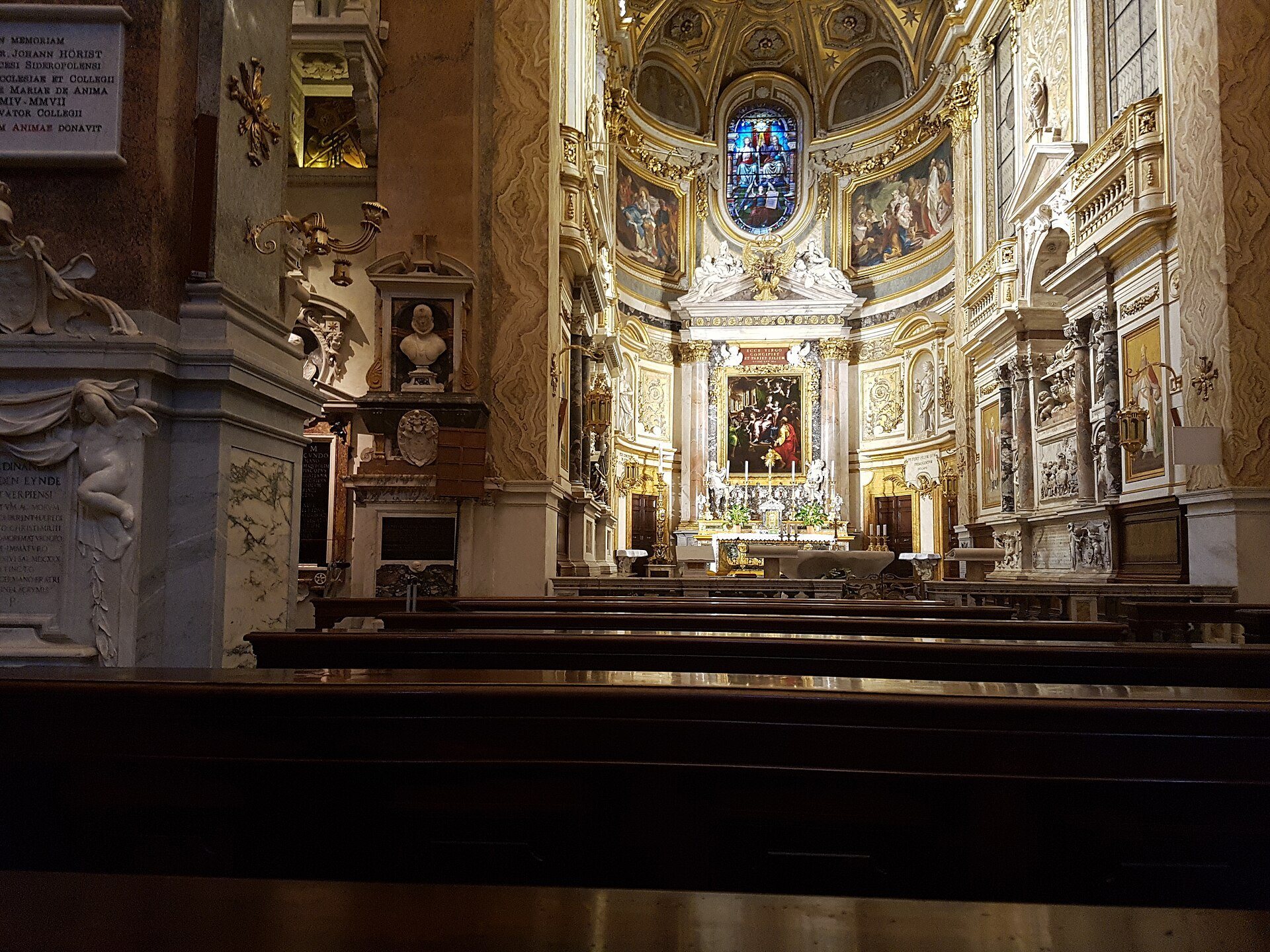
Santa Maria dell’Anima is a three-aisled Renaissance hall church without a transept. A hall church has a nave and side aisles of approximately similar height, producing a broad, unified interior. The building measures about 40 metres in length and 30 metres in width, with a long choir ending in a semicircle. Its plan combines Renaissance forms with a hall-church tradition associated with late Gothic northern Europe. The arrangement of piers and vaults creates a strongly longitudinal impression despite the almost square ground plan of the communal area.
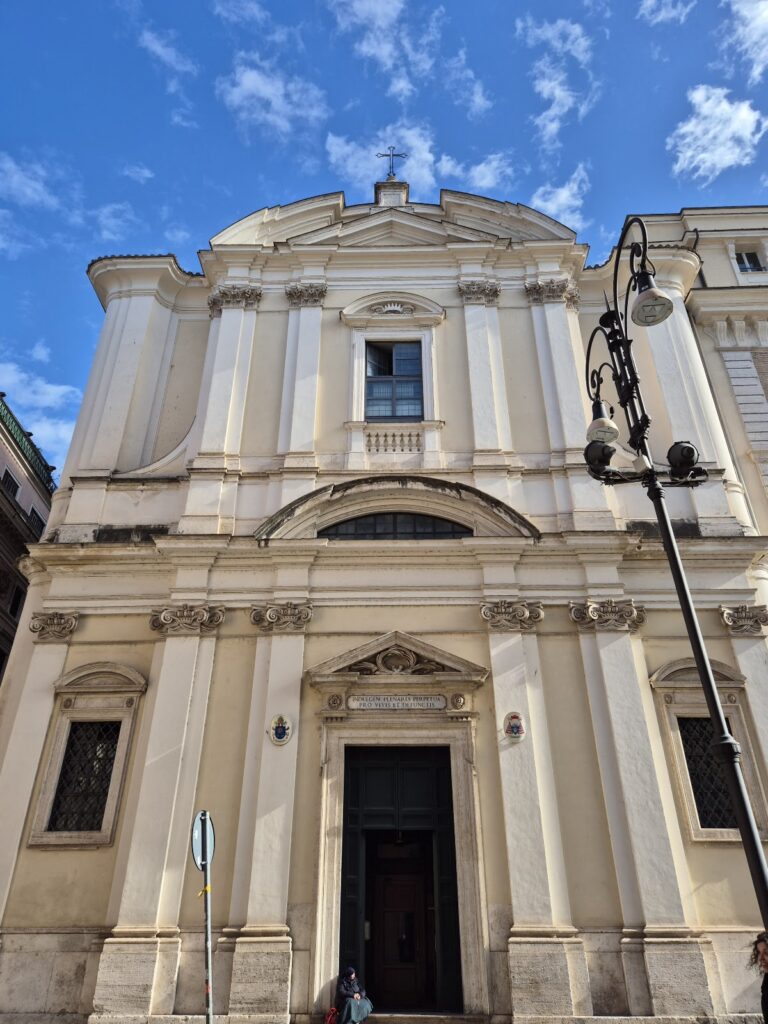
The street façade is a three-storey screen rising above the roof. Exposed brick is combined with stone architectural details, and Corinthian pilasters divide the surface. The lower storey bears the inscription Templum beatae Mariae Virginis de Anima hospitalis Teutonicorum, dated 1514. A central round window occupies the upper storey, alongside the arms of Pope Adrian VI and Emperor Maximilian I. At the rear, a bell tower rises with a Gothic spire, lateral pinnacles, and a covering of glazed tiles.
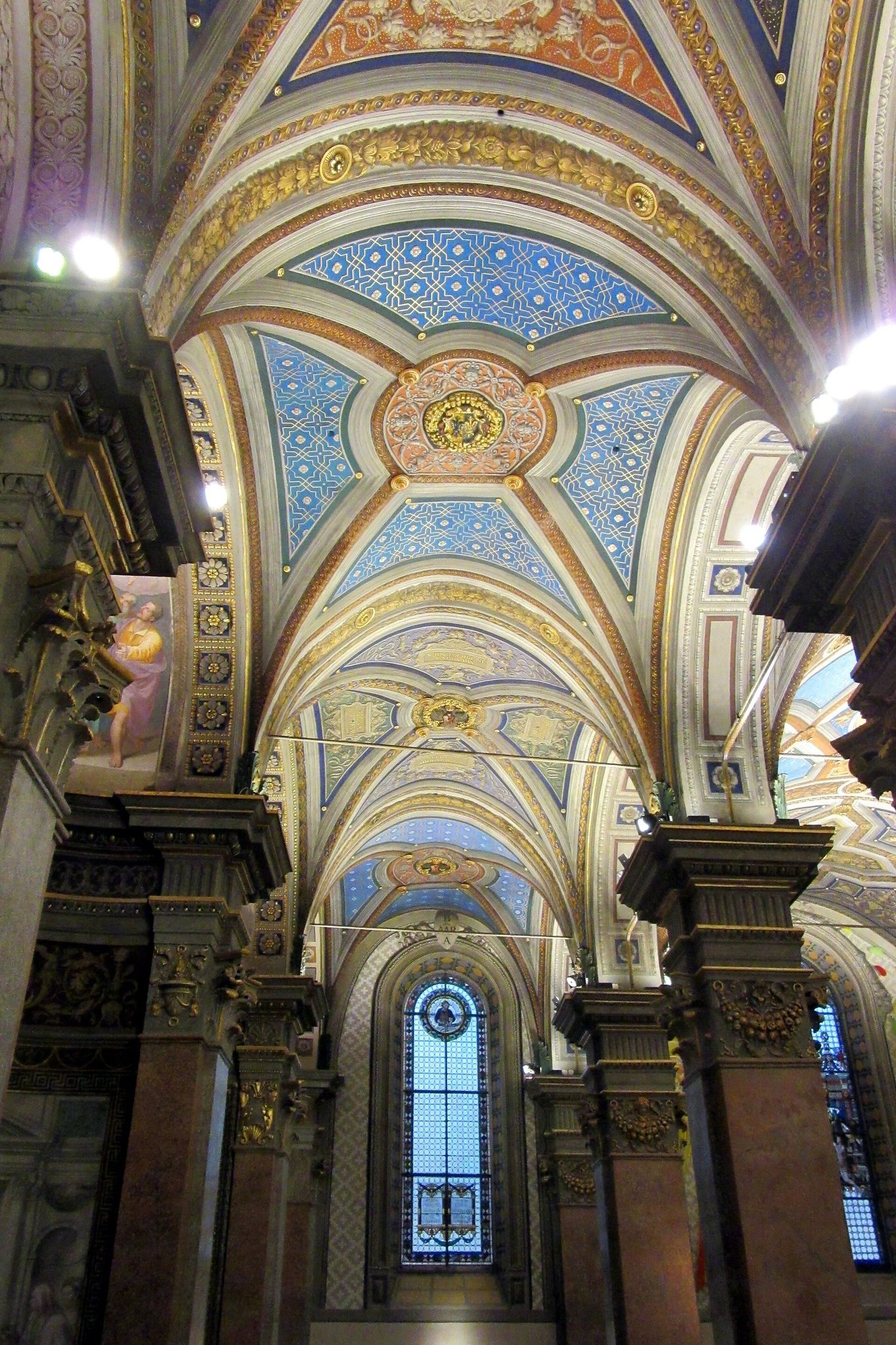
Inside, ribbed vaults rest on piers faced by Corinthian pilasters. Full-height side chapels open into the nave between the lateral buttresses through semicircular arches. Their arrangement relates to the late Gothic wall-pillar church, a form in which internal piers or buttresses organize the side chapels and vaulting. The identity of the architect is not securely established. Donato Bramante is reported to have taken part in consultations, but construction was later entrusted to a German builder. Andrea Sansovino and Giuliano da Sangallo have also been credited with the design or façade, although the detailed attribution to Sangallo remains unconfirmed.
Choir and Funerary Monuments
Monument of Adrian VI
The monument of Pope Adrian VI stands on the right side of the choir as a triumphal arch. Designed by Baldassare Peruzzi, it contains allegorical figures of Justice, Wisdom, Fortitude, and Temperance. A relief shows the pope’s entry into Rome accompanied by cardinals. Adrian VI’s burial gives physical expression to the church’s connection with the wider imperial world and its leading ecclesiastical figures.
Tomb of Karl Friedrich
Opposite Adrian VI’s monument is the honorary tomb of Karl Friedrich, hereditary prince of Jülich-Cleves-Berg, who died of smallpox in Rome in 1575 at the age of nineteen. Begun in 1577 from a design by his tutor Stephanus Winandus Pighius, it was executed by Nicolas Mostaert and Gillis van den Vliete. Its central scene depicts the Resurrection and refers to the discovery of the Laocoon group in 1506. A second relief, now in the entrance vestibule, shows Karl Friedrich receiving the title Fidei defensor, meaning “Defender of the Faith,” together with its sword and hat from Pope Gregory XIII.
Cardinals’ Monuments
Giovanni Mangone made the monument of Cardinal Willem van Enckevoirt between 1536 and 1538, while Gillis van den Vliete made the monument of Cardinal Andrew of Austria in 1600. Both were moved in reduced form to either side of the entrance in 1750. Van Enckevoirt’s monument had originally stood opposite the tomb of Adrian VI.
Chapels and Painted Decoration
Fugger Chapel
Giulio Romano’s altarpiece for the Fugger Chapel, painted in 1521–1522, has stood on the high altar since 1750. It shows Saints James and Mark adoring the Holy Family and was made for the Fugger donors, including Markus and Jakob Fugger. The chapel also contains Mannerist frescoes of the life of Mary, painted around 1550 by Girolamo Siciolante da Sermoneta.
Saint Anne Chapel
The neighbouring Saint Anne Chapel contains frescoes by Giovanni Francesco Grimaldi and the altarpiece Saint Anne with the Virgin and Child by Giacinto Gemigniani.
Benno and Lambertus Chapels
The Benno and Lambertus Chapels contain pre-1618 altarpieces by Carlo Saraceni, depicting the Miracle of the Fish and the Martyrdom of Saint Lambert. The Lambertus Chapel also has Baroque frescoes of the saint’s life and apotheosis, painted around 1650 by Jan Miel.
Margrave Chapel
The Margrave Chapel contains Francesco Salviati’s altarpiece of the Deposition, which includes a portrait of Albrecht IV. Salviati also painted its frescoes of the Resurrection and Pentecost.
Barbara Chapel
The Barbara Chapel contains an altarpiece of the Trinity and frescoes by Michiel Coxcie. The altarpiece includes a portrait of Cardinal Enckevoirt. In 1929, Sebastian Osterrieder created a large nativity scene for the chapel on the commission of Cardinal Faulhaber. Its limewood figures stand within a 3.5-metre-high architectural backdrop combining Classical and Gothic elements to correspond with the church interior.
Saint John Nepomuk Chapel
Ludwig Seitz painted the decoration of the Saint John Nepomuk Chapel, including its 1906 altarpiece. The paintings show Saint John Nepomuk and Saint John Sarkander, who had been beatified by Pope Pius IX.
Sacristy, Memorial Chapel, and Other Features
Baroque Sacristy
The present sacristy was built between 1635 and 1644 between the choir and nave. It is a rectangular room with chamfered corners and originally served as the chapel of the Anima confraternity. Its ceiling contains a fresco of the Assumption of Mary, made around 1640 by Giovanni Francesco Romanelli.
War Memorial Chapel and Crypt
The war memorial chapel created in 1937 now functions as a confessional. Beneath it, the crypt contains the remains of approximately 450 soldiers of Austria-Hungary who died in prisoner-of-war camps near Rome. Most of the soldiers remain unidentified.
Stained Glass and Organ
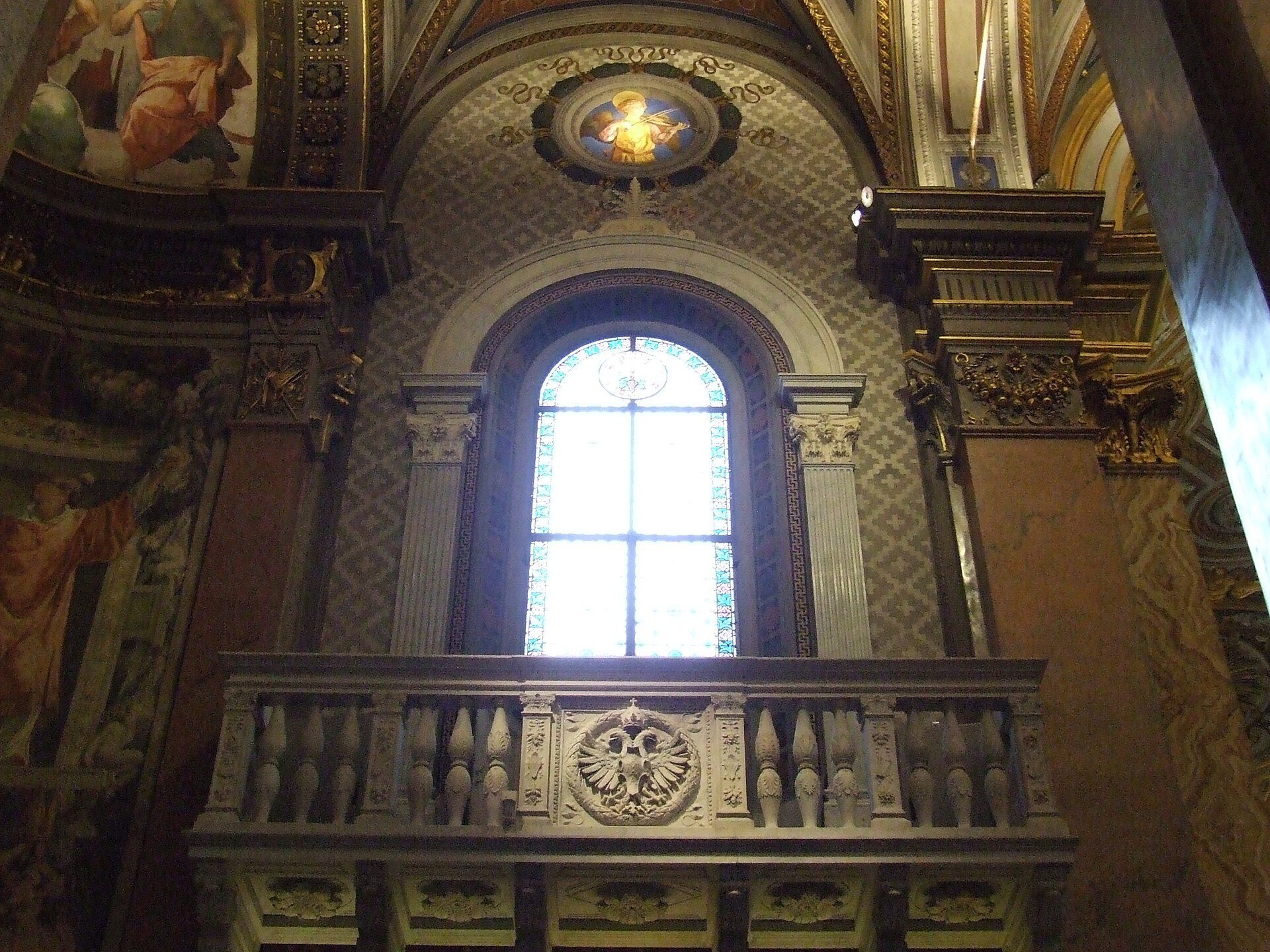
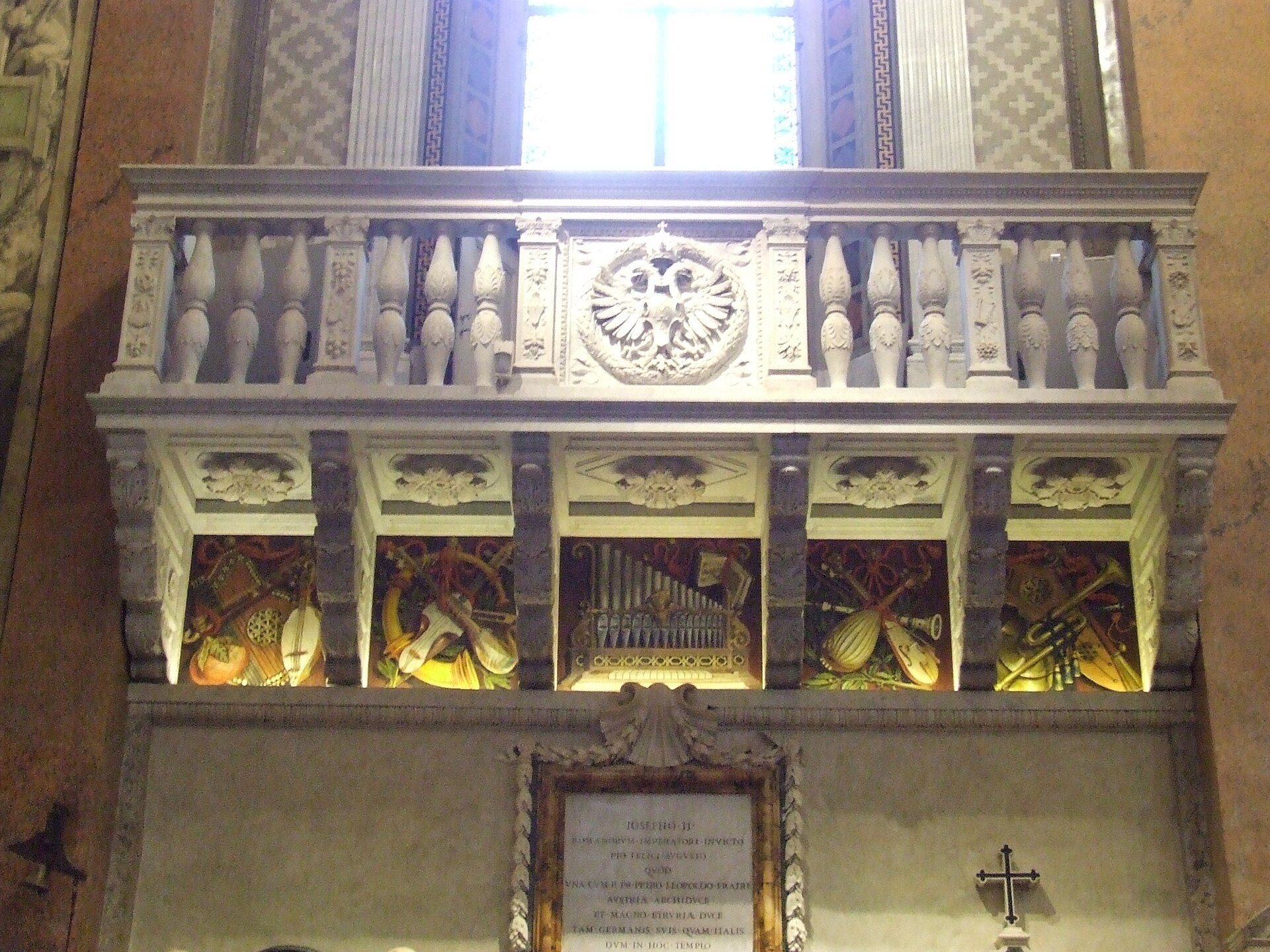
The present stained glass belongs to Ludwig Seitz’s restoration of 1874–1875 and was produced by the Tyrolean Glass Painting and Mosaic Institute. The choir window, donated by the glassworks, depicts the Trinity. The west window shows the enthroned Virgin Mary between Adam and Eve and was donated by Emperor Franz Joseph. A main organ built by Gerhard Hradetzky was installed on the gallery in 1990.
The church’s interior was heavily remodelled in Baroque style between 1747 and 1751, changing its Renaissance character. A historicist restoration and repainting by Ludwig Seitz followed in 1874–1875, and a comprehensive restoration of the interior was completed in 2018. An internal courtyard contains ancient artefacts discovered in the church.